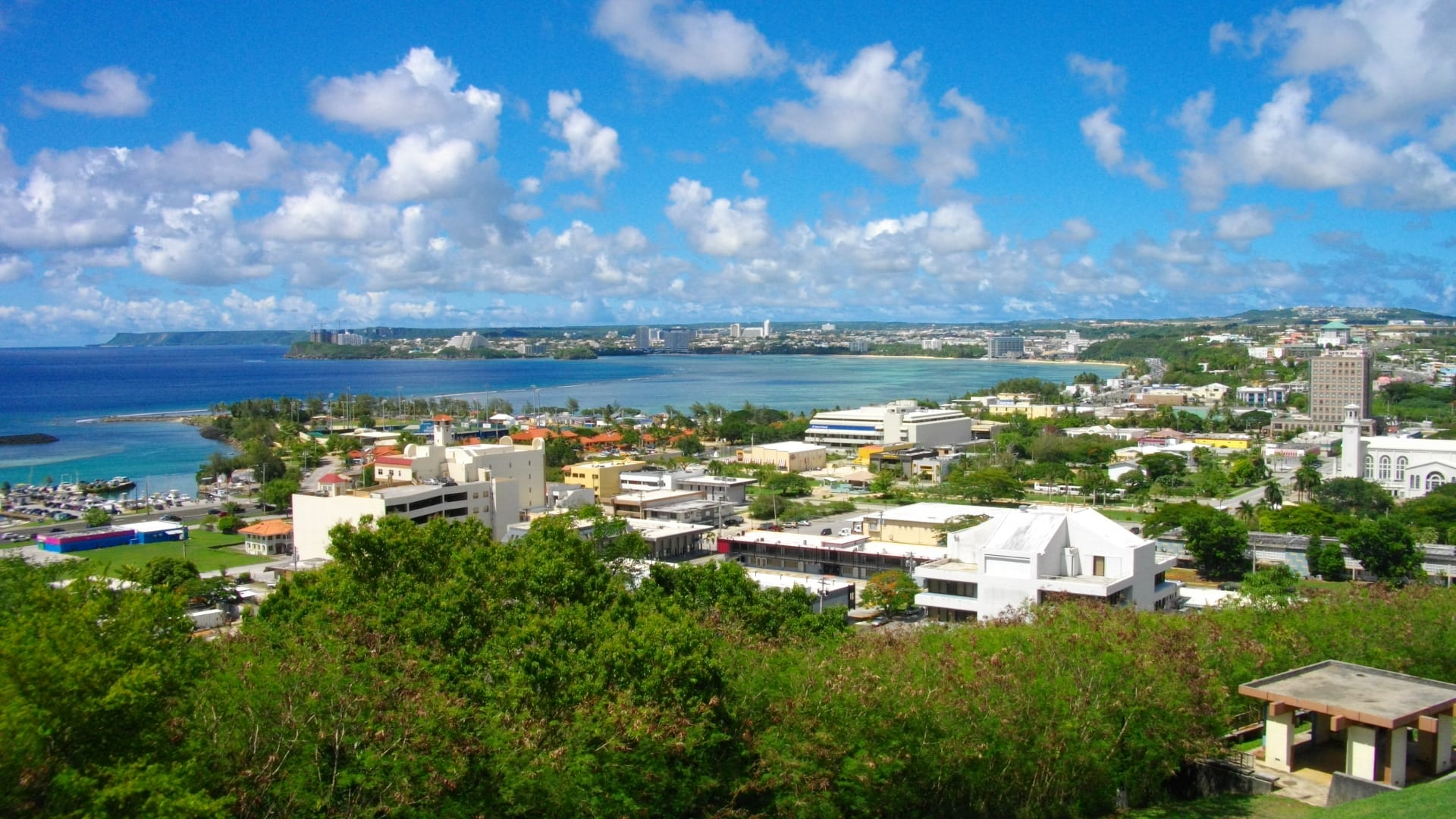
A low white-and-pastel town beside a turquoise reef bay, seen from a green hillside under towering white clouds

Guam

Hagåtña

Hagåtña and Agana Bay seen from the hill at Fort Santa Agueda. (Abasaa / Wikimedia Commons · Public domain)

Guam's capital, a small government town on the island's west coast where the Spanish colonial administration stood for two centuries. Flattened in the 1944 battle and rebuilt on a grid, it now holds the legislature, the cathedral, a plaza of Spanish ruins, standing latte stones and the island museum, with barely a thousand residents.

Neighbourhoods

  • The historic centre
    • Historic district
    • First-time visitors
    • Museums

    A few flat blocks between the hill and the bay holding the plaza with its Spanish ruins, the cathedral, the legislature, the island museum and the latte stone park. Everything of interest in the capital is within a short walk, and the streets empty in the evening when the offices close.

    Open in Maps
  • Paseo de Susana and the waterfront
    • Walks and viewpoints
    • Markets
    • Quiet and residential

    A low peninsula of reclaimed wartime rubble reaching into Agana Bay, with a park, a sports ground, a small replica of the Statue of Liberty and views back over the town. The marina and the Chamorro Village market sit at its landward end.

    Open in Maps
  • Agana Heights
    • Views
    • Quiet and residential

    The village on the ridge immediately above the capital, reached by a steep road past the old Spanish fort. It is residential, with a church, schools and government offices, and the lookout at the top gives the widest view of the bay and the coast towards Tumon.

    Open in Maps
  • Tamuning and Tumon
    • Hotels
    • Best for food
    • Shopping

    The built-up strip a few miles north-east, where almost all of the island's hotels, shopping and restaurants are. Most visitors to Hagåtña sleep here and drive in for the day, because the capital itself has very little accommodation.

    Open in Maps

Things to do

The Spanish-era centre

  • Plaza de Españalandmark

    The square laid out around the governor's palace, of which the arched Chocolate House, the Azotea terrace and sections of wall survive the destruction of 1944.

    Open in Maps
  • Dulce Nombre de Maria Cathedral Basilicalandmark

    Guam's cathedral, on the site of the island's first Catholic church of 1669, rebuilt after the war and home to the Santa Marian Kamalen statue carried through the streets each December.

    Open in Maps
  • Latte Stone Parkattraction

    Eight latte stones — the stone pillars and capstones that raised CHamoru houses — re-erected in a small park behind the plaza, with wartime tunnels cut into the hillside beside them.

    Open in Maps
  • Fort Santa Aguedalandmark

    The ruined Spanish hill fort above the town, built at the start of the nineteenth century, whose terrace gives the classic view over the capital and Agana Bay.

    Open in Maps

Museums and civic buildings

  • Guam Museummuseum

    The territory's museum on Skinner Plaza, opened in 2016, tracing CHamoru history from the latte period through Spanish and American rule to the present.

    Open in Maps
  • Guam Congress Buildinglandmark

    The legislature building of 1949 in the centre, restored in 2016 and again the seat of the Legislature of Guam, and a landmark of the CHamoru campaign that ended naval rule in 1950.

    Open in Maps

Short trips from the capital

  • War in the Pacific National Historical Parkattraction

    The 1944 invasion beaches at Asan, a couple of miles west along the coast, and at Agat further south, with gun emplacements, memorials and a visitor centre.

    Open in Maps
  • Tumon Baybeach

    The island's main swimming bay and hotel strip, a few miles north-east, with calm reef-protected water in a marine preserve.

    Open in Maps
  • Two Lovers Pointviewpoint

    A limestone cliff north of Tumon with a long view down the west coast, tied to a CHamoru legend of two lovers who leapt rather than be parted.

    Open in Maps
  • Talofofo Fallsattraction

    Waterfalls in the southern interior, near the cave where the Japanese soldier Shoichi Yokoi hid in the jungle until 1972.

    Open in Maps

Seasonal events

  • Holy WeekMarch or April

    The capital's cathedral is the focus of the island's Catholic observances, with processions and long services, and government offices close for Good Friday.

  • Liberation DayJuly

    Guam's territorial holiday on 21 July, marking the 1944 recapture, is centred on a parade through Hagåtña and a carnival that runs for weeks nearby.

  • Santa Marian Kamalen processionDecember

    On 8 December the island's patroness is carried in procession from the cathedral through the streets of the capital, one of the largest religious gatherings of the year.

Eat and drink

Long-standing places and food districts in Hagåtña. Hours, ratings and directions come from your maps app, always current.

Markets and food streets

  • Chamorro Villagemarket

    A market of open pavilions near the boat basin, busiest at its night market, where stalls sell kelaguen, red rice, barbecue plates, coconut sweets, tropical fruit and crafts, with dancing and music.

    Open in Maps
  • Downtown lunch countersneighborhood

    The capital feeds office workers on weekdays — CHamoru plate lunches, Filipino turo-turo counters, bakeries, Japanese and Korean places and food trucks parked near the government buildings.

    Open in Maps
  • Tamuning and Tumon restaurantsneighborhood

    The strip north-east of the capital holds the island's fuller choice of restaurants, from Korean barbecue and ramen to steak houses and hotel buffets.

    Open in Maps

Experience Hagåtña

History

A CHamoru settlement stood at the mouth of the river here long before Europeans came, and the Spanish made it their headquarters soon after missionary work began in 1668. The town became the seat of the governor of the Marianas, with a palace on what became the Plaza de España and the island's first church, of 1669, on the site of today's cathedral; a hill fort, Santa Agueda, was added above the bay about 1800. For two centuries it was the only place on Guam that resembled a town, and CHamoru, Spanish and Filipino families mixed in its streets.

The United States took Guam in 1898 and kept the capital as the naval government's centre, spelling it Agana. Japanese forces occupied the island from December 1941 and renamed it, and the town was almost entirely destroyed in July and August 1944, when American bombardment and street fighting preceded the recapture. Photographs from that summer show Marines walking through rubble with almost nothing standing.

Reconstruction changed the place permanently. The ruins were bulldozed and much of the debris pushed into the bay to form the Paseo de Susana peninsula, the town was rebuilt on a grid of wide streets, and residents who had been displaced settled instead in Tamuning, Dededo and other villages, where land was available. The capital regained its offices but never its people. Government has stayed, joined in 2016 by the Guam Museum on Skinner Plaza; the CHamoru spelling Hagåtña was formally restored in 1998; and the town remains the island's ceremonial heart while daily life happens elsewhere.

Culture & Customs

Hagåtña is the island's stage. Liberation Day in July fills its main street with a parade of floats, village entries, marching bands and veterans, and December brings the procession of Santa Marian Kamalen, the island's patroness, from the cathedral through the streets — the two occasions when the small capital is crowded. Inaugurations, protests and memorial services all happen on or near the plaza.

Because the government, the museum, the legislature and the courts are here, so are the island's arguments about identity: decolonisation and the political status of the territory, land taken for military use, the revival of the CHamoru language and the care of ancestral sites disturbed by construction. Carvers, weavers and dance groups perform at the museum and the Chamorro Village, and CHamoru greetings — hafa adai as hello, si Yu'us ma'åse' as thanks — are used freely in public life.

Manners are Pacific and Catholic. Extended family obligation, chenchule', binds people through weddings, christenings and funerals; elders are greeted first; and the church calendar organises much of the year, with the village fiesta for each patron saint bringing open houses and tables of food. Visitors are welcomed easily, and the expectation is simply politeness, modest dress away from the beach and patience with an unhurried pace.

Daily Life

Barely a thousand people live in Hagåtña, which makes it one of the smallest capitals in the world by population, but tens of thousands pass through it on weekdays. Government is the business of the town: the legislature, the governor's complex just west at Adelup, courts, agencies and the offices of lawyers and accountants around them, along with the museum, the cathedral and a scattering of shops and lunch places.

The day is short and sharp. Traffic builds along the coast road from Dededo and the southern villages in the early morning, offices work through a hot middle of the day, and by early evening the streets are quiet again, with the action moved to Tumon and the shopping centres. Market nights are the exception, when the Chamorro Village brings families, music and food stalls into the town after dark. Weekends belong to church, the sports grounds on the Paseo and fishing from the boat basin.

The concerns here are those of the whole island, discussed in its institutional centre: the cost of living and of shipping everything in, the health of the economy between military spending and visitor numbers, housing, and typhoon preparation, with concrete buildings and shutters ready each season. Sea-level rise and flooding of the low ground around the river mouth are a growing topic, as is what to do with a capital that has offices but almost no residents.

Food

Hagåtña's food is at its best in the open air. The Chamorro Village near the boat basin is the island's showcase for CHamoru cooking, above all at its night market, where stalls grill short ribs and chicken over open fires and serve kelaguen — meat, fish or shrimp chopped fine and cured in lemon juice with grated coconut, onion and fiery donne' peppers — with warm titiyas, the flat coconut or corn breads used to scoop it up.

The plate lunch is the staple of the working town: barbecue meat, hineksa' aga'ga' (red rice tinted with achote seed), a scoop of chicken kelaguen and finadene', the sauce of soy, lemon or vinegar, onion and chilli that appears on every table. Soups, called kå'du, and estufao, a Spanish-derived stew, turn up at the counters that feed government workers, alongside Filipino turo-turo trays of adobo, pancit and lumpia, and Japanese and Korean lunch sets.

Sweets and drinks are a CHamoru speciality worth seeking at the market: latiya, a custard poured over sponge cake and dusted with cinnamon; coconut candy; guyuria cookies; and fresh young coconuts opened to drink. Fruit stalls sell mango, papaya, soursop and bananas in season, and the fish stalls take the morning's catch from the boats at the basin next door.

Planning tools

Budget

There is almost nowhere to stay in the capital itself, so lodging costs are really Tumon and Tamuning costs, at US prices with hotel taxes on top. Hagåtña is cheap to visit: the plaza, the latte stones, the fort and the waterfront cost nothing, the museum charges a small admission, and the market and lunch counters are the least expensive eating on the island.

Daily Budget Midrange
USD 180–350 (Tumon hotel, restaurants, hire car and fuel, a boat or dive trip)
Daily Budget Shoestring
USD 80–130 (guesthouse in Tamuning, market and plate-lunch food, the island bus or a shared ride)

Time a visit to coincide with the night market at the Chamorro Village, which is the cheapest and liveliest meal in the capital.

Best Time to Visit

January to May, the dry season, is the most comfortable time for walking round the plaza and the hill fort, and the clearest for the view over the bay. July to November is wetter and stickier, and is also the typhoon season. July brings the Liberation Day parade and a much busier town.

Suggested Number of Days

The capital is small enough to see in half a day on foot, or a full day with the museum and the hill fort. Three or four days make sense for the island as a whole, based on the hotel strip nearby. Rain and midday heat slow walking more than distance does.

First Visit
Half a day to 1 day
With Surroundings
3–4 days

Transportation

Most people arrive by hire car or taxi, and there is parking in the centre. The island bus system stops in Hagåtña but runs infrequently, and ride-hailing is limited. Hotel shuttles from Tumon serve the Chamorro Village market on market nights. Once in the centre, nothing needs a vehicle. Traffic drives on the right.

Marine Corps Drive, the coast road through the capital, is slow in the morning and late-afternoon peaks; allow extra time for the few miles from Tumon.

Airport & Station Connections

A. B. Won Pat International Airport at Tamuning is about 3 miles east, roughly ten to fifteen minutes by taxi outside the peaks, with flights from Japan, South Korea, the Philippines, Honolulu, the US mainland and other Micronesian islands. Almost everyone reaches the capital by road from the hotel strip, and cruise passengers dock at Apra Harbor to the south-west.

Walkability

The centre is flat, compact and easy to cover on foot: the plaza, the cathedral, the museum, the latte stones and the legislature stand within a few hundred yards of one another, and the waterfront park is a short walk beyond. The climb to Fort Santa Agueda is steep but brief. Pavements give out along the main coast road, and shade is scarce at midday.

Safety

Hagåtña is generally safe, and the government district is quiet. Petty theft and break-ins to parked cars at beaches, trailheads and car parks are the usual problems, and the centre is deserted after office hours, so it can feel empty at night. Sea conditions outside the reef are the more serious hazard, with strong currents through the channels.

Leave nothing visible in a parked car, take normal night-time care in empty streets, and swim only inside the reef. Check current official travel advice before travelling.

Climate

Tropical, hot and humid all year, with highs usually in the mid-80s °F and little seasonal change in temperature. The dry season runs from January to May, the wet season from July to November, when heavy afternoon showers are common and typhoons are a risk; and Typhoon Mawar passed close to Guam in May 2023.

Summer
hot, humid and wet — highs near 87°F, regular downpours and the beginning of the typhoon season
Winter
the dry season — highs near 85°F, steadier trade winds, lower humidity and the best light over the bay

Local Customs

Guam is US territory with CHamoru manners and a strongly Catholic public life. Tipping is expected in restaurants, at about 15 to 20 per cent. Elders are greeted first and respectfully, and mangnginge' — taking an elder's hand and drawing it to the face to sniff it — is still practised. Dress modestly in the cathedral and in government offices; beachwear is out of place in the capital.

Ask before photographing people, processions or funerals, do not photograph military sites, and treat latte stones and burial grounds as sacred rather than as somewhere to climb. The drinking age is 21.

Common Payment Methods

The currency is the US dollar. Cards work in the museum, shops and most restaurants, and there are ATMs in the centre and at the nearby shopping centres. Market stalls, food trucks, buses and tips need cash, so small bills are worth carrying. Japanese yen and Korean won are not generally accepted.