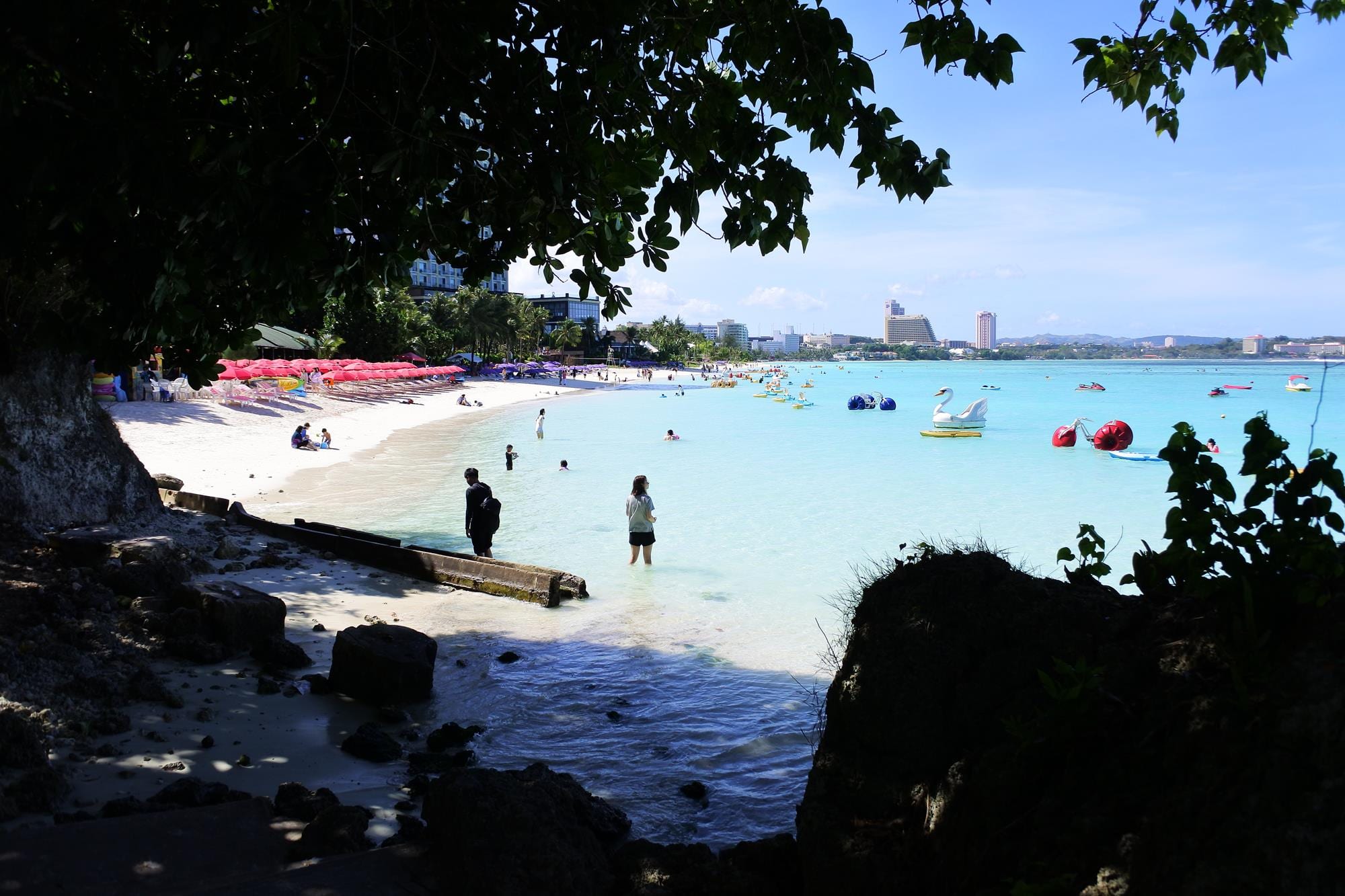
A white-sand beach curving past pale turquoise shallows towards a line of hotel towers, framed by dark tree branches

Guam

Tumon

Tumon Beach looking north along Tumon Bay towards the hotel strip. (Ken Eckert / Wikimedia Commons · CC BY-SA 4.0)

Guam's tourism centre, a two-mile crescent of hotels, shops and restaurants above a sheltered reef bay on the island's west coast, within the municipality of Tamuning. Built up from the late 1960s for visitors flying in from Japan, it holds most of the island's resorts and its calmest swimming water.

Neighbourhoods

  • The San Vitores Road strip
    • First-time visitors
    • Shopping
    • Nightlife

    The single road that runs the length of the bay, lined with hotels, duty-free stores, shopping centres, restaurants and bars, with beach access between the buildings. Almost everything a visitor needs is within walking distance of it, and it is the busiest and most expensive part of the island.

    Open in Maps
  • Ypao and the southern end of the bay
    • Beaches
    • Families
    • Quiet and residential

    The bay's southern corner, where a public beach park with lawns, shade trees and shallow water sits at the edge of the strip. It is the local end of Tumon, used for barbecues, fiestas and open-air concerts, and it looks back along the whole curve of hotels.

    Open in Maps
  • Gun Beach and the northern cliffs
    • Snorkelling
    • Walks and viewpoints

    Past the last hotels at the northern end of the bay, a rougher shoreline of coral rubble and a cliff line climbing towards Two Lovers Point. Gun Beach here is one of the island's best-known shore dives, and the sunsets draw a small crowd.

    Open in Maps
  • Tamuning and Upper Tumon
    • Local life
    • Best for food
    • Close to the airport

    The wider municipality behind the strip, where most of the people who work in the hotels shop and eat. Marine Corps Drive carries the traffic past the hospital, offices, outlet shopping and rows of Filipino, Korean and Japanese restaurants, and the airport is a few minutes away.

    Open in Maps

Things to do

The bay and the beaches

  • Tumon Baybeach

    A reef-protected bay whose calm, shallow water is a marine preserve, so fish are plentiful close to shore and fishing is restricted.

    Open in Maps
  • Two Lovers Pointviewpoint

    A limestone cliff of about 370 feet above the northern end of Tumon Bay, wrapped in a CHamoru legend of two lovers who tied their hair together and leapt.

    Open in Maps

Museums and landmarks nearby

  • Guam Museummuseum

    The territory's museum in Hagåtña, opened in 2016, with exhibitions on CHamoru history from the latte period through Spanish rule and the war.

    Open in Maps
  • Plaza de Españalandmark

    The square at the heart of the old Spanish colonial capital, keeping the arched Chocolate House, the Azotea and fragments of the governor's palace.

    Open in Maps
  • Latte Stone Parkattraction

    A small park in Hagåtña displaying eight latte stones — the pillars and capstones that held up CHamoru houses — moved here from the island's interior.

    Open in Maps
  • Dulce Nombre de Maria Cathedral Basilicalandmark

    Guam's Catholic cathedral in Hagåtña, on the site of the island's first church, rebuilt after wartime destruction and home to the Santa Marian Kamalen statue.

    Open in Maps

Short trips from Tumon

  • War in the Pacific National Historical Parkattraction

    Several separate sites south of the capital — the 1944 invasion beaches at Asan and Agat, Japanese gun emplacements and a visitor centre.

    Open in Maps
  • Ritidian Pointbeach

    The island's northern tip, a wildlife refuge with a long white beach, limestone cliffs and the remains of a pre-contact CHamoru settlement.

    Open in Maps
  • Talofofo Fallsattraction

    Waterfalls in the green southern interior, near the jungle cave where the Japanese soldier Shoichi Yokoi hid until 1972.

    Open in Maps
  • Fort Nuestra Señora de la Soledadlandmark

    A small Spanish fort of about 1802–1819 on the cliff above Umatac Bay in the south-west, with wide views over the coast.

    Open in Maps

Seasonal events

  • Holy WeekMarch or April

    Processions, night services and village observances across a strongly Catholic island, with many businesses on reduced hours on Good Friday.

  • Liberation DayJuly

    Guam's territorial holiday on 21 July marks the start of the 1944 recapture of the island, with a parade and a carnival that runs for weeks.

  • Christmas and the nobenasDecember

    Nine-night rosary gatherings in homes and villages, church fiestas and one of the busiest months on the hotel strip.

Eat and drink

Long-standing places and food districts in Tumon. Hours, ratings and directions come from your maps app, always current.

Food streets and markets

  • San Vitores Roadneighborhood

    The strip's own run of Japanese, Korean, American and CHamoru restaurants, steak houses, ramen counters and dinner-show venues, with shopping-centre food halls between them.

    Open in Maps
  • Tamuning and Upper Tumonneighborhood

    Where islanders eat — Filipino turo-turo counters, Korean barbecue, Japanese noodle shops, bakeries and roadside CHamoru barbecue stands along and behind Marine Corps Drive.

    Open in Maps
  • Micronesia Mall food courtmarket

    The island's largest shopping centre, a short drive north in Dededo, with a food court that mixes CHamoru plate lunches, Filipino, Japanese and fast food.

    Open in Maps

Experience Tumon

History

Tumon Bay was settled long before it was a resort. CHamoru villages stood along this stretch of coast in the latte period, drawn by the reef, the freshwater seeping through the limestone and the shelter of the bay, and building work on the strip has repeatedly uncovered ancient burials, which are now handled under archaeological rules. Spanish colonisation from the late seventeenth century concentrated the surviving population in mission villages, and for most of the following centuries the bay was farmland, coconut groves and a place to fish.

The Second World War left its marks at the edges of the bay rather than at its centre: Japanese forces occupied Guam from December 1941 until the US recapture in July and August 1944, and the name of Gun Beach, at the northern end of the bay, recalls those years. The American landings themselves were made further south, at Asan and Agat.

Tumon as it looks now dates from the late 1960s, when jet services from Tokyo began and Guam, as US soil a few hours from Japan, became a convenient tropical holiday. Hotels rose one after another along San Vitores Road through the 1970s and 1980s, followed by duty-free shopping, wedding chapels and dinner shows, and the bay became the centre of an industry that carried much of the island's economy. Typhoons have periodically stripped and rebuilt it, tourism from Japan has given ground to arrivals from South Korea, and the collapse and slow return of air travel after 2020 was felt here more sharply than anywhere else on Guam.

Culture & Customs

Tumon is where Guam presents itself to visitors, and the presentation is a mixture. Hotel lobbies run island-night shows with CHamoru chants and drumming alongside Polynesian fire dancing borrowed from elsewhere in the Pacific; craft stalls sell woven pandanus and coconut work; and the CHamoru language appears on signs and in greetings — hafa adai, the everyday hello, is heard constantly on the strip.

Behind the resorts, the culture is the island's own. The Tamuning area is Catholic, the parish calendar matters, and the village fiesta for the patron saint brings extended families together over tables of food, with an open invitation to neighbours and guests. Obligation to family runs through everything, from weddings and christenings to the contributions expected at funerals, and respect for elders is the first social rule. Many of the people working in the hotels are CHamoru, Filipino, or from Chuuk, Pohnpei and the Marshall Islands, which makes the district one of the most mixed places in Micronesia.

Tumon is also the island's night-time centre, with bars, karaoke rooms and clubs, and it is the setting for much of Guam's wedding and honeymoon business, including chapels built for Japanese couples. Visitors are expected to keep the holiday mood on the beach and the strip: quiet voices in church, covered shoulders away from the sand, and patience with the slower island pace are all noticed and appreciated.

Daily Life

Tumon is not a separate municipality but part of Tamuning, which together with Tumon and Harmon forms one of the most built-up parts of Guam. Comparatively few people live on the strip itself; most of the housing sits inland, and workers arrive from Dededo, Mangilao and the southern villages, so the roads in and out are busy at shift changes.

Work here is tourism and service work: hotels, restaurants, duty-free retail, dive shops, tour buses and the airport, alongside the hospital and offices in Tamuning. That makes the district the most exposed part of the island economy to events far away, from the exchange rate of the yen to airline schedules, and household budgets follow the arrival numbers. Rents are high by island standards and many families share housing across generations.

The rhythm of the day is set by heat and by flights. Mornings are for the beach, errands and school runs; the middle of the day is hot and slow; late afternoon brings swimmers and joggers back to the bay and the sunset crowd to the northern cliffs; and the restaurants and bars fill after dark. Concrete construction, shutters and stocked pantries reflect the typhoon season, and the recovery from Typhoon Mawar in 2023 is still discussed. Longer-term worries are familiar ones on Guam: the cost of living, reef health in a bay used by thousands of swimmers, and how far the island should depend on visitors and the military.

Food

The strip eats internationally. Japanese and Korean restaurants are everywhere — ramen, sushi, yakiniku and Korean barbecue cooked at the table — beside American steak and burger chains, Italian places, Indian and Thai kitchens and buffet dinners with shows. Hotel breakfast buffets are a fixture, and a run of dessert and coffee shops fills the gaps between the shopping centres.

The local food is a few minutes inland and well worth the detour. CHamoru cooking turns on grilled meat, rice and sharp sauces: kelaguen, in which chicken, beef or fish is chopped fine and cured in lemon juice with grated coconut, onion and hot donne' peppers; hineksa' aga'ga', the red rice coloured with achote seed; and finadene', the soy, lemon, onion and chilli dipping sauce that goes on everything. Roadside barbecue stands sell plate lunches of short ribs or chicken with red rice and a scoop of macaroni salad, and the fiesta table adds estufao stew, pancit, lumpia, kå'du soups and latiya, a custard-and-cake dessert, for afters.

Guam's other kitchens are close behind, above all the Filipino ones, with lechon, adobo, pancit and pan de sal in the bakeries of Tamuning and Upper Tumon. Spam and other tinned meats are eaten without apology, tropical fruit and fresh reef fish appear in the markets, and the island's coffee shops and a small group of craft brewers round out the drinking. The night market at the Chamorro Village in Hagåtña, a short drive south, is the easiest place to eat a spread of it all in one go.

Planning tools

Budget

Tumon is the most expensive place to stay on Guam, and prices follow US levels with hotel taxes on top. Rooms rise steeply around Japanese and Korean holiday weeks, Liberation Day and Christmas. Costs drop quickly for anyone eating at the plate-lunch and Filipino places behind the strip rather than in the hotels, and the beach, the reef and the bay cost nothing.

Daily Budget Midrange
USD 180–350 (Tumon hotel, restaurants, hire car and fuel, a boat or dive trip)
Daily Budget Shoestring
USD 80–130 (guesthouse or budget hotel behind the strip, plate lunches and food courts, the public bus or a shared shuttle)

A hire car pays for itself within a day or two for anyone leaving the strip; snorkelling gear is worth bringing or buying cheaply, as the best swimming is straight off the beach.

Best Time to Visit

January to May, the dry season, has the most settled weather, the clearest water and the calmest sea for boat trips. July to November is wetter and more humid, and is also the typhoon season. Temperatures barely change, so the choice is really about rain, crowds and room rates.

Suggested Number of Days

Two or three days cover the bay, the reef and the capital nearby. Four or five suit anyone adding the southern villages, the northern beaches and a diving or fishing trip. Without a hire car, allow an extra day for slow bus and shuttle connections.

First Visit
2–3 days
With Surroundings
4–5 days

Transportation

Hotel and shopping shuttles and a trolley-style bus run up and down San Vitores Road, which is the only route most visitors need. Taxis wait at the hotels, and ride-hailing is limited, so a hire car is the usual way to reach the rest of the island. The island bus system is cheap but infrequent. Traffic drives on the right.

Large areas in the north of the island and around Apra Harbor are military land and closed to the public, which shapes any driving route.

Airport & Station Connections

A. B. Won Pat International Airport at Tamuning is about 3 miles south of the strip, roughly ten minutes by taxi or hotel shuttle. Flights arrive from Japan, South Korea, the Philippines, Honolulu, the US mainland and other Micronesian islands; arrivals from the United States are domestic. Nearly everyone reaches Tumon by air and is driven the short distance in.

Walkability

Unusually for Guam, Tumon works on foot. The strip runs about two miles with pavements most of the way, and the hotels, shops, restaurants and beach entrances sit along it, so a stay here needs no vehicle. Heat, humidity and heavy midday sun make shade and water matter more than distance. Anything beyond the bay involves a road built for cars.

Safety

Tumon is generally safe, and the strip is busy and patrolled. The usual problems are petty theft, break-ins to parked cars at beaches and trailheads, and alcohol-related trouble in the bar area late at night. The sea deserves more respect than the streets: currents run strongly through the reef channels and drownings happen, mostly outside the reef line.

Swim inside the reef, watch for channel currents near Gun Beach and the bay mouth, leave nothing visible in a parked car, and keep to busy streets after dark. Check current official travel advice before travelling.

Climate

Tropical, hot and humid all year, with highs usually in the mid-80s °F and nights in the mid-70s °F. The dry season runs from January to May and the wet season from July to November, when short heavy showers are common and typhoons are a real risk; and Typhoon Mawar passed close to the island in May 2023.

Summer
hot, humid and wet — highs near 87°F, frequent afternoon downpours and the start of the typhoon season
Winter
the dry season — highs near 85°F, lower humidity, steady trade winds and the calmest sea

Local Customs

Guam is US territory with CHamoru manners. Tipping is expected in restaurants, at about 15 to 20 per cent, and for taxis and hotel staff. Family and church come first, so Sunday mornings are quiet and village fiestas are open-house occasions. Elders are greeted respectfully, and the traditional mangnginge' — taking an elder's hand to the face to sniff it — is still practised. Swimwear belongs on the beach, not in shops or churches.

Ask before photographing people, fiestas or funerals; do not photograph military installations; and remember that ancient latte stones and burial sites are treated as sacred, not as climbing frames. The drinking age is 21.

Common Payment Methods

The currency is the US dollar. Cards and contactless payment work in hotels, restaurants and shops along the strip, and ATMs are easy to find in the hotels and shopping centres. Small amounts of cash are useful for buses, market stalls, roadside barbecue and tips. Japanese yen and Korean won are not generally accepted.