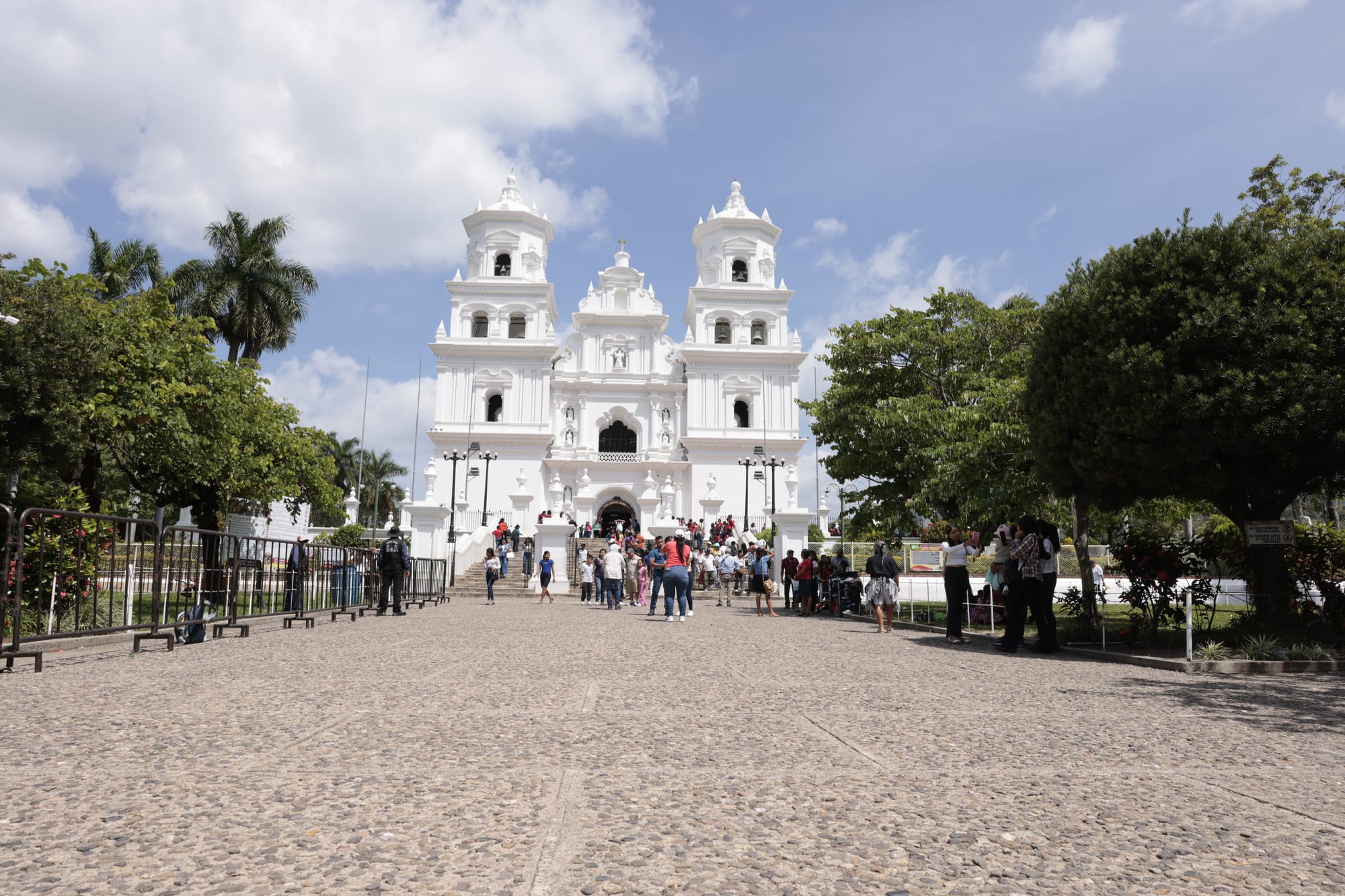
A white baroque church with twin bell towers at the end of a cobbled plaza lined with trees, with visitors on its steps

The East, Guatemala

Esquipulas

The Basilica of Esquipulas, home of the Black Christ, seen across its plaza. (Gobierno de Guatemala / Wikimedia Commons · Public domain)

A town in the hills of Chiquimula, about 9.5 km from the Honduran border, that grew around a dark wooden crucifix carved in 1594. Its four-towered white basilica, the largest Catholic church in Central America, draws pilgrims from across the region, above all in January, and the town gave its name to the Central American peace process of the 1980s.

Neighbourhoods

  • Around the basilica
    • First-time visitors
    • Pilgrims
    • Places to stay

    The southern end of the town around the basilica and its park, where hotels, restaurants and souvenir stalls line the approaches and pilgrims gather on the steps. It is the busiest part of town and the most crowded in January.

    Open in Maps
  • Parque Centroamérica and the old parish
    • Historic district
    • Local life

    The northern plaza beside the older parish church of Santiago, where the town's colonial main street began. It is the everyday centre of the town, a short walk along the main street from the basilica.

    Open in Maps
  • South of the basilica
    • Nature
    • Families

    The southern edge of the town beside the basilica, where the Cueva de las Minas park lies and the hills and rivers around the town begin.

    Open in Maps

Things to do

Churches and the pilgrimage

  • Basilica of Esquipulaslandmark

    The baroque basilica completed in 1758 to house the Black Christ, the largest Catholic church in Central America and southern Mexico, with four bell towers; it is a cathedral and minor basilica, cared for by Benedictine monks.

    Open in Maps
  • Black Christ of Esquipulaslandmark

    The darkened wooden crucifix carved by the Portuguese sculptor Quirio Cataño and brought to the town in 1595, venerated across Central America as the Miraculous Lord of Esquipulas.

    Open in Maps
  • Iglesia de Santiagolandmark

    The older parish church, built in 1680–82, which housed the Black Christ until the basilica was finished and is now a national monument.

    Open in Maps

Around the town

  • Cueva de las Minaspark

    Caves south of the town beside the basilica, with a river running through them, linked by oral tradition to the Black Christ and now part of an ecological park with a small zoo.

    Open in Maps
  • Piedra de los Compadreslandmark

    Two great stones balanced one on top of the other, about three metres high, the subject of a local legend and still a place of rituals, prayers and offerings.

    Open in Maps
  • Acueducto Los Arcoslandmark

    The colonial aqueduct at the northern end of the old main street, declared a national monument in 1970.

    Open in Maps
  • Chatún Parkattraction

    An adventure and nature park near the town, built around the region's natural resources and traditions.

    Open in Maps

Short trips from the town

  • Trifinio Fraternidad Biosphere Reservepark

    A cross-border reserve where Guatemala, El Salvador and Honduras meet, protecting the cloud forests of the Montecristo massif.

    Open in Maps

Seasonal events

  • Fiesta of the Black Christ11–15 January, with the main day on 15 January

    The great pilgrimage of the year, when the largest crowds arrive from Guatemala and neighbouring countries, some walking all the way from Guatemala City, others on horseback, motorbikes and bicycles.

  • Holy WeekMarch or April

    A second peak of pilgrimage, with crowds at the basilica through Semana Santa.

  • Fiesta of Santiago21–28 July

    The town's patronal festival for St James, the patron of the parish church.

Eat and drink

Long-standing places and food districts in Esquipulas. Hours, ratings and directions come from your maps app, always current.

Esquipulas classics

  • Sweet stalls around the basilicamarket

    Stalls selling coconut sweets and other sugar confections to pilgrims, who take them home along with souvenirs.

    Open in Maps
  • Restaurants near the basilicaneighborhood

    The approaches to the basilica are lined with restaurants and comedores serving eastern Guatemalan food to pilgrims and travellers.

    Open in Maps
  • Esquipulas coffeecafe

    Coffee grown in the municipality has won national and international awards for its quality.

    Open in Maps

Experience Esquipulas

History

Before the conquest the hills around Esquipulas were home to the Ch'orti' Maya, related to the people of Copán across today's Honduran border, and to the Payaqui. In 1525 captains under Pedro de Alvarado conquered the province of Chiquimula, and in 1530 the local people, led by the chiefs Copantl and Galel, rose again and held out for three days before surrendering. Between 1550 and 1560 Juan Pérez Dardón founded the town of Yzquipulas, laying out a main street from the parish church of Santiago to the aqueduct.

In 1594 the townspeople commissioned the Portuguese sculptor Quirio Cataño, working in Santiago de los Caballeros, to carve a crucified Christ with a dark complexion. It arrived on 9 March 1595, and its reputation for miracles spread so quickly that by 1650 pilgrims were coming from as far as El Salvador and Comayagua. The church of Santiago was finished in 1682 to receive it, and in 1740 Bishop Pedro Pardo de Figueroa commissioned a far larger sanctuary from the architect Felipe José de Porres. Pardo de Figueroa died during a visit in 1751 and was buried there; the basilica was completed in 1758, and the image moved into it in January 1759.

In 1956 Pope Pius XII created a territorial prelature for the shrine, Benedictine monks arrived in 1959, and in 1961 John XXIII raised the church to a minor basilica. In May 1986 the five Central American presidents met here at the summit known as Esquipulas I, starting the peace process that bears the town's name. Pope John Paul II visited in 1996, and in 2002 Esquipulas was placed on UNESCO's tentative World Heritage list.

Culture & Customs

Everything in Esquipulas turns on the Black Christ. The image is one of the most famous of the dark crucifixes of Latin America, and the town receives hundreds of pilgrimages a year, most of them in January and March. Pilgrims arrive by car and bus, on motorbikes, bicycles and horses, and some walk all the way from Guatemala City. The patronal fiesta of the Black Christ, from 11 to 15 January, brings the largest crowds; the town's other fiesta, for its patron St James, falls in late July.

Pilgrims take home Tierra Santa, small tablets of local clay, also called tierra bendita, that is cleaned and pressed into cakes; some eat it or rub it on their bodies as a cure, and the custom has spread under many names across Central America. The devotion also reached the United States: the Santuario de Chimayó in New Mexico is closely linked with Esquipulas and keeps similar customs.

Older beliefs survive beside Catholic ones. At the Piedra de los Compadres, two huge balanced stones, local legend tells of two friends turned to stone for betraying their bond, while traditional communities treat the place as sacred, and candles and offerings blacken the rock. Like much of the east, Esquipulas is Spanish-speaking Ladino country, but the Ch'orti' Maya heritage of the area is part of its story.

Daily Life

The 2018 census counted about 18,700 people in the town and about 53,600 in the municipality, which spreads over 495 square kilometres of villages and hamlets. More than half the population is under 25, and most pupils attend private schools; the town is known in Guatemala for its success in the national science olympiad.

The economy is built on the pilgrims. Religious tourism and hotels have boomed, and the town is said to receive four to five million visitors a year, more than anywhere in Guatemala except the capital. Hotels, restaurants and souvenir stalls line the approach to the basilica, and much of the town's work depends on the January fiesta and Holy Week. Coffee is the other mainstay: farms in the municipality have won national and international prizes for the quality of their beans.

Ordinary life goes on around the Parque Centroamérica and the old parish church in the north of the town, away from the pilgrim crowds, and cross-border trade with Honduras, only a few kilometres away, is part of the local economy.

Food

Esquipulas eats like the rest of eastern Guatemala: cattle-country food of grilled beef, fresh cheese, cream and thick tortillas, with beans and eggs at breakfast. Comedores and restaurants around the basilica cater to pilgrims with simple, filling plates, and at fiesta time street stalls fill the surrounding streets.

The town's own speciality is sweets. Stalls around the basilica sell coconut sweets and other sugar confections, bought by pilgrims to take home along with the decorated hats and souvenirs of the pilgrimage. Tierra Santa, the blessed clay tablets that pilgrims buy during the church festivals, is not food, but some pilgrims eat it for its supposed healing powers.

Coffee is the local drink to seek out. The municipality's farms grow beans that have won awards as some of the best in Guatemala. In the heat, cold beer is the usual drink, and closer to the Salvadoran border pupusas, thick maize cakes stuffed with cheese, beans or pork, are common across the east.

Planning tools

Budget

Esquipulas is inexpensive for most of the year, with many pilgrim lodgings, simple hotels and comedores. Around the January fiesta and Holy Week rooms fill and prices rise sharply. Day trips to the caves, parks and reserves are the main extras.

Daily Budget Midrange
USD 50–100 (better hotel with air conditioning, restaurants, taxis or a hired driver)
Daily Budget Shoestring
USD 25–40 (basic hotel, comedor meals, public buses)

Book well ahead for mid-January and Holy Week, and carry cash for stalls and smaller lodgings.

Best Time to Visit

The dry season, from November to April, is the most comfortable, and December and January are the coolest months. The town is at its most intense around the fiesta of the Black Christ on 15 January and again in Holy Week; at other times it is much calmer.

Suggested Number of Days

One day covers the basilica and the town, and an overnight stay is usual given the distance from the capital. Two to four days allow time for the caves, parks and cloud-forest reserves around it, or for the crowds of the January fiesta.

First Visit
1–2 days
With Surroundings
2–4 days

Transportation

The town centre is small and walkable along its main street. A bus terminal serves rural routes through the region, and the caves and parks on the edge of town are a short ride away.

Travel by day on the long highway runs, and use direct pullman buses or shuttles rather than local chicken buses.

Airport & Station Connections

Esquipulas is 222 km by road from Guatemala City, a few hours by bus or car, and 45 km from Chiquimula, the department capital. The Honduran border is about 9.5 km away. The nearest international airport is La Aurora in Guatemala City.

Walkability

The basilica, the Parque Centroamérica and the main street linking them are an easy walk, and the Cueva de las Minas is a short distance from the basilica. In January the streets are packed with pilgrims and stalls, and walking is slow.

Safety

Guatemala has significant crime, including gang activity and armed robbery, concentrated in parts of Guatemala City and on some highways and rural routes. The east has some of the country's highest homicide rates, linked to drug trafficking along the routes to Honduras and El Salvador, but the violence rarely touches visitors. Esquipulas itself is crowded but calm, with pickpockets during the fiesta.

Watch valuables in pilgrim crowds, keep to main roads in daylight, and drink plenty of water in the heat. Check current official travel advice before travelling.

Climate

The municipality lies between a tropical savanna climate and a temperate mountain one, with hot summers and mild winters in which the temperature only occasionally falls to about 10°C. The dry season runs from November to April, and the coolest months are December and January.

Summer
wet season, May to October: warm to hot with afternoon storms; across the wider east, about 20–28°C around Jalapa and 30–38°C in the Motagua valley
Winter
dry season, November to April: mild, with December and January the coolest months and lows occasionally near 10°C

Local Customs

Esquipulas is a Catholic pilgrimage town above all. Pilgrims come from across Central America and southern Mexico, many after long journeys, and buy souvenirs and Tierra Santa, small tablets of blessed local clay that some eat or rub on themselves for healing. Inside the basilica quiet and respectful behaviour is expected.

Dress modestly in the basilica, keep voices low near worshippers, and ask before photographing pilgrims at prayer.

Common Payment Methods

The currency is the Guatemalan quetzal. Larger hotels and restaurants near the basilica may take cards, but stalls, comedores and smaller lodgings expect cash, and cards are rarely accepted in the surrounding rural areas.