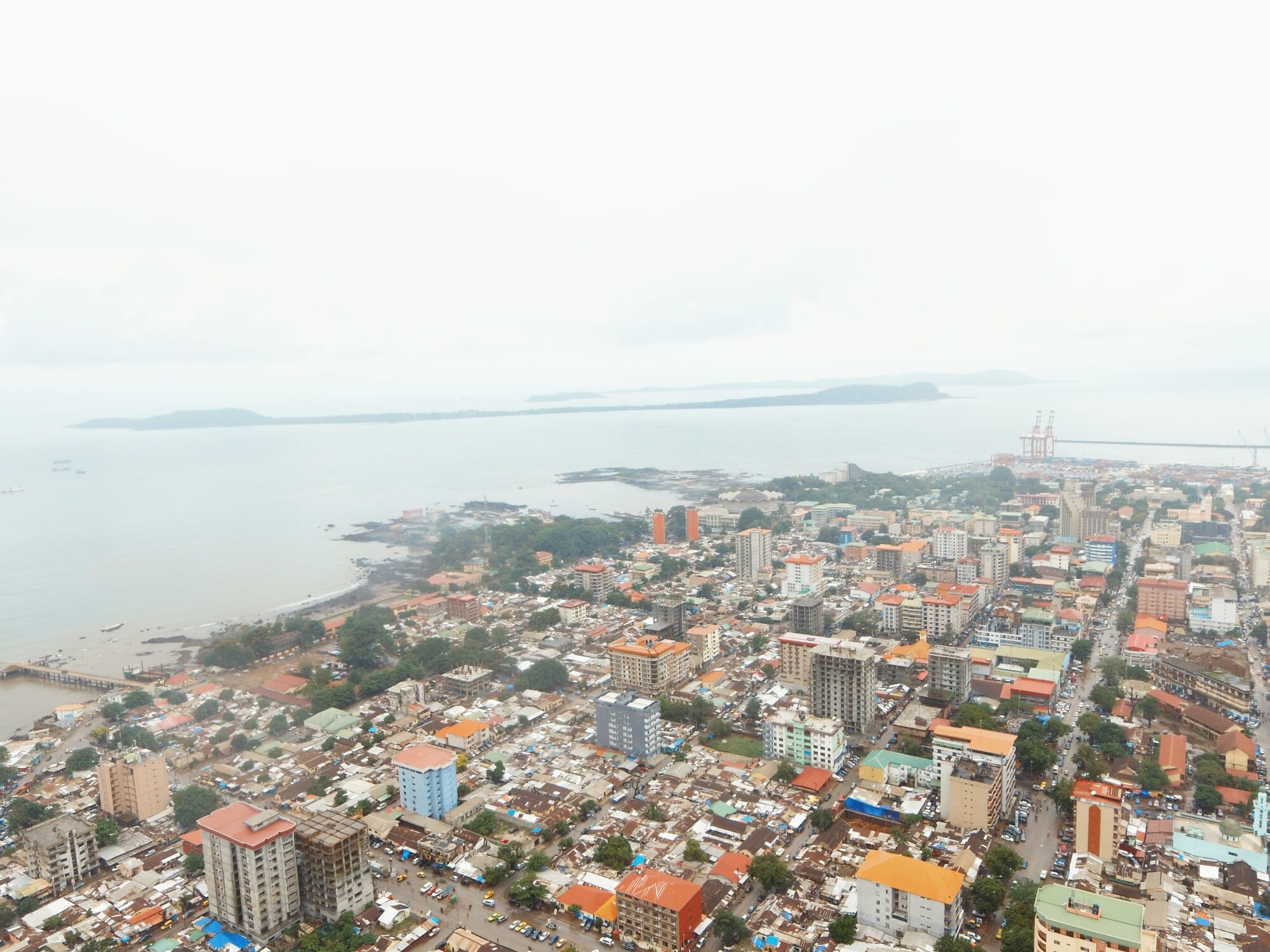
Aerial view along a crowded city peninsula of low roofs and scattered towers beside the sea

Conakry & Lower Guinea, Guinea

Conakry

Conakry from the air, looking along the Kaloum peninsula. (Alpha hmd / Wikimedia Commons · CC BY-SA 4.0)

Guinea's capital and port, built on the island of Tombo and spread along the narrow Kaloum peninsula on the Atlantic. Founded by the French in 1887, it became the seat of the state that broke with France in 1958, and is now a long, congested and very wet city of markets, mosques and mineral exports, with the Îles de Los offshore.

Neighbourhoods

  • Kaloum
    • First-time visitors
    • Historic district
    • Government quarter

    The tip of the peninsula, on and around the old island of Tombo, holding the port, the ministries, the presidential palace, the cathedral, the national museum and most of the city's older buildings. It is the business centre by day and empties at night.

    Open in Maps
  • Madina and Matam
    • Markets
    • Street food
    • Local life

    The dense commercial districts just inland of Kaloum, built around the sprawling Madina market. Traffic, traders and workshops fill the streets, and this is where much of the city does its shopping.

    Open in Maps
  • Dixinn
    • Universities
    • Quiet and residential

    A middle section of the peninsula with the university, hospitals, embassies and the botanical garden, mixing institutional compounds with ordinary residential streets and a shoreline of rocks and small beaches.

    Open in Maps
  • Ratoma
    • Nightlife
    • Restaurants
    • Beaches

    The large northern district, including Taouyah and Kipé, with much of the city's newer building, restaurants, bars and clubs, and the beaches and rocky shore along the Corniche Nord.

    Open in Maps
  • Matoto
    • Local life
    • Close to the airport

    The inland end of the built-up area, around the airport and the main road out of the city, with markets, workshops, warehouses and some of the densest and fastest-growing housing.

    Open in Maps

Things to do

Famous landmarks

  • Conakry Grand Mosquelandmark

    The largest mosque in sub-Saharan Africa, opened in 1982 with funding from Saudi Arabia, its gardens holding the Camayanne Mausoleum and the tombs of Samori Ture, Sékou Touré and Alfa Yaya.

    Open in Maps
  • Saint Mary's Cathedrallandmark

    The Catholic cathedral in Kaloum, its foundation stone laid in 1928 and the building finished in the 1930s, serving Guinea's Christian minority.

    Open in Maps
  • Stade du 28 Septembreattraction

    The national stadium, named for 28 September 1958, the day Guinea voted against joining the French Community, and the site of a massacre of opposition demonstrators in 2009.

    Open in Maps

Museums and gardens

  • Sandervalia National Museummuseum

    Guinea's national museum, founded in 1960 in the Sandervalia quarter of Kaloum, with antique objects representing the country's different cultures and peoples, and pieces from the colonial era.

    Open in Maps
  • Conakry Botanical Gardenpark

    A garden in the Camayenne quarter, between the Grand Mosque and the Ambroise Paré Hospital, noted for its kapok trees and its shade.

    Open in Maps

Markets and the waterfront

  • Madina Marketmarket

    One of the largest markets in West Africa, a maze of alleys and stalls selling food, cloth, housewares, electronics and almost everything else traded in Guinea.

    Open in Maps
  • The Corniche Nordviewpoint

    The road along the northern shore of the peninsula, with rocky coves, small beaches, cafés and views out towards the islands, busy in the late afternoon.

    Open in Maps
  • Port of Conakrytransit hub

    The bauxite and container port at the tip of the peninsula, handling the country's imports and much of its mineral exports; ferries to the Îles de Los leave from Kaloum.

    Open in Maps

Short trips from the city

  • Îles de Losattraction

    The small archipelago off the city, held by Britain until 1904, with beaches, palm groves and fishing villages, and a weekend escape for Conakry residents.

    Open in Maps
  • Kassa Islandbeach

    One of the three main islands of the group, with beaches, bars and paths through the palms; its name is thought to come from the Portuguese word for house.

    Open in Maps
  • Tamara Islandbeach

    One of the three main islands, also written Fortoba, with the Île Tamara Lighthouse and a former prison.

    Open in Maps
  • Dubrékaattraction

    A town north of the capital on the Soumba river, below Mount Kakoulima, with waterfalls and the mangrove creeks of the coast nearby.

    Open in Maps

Eat and drink

Long-standing places and food districts in Conakry. Hours, ratings and directions come from your maps app, always current.

Markets and food streets

  • Madina Marketmarket

    Rice, palm oil, smoked fish, chillies, fruit and vegetables in bulk, with cooked-food stalls around the edges serving rice and sauce to traders.

    Open in Maps
  • The Corniche fish grillsneighborhood

    Stalls and open-air kitchens along the northern shore, grilling fish over charcoal with chilli, onions and fried plantain as the sun goes down.

    Open in Maps
  • Taouyah and Kipé restaurantsneighborhood

    The northern districts where much of the city's sit-down dining is found, from Guinean and Lebanese kitchens to bars playing local music.

    Open in Maps

Conakry classics

  • Rice and saucerestaurant

    The everyday meal — rice under sauce feuille of cassava leaves, groundnut sauce, palm-oil sauce or okra, with fish or a little meat.

    Open in Maps
  • Grilled fish and brochettesrestaurant

    Whole fish and skewered meat cooked over charcoal at street stalls across the city, usually with bread, onions and a fierce chilli sauce.

    Open in Maps

Experience Conakry

History

Conakry began as villages on the island of Tombo, in Susu and Baga country at the end of a peninsula. The French, expanding along the coast, were ceded the island by Britain in 1887 and laid out a town on a grid, moving the capital of the colony there in 1904 and linking it by causeway to the mainland. A railway to Kankan, a deep-water port and the export of groundnuts and other produce made it French Guinea's administrative and commercial centre, with a European quarter on the island and African quarters spreading inland.

In September 1958 Guinea voted against joining the French Community — the only territory to do so — and Conakry became the capital of an independent state under Ahmed Sékou Touré. France withdrew abruptly, and the city turned into a centre of radical pan-African politics, hosting exiled movements from across the continent while its own citizens faced surveillance, purges and the Camp Boiro detention centre. In 1970 Portuguese troops and Guinean loyalists raided the city, an attack followed by further mass arrests.

After Sékou Touré's death in 1984 the state opened to trade, and the population grew enormously, spreading far up the peninsula in unplanned quarters. Conakry has also been the stage for the country's political crises: a 2008 coup, the massacre of opposition demonstrators at the national stadium in September 2009, repeated protest and repression under later governments, and the September 2021 coup that removed President Alpha Condé. A new constitution was approved in a referendum in September 2025, and the coup leader, Mamady Doumbouya, won the presidential election of December 2025, a vote criticised by opposition groups and the United Nations. Mining money has built new roads and towers along the peninsula, but the city's services have not kept pace with its growth.

Culture & Customs

Conakry is where Guinea's peoples meet. Susu is the everyday language of the streets, but Pular and Maninka speakers make up much of the population, and families from the Fouta Djallon, Upper Guinea and the forest region all have their quarters, mosques and associations. The city is strongly Muslim, with a visible Christian minority around the cathedral and the schools.

Its musical reputation is out of proportion to its size. Sékou Touré's state built national orchestras, ballets and recording facilities, and the bands of that era — Bembeya Jazz National above all — made Guinean guitar music famous across Africa. Les Ballets Africains, founded by Keïta Fodéba and later the national company, took Guinean dance and djembé drumming around the world, and the balafon and kora traditions of the Mande world feed into the clubs of Ratoma, where Guinean pop, Afrobeats and rap are played.

Manners are formal in the West African way: long greetings before business, deference to elders and religious teachers, and hospitality that assumes a guest will be fed. Naming ceremonies and weddings fill streets at weekends, with drumming and rented chairs. Politics is discussed cautiously in public; people are wary of cameras, particularly near officials and installations, and asking first is not optional.

Daily Life

Conakry had about 3.4 million people at the 2025 census, roughly a fifth of Guinea's population, squeezed onto a peninsula about 36 km long and only a few kilometres wide at most points. That shape governs everything: one main road, one direction of travel, and commutes of hours from Matoto or Ratoma to Kaloum and back.

The economy is government, the port, trade and services, with mining companies headquartered in the city and a huge informal sector of market traders, transporters, mechanics and street vendors. The bauxite and alumina that pay for much of the state leave from Kaloum and from ports up the coast, and the container terminal handles the country's imports.

Daily life contends with traffic, frequent power cuts and water shortages, and rains heavy enough to flood whole quarters between June and October. Houses are often shared by extended families, and remittances from Guineans abroad support many of them. Recent years have brought new roads, flyovers and building along the peninsula, alongside demolitions and evictions in some quarters that have been the subject of complaint, and the cost of living, particularly rice and fuel, is the matter people raise first.

Food

Conakry eats rice, and the sauce over it is the question. Sauce feuille, made from pounded cassava or sweet-potato leaves cooked long with palm oil and fish or meat, is the everyday favourite; sauce arachide, a groundnut stew, and okra and palm-oil sauces are the other standards. Riz gras, rice cooked in a rich tomato sauce with vegetables and meat, is the dish for celebrations, and fouti, rice served with a fish broth, appears on the coast.

Fish is central in a city built on the sea: bonga and other fish grilled whole over charcoal at roadside stalls, fried fish with onions and chilli, and smoked fish sold in the markets to flavour sauces. Street food runs to brochettes, fritters of bean or wheat flour, fried plantain, and the sweet fried dough sold in the mornings.

Fonio, brought down from the Fouta Djallon, is steamed and eaten with sauce or milk, and cassava, plantain and sweet potato fill out the diet. Mangoes, pineapples, oranges and avocados are abundant in season, much of them from the Kindia hills. Ginger juice, strong and sharp, bissap made from hibiscus, sweet tea poured in rounds and locally roasted coffee are the drinks; beer and imported spirits are sold in bars and restaurants rather than openly.

Planning tools

Budget

Conakry is the most expensive place in Guinea, because its hotels and restaurants serve mining, diplomatic and aid workers while almost everything else is cheap. Street food, shared taxis and basic guesthouses cost very little; a hotel room, a hired car with driver and a boat to the islands are what fill a budget.

Daily Budget Midrange
USD 90–190 (city hotel, restaurant meals, a hired car with driver, a boat to the islands)
Daily Budget Shoestring
USD 25–45 (basic hotel or guesthouse, street food, shared taxis)

Bring euros to change and keep small notes: cards work only in a handful of hotels and supermarkets, and cash machines are unreliable.

Best Time to Visit

November to April, the dry season, is far easier: the sea is calmer for the islands, the streets are passable and the humidity is lower, though harmattan haze dulls the air in December and January. Conakry is one of the wettest capitals in the world from June to October, when flooding is common.

Suggested Number of Days

Two days cover the city itself, which has few formal sights and a great deal of traffic. Three or four allow for the islands and the country just outside the capital. Journey times across the peninsula are the main thing that stretches a stay.

First Visit
2 days
With Surroundings
3–4 days

Transportation

One congested axis runs the length of the peninsula, and everything moves along it. Shared yellow taxis and minibuses run fixed routes, ride-hailing apps operate in the city, and motorbike taxis weave through the jams, though they are barred from some central areas. Boats to the Îles de Los leave from the port area in Kaloum.

Allow far more time than the distance suggests, agree taxi fares in advance, and arrange transport rather than walking between districts after dark.

Airport & Station Connections

Ahmed Sékou Touré International Airport, at Gbessia about 13 km from Kaloum, is the country's main gateway, with flights to West African capitals and Europe; the drive into the centre can take well over an hour in traffic. Overland, buses and bush taxis connect the city with Kindia, Mamou and the interior, and with neighbouring countries.

Walkability

Kaloum is walkable in parts, with the ministries, market and museum close together, but the city as a whole is not: it stretches some 35 km along the peninsula, pavements are broken or absent, drainage channels are open, and the traffic is heavy. Walking after dark is not advisable, and the rains flood streets quickly.

Safety

Street crime — muggings, phone theft and robbery — occurs in Conakry, especially after dark, and political protests have taken place in some suburbs, where they have been met with force. Checkpoints are common on the roads out of the capital, road accidents are a serious risk, and photographing government, military, port or airport sites is not permitted.

Avoid demonstrations, use arranged transport at night in Conakry, do not photograph military or government sites, and take malaria precautions. Check current official travel advice before travelling.

Climate

Tropical monsoon, hot and humid all year, with one of the heaviest rainy seasons of any capital city. Temperatures vary little; what changes is the rain and the humidity.

Summer
hot, humid and extremely wet, around 23–30°C, with torrential rain from June to October
Winter
dry and sunny, around 22–32°C, with harmattan haze in December and January

Local Customs

Conakry is overwhelmingly Muslim, and Ramadan and the main festivals shape the year. Susu is the language of the streets alongside French, with Pular and Maninka widely spoken. Greetings are long and are expected before any request; elders are addressed first. Dress is modest, alcohol is sold but discreetly, and photography of people, officials and installations is sensitive.

Ask before photographing anyone, never photograph soldiers, police or official buildings, dress modestly away from hotel grounds, and expect to greet people properly before business.

Common Payment Methods

The currency is the Guinean franc (GNF), which comes in large denominations and cannot be obtained outside the country. Cash is used for almost everything, cards only in some hotels and supermarkets, and mobile money is widespread. Euros are the easiest currency to exchange.