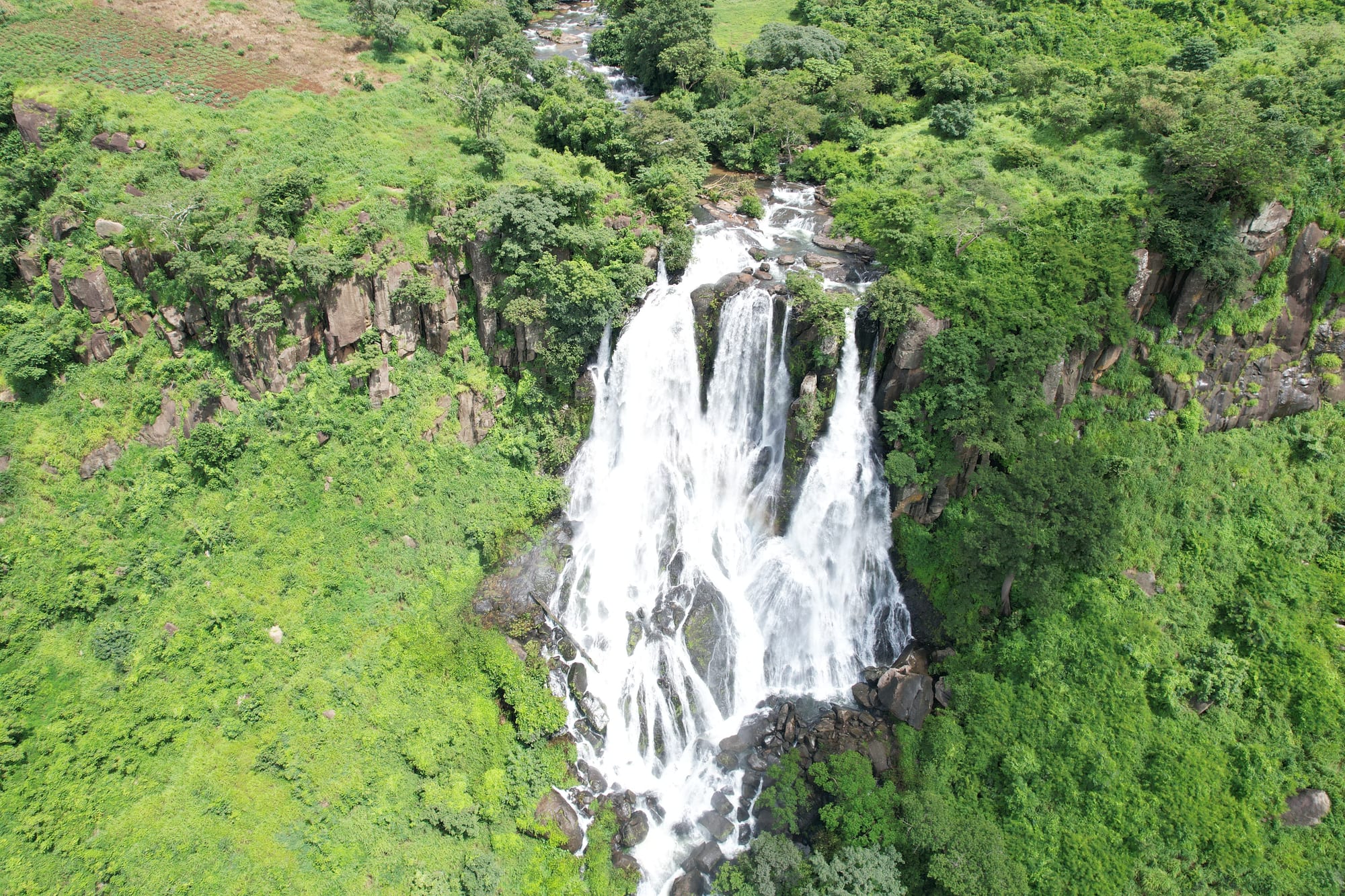
Aerial view of a wide waterfall splitting into several white streams over dark rock, surrounded by green forest

Guinea

Conakry & Lower Guinea

The Tabouna falls in Kindia region, in the hills of Lower Guinea. (Aboubacarkhoraa / Wikimedia Commons · CC BY-SA 4.0)

Guinea's Atlantic lowlands, from the capital Conakry on its narrow peninsula north through the mangrove coast and bauxite country of Boké and inland to the hills and waterfalls around Kindia — the Susu-speaking coast where most of the country's trade, government and mining exports are concentrated.

Explore Conakry & Lower Guinea

History

The coast was settled long before the colonial era by peoples such as the Baga, Nalu and Landuma, who farmed rice in the mangrove estuaries, and by the Susu, who moved towards the sea from the interior over several centuries. From the 16th century European ships traded along the rivers, and by the 18th and 19th centuries the Rio Nunez and the Rio Pongo were known for slave-trading posts run by European and Afro-European merchants.

The French extended their influence along the coast in the 19th century, building a fort at Boké, and founded Conakry on the small island of Tombo in the late 1880s. The town became the capital of French Guinea, and a railway from Conakry to Kankan was completed in the early 20th century. The Îles de Los, held by Britain for much of the 19th century, passed to France in 1904.

After independence in 1958 Conakry was the centre of Sékou Touré's state; in 1970 Portuguese forces and Guinean exiles raided the city, an attack that led to purges and new detentions. The capital was the scene of the 2009 stadium massacre of opposition supporters and of the 2021 coup led by Mamady Doumbouya. Since the 1970s Boké has become the heart of Guinea's bauxite industry, with the port of Kamsar, and its output has grown rapidly since the 2010s.

Culture & Customs

Susu is the everyday language of the coast and of Conakry, used across ethnic lines alongside French, although Pular and Maninka speakers make up much of the capital's population. The region is mainly Muslim, with Christian minorities, and Conakry's Grand Mosque is among the largest in West Africa.

The Baga have one of the region's best-known artistic traditions: their carved headdresses, including the tall D'mba figure of a mother, appear in museums around the world, and some masks are still danced at local celebrations. Music and dance are central to national life; the Ballets Africains, based in Conakry, took Guinean dance around the world, and the capital's clubs play Guinean modern music and Afro-pop.

Social life follows national norms: long greetings, respect for elders and religious leaders, and weddings and naming ceremonies that fill streets at weekends.

Daily Life

Conakry has more than 3 million people, spread along the Kaloum peninsula, with the old administrative centre at its tip and dense suburbs such as Ratoma and Matoto stretching inland. Kindia, Coyah and Dubréka are growing towns on the main roads, and Boké, Kamsar and Fria are mining centres.

The capital runs on government, trade through the port, informal commerce and services. Boké region produces much of Guinea's bauxite, the ore of aluminium, much of it exported to China; Kindia region grows fruit, especially bananas, and the coast produces rice, salt and fish.

Days in Conakry are shaped by traffic jams, frequent power cuts and the heavy rains, which flood streets. Rapid mining growth in Boké has brought jobs but also dust, displacement and anger over the lack of local benefits, and protests there have been frequent.

Food

The coast eats rice with a sauce and fish. Sauce feuille, made from cassava or sweet-potato leaves cooked with palm oil and fish or meat, is an everyday dish, as is sauce arachide, a groundnut stew. Riz gras, rice cooked in a rich tomato sauce with vegetables and meat or fish, is served at celebrations.

Conakry's seafront grills and street stalls sell grilled or fried fish with chilli, onions and fried plantain, and smoked fish is sold in markets to flavour sauces. Rice from the mangrove paddies and salt from the coast are local products, and Kindia's fruit fills the capital's markets.

Drinks include a sharp ginger juice and bissap, made from hibiscus flowers, as well as sweet tea poured in rounds. Local beer is sold in bars in Conakry.

Attractions & Natural Wonders

Conakry has a few sights of its own: the Grand Mosque, the national museum, the Madina market, the colonial buildings of Kaloum at the tip of the peninsula, and the beaches along the peninsula's shore. Off the city lie the Îles de Los — Kassa, Room and Tamara, with its village of Fotoba — reached by boat from the capital, with beaches, fishing villages and forested hills, and a popular weekend escape for Conakry residents.

Inland, the hills around Kindia are the region's most scenic landscape. The Voile de la Mariée, a veil-like waterfall near the town, and the Tabouna falls are the best-known, along with Mount Gangan above Kindia. The Soumba falls near Dubréka are another easy trip from Conakry.

North of the capital, the Atlantic mangrove coast stretches through the estuaries of the Boffa and Boké areas, with fishing villages, rice fields and birdlife. Boké itself has the old colonial fort, now a museum, on the Rio Nunez.

Cities in Conakry & Lower Guinea

Planning basics

Budget

Conakry is by far the most expensive place in Guinea. Its business hotels and restaurants are priced for mining and aid workers, and taxis add up in the traffic. Outside the capital, Kindia and Boké have basic hotels and cheap local food, but there is little tourist infrastructure, and a hired car with driver is often the largest cost.

Daily Budget Midrange
USD 90–190 (Conakry hotel, restaurants, a hired car with driver, a boat to the islands)
Daily Budget Shoestring
USD 25–45 (basic hotel or guesthouse, local food, shared taxis)

Carry cash in small notes; card payments work only in a few Conakry hotels and supermarkets.

Safety

Conakry has street crime — muggings, phone theft and robbery, especially after dark — and political protests have taken place in some suburbs, where they have been met with force. Checkpoints are common on the roads out of the capital. Boké's mining towns have seen protests over jobs and services. Road accidents are a serious risk everywhere.

Avoid demonstrations, use arranged transport at night in Conakry, do not photograph military or government sites, and take malaria precautions. Check current official travel advice before travelling.

Climate

The coast is hot and humid all year, and Conakry receives exceptionally heavy rain between roughly June and October, with July and August the wettest months. The dry season from December to April is sunnier, with harmattan haze early in the year. Kindia, in the hills inland, is a little cooler and less humid than the capital.

Summer
hot, very humid and extremely wet on the coast, around 23–30°C, with torrential rain
Winter
dry and sunny, around 22–32°C, with harmattan haze in December and January

Transportation

Conakry's airport is the country's main gateway. The capital is heavily congested, with one main road running along the peninsula. Boats to the Îles de Los leave from the port area. Kindia is a few hours inland by road, and a paved road runs north to Boké, though roads in the region vary from good tarmac to rough tracks. Bush taxis and minibuses link the towns.

Allow long journey times out of Conakry, as traffic can add hours, and choose reputable boats with life jackets for the islands.

Best Time to Visit

November to April is the dry season and the most practical time to travel, with calmer seas for the Îles de Los. The waterfalls around Kindia are fullest in the late rains and early dry season, from about September to December. The heaviest rains of July and August make roads and island trips difficult.