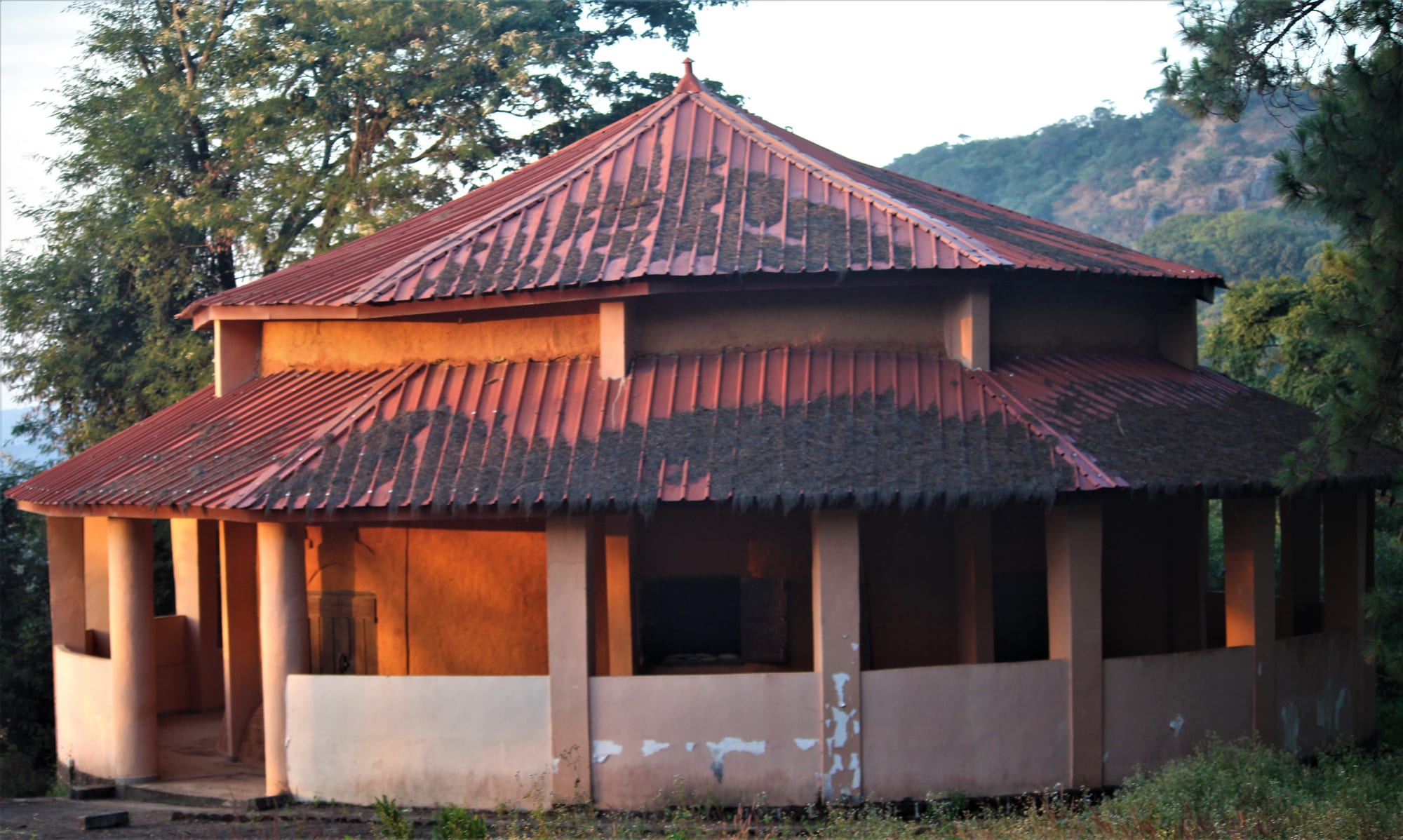
A low round building with a deep tiled roof and open veranda on a grassy slope, wooded hills behind

The Fouta Djallon, Guinea

Dalaba

The case à palabres, the old meeting hut at Dalaba in the Fouta Djallon. (Aboubacarkhoraa / Wikimedia Commons · CC BY-SA 4.0)

A small town high on the Fouta Djallon plateau in central Guinea, developed by the French as a hill station for the cool air at about 1,275 metres. Pines, gardens, a colonial villa and a carved meeting hut survive from that period, and the plateau edge above the town opens onto escarpments, waterfalls and Fula farming villages.

Neighbourhoods

  • The town centre and market
    • First-time visitors
    • Local life
    • Transport

    A short main street off the Conakry–Labé road, with the market, small shops, transport yards and most of the town's simple lodgings. It is where bush taxis stop and where the surrounding villages come to trade.

    Open in Maps
  • The villa quarter and the gardens
    • Historic district
    • Quiet and residential
    • Walks

    The slope above the centre, where the French built their rest houses among planted trees. The old villa, the meeting hut and the botanical garden stand within a short walk of one another, among hedged compounds and gardens.

    Open in Maps
  • The pine slopes and the plateau edge
    • Views
    • Walking
    • Quiet and residential

    Ridges of planted pine and grassland on the rim of the plateau, reached on foot or by motorbike taxi from the centre. Scattered hamlets, orange trees and vegetable gardens lie between the viewpoints over the valleys below.

    Open in Maps

Things to do

In and around the town

  • Villa Sililandmark

    The best known of the thirty or so villas built for Europeans in the 1930s, originally the villa Jeannine and renamed at independence, set in gardens above the town.

    Open in Maps
  • The case à palabreslandmark

    A round meeting hut with a deep tiled roof and carved woodwork, built in 1935 for meetings between the governor and the canton chiefs of the Fouta Djallon.

    Open in Maps
  • The botanical gardenpark

    The garden the botanist Auguste Chevalier laid out in 1906 to acclimatise plants from Africa and beyond, with introduced trees and shrubs on the slope below the villa.

    Open in Maps
  • Dalaba marketmarket

    The town's trading place, busiest on market day, with potatoes, oranges, fonio, dried fish, cloth and household goods brought in from the surrounding villages.

    Open in Maps
  • The viewpoints above the townviewpoint

    Rock outcrops and open ridges a short walk from the centre, looking out over the plateau, its escarpments and the valleys below, with Mount Tinka rising to 1,372 m north of the town.

    Open in Maps

Short trips from the town

  • Ditinn fallsattraction

    A waterfall about 120 metres high that drops from a cliff into the Ténée valley in the commune of Ditinn, north of Dalaba, reached by a rough track and then on foot.

    Open in Maps
  • Pitaneighborhood

    A small highland town on the road towards Labé, the base for the Kinkon falls, where a river drops over the plateau edge beside a small hydroelectric dam; about 50 kilometres away.

    Open in Maps
  • Mamouneighborhood

    The crossroads town where the roads from Conakry and from Upper Guinea meet, the gateway to the highlands and the junction most travellers pass through; about 60 kilometres away.

    Open in Maps

Seasonal events

  • Tabaski (Eid al-Adha)varies with the Islamic calendar

    The high point of the year in this strongly Muslim region, when sheep are slaughtered, families gather and emigrants return home.

  • End of Ramadanvaries with the Islamic calendar

    The festival closing the fasting month, marked by morning prayers, new clothes and visiting between households.

  • The potato and orange harvestsdry season, roughly November to February

    The season when highland crops reach the market in quantity and the roadside stalls around Dalaba are at their fullest.

Eat and drink

Long-standing places and food districts in Dalaba. Hours, ratings and directions come from your maps app, always current.

Highland cooking

  • Fonio with saucerestaurant

    The grain of the Fouta Djallon, steamed like couscous and eaten with a groundnut or leaf sauce, or with milk; it is the dish most associated with Fula cooking and is served in the small eating houses along the main street.

    Open in Maps
  • Rice with leaf saucerestaurant

    Plain rice with a sauce of cassava or sweet-potato leaves thickened with groundnuts, sometimes with a little fish or meat, the everyday meal in the town's cookshops.

    Open in Maps

Markets and stalls

  • Dalaba marketmarket

    Potatoes, oranges, avocados, bananas, fonio, dried fish and soured milk from the surrounding villages, along with bread and fried snacks sold from tables at the edge of the market.

    Open in Maps
  • Roadside tea and fruit stallsmarket

    Sweet strong tea poured in rounds, ginger juice, grilled maize in season and fruit sold along the main road, where bush taxis pull in.

    Open in Maps

Experience Dalaba

History

Dalaba owes its existence to its height. The French, who imposed a protectorate over the Futa Jallon imamate at the end of the nineteenth century, looked for places on the plateau where administrators and their families could escape the heat and the fevers of the coast, and the ridge at about 1,275 metres above the Kokoulo valley suited them. The botanist Auguste Chevalier, sent to find a site with a sub-temperate climate, chose Dalaba and laid out a botanical garden there in 1906 to test African and foreign species at altitude; pine and eucalyptus were planted on the slopes, and the arboretum that bore his name is now the Barry Gassimou garden. The hill station itself followed in the 1930s, its climatic station inaugurated in 1936, with rest houses for officials sent up from Conakry and some thirty villas for Europeans from Dakar.

The best-known survival of that period is the villa on the slope above the town, built as a rest house for senior officials and long shown to visitors as the governor's residence. Beside it stands the case à palabres, a round meeting hut with a tiled roof and carved wooden panels, built in 1935 for meetings between the governor and the canton chiefs of the Fouta Djallon — a colonial building using a local form.

Independence in 1958 ended the traffic of holidaying officials, and the relationship between Sékou Touré's government and the Fula elite of the highlands was a difficult one. Dalaba became an ordinary Guinean prefecture town, its plantations and villas slowly weathering. What remains is a small place with an unusual inheritance: a planted landscape and a handful of buildings that belong to a European idea of a hill resort, set in a wholly Fula countryside.

Culture & Customs

Dalaba is a Pular-speaking town in the heartland of Guinea's Fula people, and the values of the Fouta Djallon set the tone. Islam is central: Koranic schooling, the mosque and the religious calendar order the week and the year, and the scholarly tradition of the old imamate, in which Pular was written in Arabic script, is remembered with pride. Manners follow pulaaku, the Fula code of dignity, patience and self-restraint, and quietness in public is a virtue rather than a coldness.

Greetings are the substance of an encounter, not a preliminary to it: enquiries after the household, the cattle and the harvest run on at length before anything else is raised. Hospitality is expected of hosts and honoured by guests, and a visitor arriving at a compound will be offered milk, food or tea poured in rounds. Elders and religious teachers are deferred to, and decisions in the villages around the town are still discussed collectively, the practice the old meeting hut was named for.

Cattle remain a mark of standing even for families who now live by gardening or trade, and the round house with a thatched roof inside a hedged compound is still the pattern of village building on the plateau. Crafts include dyed cloth, basketry and leatherwork. The great gatherings of the year are Tabaski and the end of Ramadan, when emigrants working in Conakry, Senegal, Europe and North America come back to the highlands.

Daily Life

Dalaba is a small town — a prefecture centre of about 40,000 people in the urban commune at the 2025 census, in a rural prefecture where far more live in the villages than in the town itself. It sits on the Conakry–Labé road, which supplies it and takes its produce away, and much of the working day turns on that road and on the market beside it.

The economy is agricultural. The cool plateau grows crops that will not thrive in lowland Guinea: potatoes above all, along with vegetables, maize, fonio on the poorer hillsides, and oranges, avocados and bananas from the hedged gardens. Cattle are kept in most villages, and milk, fresh and soured, is part of both diet and trade. Traders move produce down to Mamou and Conakry, and money sent home by relatives abroad supports many households, as it does across the Fouta Djallon.

The day begins early with prayers and with work in the gardens before the sun is high, and slows in the afternoon heat. Electricity and water supply are intermittent, health care is limited, and young people leave for Conakry or abroad for want of work — the long-standing pattern of the highlands. Local concerns include the erosion of the plateau soils, deforestation, and the drying of springs in a region whose rivers supply much of West Africa.

Food

Dalaba eats the food of the Fouta Djallon. Fonio, the tiny highland grain that grows where little else will, is steamed like couscous and served with a groundnut sauce or a sauce of cassava or sweet-potato leaves, or eaten as a porridge with milk. Rice is the other staple, plain with a sauce over it, and tô, a stiff paste eaten with okra or groundnut sauce, appears on some tables.

Milk matters here more than anywhere else in Guinea. Kossam, fresh or soured milk, is drunk on its own, poured over fonio or rice, and made into butter in the villages. Meat is not an everyday food: chicken or a little beef goes into a sauce, and sheep are killed for Tabaski.

The plateau's gardens give the town a range of produce unusual in the country. Potatoes are the local speciality — Guinean highland potatoes are traded as far as Conakry — and oranges, mangoes, avocados and bananas fill the market in season. Bread from the town bakeries, bean and wheat fritters, and grilled maize are the quick foods at the roadside.

Drinks are non-alcoholic almost everywhere: sweet strong tea poured from a height in small glasses and taken in rounds, ginger juice, and bissap made from hibiscus. Alcohol is rarely sold in a region as observant as this one.

Planning tools

Budget

Dalaba is inexpensive. Food and the few simple hotels cost little, and the main expense is transport: a hired four-wheel-drive with driver for the tracks to the waterfalls and villages, or long bush-taxi journeys. Local guides are worth paying for on walks. There is no reliable cash machine, so money has to be brought in.

Daily Budget Midrange
USD 70–150 (the better hotels in Dalaba, a hired car with driver, a guide)
Daily Budget Shoestring
USD 25–40 (basic hotel or village stay, local food, bush taxis)

Bring enough Guinean francs for the whole stay, in small notes, and agree a price for a guide or a vehicle before setting out.

Best Time to Visit

November to February, when the rains have ended, the waterfalls still have flow, the tracks are passable and the walking is pleasant. March and April are hot and hazy, and from May to October heavy rain makes the minor roads difficult, although the plateau is at its greenest.

Suggested Number of Days

A day or two covers the town itself. Three or four allow walks out to the villages on the plateau and a trip to one of the waterfalls, which take far longer than the distances suggest. Anyone travelling by bush taxi should allow extra time.

First Visit
1–2 days
With Surroundings
3–4 days

Transportation

The main Conakry–Mamou–Labé road passes the town, and bush taxis and minibuses stop there. Within Dalaba people walk or take motorbike taxis, which are also the usual way to reach nearby villages. The tracks to the waterfalls need a four-wheel-drive vehicle, especially in the rains.

Travel in daylight, and expect journeys on the plateau tracks to be slow even in the dry season.

Airport & Station Connections

Dalaba is reached by road. Conakry is roughly 300 kilometres away by the highway through Kindia and Mamou, a long day's drive that is usually broken at Mamou, about 60 kilometres to the south-east. Labé lies to the north beyond Pita. There is no passenger rail service and no commercial airport in the highlands.

Walkability

The town is small and easily crossed on foot, and the villa, the meeting hut, the garden and the market lie within a short walk of the centre. Slopes are steep, surfaces are rough and unlit after dark, and the walks that make Dalaba worth visiting lead out of town onto tracks where a local guide is useful.

Safety

The Fouta Djallon is one of the calmer parts of Guinea and walkers are generally welcomed in villages. The practical risks are road accidents, slippery paths near waterfalls and cliff edges, and the lack of medical care outside the larger towns. Political protests have occurred in highland towns, as elsewhere in the country.

Avoid political demonstrations, don't photograph government, military, or the airport, use arranged transport at night in Conakry, and check current advice before travelling near the borders. Walk with a local guide away from the town, keep back from cliff edges and fast water at the falls, and take malaria precautions. Check current official travel advice before travelling.

Climate

Altitude makes Dalaba markedly cooler than the Guinean coast. Days are warm rather than hot, and dry-season nights can be genuinely cold by West African standards. The rains run from about May to October and are heavy, and mist often sits on the plateau in the mornings.

Summer
rainy season, warm and wet, around 18–28°C, with frequent heavy rain and low cloud
Winter
dry season, warm days and cool nights, around 10–30°C, with harmattan haze

Local Customs

This is a conservative Muslim region where Fula ideals of dignity and restraint shape manners. Greetings are long and matter more than the business that follows; loud behaviour is frowned upon. Modest dress is expected, with shoulders and knees covered. Guests are offered milk, food or tea, and refusing outright is impolite. Alcohol is rarely drunk and little sold.

Ask before photographing people, houses or compounds, remove shoes at the door of a mosque or home, use the right hand for greeting and eating, and ask permission through the village head before walking through a hamlet.

Common Payment Methods

The currency is the Guinean franc (GNF), and prices run into the tens of thousands. Cash is the only practical means of payment: cards are not accepted, and cash machines in the highlands are scarce and unreliable. Euros can be changed in Labé or Conakry rather than here, so money is best brought in already changed and in small notes.