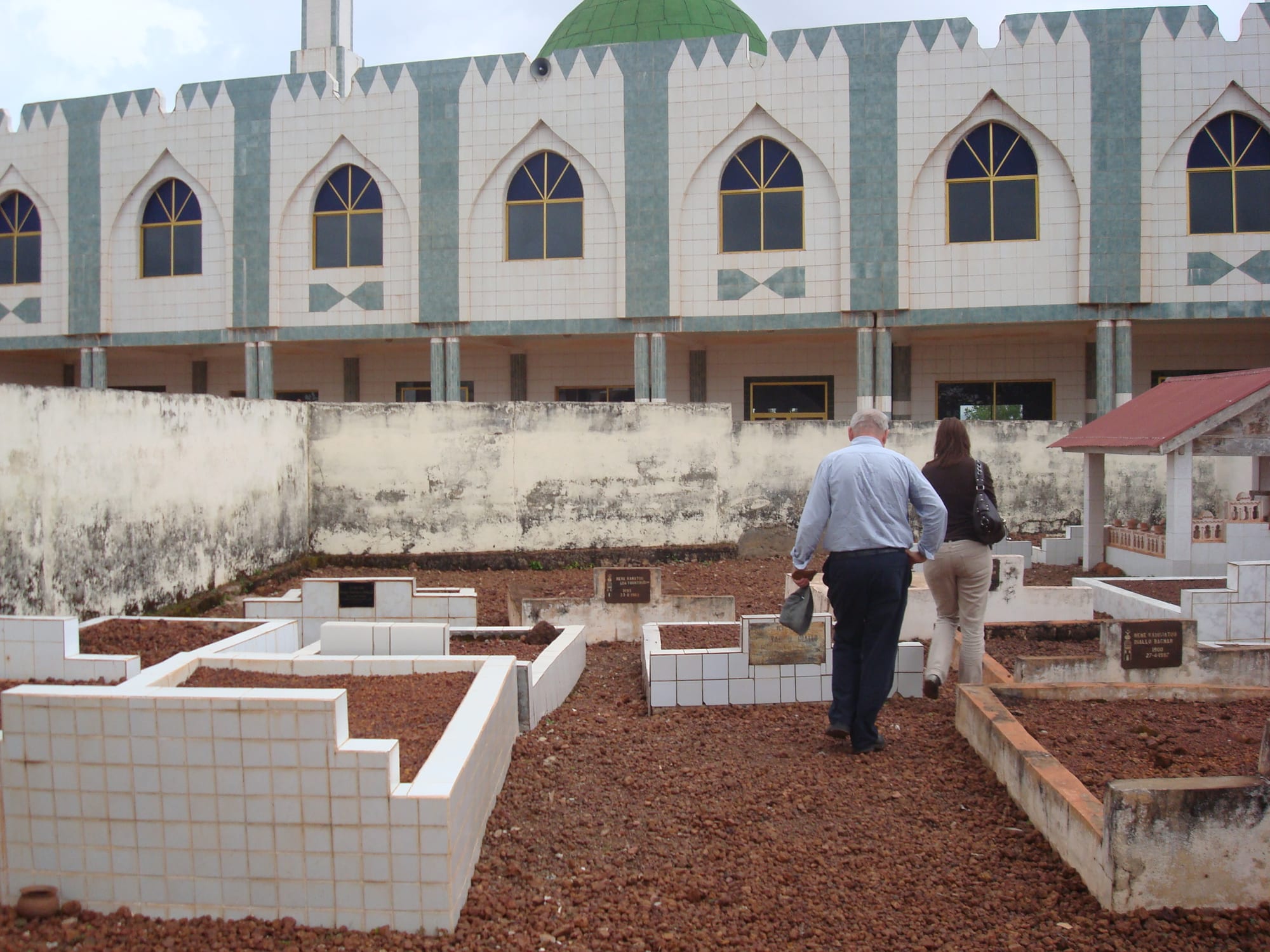
A white and green tiled mosque with pointed arched windows and a green dome, behind a walled cemetery of tiled graves

The Fouta Djallon, Guinea

Labé

The main mosque in Labé, with a walled burial ground in front of it. (Dbal / Wikimedia Commons · Public domain)

The main town of the Fouta Djallon highlands in central Guinea, set high on a plateau where the air is cooler and the nights can be cold. It was the seat of one of the provinces of the Fula imamate of Futa Jallon, and is now a trading centre, a university town and the usual base for journeys to the waterfalls and escarpments of the highlands.

Neighbourhoods

  • The centre and the market
    • First-time visitors
    • Markets
    • Local life

    The few blocks around the main market and the mosque, with shops, transport offices, banks and most places to stay. It is the busiest part of the highlands and the place trade from the villages converges on.

    Open in Maps
  • Tata
    • Close to the airport
    • Quiet and residential

    The quarter on the edge of town that shares its name with the airfield, with compounds, gardens and small shops spreading towards open country. It is quieter and greener than the centre.

    Open in Maps
  • The university quarter
    • Students
    • Quiet and residential

    The area around the university and the secondary schools, where students from across the highlands live in rented rooms, giving a small town a young population during term.

    Open in Maps
  • The village fringe
    • Walks and viewpoints
    • Countryside

    Where the town gives way to Fula hamlets of round houses, hedged gardens and orange trees on the plateau. Footpaths from here lead into the country that most visitors come for.

    Open in Maps

Things to do

In the town

  • Labé marketmarket

    The main market of the Fouta Djallon and, after Madina in Conakry, the second largest in Guinea, trading oranges, potatoes, fonio, cattle and cloth, and gathering produce from the highland villages for the capital.

    Open in Maps
  • The grand mosquelandmark

    The principal mosque in the centre of town, a focus of a region with a long tradition of Islamic learning, with a walled burial ground beside it.

    Open in Maps
  • Tata Airporttransit hub

    The airfield on the edge of town, its runway now grass and dirt, which has had no scheduled passenger flights since regional airlines stopped serving it in the mid-2000s.

    Open in Maps

Waterfalls and the plateau

  • Kinkon fallsattraction

    A waterfall on the Kokoulo about 15 km from Pita, beside the Kinkon hydroelectric dam built in the 1960s, which still supplies the towns of the plateau; the falls are fullest at the end of the rains.

    Open in Maps
  • Ditinn fallsattraction

    A tall waterfall that plunges from a cliff into a wooded gorge in the country near Dalaba, one of the best known in the highlands.

    Open in Maps

Short trips from the town

  • Pitaattraction

    A small town south of Labé on the road to Mamou, the base for the Kinkon and Kambadaga falls and for walking on the escarpments nearby.

    Open in Maps
  • Dalabaattraction

    The highest town in Guinea, among pines further south, developed as a French colonial retreat, known for its cool air, colonial villas and views across the plateau.

    Open in Maps

Eat and drink

Long-standing places and food districts in Labé. Hours, ratings and directions come from your maps app, always current.

Markets and food streets

  • Labé marketmarket

    Fonio, rice, potatoes, oranges, avocados and dried fish, with butter and milk brought in from the villages and cooked food sold along the edges.

    Open in Maps
  • Eating houses around the transport yardsneighborhood

    Simple kitchens near where the bush taxis load, serving rice and sauce, fonio, brochettes and tea to travellers heading for Conakry or the villages.

    Open in Maps

Fouta Djallon classics

  • Fonio with saucerestaurant

    The highland grain steamed like couscous and served with a leaf or groundnut sauce, or eaten with sour milk — the dish most associated with Fula cooking.

    Open in Maps
  • Milk, butter and highland fruitmarket

    Fresh and soured milk from the herds, village butter, and the oranges, avocados and bananas that the plateau's gardens produce in quantity.

    Open in Maps

Experience Labé

History

Labé takes its name and its standing from the Fula state that formed in these highlands. Jallonke and other farming peoples held the plateau before Fula herders moved in over several centuries, and in the early eighteenth century Muslim Fula leaders launched a jihad that produced the imamate of Futa Jallon, a state ruled by an almamy, with its political capital at Timbo and its religious centre at Fougoumba. Labé became the seat of one of its nine provinces, and a powerful one, controlling trade routes north and west towards the Gambia and the coast.

Its rulers were powerful enough to act almost independently. When the French advanced from the coast in the late nineteenth century and imposed a protectorate after the death of the almamy Bokar Biro in 1896, Alfa Yaya of Labé attempted to preserve his province's autonomy; he was arrested, exiled and died in exile in 1912, and is remembered in Guinea as a figure of resistance.

Under colonial rule Labé became an administrative centre and the commercial hub of the highlands, a gathering point for cattle, hides and oranges. After independence, relations between Sékou Touré's government and the Fula elite were poor, and the region lost many people to detention and to exile in Senegal, Sierra Leone, Côte d'Ivoire and later France and the United States. That emigration became a permanent feature: money sent home by Fula traders abroad has built much of the modern town, which gained a university and remains the capital of the highlands in everything but name.

Culture & Customs

Labé is the cultural capital of the Fouta Djallon and of Guinea's Fula, and the tone of the town follows from that. Pular is spoken everywhere, and the region's long scholarly tradition — Koranic schools, manuscripts written in Pular using Arabic script, and respected teaching families — gives religion an intellectual as well as devotional weight. Mosques are central, Ramadan and Tabaski are the high points of the year, and emigrants return for them.

Restraint is the social ideal. Pulaaku, the Fula code of dignity, patience and self-control, discourages display and loud behaviour; greetings are elaborate, elders are deferred to, and visitors who follow the forms are treated with considerable generosity. Guests are offered milk, food and a place to rest almost as a matter of course.

Cattle remain a marker of identity and wealth even for families who now trade or farm, and village life keeps its old pattern of round houses, hedged gardens and orange trees. Crafts include indigo-dyed cloth, leatherwork, basketry and embroidery, sold in the market. Music here is quieter than the drumming traditions of the coast and the Mande east, leaning on flute, voice and religious song, and weddings and naming ceremonies are the main public celebrations.

Daily Life

About 200,000 people live in Labé, the main town of the highlands and the service centre for a wide, thinly settled region of villages.

The economy is trade, farming and remittances. The market gathers oranges, potatoes, fonio, maize, rice, vegetables and cattle from the plateau and sends them down to Conakry, and brings back rice, fuel, cement and manufactured goods. Government offices, the university, schools and the hospital provide salaried work, and money from the very large Fula diaspora in West Africa, Europe and North America supports many households and pays for much of the building visible around the town.

Days follow the prayers, the market and the farming calendar, and the cool climate makes work easier than on the coast. Electricity and water supplies are uneven, and the rains cut tracks to the villages for months at a time. The concerns raised locally are the state of the Conakry road, jobs for young people, who continue to leave in numbers, soil erosion and deforestation on the plateaux, and the drying of springs in a region that feeds several of West Africa's major rivers.

Food

Highland food is built on fonio, milk and garden produce rather than the fish and palm oil of the coast. Fonio, a tiny grain that grows on poor hillside soils, is steamed like couscous and eaten with a leaf or groundnut sauce, or served with sour milk as a dish in its own right; it is the food most closely identified with the Fouta Djallon.

Rice is eaten too, with sauce feuille made from cassava or sweet-potato leaves cooked with palm oil, or with a groundnut sauce. Maize and millet appear as porridge, and potatoes — an important highland crop — go into stews or are fried. Meat is saved largely for festivals, when sheep are slaughtered for Tabaski, though brochettes and grilled beef are sold in town.

Milk is essential: fresh or soured milk, kossam, is drunk on its own, poured over fonio or grain, and churned into butter in the villages. The plateau's gardens and orchards give oranges, mangoes, avocados, bananas and guavas in season, sold in quantity at the market. Sweet tea poured in small rounds and sharp ginger juice are the everyday drinks, and alcohol is rare and largely disapproved of in this strongly Muslim region.

Planning tools

Budget

Labé is inexpensive. Rooms are basic, market food costs very little, and bush taxis are cheap if slow. The real costs are a hired four-wheel-drive vehicle with a driver for the tracks to the falls and the escarpments, and the local guides who arrange village walks and access.

Daily Budget Midrange
USD 70–150 (the better hotels in Labé or Dalaba, a hired car with driver, a guide)
Daily Budget Shoestring
USD 25–40 (basic hotel or village stay, local food, bush taxis)

Bring enough Guinean francs for the whole trip: banking is limited in Labé and effectively absent in the villages.

Best Time to Visit

November to February is the best season: the rains have finished, the waterfalls still run, the tracks are passable and walking is comfortable in cool weather. March to May grows hot and hazy and the hills turn brown, and the rains from May to October make many tracks difficult.

Suggested Number of Days

A day or two covers the town itself. Four to six suit walking in the highlands, where villages, escarpments and waterfalls are spread over rough roads and each move takes far longer than the distance suggests.

First Visit
1–2 days
With Surroundings
4–6 days

Transportation

The town is small and walkable, with motorbike taxis and shared taxis for anything further. Bush taxis and minibuses run south to Pita, Dalaba and Mamou and on to Conakry, north to Mali-ville, and east towards Tougué and Siguiri. Reaching the falls and the villages usually means a hired vehicle and then walking with a guide.

Allow a full day to reach Conakry by road, travel in daylight, and hire guides locally for walks off the main roads.

Airport & Station Connections

Almost everyone arrives by road from Conakry, roughly 450 km away by the route through Kindia, Mamou, Dalaba and Pita, a long day's journey by bush taxi or minibus on a road that varies from good tarmac to broken surfaces. The airfield at Tata sees no regular scheduled service, and there is no passenger railway.

Walkability

The centre is compact and pleasant to walk, helped by an altitude that keeps it cooler than the coast, though pavements are patchy and the streets are dusty in the dry season and muddy in the rains. Beyond the town, everything is footpaths, and walking between villages is the main reason people come.

Safety

The Fouta Djallon is one of the calmer parts of Guinea, and walkers are generally welcomed in villages. The main risks are road accidents, slippery paths near waterfalls and cliff edges, and the lack of medical care away from the towns. Political protests have occurred in Labé, as in other Guinean cities.

Walk with a local guide, keep away from cliff edges and fast water near the falls, avoid demonstrations, and take malaria precautions. Check current official travel advice before travelling.

Climate

Cooler than the rest of Guinea because of the altitude, with one long rainy season and a dry season of warm days, cold nights and harmattan haze. Rain is heavy from about May to October, though less extreme than on the coast.

Summer
warm and wet, around 18–28°C, with frequent heavy rain and green hills
Winter
dry, with warm days and cold nights, roughly 12–32°C, and dusty air in December and January

Local Customs

This is the Fula heartland, strongly Muslim and socially reserved, and Pular is the language of everyday life alongside French. The Fula ideal of pulaaku — dignity, restraint and self-control — shapes manners: loud behaviour draws disapproval, greetings are long, elders and religious teachers are greeted first, and modest dress is expected of both men and women.

Ask before photographing people, houses or mosques, dress modestly, greet people properly before asking anything, and expect alcohol to be rare and unwelcome in village settings.

Common Payment Methods

The currency is the Guinean franc (GNF), in cash, for almost everything. Labé has banks and cash machines, which can be out of service or short of notes, and mobile money is widely used. Cards are of no use outside a very few places.