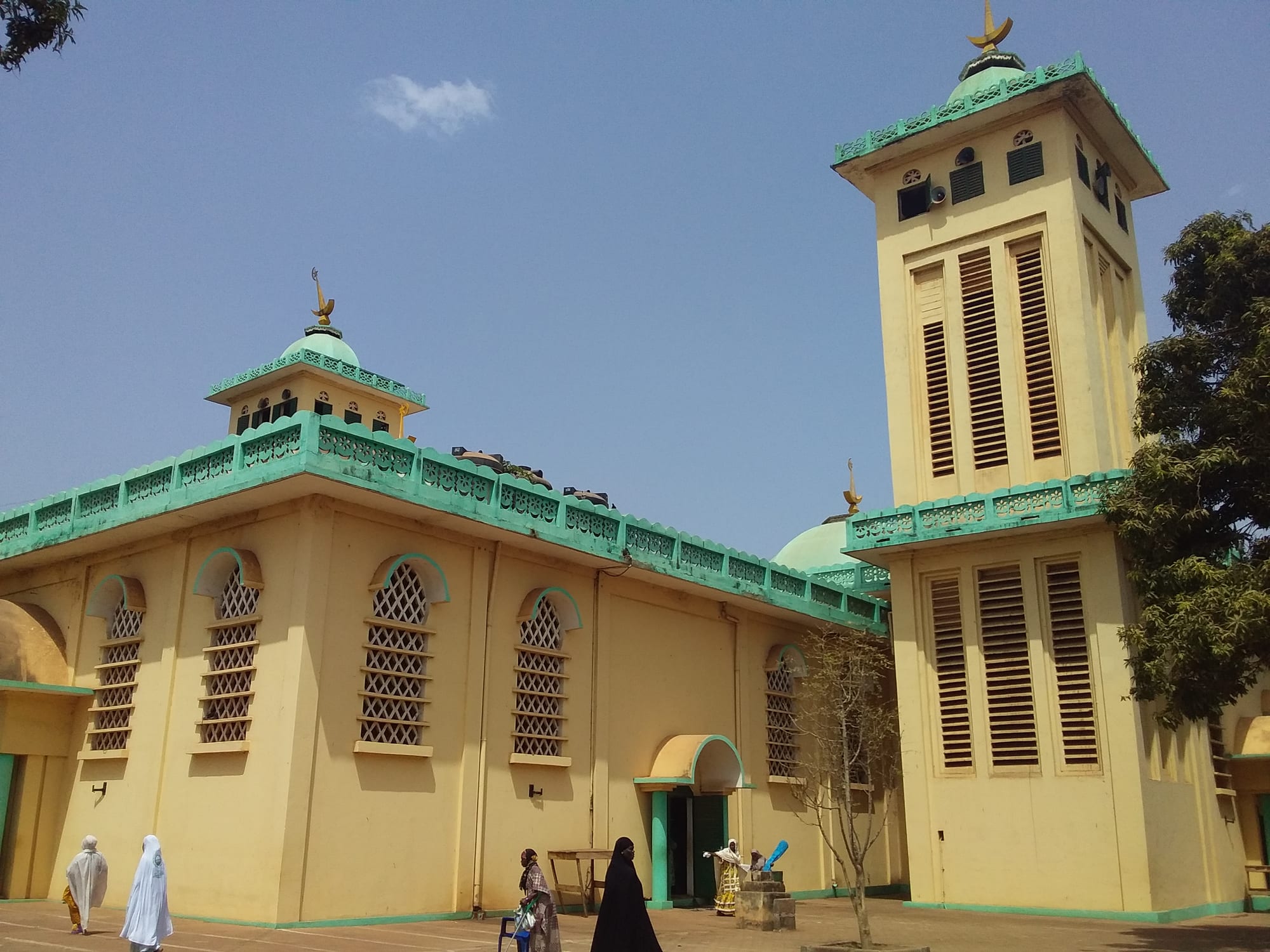
A pale yellow mosque with green trim, a square minaret and small domes under a clear blue sky

Kankan, Nzérékoré & the East, Guinea

Kankan

The grand mosque of Kankan, the main landmark of the town. (Ourysow92 / Wikimedia Commons · CC BY-SA 4.0)

The largest town of Upper Guinea, on the Milo river in the savanna east of the highlands. Founded by Muslim traders in the late seventeenth century, it grew rich on kola, gold and cloth, became a centre of Islamic learning and the terminus of the railway from Conakry, and remains a centre of Maninka culture and learning, with a university and a large market.

Neighbourhoods

  • The centre and the grand mosque
    • First-time visitors
    • Historic district
    • Walking

    The old core of the town, laid out around the grand mosque and the administrative buildings, with low compounds, mango trees and the widest streets in Kankan. Most of the offices, banks and the larger lodgings are here.

    Open in Maps
  • The market quarter
    • Best for food
    • Local life
    • Shopping

    The trading heart, a dense grid of stalls, lock-up shops and transport yards where goods come in from Mali, Côte d'Ivoire and Conakry. Kola nuts, cloth, grain and household goods are sold side by side, and it is the busiest and noisiest part of town.

    Open in Maps
  • Along the Milo
    • Quiet and residential
    • Walks
    • River life

    The eastern edge of the town, where compounds, gardens and washing places run down to the Milo river. The bank is used for market gardening, fishing and laundry, and the riverside is the coolest place in the late afternoon.

    Open in Maps
  • The university quarter
    • Students and nightlife
    • Quiet and residential

    The district around the Julius Nyerere University, with student housing, cheap eating places and small shops. It is the youngest part of the town and busiest during term.

    Open in Maps

Things to do

Landmarks and the river

  • The grand mosquelandmark

    The main mosque of Kankan, a pale, green-trimmed building with a square minaret that stands at the centre of the town and of its long tradition of Islamic scholarship.

    Open in Maps
  • The Milo riverattraction

    The tributary of the Niger that runs along the edge of the town, used for fishing, washing and market gardening, and a wide shallow channel by the end of the dry season.

    Open in Maps
  • The railway terminustransit hub

    The eastern end of the line built from Conakry to Kankan under French rule, which made the town the transhipment point for the interior; traffic on the narrow-gauge line has been suspended since 1993.

    Open in Maps
  • Camp Soundiata Keita museummuseum

    A museum inside the Soundiata Keïta military camp whose collections trace Guinea's history and its armed forces from pre-colonial times onwards, with photographs, documents, weapons and objects connected with Samori Touré.

    Open in Maps

Markets and street life

  • Kankan central marketmarket

    The town's main market, drawing traders from Mali and Côte d'Ivoire, with kola nuts, grain, dried fish, cloth, gold work and imported goods.

    Open in Maps
  • Julius Nyerere University of Kankanattraction

    A university founded in 1964 as a college for training secondary-school teachers and named after Julius Nyerere, the first president of Tanzania, with faculties spread across a campus near the centre of the town.

    Open in Maps

Short trips from the town

  • Kouroussaneighborhood

    A town on the Niger north-west of Kankan, the birthplace of the writer Camara Laye, whose novel L'Enfant noir describes a childhood there; about 70 kilometres away.

    Open in Maps

Seasonal events

  • Tabaski (Eid al-Adha)varies with the Islamic calendar

    The largest festival of the year in a strongly Muslim town, when sheep are slaughtered, families gather and the mosque overflows.

  • End of Ramadanvaries with the Islamic calendar

    The close of the fasting month, marked by mass prayers, new clothes and visits between households across the town.

  • Maouloudvaries with the Islamic calendar

    The Prophet's birthday, observed in a town proud of its Islamic scholarship with readings, chanting and gatherings at the mosques.

Eat and drink

Long-standing places and food districts in Kankan. Hours, ratings and directions come from your maps app, always current.

Upper Guinea cooking

  • Rice with groundnut saucerestaurant

    The everyday meal of plain rice under a sauce thickened with groundnuts, okra or leaves and flavoured with soumbala, the fermented seeds of the néré tree, served in small cookshops through the town.

    Open in Maps
  • Tô and foniorestaurant

    Tô, a stiff paste of cassava semolina eaten with okra or groundnut sauce, and fonio, the fine grain steamed like couscous, both common on Upper Guinean tables.

    Open in Maps

Markets and street food

  • Kankan central marketmarket

    Grain, dried and smoked fish, kola nuts, mangoes and vegetables from the Milo gardens, with women selling cooked rice and sauce from bowls at the edges.

    Open in Maps
  • Grilled meat and frittersmarket

    Brochettes grilled at the roadside in the evening, bean and wheat fritters in the morning, and bread from the town bakeries, the quick foods of the streets around the market.

    Open in Maps
  • Tea and ginger juice stallscafe

    Sweet strong tea brewed over small charcoal stoves and poured in rounds, alongside chilled ginger juice and bissap made from hibiscus; alcohol is little sold in the town.

    Open in Maps

Experience Kankan

History

Oral tradition dates the founding of Kankan to about 1690, attributing it to Daouda Kaba, and the town grew as a settlement of Muslim trading and scholarly families, the Maninka Mori, in a landscape of farming villages. Its position on the Milo, a navigable tributary of the Niger, put it on the routes carrying kola nuts north from the forest, gold from the fields towards Siguiri, cloth, salt and cattle. Wealth from that trade supported Koranic schools and a reputation for learning that made Kankan one of the most respected Islamic centres in the western Sudan.

In the nineteenth century the town was drawn into the wars of Samori Touré, the Maninka leader who built the Wassoulou Empire from Upper Guinea and resisted the French advance for almost two decades. French forces took Kankan in 1891 in the course of that campaign, and the town became a colonial administrative and military post. The railway built inland from Conakry reached Kankan and ended there, making it the transhipment point between the coast and the interior and confirming its commercial weight.

After independence Kankan remained the capital of Upper Guinea and the main city of the Maninka country, and the institute that became the Julius Nyerere University was founded here in 1964, first as a college for training secondary-school teachers. The railway declined and the roads improved little, but trade across the Malian and Ivorian borders continued, and the gold economy around Siguiri to the north has shaped the town's fortunes in recent decades.

Culture & Customs

Kankan is a leading centre of Maninka culture in Guinea, and two traditions meet here. One is Islamic: families of scholars, Koranic schools, the mosques and a reputation for learning that has drawn students from across the region for generations. The other is the Manding heritage of the old Mali Empire, kept by griots, the hereditary musicians and historians who perform the epic of Sundiata Keita on the kora and the balafon and who are called on at weddings, namings and funerals.

The town is closely associated with the N'Ko alphabet, devised in 1949 by Solomana Kanté, a scholar from the Kankan region, to write Manding languages in their own script. N'Ko is taught informally, used in signs and publications, and is a source of pride locally; it is one reason Kankan is spoken of as the intellectual centre of Maninka culture.

Social life runs on extended families and on respect for age. Greetings are long and formal, questions about family and health coming before anything else, and an approach to an elder or an official is often made through an intermediary. Kola nuts are exchanged to mark agreements, invitations and condolences. The festivals of the Islamic year are the great gatherings, and marriage ceremonies bring out musicians, drummers and dancing that lasts into the night.

Daily Life

About 410,000 people were counted in the urban commune of Kankan at the 2025 census, making it Upper Guinea's largest town and the second most populous in the country after Conakry. It is a low, spread-out place of walled compounds, mango trees and wide dusty streets, with the mosque, the administration and the market at the centre and the university and newer districts on the edges.

Trade is the town's business. The market draws produce from the savanna villages and goods from Mali and Côte d'Ivoire, and lorries and bush taxis are the circulatory system. Around the town people farm rice on the wet ground by the Milo, and millet, maize, cassava and groundnuts on the higher land; gardens along the river supply vegetables. The university, the schools, the hospital and government offices provide most of the salaried work, and gold mining to the north pulls in young men and sends money back.

The day starts before dawn with prayer and market deliveries, works through the morning, and slows in the afternoon heat before the streets fill again in the evening. Electricity and water supply are irregular, roads within the town are poor, and unemployment among the young is the constant complaint. Many families depend on relatives in Conakry or abroad.

Food

Kankan eats the cooking of Upper Guinea, which is rice-based. The standard meal is plain rice under a sauce: groundnut sauce, okra sauce, or a leaf sauce made from cassava or sweet-potato leaves, seasoned with soumbala, the strong-smelling fermented seeds of the néré tree that gives Manding cooking much of its character. Fish, often smoked or dried, goes into the sauce more often than meat does.

Tô, a firm paste of cassava semolina eaten by hand with a sauce, is a regional dish, and fonio, the fine grain of the highlands, is steamed like couscous. Riz gras, rice cooked in a tomato and oil sauce with vegetables and a piece of meat, appears at celebrations. Mangoes in the hot season, oranges, bananas and vegetables from the Milo gardens fill the market.

Street food is cheap and constant: brochettes of grilled meat at the roadside in the evening, bean and wheat fritters early in the morning, roasted maize in season, and bread from the bakeries. Kola nuts, traded north through Kankan for centuries, are chewed as a stimulant and offered as a courtesy.

Drinks are non-alcoholic for the most part. Tea is brewed strong and sweet over charcoal and poured in rounds from a height, and ginger juice and bissap, made from hibiscus, are sold chilled in small bags at the market.

Planning tools

Budget

Kankan is cheap for food and lodging, and the main costs are transport and guides. A hired four-wheel-drive with driver is the practical way to move around Upper Guinea, and the long journey in from Conakry is an expense in itself. Cash machines exist but are unreliable, so money is best carried.

Daily Budget Midrange
USD 80–170 (the better local hotels, a hired car with driver, guides)
Daily Budget Shoestring
USD 25–40 (basic hotel, local food, bush taxis)

Carry enough Guinean francs for the whole trip in small notes, and budget for checkpoints and delays on the road.

Best Time to Visit

November to February, when the roads are dry and passable and the heat is bearable. March and April are the hottest months in Upper Guinea, often well above 35°C. From about May to October the rains make some roads difficult, though the savanna is green and the Milo full.

Suggested Number of Days

One or two days cover the town. Three or four allow trips along the Niger and to the towns of Upper Guinea, where the distances are long and the roads slow. Travellers arriving by bush taxi should add time for the journey itself.

First Visit
1–2 days
With Surroundings
3–4 days

Transportation

Within the town people walk, use shared taxis along the main roads, or take motorbike taxis, which are the quickest way across Kankan. Bush taxis and minibuses leave from yards near the market for Kouroussa, Siguiri, Faranah and Conakry. A hired vehicle with a driver is the usual choice for anything beyond the town.

Agree fares before setting off, and avoid road travel after dark.

Airport & Station Connections

Kankan is a long road journey from the coast — roughly 555 kilometres from Conakry by the highway through Mamou and Faranah, usually taking a full day or more and often broken overnight at Mamou. Roads also run north-west to Kouroussa and on to Mali, and south towards the forest region. The town has an airport at Diankana, about 7 kilometres to the north-east, and the railway from Conakry has carried no traffic since 1993.

Walkability

The centre is flat and walkable, and the mosque, the administrative quarter and the market lie within twenty minutes or so of each other. The town spreads a long way, however, and the university and the outer districts are too far to walk comfortably in the heat. Streets are dusty in the dry season, muddy in the rains and largely unlit after dark.

Safety

Kankan is a calm town by day, and the main daily risks are road traffic, motorbike taxis and the heat. Political protests can turn violent, as elsewhere in Guinea, and the gold-mining areas to the north and the border zone towards Mali are more sensitive than the town itself. Malaria is present year-round, and the region has a history of Ebola and Lassa fever outbreaks.

Avoid political demonstrations, don't photograph government, military, or the airport, use arranged transport at night in Conakry, and check current advice before travelling near the borders. Take malaria precautions, follow health advice on outbreaks, and use a reliable driver rather than travelling at night. Check current official travel advice before travelling.

Climate

Savanna climate with one rainy season and a long, hot dry season. The rains run from about May to October and bring humid air and heavy downpours; the dry months that follow are hazy with harmattan dust at first, then very hot before the rains return.

Summer
rainy season, around 22–32°C, humid, with heavy afternoon and evening rain
Winter
dry season, around 15–35°C, cooler nights and harmattan haze, with fierce heat in March and April

Local Customs

Kankan is a conservative Muslim town with a long scholarly tradition, and dress is modest: shoulders and knees covered, and a head covering usual for women near the mosque. Greetings are extended and matter greatly, and elders and religious teachers are addressed first. Kola nuts are offered as a mark of respect at ceremonies, and the right hand is used for greeting, eating and giving.

Ask before photographing people, the mosque or official buildings, remove shoes when entering a home or mosque, dress modestly, and expect little alcohol to be available or welcome.

Common Payment Methods

The currency is the Guinean franc (GNF), and everyday prices run into the tens of thousands. Cash is essential; cards are not accepted outside a very few places, and the town's cash machines are unreliable and can run empty. Euros can be changed with traders, but rates are better in Conakry, so it is worth arriving with francs in small notes.