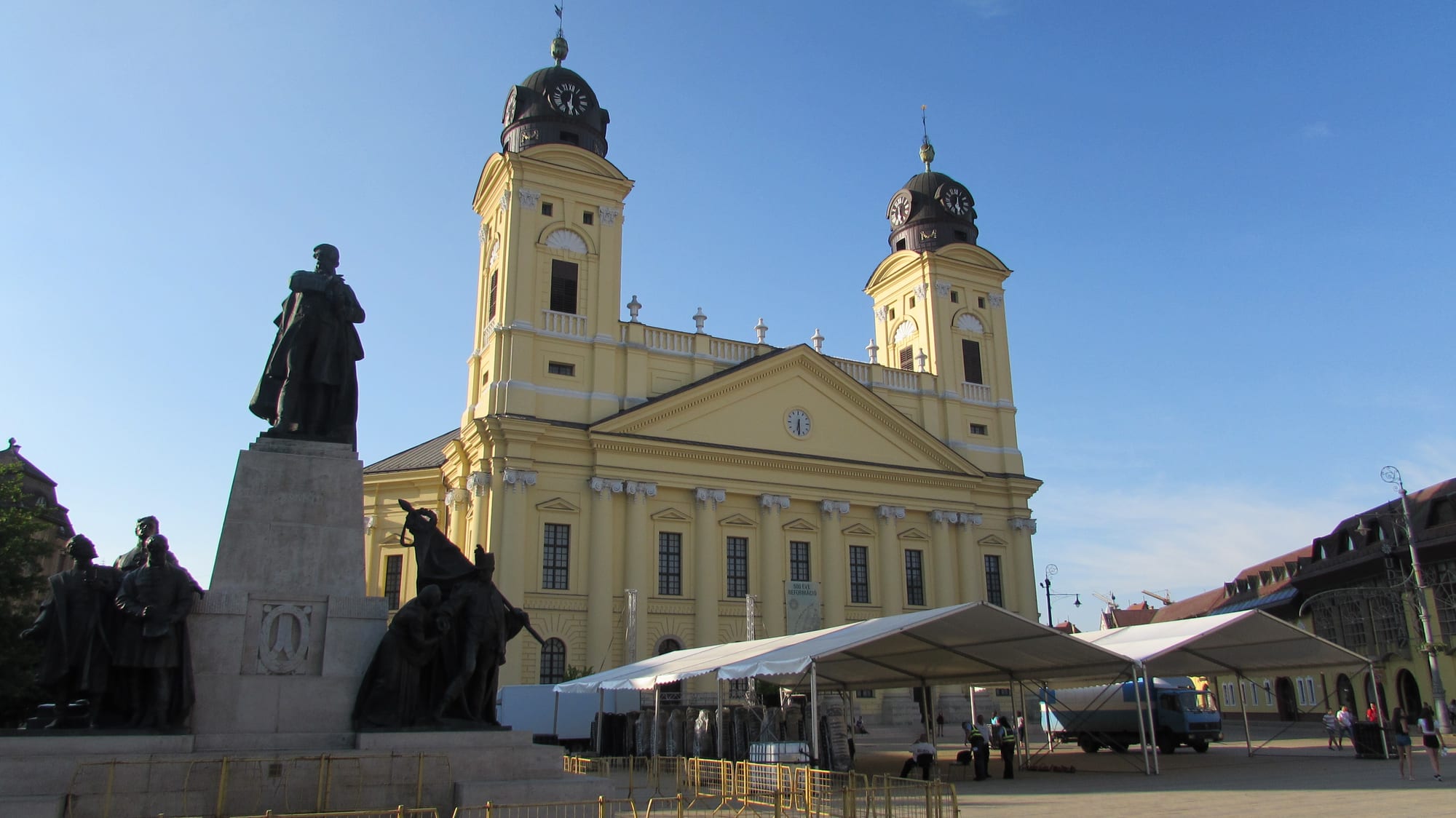
The yellow twin-towered neoclassical Great Church behind a bronze Kossuth monument on a wide square under a blue sky

The Great Plain, Hungary

Debrecen

The Reformed Great Church and the Kossuth monument on Kossuth Square in Debrecen. (Joergsam / Wikimedia Commons · CC BY-SA 4.0)

Hungary's second-largest city, on the eastern Great Plain about 220 km east of Budapest. A wealthy market town that embraced Calvinism early, it became known as the 'Calvinist Rome' and twice served as the national capital, in 1849 and 1944–45. Today it is a university and industrial city of about 200,000, with a forest park, thermal baths and the Hortobágy puszta nearby.

Neighbourhoods

  • City centre and Piac utca
    • First-time visitors
    • Historic district
    • Close to public transport

    The historic core lies along Piac utca, the main street, which runs from the railway station to Kossuth Square and the Great Church, lined with old bank buildings, shops and the old town hall, with the Reformed College, the Déri Museum and the theatre close by.

    Open in Maps
  • Nagyerdő and the university
    • Parks and baths
    • Families
    • Students

    The 'Big Forest' park just north of the centre, reached by tram. It holds the thermal baths, the zoo and amusement park, a small lake, the football stadium and the University of Debrecen's grand main building with its botanic garden — the green, leisurely side of the city.

    Open in Maps
  • Újkert and Tócóskert
    • Quiet and residential
    • Local life

    Large housing estates built in the Kádár era, where many Debrecen families live. Újkert has tower blocks of more than ten storeys, unusual outside Budapest; Tócóskert has a small artist's memorial museum.

    Open in Maps
  • Hal köz and the old market streets
    • Nightlife
    • Best for food

    The lanes around Hal köz, the old fish market near the main square, are the centre's best-known cluster of bars and places to eat, a short walk from Piac utca.

    Open in Maps

Things to do

Famous landmarks

  • Reformed Great Churchlandmark

    Built in 1805–24 after a fire destroyed most of the town, it is Hungary's largest Protestant church; Kossuth declared independence from the Habsburgs here in April 1849, and a tower holds the Rákóczi bell and a view over the city.

    Open in Maps
  • Reformed Collegelandmark

    Founded in 1538, the school that made Debrecen the intellectual centre of the region and the forerunner of the University of Debrecen, with its historic library.

    Open in Maps
  • St Anne's Cathedrallandmark

    The baroque Catholic church built in 1721 after Catholics returned to the Calvinist town, the cathedral of the Diocese of Debrecen-Nyíregyháza since 1993.

    Open in Maps
  • Csokonai Theatrelandmark

    The city's oldest and largest theatre, opened in 1865 with Moorish-style ornament and statues of six Hungarian poets on its façade.

    Open in Maps
  • Greek Catholic Churchlandmark

    A neo-Byzantine church of 1910 on Attila Square, with an inlaid altar and pulpit decorated with mosaic.

    Open in Maps
  • Pásti Street Synagoguelandmark

    An Orthodox synagogue built in 1893 to plans by Eugene Berger.

    Open in Maps

Museums

  • Déri Museummuseum

    The city's main museum, behind the Great Church, best known for Mihály Munkácsy's three huge paintings of Christ's Passion, with Egyptian antiquities, arms and regional natural history.

    Open in Maps
  • MODEMmuseum

    A centre for modern and contemporary art in the historic centre, open since 2006, with exhibitions, talks and performances.

    Open in Maps
  • Medgyessy Memorial Museummuseum

    The life and work of the sculptor Ferenc Medgyessy, shown in an old house on Péterfia utca.

    Open in Maps

Nagyerdő park

  • Nagyerdőpark

    The protected woodland park just north of the centre, Debrecen's favourite place for walks, with a lake and many of the city's attractions.

    Open in Maps
  • Aquaticum thermal bathsattraction

    The thermal bath complex in Nagyerdő, with medicinal pools, a public pool and a water park.

    Open in Maps
  • Zoo and amusement parkattraction

    The city zoo and a traditional amusement park side by side in Nagyerdő, on the tram line.

    Open in Maps
  • University of Debrecen main buildinglandmark

    The grand main building of Hungary's largest university, with the botanic garden behind it, known for its cactus research.

    Open in Maps
  • Nagyerdei Stadionattraction

    The 20,340-seat home of Debreceni VSC, opened in 2014 in the park, and an occasional venue for the national team.

    Open in Maps

Short trips from the city

  • Hortobágy National Parkpark

    Hungary's first national park and a World Heritage Site: Europe's largest semi-natural grassland, with the Nine-holed Bridge, sweep wells and grey cattle; the city once owned the pasture.

    Open in Maps
  • Hajdúszoboszlóneighborhood

    A spa town about 20 km from the city, known for its medicinal waters, thermal pools and water park.

    Open in Maps
  • Erdőspusztaattraction

    An exhibition house about 10 km south-east of the city, with a display on living in the forest-steppe.

    Open in Maps

Seasonal events

  • Flower Carnival20 August

    Debrecen's flower festival, held every year on 20 August and the biggest event of the city's year.

Eat and drink

Long-standing places and food districts in Debrecen. Hours, ratings and directions come from your maps app, always current.

Debrecen classics

  • Debreceni sausagerestaurant

    The city's namesake sausage: finely textured pork heavily spiced with paprika, garlic, pepper and marjoram, sold in pairs and traditionally slashed and fried or grilled so that it curls.

    Open in Maps
  • Hortobágyi palacsintarestaurant

    Savoury crêpes filled with a paprika-seasoned meat stew, with the sauce poured over and sour cream on top; despite its name, the dish has no link to the Hortobágy.

    Open in Maps

Food districts and markets

  • Hal közneighborhood

    The old fish-market lane near the main square, now the centre's best-known cluster of bars and places to eat.

    Open in Maps
  • Piac utcaneighborhood

    The main street, whose name means Market Street, with cafés, pastry shops and restaurants between the station and the Great Church.

    Open in Maps

Experience Debrecen

History

Debrecen grew up after the Magyar conquest and gained importance when nearby villages were abandoned after the Mongol invasion. It is first recorded in 1235, and in 1361 Louis I granted its citizens the right to choose their own judge and council. By the early 16th century it was a major market town, enriched by trade and fairs. Without a castle or walls, it survived the Ottoman period through the diplomacy of its leaders, protected by different powers at different times, while under Ottoman rule as a sanjak from 1558 to 1693. It embraced the Reformation early: the Reformed College was founded in 1538, Catholics were barred from settling from 1551, and the town became known as the "Calvinist Rome". In 1693 Leopold I made it a free royal town, and by the 18th century it was the largest Hungarian city.

In 1849 the revolutionary government fled here from Pest-Buda, and in April Lajos Kossuth proclaimed Hungary's independence and the dethronement of the Habsburgs in the Great Church; the last battle of the war was fought close to the city. The railway from Budapest arrived in 1857, and in 1884 Debrecen became the first Hungarian city with a steam tramway. After 1920 it again lay near the border, and in 1919 it was briefly occupied by the Romanian army.

The Second World War was devastating. Most of the city's Jews were deported in June and July 1944, and in October a great tank battle was fought nearby; around 70 per cent of buildings were damaged. Debrecen briefly became the capital again in 1944–45. The communist state then took over its estates, removed half its area and its rights over the Hortobágy, and in the following decades large housing estates changed the face of the outer districts.

Culture & Customs

The Reformed Church still shapes the city's identity. Debrecen is home to the Reformed Theological University, the only Calvinist theological institute allowed to function under communism, and about 20 Reformed congregations. The Reformed College made it the intellectual centre of the region, and the university that grew from it in 1912 is now the largest in the country. Mihály Csokonai Vitéz, one of Hungary's best-known poets, was born and lived here, as was the novelist Magda Szabó, and Endre Ady, Gyula Krúdy and Árpád Tóth began their journalistic careers in Debrecen. The Csokonai Theatre traces its roots to a company founded in the city in 1789.

Music runs from the Béla Bartók International Choir Competition, part of the European Grand Prix for Choral Singing, to Tankcsapda, one of Hungary's most successful rock bands, and a rock school for young musicians. The Flower Carnival, held every year on 20 August, is the year's great event.

Sport is followed closely. Debreceni VSC has won the Hungarian football championship seven times and played in the Champions League group stage in 2009–10, and the city has hosted world and European championships in athletics, swimming, gymnastics and hot-air ballooning, as well as international speedway at its stadium in the south.

Daily Life

Debrecen had about 200,000 residents at the 2022 census, more than a third of the population of Hajdú-Bihar County, and it is the main shopping centre of eastern Hungary. Agriculture, healthcare and education have long driven its economy; more recently international companies — BMW, CATL, Continental, National Instruments, Teva and Gedeon Richter among them — have made it one of the most developed cities in Hungary. The university draws large numbers of students, including many from abroad who come to study medicine.

Many people live in the housing estates built in the later 20th century, or in family-house districts; the historic centre along Piac utca is the place for shopping and going out. Trams, trolleybuses and buses run by the city company carry much of the daily traffic, and since the M35 motorway opened Budapest is within two hours by car.

Weekends and summer evenings centre on Nagyerdő, with its baths, lake and stadium. The city is led by Mayor László Papp of Fidesz-KDNP and an assembly elected in 2024.

Food

Debrecen gave its name to one of Central Europe's best-known sausages. Debreceni is a finely textured pork sausage, reddish-orange from paprika and seasoned with garlic, pepper and marjoram, usually unsmoked or lightly smoked and sold in pairs joined at one end; it is traditionally slashed across and baked, grilled or fried, so that it curls into a chain of coins. It spread across the former Austro-Hungarian lands and is eaten from Austria to Poland and Romania.

The cooking of the plain fills local menus. Hortobágyi palacsinta, crêpes filled with a paprika-seasoned meat stew and topped with sour cream, is a favourite, though the dish has no link to the Hortobágy itself, and gulyás traces its roots to the kettle cooking of the plain's herdsmen. Grey cattle and mangalica, a curly-coated Hungarian breed of pig, supply prized meat, and plum pálinka from Szatmár, to the north-east, carries a protected designation.

For eating out, the lanes around Hal köz, the old fish market near the main square, hold the centre's main cluster of bars and restaurants, while the cafés and pastry shops of Piac utca serve the shoppers and students of the main street.

Planning tools

Budget

Debrecen is among the cheaper large cities in Hungary, with student-town prices for food and drink and good-value hotels. Thermal baths, museum tickets and tours to the Hortobágy are the main extra costs.

Daily Budget Midrange
USD 85–160 (city or spa hotel, restaurant meals, the thermal baths, a hire car or tour for the puszta)
Daily Budget Shoestring
USD 40–65 (guesthouse or hostel, canteen lunches and street food, trams and buses)

City transport tickets are separate from Budapest's; the tram line from the station to Nagyerdő covers most of what visitors want to see.

Best Time to Visit

May to June and September to October are the most comfortable months. July and August are hot but suit the baths and park, and the Flower Carnival falls on 20 August. The nearby Hortobágy is a stopover for migrating cranes. Winters are cold and grey, though the thermal baths stay open.

Suggested Number of Days

Two days suit a first visit to the city. Allow three or four to add the Hortobágy and a spa town on the plain; the Flower Carnival or a car makes a longer stay worthwhile.

First Visit
2 days
With Surroundings
3–4 days

Transportation

The DKV company runs two tram lines, five trolleybus lines and about 60 bus lines. Tram 1 links the railway station with the main street, the Great Church, Nagyerdő and the university, and taxis can be ordered by app. Nearby towns are reached by regional bus, and a car or tour makes the Hortobágy much easier.

Budapest public transport tickets are not valid in Debrecen.

Airport & Station Connections

Debrecen International Airport, the second-largest in Hungary, lies about 5 km south-south-west of the centre, with flights to several European cities; an airport bus runs to the centre. Trains from Budapest Nyugati run about every hour and take about two and a half hours, and the M35 motorway brings Budapest within two hours by car.

Walkability

The centre is compact and easy on foot: Piac utca runs straight from the station to the Great Church, with the museums and theatre close by. Nagyerdő is about 2 km north of the centre — a pleasant walk or a short tram ride — and the park itself is made for walking. Outer districts are spread out and best reached by bus.

Safety

Hungary is a safe country with low levels of violent crime. Debrecen is a calm university city, and crime against visitors is uncommon; the usual care with bags in busy places and with taxis applies. Summer heat is the main practical hazard.

Use app-ordered or licensed taxis, keep valuables secure in crowds at the Flower Carnival, and carry water on hot days. Check current official travel advice before travelling.

Climate

A humid continental climate. Summers are warm to hot and winters cold. July is the wettest month and January the driest.

Summer
warm to hot — July averages 21.9°C
Winter
cold — January averages −0.8°C

Local Customs

Debrecen is proud of its Calvinist heritage, and the Great Church is closed to visitors during services. Most Hungarians leave a tip of at least 10 per cent in restaurants, telling the server the amount when paying; if a service charge (szervizdíj) is on the bill, no tip is expected.

Visit churches outside service times and dress modestly.

Common Payment Methods

The currency is the Hungarian forint (HUF). Cards are widely accepted in shops, restaurants and hotels, but cash is useful at the bus station, markets and small stalls. ATMs are easy to find in the centre; avoid the expensive currency-exchange ATMs at the airport.