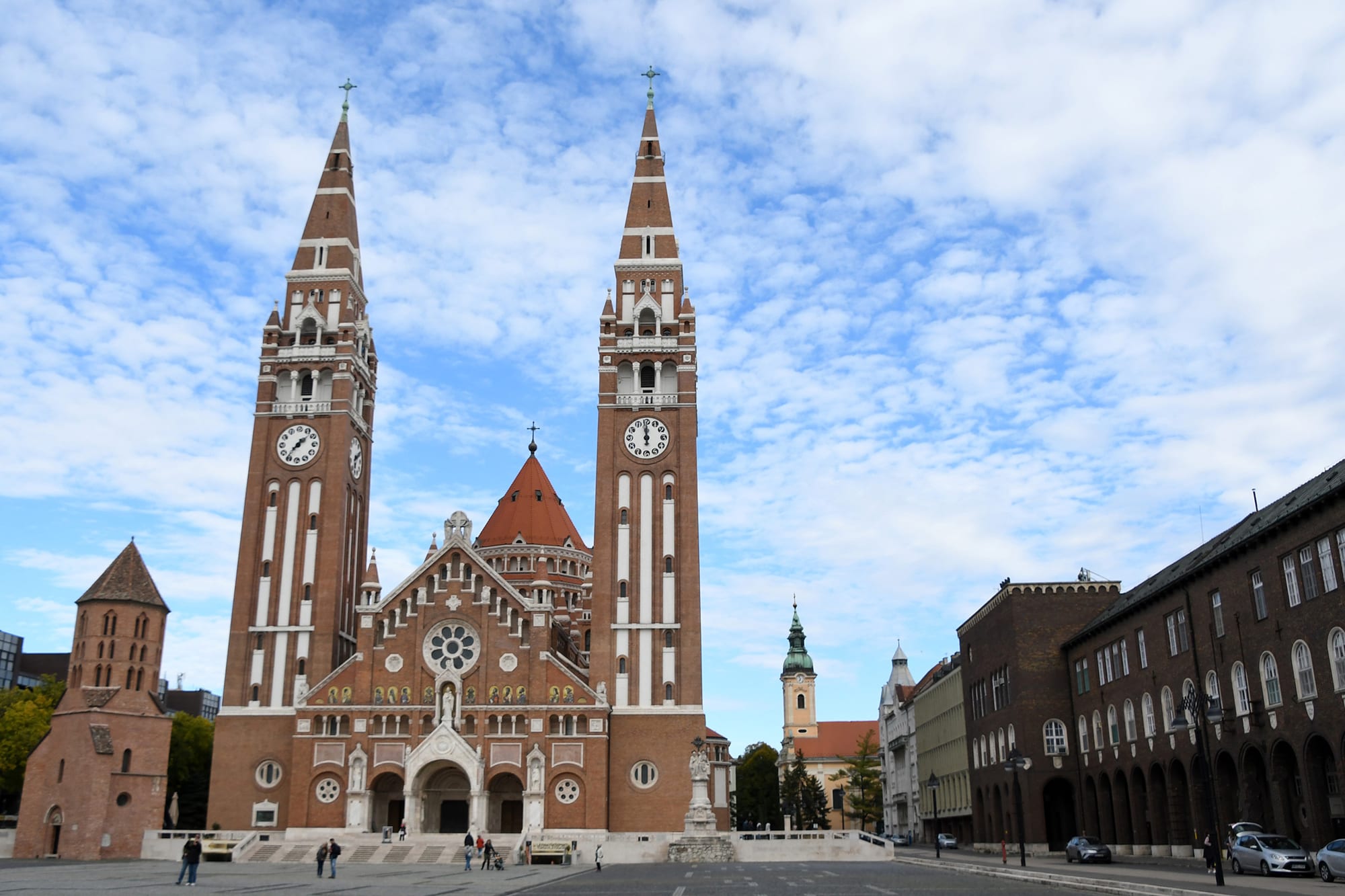
The red-brick twin-spired Votive Church on a wide paved square, with the old Dömötör tower to its left and arcaded university buildings to the right

The Great Plain, Hungary

Szeged

The Votive Church, the Dömötör tower and the university buildings on Dóm Square in Szeged. (Pasztilla aka Attila Terbócs / Wikimedia Commons · CC BY-SA 4.0)

Hungary's third-largest city, on both banks of the Tisza just below the mouth of the Maros, close to the Serbian border. An old river town and paprika centre, it was almost wiped out by the flood of 1879 and rebuilt with ring boulevards, palaces and a great votive church. Today it is a sunny university city known for its summer open-air festival and fish soup.

Neighbourhoods

  • Belváros (city centre)
    • First-time visitors
    • Historic district
    • Cafés

    The downtown rebuilt after 1879 inside the inner ring boulevard, with Kárász utca, a pedestrian street since the 1980s, Klauzál Square and its pastry shops, the Town Hall on Széchenyi Square and Dóm Square with the cathedral. After their renovation, Klauzál Square and Kárász utca won a Europa Nostra award in 2003.

    Open in Maps
  • Alsóváros
    • Historic district
    • Quiet and residential

    The old Lower Town to the south, where people sheltered around the Franciscan church in troubled times and lived by fishing and herding. The Gothic church and monastery, completed in 1503, survived the flood and still anchor this low-rise district.

    Open in Maps
  • Újszeged
    • Parks and baths
    • Families
    • Rivers

    The newer town on the east bank, joined to Szeged in 1880 and linked by bridges since 1883. It has the thermal bath and swimming complex, green streets and a 17-storey tower block that opened in 1977.

    Open in Maps
  • Felsőváros and the upper riverbank
    • Rivers
    • Best for food

    The Upper Town north of the centre along Felső Tisza-part, home to the Pick Salami and Paprika Museum and, further out on the bank, one of the city's traditional fish taverns.

    Open in Maps
  • Tápé
    • Village atmosphere
    • Historic church

    A former village on the Tisza, annexed to the city in 1973, with a Gothic church of the 1390s built on the walls of an 11th-century church.

    Open in Maps

Things to do

Famous landmarks

  • Votive Churchlandmark

    The twin-spired cathedral vowed after the 1879 flood and built in 1913–30, with 91-metre towers and one of Europe's largest church organs, with more than 9,000 pipes.

    Open in Maps
  • Dóm Squarelandmark

    One of the largest squares in Hungary, enclosed by arcaded university buildings of 1929–32, and every summer the stage of the Open-Air Festival.

    Open in Maps
  • Dömötör Towerlandmark

    The oldest building in Szeged, the Romanesque and Gothic tower of a vanished church in front of the cathedral, with a fresco of the baptism of the Hungarians inside.

    Open in Maps
  • Szeged Synagoguelandmark

    Lipót Baumhorn's synagogue, completed in 1902, blending Art Nouveau and Moorish Revival styles under a 48.5-metre dome, with stained glass by Miksa Róth; also used for concerts and events.

    Open in Maps
  • Reök Palacelandmark

    Ede Magyar's Art Nouveau palace of 1907, now a regional arts centre with changing exhibitions of modern and contemporary art.

    Open in Maps
  • National Theatre of Szegedlandmark

    The city's main theatre, built in 1883 by Fellner and Helmer in eclectic and neo-baroque style, also home to concerts by the Szeged Symphony Orchestra.

    Open in Maps
  • Franciscan church and monastery, Alsóvároslandmark

    A Gothic church completed in 1503, one of the few buildings to survive the flood, with two icons of Mary, one of them the Black Mary.

    Open in Maps
  • Old Water Towerlandmark

    The water tower on Szent István Square, the oldest reinforced-concrete building in Hungary.

    Open in Maps

Museums

  • Móra Ferenc Museummuseum

    The city's main museum, by the Tisza at the Downtown Bridge, with archaeology, folk life, history and natural history and large seasonal exhibitions.

    Open in Maps
  • Pick Salami and Szeged Paprika Museummuseum

    The story of Szeged's two famous foods, on the upper riverbank north of the centre.

    Open in Maps
  • Castle Museummuseum

    A branch of the Móra Ferenc Museum in the one surviving corner of Szeged's castle.

    Open in Maps

Baths, parks and the river

  • Anna Bathattraction

    A historic downtown bath with thermal pools, spas and saunas, popular with younger locals for its night-swimming evenings.

    Open in Maps
  • Széchenyi Squarepark

    The large square in front of the Town Hall, lined with listed houses and monuments.

    Open in Maps
  • Szeged Zoopark

    The city's wildlife park (Vadaspark).

    Open in Maps
  • University Botanic Gardenpark

    The University of Szeged's botanic garden.

    Open in Maps

Short trips from the city

  • Ópusztaszer National Heritage Parkmuseum

    An open-air museum of Hungarian history, best known for the Feszty Panorama, a vast circular painting of the Magyar arrival completed in 1894.

    Open in Maps
  • Hódmezővásárhelyneighborhood

    A neighbouring city on the plain, linked to Szeged since 2021 by a tram-train.

    Open in Maps

Seasonal events

  • Szeged Open-Air Festivalsummer

    Held since 1931, it turns Dóm Square into an open-air theatre with seating, each production running for about a week.

  • Szeged Youth Days (SZIN)late August

    An open-air music festival with Hungarian and international bands, popular with locals and visitors alike.

  • Fish Soup FestivalSeptember

    A festival devoted to Szeged's famous halászlé.

Eat and drink

Long-standing places and food districts in Szeged. Hours, ratings and directions come from your maps app, always current.

Szeged classics

  • Roosevelt téri Halászcsárdarestaurant

    A traditional fish tavern facing the Móra Ferenc Museum at the old bridgehead, one of the places locals go for halászlé.

    Open in Maps
  • Kiskőrössy Halászcsárdarestaurant

    A traditional fish tavern on the bank of the Tisza in the north-east of the city.

    Open in Maps
  • Pick salamirestaurant

    Szeged's own winter salami, made since Mark Pick opened his shop in 1869 and exported around the world.

    Open in Maps

Cafés and sweets

  • Klauzál Squareneighborhood

    The elegant downtown square of cafés and confectioners, among them Hatos Rétes, known for its strudel.

    Open in Maps
  • Kárász utcaneighborhood

    The downtown main street, pedestrianised since the 1980s, with cafés, bars and restaurants.

    Open in Maps

Experience Szeged

History

People have lived where the Maros meets the Tisza since ancient times. Ptolemy recorded a place called Partiscum here, the Romans had a trading post on an island in the river, and Szeged itself is first named in a document of King Béla III in 1183. The Mongols destroyed the town, but its people returned from the marshes and rebuilt it. Under Louis the Great it became the most important town in southern Hungary, Sigismund gave it walls, and in 1498 it was made a free royal town. The Ottomans pillaged it in 1526 and held it from 1543 to 1686 as an administrative centre.

Prosperity returned in the 18th century, with a Piarist school, though also with witch trials in 1728–44. Szeged played a leading part in the revolution of 1848–49, when it was the last seat of the revolutionary government and Kossuth gave his last public speech here. The railway arrived in 1854, and in 1869 Mark Pick opened the shop that became the salami factory. Then, in March 1879, the Tisza flood destroyed the town: only 265 of 5,723 houses survived. Emperor Franz Joseph promised that Szeged would be more beautiful than before, and the city was rebuilt with ring boulevards, palaces and the votive church.

After 1920 Szeged lay near the new border, but it gained the university moved from Kolozsvár in 1921 and became a bishopric in 1923. Around 6,000 inhabitants were killed in the Second World War, and in June 1944 the Jews of the city and nearby villages were deported from the ghetto. Under communism Szeged grew as a centre of light and food industry, oil was found nearby in 1965, and neighbouring villages were annexed in 1973. Today it is a university city and a popular destination.

Culture & Customs

The summer Open-Air Festival, held since 1931, is the event that made the city's name: each summer Dóm Square is turned into an open-air theatre, with the cathedral as backdrop. The National Theatre and the Szeged Symphony Orchestra keep a full season through the rest of the year, and the Szeged Youth Days festival brings a younger crowd. The rebuilt city is a showcase of Art Nouveau and historicist architecture, from the Reök Palace and Baumhorn's synagogue to the palaces of Kárász utca and Klauzál Square; in 2023 the city won the Hild János Prize for the renewal of its centre.

The University of Szeged, among the largest and oldest in Hungary, gives the city a large student population, many of them foreign medical students, and the ELI attosecond laser research centre opened in 2018. Szeged is largely Catholic by tradition, and the Franciscan church of Alsóváros, with its Black Mary icon, is one of its oldest churches.

Local crafts include the Szeged slipper (papucs), the red women's slipper of local folk dress, and the rose growers of Szőreg keep a tradition of close to a century. Handball is the city's favourite sport: SC Pick Szeged won the EHF Cup in 2014 and plays at the Pick Aréna, opened in 2021.

Daily Life

Szeged had about 159,000 residents at the 2022 census, around 40 per cent of the population of Csongrád-Csanád County, down by more than 9,000 since 2011. It is the regional centre of the Southern Great Plain and an important centre of science and culture. Food industry is the traditional base — Pick salami, paprika, dairy and meat processing — and BYD announced plans to begin building cars in the city by the second quarter of 2026.

Most residents live in the districts around the centre — Rókus, Móraváros, Felsőváros and Alsóváros — in Tarján and the other outer districts, or across the river in Újszeged. Public transport is good for a city of its size, and since 2021 the tram-train has tied Szeged to Hódmezővásárhely, forming the country's second-largest urban area after Budapest. The motorways towards Belgrade and Timișoara and the nearby Serbian border make the city a transport hub.

Life moves outdoors for much of the year in this sunny city: cafés on Klauzál Square, evenings at the baths and festival nights in summer. The city has been led since 2002 by Mayor László Botka, now of the Association for Szeged.

Food

Szegedi halászlé is the city's signature dish: a slightly spicy paprika fish soup traditionally cooked in a kettle with at least four kinds of river fish, mostly carp, catfish, sterlet and pike. It is served mild unless ordered hot, and the traditional fish taverns along the Tisza are where locals go for it. It has its own festival in September and a long rivalry with Baja's version, made with thick pasta.

Paprika arrived in Hungary in the second half of the 16th century as an ornamental plant and about a century later was being grown as a spice; Szeged is known as its home, producing sweet, hot and rose varieties. Abroad, Székely goulash of pork and sauerkraut is sometimes called 'Szegediner Gulasch', though the dish does not come from Szeged. Pick salami, a winter salami made in the city since the 19th century, is exported around the world.

For sweets, the confectioners of Klauzál Square are a local institution, Hatos Rétes among them, known for strudel. Onions from nearby Makó and summer lecsó, a stew of peppers, tomatoes and onions, complete the picture of southern plain cooking.

Planning tools

Budget

Szeged has student-town prices and good-value hotels, cheaper than Budapest. The Open-Air Festival is the main extra cost in summer and fills the city's rooms, while thermal baths, museums and fish-tavern meals are inexpensive.

Daily Budget Midrange
USD 85–160 (city hotel, fish-tavern dinners, the baths, festival tickets or a day trip)
Daily Budget Shoestring
USD 40–65 (hostel or guesthouse, canteen lunches, trams and buses)

Book festival tickets and summer rooms early; tram tickets can be bought on board by card.

Best Time to Visit

May to June and September to October are the most comfortable months, and the fish soup festival falls in September. July and August are hot but bring the Open-Air Festival on Dóm Square and, in late August, the Youth Days. Winters are cold but the thermal baths are at their best.

Suggested Number of Days

Two days cover a first visit. Allow three or four to add the heritage park and a neighbouring town on the plain, or to fit in festival evenings in summer.

First Visit
2 days
With Surroundings
3–4 days

Transportation

The city company runs five tram lines, six trolleybus lines and 38 bus lines, with the same tickets valid on all three, and a tram-train runs to Hódmezővásárhely. Taxis can be ordered by phone or app. The flat centre and riverbanks also suit cycling.

Board buses at the front door to buy a ticket from the driver.

Airport & Station Connections

Szeged is about 171 km south of Budapest on the M5 motorway, roughly 1½–2 hours by car from Budapest's airport. Trains from Budapest Nyugati take about two hours and stop at the airport's Ferihegy station, and regional trains cross from Subotica in Serbia. Szeged's own small airport handles only small aircraft.

Walkability

Very walkable: the flat downtown inside the ring boulevard, with Kárász utca, Klauzál Square, Dóm Square and the riverside, is easily covered on foot. Újszeged is a walk across the Downtown Bridge, while Alsóváros and the outer districts are easier by tram or bus.

Safety

Hungary is a safe country with low levels of violent crime. Szeged is a relaxed university city, and crime against visitors is uncommon. Summer heat is the main practical hazard — temperatures have passed 40°C — along with mosquitoes by the river and care when swimming in the Tisza.

Carry water and sun protection on hot days, use insect repellent by the river, and swim only at designated beaches. Check current official travel advice before travelling.

Climate

A climate between humid continental and humid subtropical, with hot summers, cold winters and fairly low rainfall; the average annual temperature is 11.6°C. Its long sunshine hours have earned it the name 'City of Sunshine'.

Summer
hot and sunny — a record 40.1°C was measured on 23 July 2022
Winter
cold, with some snow between late November and early March, against an annual average of 11.6°C

Local Customs

Most Szeged residents who name a religion are Catholic, and the cathedral and churches expect modest dress and quiet. Most Hungarians leave a tip of at least 10 per cent in restaurants, telling the server the amount when paying; if a service charge (szervizdíj) is on the bill, no tip is expected. Halászlé is served mild unless ordered hot.

Visit churches outside service times.

Common Payment Methods

The currency is the Hungarian forint (HUF). Cards are widely accepted, including on trams, but cash is useful for buses, markets and small kiosks. ATMs are easy to find in the centre.