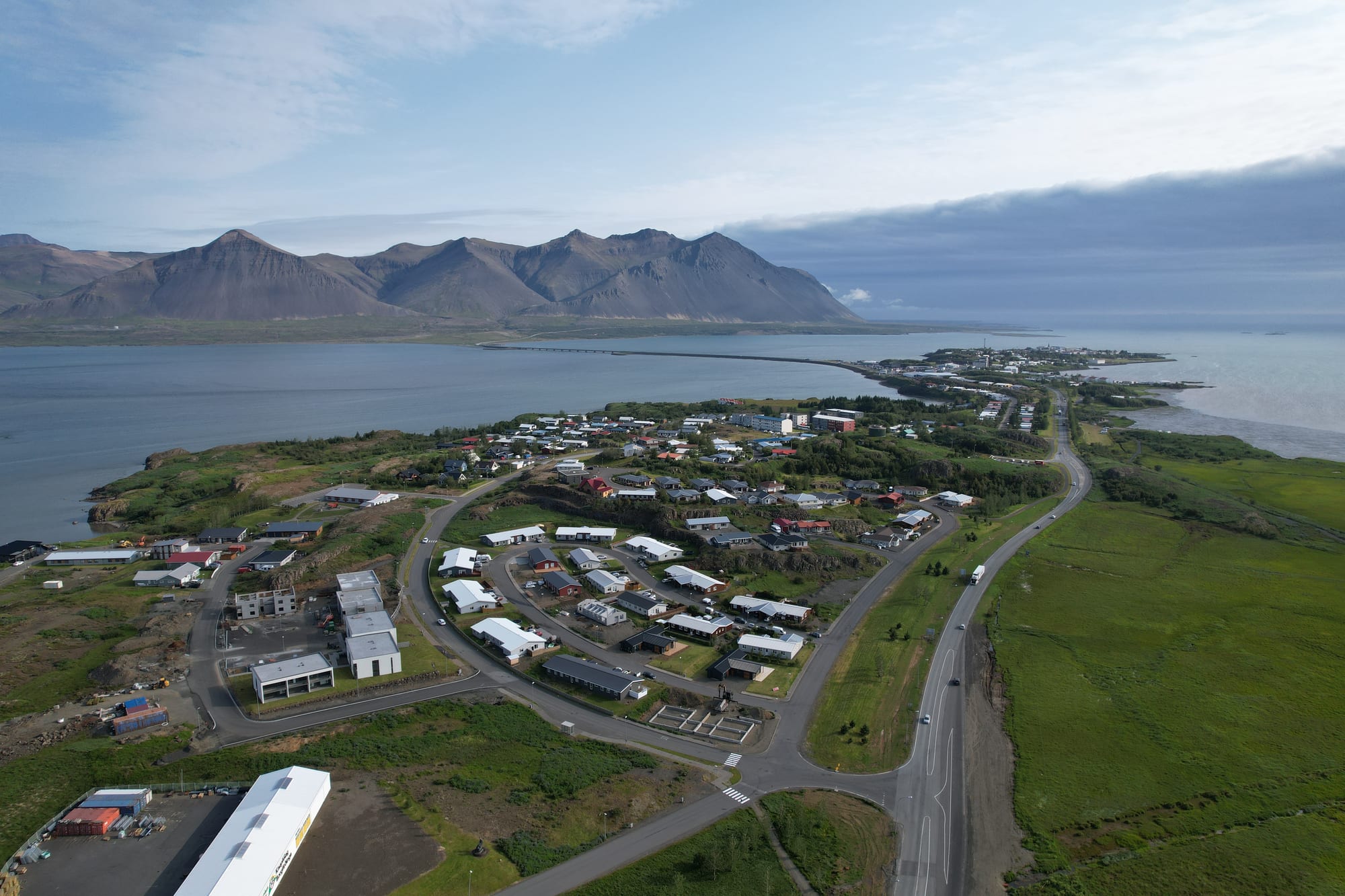
Aerial view of Borgarnes on its green peninsula, with the dark peaks of Hafnarfjall across the water

West Iceland & the Westfjords, Iceland

Borgarnes

Borgarnes on Borgarfjörður from the air, with Hafnarfjall in the background. (Eysteinn Guðni Guðnason / Wikimedia Commons · CC BY-SA 4.0)

A small town on a peninsula in Borgarfjörður, about an hour north of Reykjavík on the Ring Road, named after Borg, the farm of the saga poet Egill Skallagrímsson. Founded in the late 19th century, it is the service centre of a farming district and a stopping point for travellers, with a saga museum, a park with a Viking burial mound and saga sites all around.

Neighbourhoods

  • The old town on the point
    • First-time visitors
    • Historic district
    • Museums

    The older streets towards the tip of the peninsula, around Brákarbraut and Skúlagata, where the Settlement Centre, the park of Skallagrímsgarður and the town's small museums sit close to the shore. It is compact, quiet and best seen on foot.

    Open in Maps
  • Borgarbraut and the Ring Road
    • Close to public transport
    • Best for food

    The main road through the newer part of town, lined with fuel stations and fast-food stops — the Borgarnes most travellers see on their way north.

    Open in Maps

Things to do

Saga sites and museums in town

  • Settlement Centre (Landnámssetur)museum

    A centre on Brákarbraut devoted to the saga age, with exhibitions on the settlement of Iceland and Egils saga, regular plays and shows, and a restaurant.

    Open in Maps
  • Skallagrímsgarðurpark

    A small park in the middle of town where, by tradition, Egill's father Skallagrímur Kveldúlfsson lies in a burial mound, with a memorial to Egill and his poem Sonatorrek, his lament for his drowned son.

    Open in Maps
  • Safnahús Borgarfjarðarmuseum

    The district museum house, gathering a natural history collection, a local history museum, an art collection, the archives and the library under one roof.

    Open in Maps
  • Borgarnes swimming poolattraction

    The town pool, with a steam bath, sauna, two hot tubs and three water slides.

    Open in Maps
  • Borgarfjarðarbrúlandmark

    The 520-metre bridge across the fjord, opened in 1981, which links the town to the Ring Road and is the second longest bridge in Iceland.

    Open in Maps

Short trips from the town

  • Borg á Mýrumlandmark

    The farm just west of town that the settler Skallagrímur claimed as his land and where his son Egill later lived and farmed, with a monument to Egill by the sculptor Ásmundur Sveinsson.

    Open in Maps
  • Hvanneyriattraction

    A small farming and church centre near the town, home to the Agricultural University of Iceland.

    Open in Maps
  • Deildartunguhverattraction

    The highest-flow hot spring in Europe, pouring out 180 litres a second at 97°C — some of its water is piped to heat Borgarnes.

    Open in Maps
  • Reykholtattraction

    The village where the medieval chieftain and writer Snorri Sturluson lived, now with a centre devoted to his works, a statue of him by Gustav Vigeland and the remains of his home.

    Open in Maps
  • Hraunfossarlandmark

    A series of falls where rivulets stream for about 900 metres out of the Hallmundarhraun lava field into the river Hvítá, with the waterfall of Barnafoss just upstream.

    Open in Maps
  • Surtshellirattraction

    A lava tube about a mile long in the Hallmundarhraun field, one of the longest caves of its kind in Iceland.

    Open in Maps
  • Glymurlandmark

    The second-tallest waterfall in Iceland, falling 198 metres into a steep canyon at the head of Hvalfjörður, reached on foot from a parking area.

    Open in Maps

Eat and drink

Long-standing places and food districts in Borgarnes. Hours, ratings and directions come from your maps app, always current.

Borgarnes classics

  • Settlement Centre restaurantrestaurant

    The restaurant inside the saga centre in the old town.

    Open in Maps
  • Geirabakarícafe

    A bakery café that appeared in the film The Secret Life of Walter Mitty, dressed up as a Papa John's for the shoot.

    Open in Maps
  • Dússabarrestaurant

    An Icelandic country bar and a Thai restaurant rolled into one, popular with locals.

    Open in Maps

Food districts

  • Ring Road food stopsneighborhood

    Fuel-station grills and fast-food eateries along the main road, the part of town many Icelanders know from the drive between Reykjavík and the north.

    Open in Maps

Experience Borgarnes

History

Borgarnes stands in the heart of saga country. The settler Skallagrímur Kveldúlfsson claimed the land around Borg, just west of the present town, and built his farm there; his son Egill, warrior and poet, is the hero of Egils saga, and much of the saga is set on these shores. By tradition Skallagrímur and his father Kveldúlfur lie in a burial mound in what is now Skallagrímsgarður, the park at the centre of town, joined there by Egill's son Böðvar, who drowned in Borgarfjörður and whom Egill mourned in his poem Sonatorrek. The island of Brákarey off the point recalls Þorgerður brák, Egill's foster-mother, who in the saga gave her life to save him.

The town itself is young. It was founded in the late 19th century and took its name, "Borg peninsula", from Egill's farm. It became a separate municipality, Borgarneshreppur, in 1913. Although it stands on the sea, it was never mainly a fishing town; ships were once run from here, among them the Eldborg, at times the top herring catcher, but almost no fishing is done today.

The bridge across Borgarfjörður, opened in 1981, linked the town to the Ring Road, and it became a stopping point for travellers between Reykjavík and the north. Borgarnes became a town in 1987, and in 1994 it merged with neighbouring rural districts to form the municipality of Borgarbyggð, of which it is the centre.

Culture & Customs

The sagas are the town's culture. The Settlement Centre tells the story of Iceland's settlement and of Egils saga in exhibitions and staged performances, and Safnahús Borgarfjarðar, the district museum house, was among the first collections in Iceland to receive formal recognition from the Saga Council, in 2013. Up the valley at Reykholt, Snorri Sturluson, the medieval chieftain thought to have compiled parts of the Prose Edda, a major source for Norse mythology, lived and was killed.

Modern culture has a foothold too. The composer Anna Thorvaldsdottir was born in Borgarnes, and Magnús Scheving, the athlete who created the children's television series LazyTown, grew up here, recalling a school with only three other pupils in his year. The town has its own brass band, and it was one of the filming locations of The Secret Life of Walter Mitty.

Local identity is that of a market town for a wide farming district. Borgarfjörður's forests, of mixed birch and conifers, hold some of the oldest and tallest birch trees in Iceland.

Daily Life

About 2,150 people lived in Borgarnes in 2024, on its peninsula at the shore of Borgarfjörður. It is the centre of Borgarbyggð and the service town for the surrounding countryside, with the municipal offices, schools, shops and the swimming pool, and a popular stopping place for travellers on the Ring Road.

The economy rests on agriculture, tourism and culture rather than the sea. Farming in the Borgarfjörður valleys is a mainstay, the Agricultural University of Iceland is nearby at Hvanneyri, and Bifröst University is at Bifröst in Norðurárdalur. The town's heating comes partly from Deildartunguhver, Europe's highest-flow hot spring, whose water is piped about 34 kilometres to Borgarnes.

Reykjavík is about an hour away, and the Hvalfjörður tunnel has been free since 2018. Daily life is that of a small Icelandic town — the pool in the morning, the supermarket and fuel station as meeting points, and a steady stream of traffic through on the main road.

Food

Borgarnes is a farming town, and its tables reflect that: lamb from the hill pastures, dairy from the valleys and fish from the coast. Hangikjöt, smoked lamb, is eaten here as throughout Iceland, along with skyr, the thick strained milk product that is technically a cheese, and harðfiskur, wind-dried fish eaten with butter.

Many Icelanders know the town for its roadside eating: the fuel-station grills and fast-food stops along the Ring Road where Icelanders break the drive north. The Icelandic hot dog, pylsur, made from Icelandic lamb, pork and beef and served with fried and raw onion, ketchup, sweet mustard and remoulade, is the classic order. The Settlement Centre has its own restaurant in the old town, and Geirabakarí, is the bakery café that appeared in The Secret Life of Walter Mitty.

Borgarnes also has a distillery: Reyka vodka has been made in the town since 2005, in a still fed with water drawn from a lava field. Kleina, knotted fried pastries, and snúður cinnamon rolls fill the bakery counters, as they do across Iceland.

Planning tools

Budget

Prices are as high as anywhere in Iceland, but the town has a hostel with a campsite, and it fills up less than Snæfellsnes. The Hvalfjörður tunnel from Reykjavík has been toll-free since 2018. Guided trips into the man-made ice tunnels of Langjökull are the big extra cost in the area.

Daily Budget Midrange
USD 280–500 (guesthouse, one restaurant meal a day, a hire car, the Settlement Centre and a pool)
Daily Budget Shoestring
USD 120–200 (hostel bed or campsite, supermarket food, buses or a shared hire car)

Stock up on food and fuel here before heading west onto Snæfellsnes or north along the Ring Road.

Best Time to Visit

June to August brings the longest days and the easiest driving to the valleys inland. The town works all year: it is on the main road an hour from the capital, and winter nights bring chances of the northern lights, though short days and icy roads call for slack in the plan.

Suggested Number of Days

The town can be seen in a day or less. Allow two or three days to take in the saga sites, hot springs and waterfalls of the Borgarfjörður valleys; short winter daylight and weather can add time.

First Visit
1 day
With Surroundings
2–3 days

Transportation

The town is small and easily explored on foot; there are no local buses or taxi companies. A hire car is needed for the valleys inland. Long distance buses from Reykjavík stop in Borgarnes, and buses connect it with Akureyri, Hólmavík and the north coast of Snæfellsnes.

The roads up the Borgarfjörður valleys lead to the main sights inland; check road.is before driving in winter.

Airport & Station Connections

Borgarnes is about 70 kilometres from Reykjavík on the Ring Road, an hour's drive through the toll-free Hvalfjörður tunnel and over the Borgarfjarðarbrú bridge. Several buses a day run from Reykjavík, and any northbound bus should stop here. Akureyri is about four hours away by road and Stykkishólmur just over an hour. International flights land at Keflavík, beyond Reykjavík.

Walkability

Very walkable: the old town, the Settlement Centre, the park and the shore are all a few minutes apart. The Ring Road strip is less pleasant on foot, and wind off the fjord can make even short walks cold.

Safety

Iceland has almost no violent crime and is one of the safest countries in the world. In and around Borgarnes the risks are the weather and the roads: wind, ice and heavy traffic on the Ring Road, and slippery rock and scalding water at the hot springs.

Keep to the marked paths at Deildartunguhver, where the water is near boiling, and drive with care on icy roads in winter. Check current official travel advice before travelling.

Climate

A mild, wet and windy oceanic climate like the capital's, with cool summers, winters rarely bitter and weather that changes fast.

Summer
cool — in nearby Reykjavík summer temperatures fluctuate between 10 and 15°C and rarely exceed 20°C
Winter
mild for the latitude — in nearby Reykjavík temperatures very rarely drop below -15°C, with wind, rain and snow

Local Customs

Tipping is not practised in Iceland. The town is proud of its saga heritage, and sites such as Skallagrímsgarður and Borg are treated as part of local history. The pool is the social centre.

Alcohol is sold in the state liquor shop on Borgarbraut and in licensed bars and restaurants; the buying age is 20. Keep to roads and paths to protect the ground.

Common Payment Methods

The currency is the Icelandic króna (ISK). Cards, including contactless, are used for everything and cash is almost never needed. A card with a PIN is useful for unattended fuel pumps.