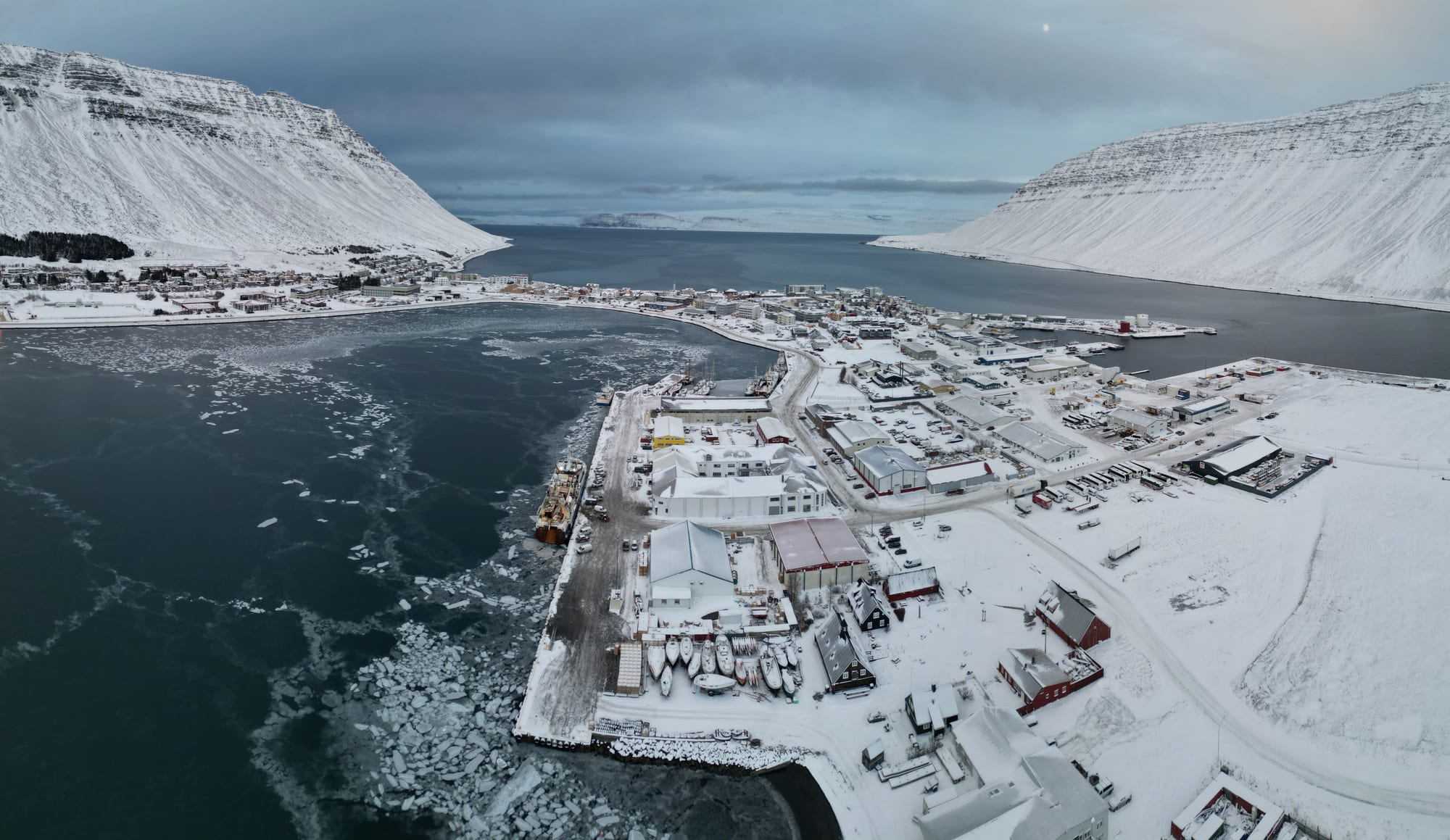
Aerial view of snow-covered Ísafjörður on its spit, with ice floes in the harbour and white mountains on both sides of the fjord

West Iceland & the Westfjords, Iceland

Ísafjörður

Ísafjörður from the air, its old centre on a sandspit in Skutulsfjörður. (JirkaPanek / Wikimedia Commons · CC BY-SA 4.0)

The largest town in the Westfjords, built on a sandspit in Skutulsfjörður. A Danish trading post that grew on fishing, it keeps Iceland's oldest group of timber-frame trading houses, and today combines a fishing harbour, cruise ships, a university centre and a lively music scene with boats to Vigur and Hornstrandir.

Neighbourhoods

  • The town centre on the spit
    • First-time visitors
    • Best for food
    • Close to public transport

    The old part of town on the sandspit, or eyri, in Skutulsfjörður, around Hafnarstræti, Aðalstræti and Silfurtorg. The shops, bakeries, cafés, the tourist information centre and most restaurants are here, and its small streets give the town its unusually urban feel.

    Open in Maps
  • Neðstikaupstaður
    • Historic district
    • Museums

    The old Danish trading post at the tip of the spit, with the oldest collection of timber-frame houses in Iceland — Krambúð of 1757, Faktorshús of 1765, Tjöruhúsið of 1781 and Turnhúsið of 1784, home of the Westfjords Heritage Museum.

    Open in Maps
  • Hnífsdalur
    • Quiet and residential
    • Walks

    A small village of about 250 people in a valley about five kilometres north, between Ísafjörður and Bolungarvík, linked to town by a paved path beside Road 61 and close to hiking trails.

    Open in Maps

Things to do

Museums and the old town

  • Westfjords Heritage Museummuseum

    A maritime museum in Turnhúsið, a storehouse of 1784, opened in 1988, on the fisheries and coastal life of the Westfjords, with old boats, objects found by divers and a collection of 190 accordions.

    Open in Maps
  • Neðstikaupstaður trading houseslandmark

    The 18th-century Danish trading post at the end of the spit, the oldest group of timber-frame houses in Iceland, including the merchant's house of 1765, now the Danish consulate.

    Open in Maps
  • Old hospital cultural centreattraction

    The town's former hospital building, now a cultural centre holding the library and exhibition rooms.

    Open in Maps
  • Ísafjörður swimming poolattraction

    A small indoor pool on Austurvegur with a hot pot, the town's meeting place in the long winters.

    Open in Maps

Islands

  • Vigurattraction

    The second largest island in Ísafjarðardjúp, with a single farm, Iceland's only surviving historic windmill, some 3,500 nesting pairs of eider and one of the largest puffin colonies in the country, reached by boat from town.

    Open in Maps

Short trips from the town

  • Bolungarvík and the Ósvör Maritime Museummuseum

    In the fishing town of Bolungarvík, about 15 kilometres north-west through a road tunnel, a maritime museum built as a replica of a 19th-century fishing station, with a crew hut, salt house and drying hut.

    Open in Maps
  • Suðureyriattraction

    A small fishing village at the tip of Súgandafjörður, reached through the Vestfjarðagöng tunnel, where visitors can go out on fishing boats or tour the fish factory.

    Open in Maps
  • Flateyriattraction

    A village of about 200 people on Önundarfjörður, reached through the Vestfjarðagöng tunnel.

    Open in Maps
  • Hornstrandirpark

    Iceland's northernmost peninsula, an uninhabited nature reserve of 580 square kilometres, reached by ferries that run daily in summer.

    Open in Maps
  • Dynjandilandmark

    The largest waterfall in the Westfjords, 100 metres high, with five other falls below it, protected as a natural monument since 1981.

    Open in Maps

Seasonal events

  • Aldrei fór ég suðurEaster weekend

    A rock festival founded in 2004 by the musician Mugison and his father, Guðmundur Kristjánsson, named after a Bubbi Morthens song meaning 'I never went south' and broadcast live nationally.

  • Ski Week (Skíðavikan)The week before Easter

    A yearly town festival held in the week leading up to Easter, ahead of the rock festival.

  • Act AloneAugust

    A theatre festival devoted to monodrama, the art of acting alone.

Eat and drink

Long-standing places and food districts in Ísafjörður. Hours, ratings and directions come from your maps app, always current.

Ísafjörður classics

  • Tjöruhúsiðrestaurant

    A seafood restaurant in an 18th-century tar house in Neðstikaupstaður, the oldest cluster of houses in Iceland, which began as a summer coffee shop and turned to seafood after a new owner took it over in 2004.

    Open in Maps
  • Dokkan Brugghúsrestaurant

    A small brewery and taproom in the town.

    Open in Maps

Food districts

  • Hafnarstræti and Aðalstrætineighborhood

    The two main streets of the spit, with the town's cafés, bakeries, bars and restaurants close together.

    Open in Maps

Experience Ísafjörður

History

According to the Landnámabók, the Book of Settlements, Skutulsfjörður was first settled by Helgi Magri Hrólfsson in the 9th century. The town grew in the 16th century as a trading post for foreign merchants, at a time when witch trials were common across the Westfjords and many people were banished to the Hornstrandir peninsula to the north. Under the Danish monopoly the merchants built the post now called Neðstikaupstaður on the end of the spit, and its storehouses and merchant's house, put up between 1757 and 1784, are the oldest group of timber-frame houses in Iceland. Ísafjörður was granted municipal status in 1786.

In the first half of the 20th century the town kept growing as a centre of fish processing; the harbour and the fleet expanded, and the population with them. Ísafjörður became one of the largest fishing towns in Iceland. The decline came from the early 1980s, when fishing restrictions and falling fish stocks sent people away in search of work, and the town's population fell.

The map of the area was redrawn in the 1990s. In 1996 Ísafjörður merged with five neighbouring municipalities to form Ísafjarðarbær, and the same year the Vestfjarðagöng tunnel replaced the high, avalanche-prone pass of Breiðadalsheiði to Flateyri and Suðureyri. A tunnel to Bolungarvík followed in 2010. The University Centre of the Westfjords opened in 2005, and new companies, among them Kerecis, have joined the fishing firms as employers.

Culture & Customs

For its size Ísafjörður has a remarkable musical life. It has a school of music, and in recent years has become known as a centre of alternative music outside Reykjavík. In 2004 the musician Mugison and his father started Aldrei fór ég suður — "I never went south" — as a free concert, and it has become an Easter festival broadcast live across Iceland, a statement that culture need not be confined to the capital. The Við Djúpið festival has brought musicians from Iceland and around the world for master classes and concerts since 2003, and Act Alone, a festival of one-person theatre, is held every August.

Skiing is the other passion. Ski Week fills the town in the week before Easter, and the Fossavatnsgangan ski marathon, held since 1935, is the oldest ski race in Iceland and part of the Worldloppet series; the town has produced many Olympic skiers. The multi-sport club Vestri fields basketball, football and volleyball teams that have played in the top divisions.

Despite its isolation, the town has an unusually urban atmosphere, with a cultural centre and library in the old hospital building and a summer stream of cruise passengers through the heritage museum, where a local troupe in national costume has performed scenes of early 19th-century life.

Daily Life

About 2,700 people lived in Ísafjörður in 2024, making it the largest settlement in the Westfjords and the administrative centre of the Ísafjarðarbær municipality, which also includes Hnífsdalur, Flateyri, Suðureyri and Þingeyri. The town has a hospital, the region's only upper-secondary school and the University Centre, which offers master's programmes in coastal and marine subjects.

Fishing remains the base of the economy, with fish processing, aquaculture firms and the regional energy company among the major employers, and the town is also home to start-ups such as Kerecis. Tourism is growing: the harbour receives large cruise ships, and the town is the main gateway to Hornstrandir, whose ferries run daily in summer.

The rhythm of life is set by the weather and the light. Summer is busy with boats, walkers and cruise passengers; winter brings snow, high winds and very few clear days, and life centres on the pool, the ski slopes and the sports halls.

Food

Fish has long been Ísafjörður's main industry, and it is what Tjöruhúsið serves. The restaurant, in a tar house of 1781 among the trading houses of Neðstikaupstaður, began as a summer coffee shop and turned to seafood after a new owner took it over in 2004. At the heritage museum a costumed troupe has re-enacted the old work of laying out bacalao to dry in the sun.

Dried fish with butter, harðfiskur, was once served with every meal in Iceland, and serving fermented skate on 23 December is a tradition that began in the Westfjords. Hákarl, Greenland shark cured by fermentation and hung to dry for four to five months, with a strong ammonia-rich smell, appears above all at the midwinter þorrablót feasts.

The centre's bakeries and cafés on Aðalstræti and Hafnarstræti are the everyday places to eat, and the town has its own small brewery, Dokkan Brugghús. Wild crowberries and blueberries are among the local ingredients of Icelandic cooking.

Planning tools

Budget

Prices match the rest of Iceland, and the choice of rooms is limited for a town that receives cruise ships and summer walkers, so beds in July and August go early. The town has a grocery store in the centre for self-catering. The boat transfers to Hornstrandir and Vigur and the flight from Reykjavík are the big extra costs.

Daily Budget Midrange
USD 290–530 (guesthouse, one restaurant meal a day, a hire car, a boat trip to Vigur or Hornstrandir)
Daily Budget Shoestring
USD 120–200 (campsite or hostel bed, supermarket food, walking and the town bus)

Book summer beds and the Hornstrandir boats early, and stock up on food and fuel in town before driving on into the outer fjords.

Best Time to Visit

June to August, when the mountain roads are open, the boats run to Hornstrandir and Vigur and the days barely end. Easter is the other big season, with Ski Week in the week before it and the Aldrei fór ég suður festival over the Easter weekend. The rest of the winter is dark, snowy and windy, with flights and roads sometimes cut by weather.

Suggested Number of Days

Two or three days cover the town and a boat trip. Allow four to six to take in the neighbouring fjords or a multi-day walk, plus slack for weather, which can delay boats and flights.

First Visit
2–3 days
With Surroundings
4–6 days

Transportation

The town itself is very small and easily walked, and a bike can be rented. Neighbouring villages are beyond walking distance and are reached by bus or car through tunnels: a road tunnel to Bolungarvík and the Vestfjarðagöng, opened in 1996 and partly one-lane with passing places, to Flateyri and Suðureyri. Boats from the harbour serve Vigur and, in summer, Hornstrandir.

Inside the Vestfjarðagöng tunnel much of the road is one lane with passing places; give way as signed and take it slowly.

Airport & Station Connections

Ísafjörður Airport, about five kilometres from town across the fjord, has regular flights from Reykjavík's domestic airport, with views of the fjords on the descent. By road it is a long drive from Reykjavík, either by Route 61 by way of Hólmavík or, in summer only, by the shorter route over the Þorskafjarðarheiði moor. Buses run from Reykjavík and Akureyri in summer, the Baldur ferry from Stykkishólmur offers a route via the southern Westfjords, and cruise ships dock in the harbour.

Walkability

Very walkable: the centre, Neðstikaupstaður and the harbour are a few minutes apart on the flat spit, and a paved path leads to Hnífsdalur. Wind, ice and snow make winter walking harder, and the hills around the town call for proper boots.

Safety

Iceland has almost no violent crime and is one of the safest countries in the world. Around Ísafjörður the dangers are the weather and the land: high winds, few clear days, snow on the mountain roads in winter, and Hornstrandir, an uninhabited wilderness.

Leave a travel plan at safetravel.is before walking in Hornstrandir, carry spare food in case a boat is delayed, and check road.is before driving in winter. Check current official travel advice before travelling.

Climate

The Westfjords are the coolest part of Iceland at sea level, and Ísafjörður has cold winters and cool summers, high winds and very few clear days. November is the wettest month. The climate has warmed markedly in recent years.

Summer
cool — July, the warmest month, has a mean temperature of 9.9°C, with very long days
Winter
cold, with high winds and very few clear days; Iceland's northern lowland coast averages around −1°C in winter

Local Customs

Tipping is not practised in Iceland. The town is proud of its music and skiing traditions. The pool and the sports clubs are the social centres, and the town follows its teams, the multi-sport club Vestri above all.

Alcohol is sold in the state Vínbúð shop in the centre and in licensed bars and restaurants; the buying age is 20. Keep to marked paths and leave nature as found in Hornstrandir.

Common Payment Methods

The currency is the Icelandic króna (ISK). Cards, including contactless, are used for everything and cash is almost never needed. A card with a PIN is useful for unattended fuel pumps on the fjord roads.