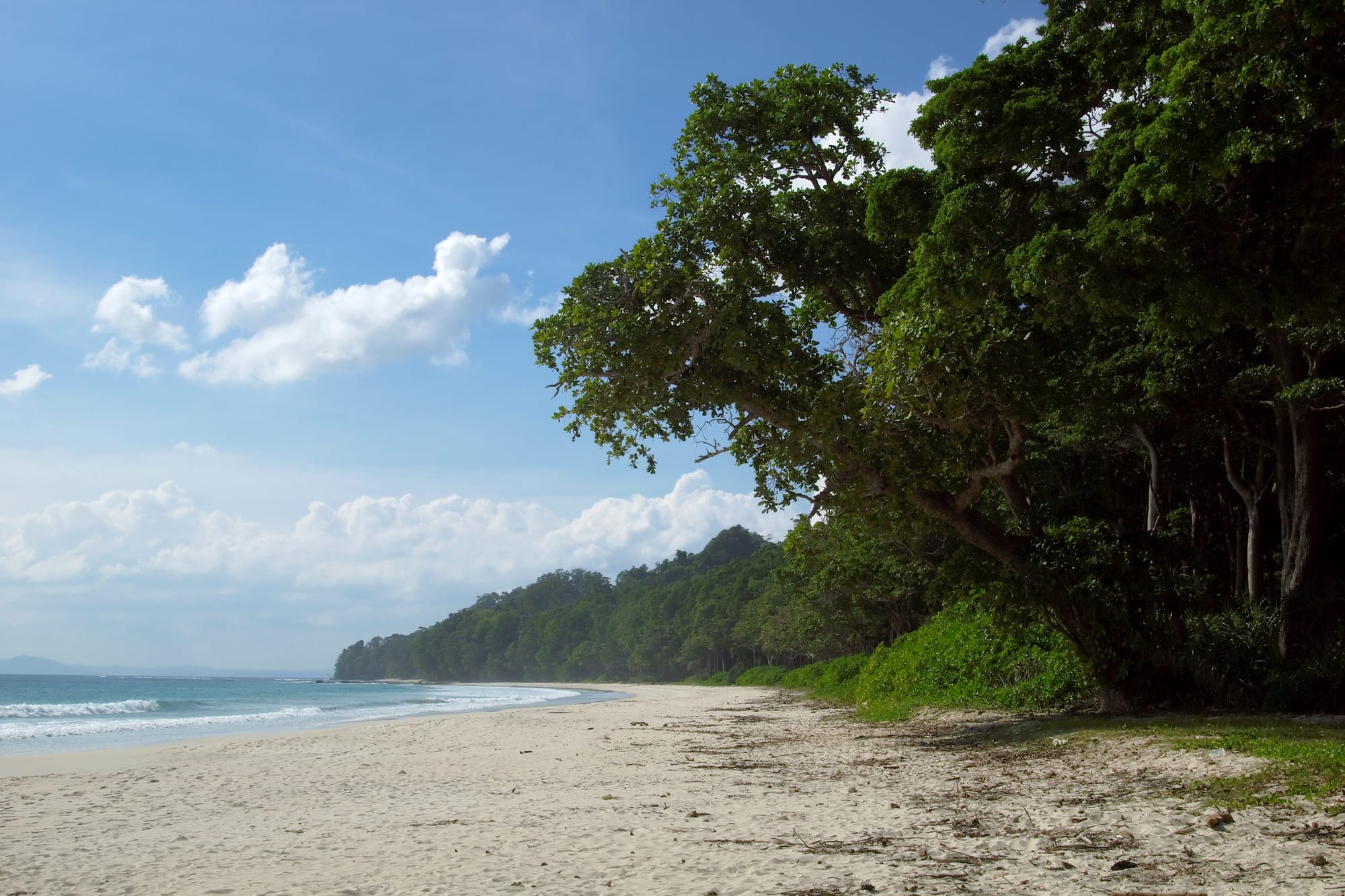
An empty white-sand beach curving away under a big spreading tree, with surf on the left and dense green forest running down to the shore

The Andaman & Nicobar Islands, India

Havelock Island

Radhanagar Beach on the west coast of Havelock Island, backed by tropical forest. (Vyacheslav Argenberg / Wikimedia Commons · CC BY 4.0)

The largest island of Ritchie's Archipelago, east of South Andaman and about two hours by boat from Port Blair, officially renamed Swaraj Dweep in 2018. Settled by Bengali families after Partition, it is now the main beach and diving destination of the Andamans, with Radhanagar Beach on its west coast and reefs and forest covering most of the rest.

Neighbourhoods

  • Govind Nagar and the jetty
    • First-time visitors
    • Close to transport
    • Best for food

    The island's main village, where the ferries dock and the shops, dive centres, scooter hire and market are found. The beach here, known as Beach No. 3, is shallow and lined with guesthouses and beach cafés, and most services on the island are within a short walk.

    Open in Maps
  • Vijay Nagar
    • Beaches
    • Resort hotels
    • Sunrise

    A stretch of east-coast sand a few kilometres north of the jetty, called Beach No. 5, with the island's larger resorts set back among casuarina trees. The water is calm and shallow at low tide, and the sun rises over the sea here.

    Open in Maps
  • Radhanagar
    • Beaches
    • Quiet
    • Sunset

    The west-coast settlement about twelve kilometres from the jetty, named after the beach that made the island known. There are fewer places to stay, a scatter of small restaurants, and forest and farmland along the road in.

    Open in Maps
  • Kalapathar and the south-east
    • Quiet and residential
    • Coastal drives

    The road south-east from the village runs past paddy fields and coconut groves to a dark-rock shoreline and a long quiet beach, with a few small hotels and homestays and very little else.

    Open in Maps

Things to do

Beaches

  • Radhanagar Beachbeach

    A long curve of white sand and clear water backed by tall forest on the west coast, also known as Beach No. 7; Time named it the best beach in Asia in 2004 and it holds Blue Flag certification. It is busiest at sunset.

    Open in Maps
  • Kalapathar Beachbeach

    A quiet east-coast beach named after the dark rocks along its shore, reached by a coastal road through villages south-east of the jetty.

    Open in Maps
  • Vijaynagar Beachbeach

    Beach No. 5 on the east coast, a long shallow shore shaded by casuarina and mahua trees, used for swimming and morning walks.

    Open in Maps
  • Elephant Beachbeach

    A small beach on the north-west coast reached by boat or a forest walk, the island's most popular snorkelling spot for shallow coral and fish.

    Open in Maps
  • Neil's Covebeach

    A small enclosed bay at the northern end of the Radhanagar shore, reached by a short path through the trees, with calm water inside the rocks.

    Open in Maps

The water and the village

  • Ritchie's Archipelago dive sitesattraction

    The reefs, pinnacles and walls around Havelock and its neighbours are the main diving grounds of the Andamans, with dive schools based in the village running courses and boat trips.

    Open in Maps
  • Havelock jettytransit hub

    The arrival point for every visitor, where government ferries and private catamarans from Port Blair and Neil tie up and the island's taxis, autorickshaws and buses wait.

    Open in Maps

Short trips from the island

  • Neil Islandattraction

    A smaller, flatter island to the south-west, officially Shaheed Dweep, about an hour away by ferry, with quiet beaches and a natural rock bridge.

    Open in Maps
  • Port Blairattraction

    The territory's capital, two hours or so by boat, with the Cellular Jail, museums and the airport that connects the islands to the mainland.

    Open in Maps

Eat and drink

Long-standing places and food districts in Havelock Island. Hours, ratings and directions come from your maps app, always current.

Island classics

  • Beach shacks and seafood grillsrestaurant

    Open-sided kitchens along the Govind Nagar shore and at the resorts grill the day's fish, prawns and squid with masala or lemon and garlic, usually served with rice.

    Open in Maps
  • Bengali fish curry kitchensrestaurant

    The settler villages cook fish in mustard oil with mustard seed and turmeric, alongside dal, rice and vegetable dishes; several family-run places in the village serve the same food to visitors.

    Open in Maps

Markets and cafés

  • Govind Nagar village marketmarket

    A small market of vegetable stalls, bakeries and general stores near the jetty, supplied by boat from Port Blair and by the island's own farms.

    Open in Maps
  • Coconut and juice stallsmarket

    Green coconuts, banana, papaya and fresh lime soda are sold at roadside stalls between the jetty and the beaches.

    Open in Maps

Experience Havelock Island

History

The island is named after Sir Henry Havelock, a British general of the mid-nineteenth century, a name given during the colonial administration of the Andamans, though the island had no permanent settlement then. The wider archipelago was inhabited for thousands of years by Andamanese peoples, and Ritchie's Archipelago was mapped by British surveyors as part of the work that followed the founding of the penal settlement at Port Blair in 1858.

Havelock's modern population arrived after independence. From the late 1940s and through the 1950s the government resettled Bengali refugees displaced by the partition of Bengal on the Andaman islands, clearing forest for paddy fields and coconut groves and laying out villages that were given the names still used today — Govind Nagar, Vijay Nagar, Radhanagar, Shyam Nagar, Krishna Nagar. The settlers fished, farmed rice and kept cattle, and for decades the island was connected to the outside world only by a slow government boat.

Tourism began in a small way in the 1990s, with simple huts on the beaches, and accelerated after international magazines singled out Radhanagar Beach in the early 2000s. The 2004 Indian Ocean earthquake and tsunami altered parts of the Andaman coastline and disrupted the islands badly, though Havelock suffered less than the Nicobars. Since then resorts, dive schools and fast catamaran services have grown quickly, and the island has become the centre of Andaman tourism. In 2018 it was officially renamed Swaraj Dweep, one of several islands given new names that year, although both names remain in everyday use.

Culture & Customs

Havelock is a settler society, and its culture came in the boats with the families who cleared the forest. Bengali is the language of most households, and Bengali customs shape the year: Durga Puja and Kali Puja are the main festivals, Saraswati Puja is kept in the schools, and fish and rice are the basis of every meal. Tamil and Telugu families, government employees posted from the mainland and a growing number of workers who come for the tourist season add other languages to the mix, with Hindi used between them.

Two economies now sit side by side. The older one is agricultural — paddy, coconut, areca nut, bananas and fishing — and still visible in the fields and cattle along the road between the villages. The newer one is tourism, and many younger islanders work as dive instructors, boat crew, cooks, drivers and guesthouse staff, often returning to family land in the monsoon when visitors disappear and much of the island closes.

Manners are those of a village rather than a beach resort. Modest dress away from the sand is expected, shoes come off at temples and in homes, and people are generally reserved and helpful. Conservation rules are taken seriously by the dive community: reef damage, shell collecting and plastic waste are live local issues, and turtle nesting beaches are protected. The rules that forbid contact with the islands' indigenous peoples apply here as everywhere in the territory.

Daily Life

Something over six thousand people live on Havelock, spread among a handful of villages across an island of roughly a hundred square kilometres, most of it forest. Govind Nagar, by the jetty, is the centre of everything: the market, the school, the health centre, the dive shops and the offices. The other settlements are strings of houses along the two roads, with paddy fields, coconut groves and grazing cattle between them.

The rhythm of the day is set by the boats. Ferries from Port Blair arrive in the morning and early afternoon, and the jetty fills with arriving visitors, departing ones, freight and the autorickshaw drivers who meet them; the supply that comes in determines what the shops sell that week. Diving and snorkelling trips leave early, scooters move along the Radhanagar road through the middle of the day, and the island's social life gathers on the beach at sunset. Electricity, water and mobile coverage are less reliable than on the mainland, and many places run generators.

The season governs the year. From November to April the island is busy and everyone works; in the monsoon rooms empty, some businesses shut entirely, and families turn back to fields and fishing. Fresh water in the dry months, waste disposal, coral bleaching and the pressure of rising visitor numbers on a small island are the recurring concerns, along with the reliability of the ferries that every livelihood depends on.

Food

Eating on Havelock means fish. It is landed at the jetty and in the village, bought the same morning, and cooked either in the Bengali way of the settlers — in mustard oil with mustard seed, green chilli and turmeric, served with plain rice — or grilled at the beach kitchens with masala, lemon and garlic for visitors. Snapper, grouper, barracuda, tuna, squid, prawns and, at some places, crab and lobster all appear, depending on what the boats have brought in.

Rice is the staple, grown on the island itself, and a village meal is rice with dal, a vegetable curry, a fried item and fish. South Indian breakfasts of idli, dosa and vada are easy to find, as are the north Indian vegetarian thalis and parathas that suit the many Indian holidaymakers, and the larger resorts cook pasta, pizza and pancakes for international guests. Bengali sweets such as rasgulla turn up in the village shops.

Coconut is the island flavour and the island drink: green coconuts opened at roadside stalls, grated coconut in curries and chutneys, and coconut oil in the cooking. Bananas, papaya, pineapple and jackfruit come from island farms, and areca nut grows along the roads. Tea is drunk strong and sweet with milk throughout the day; fresh lime soda is the standard cold drink, and alcohol is available at licensed bars and resorts rather than everywhere. Supplies of anything imported depend on the boats, so menus shorten in bad weather and in the monsoon.

Planning tools

Budget

Havelock is the most expensive place to stay in the Andamans. Beach huts and homestays in the village are reasonable, but the resorts on the east coast charge mainland-city prices, and everything from bottled water to vegetables has been shipped twice over. Diving, boat trips and private catamaran tickets are the other large items. Prices peak between Christmas and mid-January and fall sharply in the monsoon.

Daily Budget Midrange
USD 75–160 (resort or boutique hotel, restaurant meals, private catamaran, a snorkelling or diving trip)
Daily Budget Shoestring
USD 25–45 (beach hut or homestay, village meals, government ferry, scooter hire)

Rooms and ferry seats in the December to February peak are booked weeks ahead; ATMs on the island are few and can be empty, so bring cash from Port Blair.

Best Time to Visit

November to April, with December to March the best window for calm seas, clear water and reliable boats. The monsoon from about May to September brings heavy rain, rough crossings and cancelled ferries, but also empty beaches and low prices. Late December and New Year are the busiest and dearest weeks.

Suggested Number of Days

Two or three days suit most visitors to the island, and longer if diving or a course is planned. Five to seven days covers a wider island trip and leaves room for a weather delay, since ferry cancellations are common.

First Visit
2–3 days
With Surroundings
5–7 days

Transportation

The island has one main road running from the jetty north-west to Radhanagar and south-east towards Kalapathar. Autorickshaws and a small number of taxis wait at the jetty, a local bus runs a few times a day, and hired scooters and bicycles are the usual way to get about. Resorts arrange transfers, and boats from the jetty and from Elephant Beach handle snorkelling and diving trips.

Fuel stations are few and can run short, so fill a hired scooter early in the day; roads are narrow, unlit at night and shared with pedestrians.

Airport & Station Connections

Havelock is reached mainly by sea, about 40 kilometres north-east of Port Blair. Private catamarans cross in roughly ninety minutes to two hours and government ferries take longer; both leave from Port Blair's Phoenix Bay and jetty area, and some sailings continue to or from Neil Island. There is no airport on the island, though a helipad handles subsidised helicopter flights and medical evacuations, and Port Blair's airport is the gateway to the archipelago.

Walkability

The village around the jetty is easy on foot, with shops, dive centres and cafés along one main road, and the beach there runs for a couple of kilometres. Beyond that the island is too spread out to walk: Radhanagar is about twelve kilometres away and Kalapathar around ten, along roads with no pavements and little shade. Most visitors hire a scooter or take an autorickshaw.

Safety

The island is calm and crime is rare. The risks are in the water and on the roads: currents and sudden drop-offs at some beaches, saltwater crocodiles, which have been recorded in Andaman waters and creeks, coral cuts, jellyfish, and scooter accidents on narrow unlit roads. Medical facilities are basic, and anything serious means a boat or flight to Port Blair and possibly on to the mainland. Seas are rough and boats unpredictable in the monsoon.

Swim at recognised beaches within any marked area and follow lifeguard flags at Radhanagar, dive and snorkel with certified operators, and leave a spare day before an onward flight in case a ferry is cancelled. Check current official travel advice before travelling.

Climate

Tropical and humid throughout the year, with a sea temperature that barely changes and air temperatures that stay between the low twenties and the low thirties. Rain is heaviest from May to September with the south-west monsoon, and a second wetter spell comes with the north-east monsoon late in the year.

Summer
hot and humid, about 25–32°C, with heavy rain from May and rough seas
Winter
warm and mostly dry, about 23–30°C, with calm seas and the clearest water from December to March

Local Customs

Most residents are Bengali-speaking families descended from settlers, with Tamil and Telugu households as well, and Hindi serves as the common language. The island is a working village community rather than a resort strip: swimwear is for the beach, and covering up is expected in the village, at the market and at temples. Alcohol is served in some resorts and licensed places but is not a feature of village life.

Take nothing from the reef, including shells and coral, and follow the single-use plastic restrictions that apply across the islands; ask before photographing residents at work.

Common Payment Methods

The currency is the Indian rupee. Resorts and dive schools accept cards and phone payments when the connection allows, but small restaurants, scooter hire, autorickshaws and market stalls run on cash. The island has very few ATMs and they are not always working or stocked, so bringing rupees from Port Blair is the safest approach.