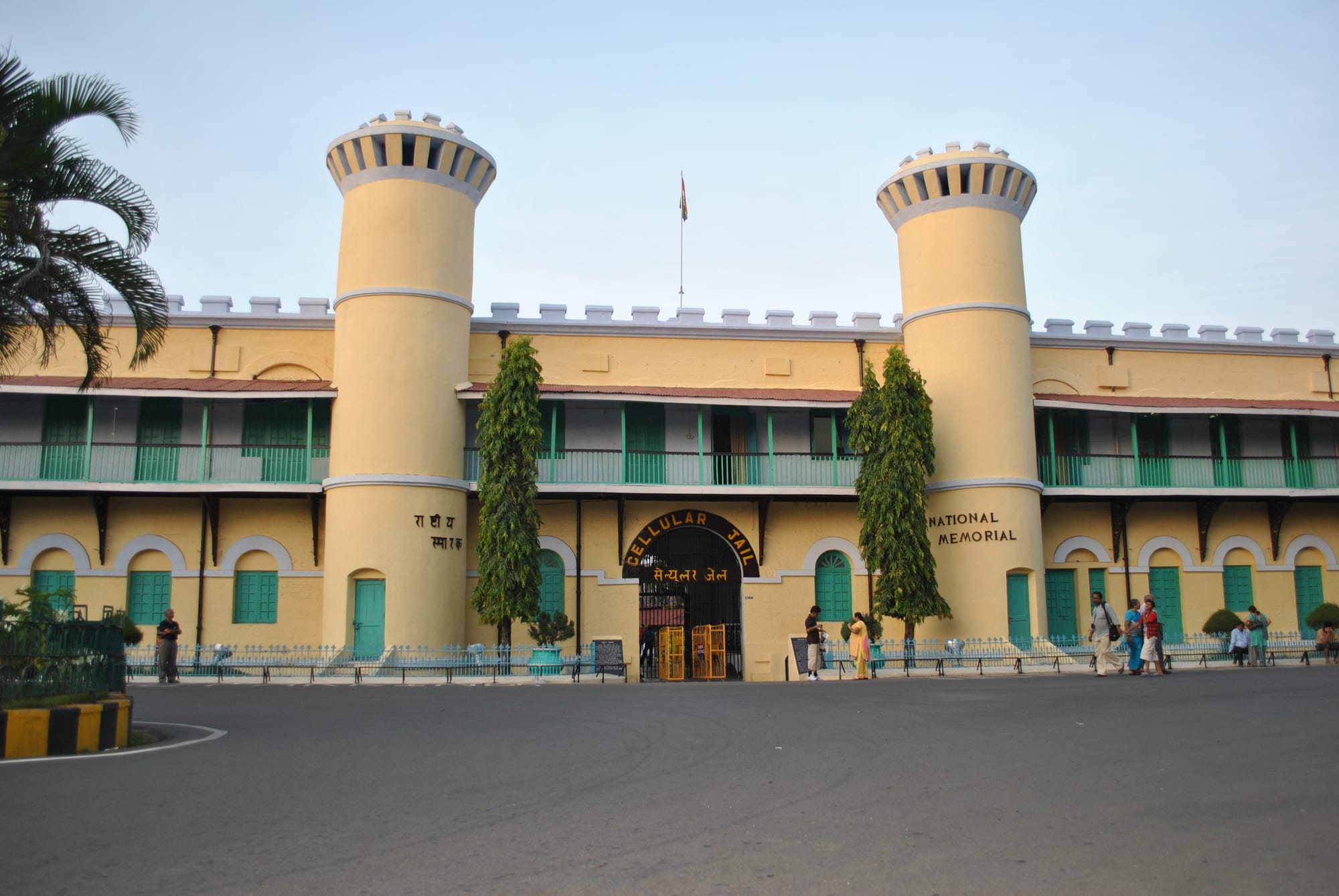
The long cream and green façade of the Cellular Jail with two round turrets and a central gateway, seen across an empty forecourt

The Andaman & Nicobar Islands, India

Port Blair

The main gate of the Cellular Jail, now a national memorial, in Port Blair. (Jomesh / Wikimedia Commons · CC BY 3.0)

The capital of the Andaman and Nicobar Islands, a hilly harbour town on South Andaman that grew from the British penal settlement founded in 1858. The Cellular Jail, a national memorial, stands above a working port of jetties, markets and government offices, and almost every visitor to the islands passes through on the way to the beaches and reefs further out.

Neighbourhoods

  • Aberdeen Bazaar
    • First-time visitors
    • Markets
    • Central

    The commercial centre of the town, a knot of streets around the clock tower where shops, banks, travel agents, small hotels and eating houses are concentrated. The Cellular Jail and the Marina Park seafront are both a short walk away.

    Open in Maps
  • Haddo and Phoenix Bay
    • Ferries
    • Harbour views
    • Close to transport

    The port quarter on the western side of the harbour, with the passenger jetties for Havelock and Neil, the fishing wharf, government offices and the water sports complex. Several mid-range hotels stand on the slopes above the water.

    Open in Maps
  • Corbyn's Cove and the southern shore
    • Beaches
    • Quiet and residential
    • Resort hotels

    A coastal road a few kilometres south-east of the centre leads past coconut palms to the town's nearest beach and a cluster of resorts and guesthouses. It is quieter than the bazaar and good for sunrise walks along the shore.

    Open in Maps
  • Chatham and Delanipur
    • Local life
    • Industry and history

    North of the centre, Chatham Island is joined to the mainland by a bridge and holds the old sawmill and the forest museum, while the neighbouring residential areas of Delanipur and Dairy Farm are everyday Port Blair of schools, temples and shops.

    Open in Maps

Things to do

History and landmarks

  • Cellular Jaillandmark

    The colonial prison completed in 1906, built as seven wings of solitary cells around a central tower; three wings, the gallows and a museum survive, with an evening light-and-sound show.

    Open in Maps
  • Ross Islandattraction

    The administrative headquarters of the penal settlement, a short boat ride across the harbour, where a church, ballroom and officers' bungalows are being pulled apart by fig roots.

    Open in Maps
  • Chatham Saw Millattraction

    A timber mill set up in 1883 under British rule on an island at the north of the harbour, with a forest museum alongside it.

    Open in Maps
  • Marina Parkpark

    A seafront park and promenade facing the harbour beside the water sports complex, with a memorial and views across to Ross Island.

    Open in Maps

Museums

  • Samudrika Naval Marine Museummuseum

    A navy-run museum on the islands' geography, marine life and corals, with shells, skeletons and a small aquarium.

    Open in Maps

Beaches and viewpoints

  • Corbyn's Cove Beachbeach

    The town beach, a curve of sand backed by coconut palms about seven kilometres from the centre, with a beach road used for evening walks.

    Open in Maps
  • Chidiya Tapuviewpoint

    The southern tip of South Andaman, about 25 kilometres away, known for birdlife, a biological park and a sunset point looking over forested islets.

    Open in Maps
  • North Bay Islandbeach

    A reef island across the harbour reached by boat, used for snorkelling, glass-bottom boat trips and views of its lighthouse.

    Open in Maps

Markets

  • Aberdeen Bazaarmarket

    The town's main bazaar, a compact grid of shops selling clothes, hardware, shells, spices and everyday goods, with a fish and vegetable market nearby.

    Open in Maps

Short trips from the town

  • Mahatma Gandhi Marine National Parkpark

    Reefs and forested islets off Wandoor, about 30 kilometres south-west, visited by boat from the jetty there for snorkelling in clear water.

    Open in Maps
  • Mount Harriet National Parkpark

    Rainforest on Mount Harriet, at 383 metres the highest hill in South Andaman and officially renamed Mount Manipur, across the harbour by ferry and road, with a nature trail and a view over the islands.

    Open in Maps
  • Viper Islandattraction

    A small island in the harbour holding the ruins of an earlier jail and gallows used before the Cellular Jail was built.

    Open in Maps
  • Baratang Islandattraction

    Reached by a long road journey north through the Jarawa reserve and then by boat, with limestone caves entered through mangrove creeks and a small mud volcano.

    Open in Maps

Seasonal events

  • Durga PujaSeptember or October

    The main festival of the islands' large Bengali community, with pandals, images of the goddess and processions through the town.

  • Pongal and Tamil new yearJanuary and April

    Kept by the many families with roots in Tamil Nadu, with rice boiled in new pots, sugarcane and decorated doorways.

  • Netaji's birth anniversaryJanuary

    Marked in Port Blair because Subhas Chandra Bose raised the flag of his Provisional Government here in 1943; the day brings ceremonies and school events.

Eat and drink

Long-standing places and food districts in Port Blair. Hours, ratings and directions come from your maps app, always current.

Island classics

  • Seafood grills and fish curry housesrestaurant

    Small restaurants across the town cook the day's catch — snapper, grouper, tuna, prawns, crab and lobster — grilled with masala or in Bengali mustard and south Indian coconut curries, served with rice.

    Open in Maps
  • Coconut and fruit stallsmarket

    Green coconuts are opened at roadside stalls all over the town, alongside banana, papaya and pineapple grown on island farms.

    Open in Maps

Food districts and markets

  • Aberdeen Bazaarneighborhood

    The densest concentration of eating places in the islands: vegetarian thali kitchens, Bengali and south Indian canteens, bakeries and tea shops within a few streets.

    Open in Maps
  • Junglighat fish marketmarket

    The fishing harbour and market on the western shore, where boats land the catch that supplies the town's restaurants.

    Open in Maps
  • Marina Park seafront stallsneighborhood

    Evening snack stalls along the harbour promenade sell chaat, fried fish, corn and tea to families out for the cool of the day.

    Open in Maps

Experience Port Blair

History

The harbour takes its name from Archibald Blair, a lieutenant of the East India Company who surveyed it in 1789 and established a short-lived settlement that disease forced the British to abandon within a few years. The islands' older history belongs to the Great Andamanese, whose communities lived along these coasts for thousands of years, and to the ships that avoided the archipelago's reputation for shipwreck and hostile shores.

After the rebellion of 1857 the British returned in 1858 and founded a penal settlement for political prisoners and convicts, choosing the sheltered harbour and putting the headquarters on Ross Island, a tiny islet that was built up with a church, a bakery, tennis courts and officers' bungalows. Convict labour cleared forest, drained ground and built the town, and contact with the settlement brought disease that reduced the Great Andamanese from thousands to a few dozen. The Cellular Jail, finished in 1906, held prisoners in single cells so that they could not communicate, and the name Kala Pani — the black water — came to stand for transportation and exile.

Japan occupied the islands from 1942 to 1945, and in December 1943 Subhas Chandra Bose raised the flag of his Provisional Government of Free India in Port Blair. After independence the town became the capital of a union territory, and the government settled refugees from East Bengal along with migrants from Tamil Nadu, Kerala and elsewhere, so that its population is largely descended from settlers and from the "local-born" families of the penal colony. An earthquake and tsunami struck in December 2004, damaging the coast and jetties. Tourism has grown steadily since, and in 2024 the town was officially renamed Sri Vijaya Puram, though Port Blair remains in common use.

Culture & Customs

Port Blair is a settler town, and its culture is an assembly of mainland traditions kept up several sea days from their origins. Bengali is heard as often as Tamil or Telugu, Hindi serves as the common language, and temples, mosques, gurdwaras and churches stand within a few streets of each other. Families descended from the convicts of the penal colony, known locally as local-born, form a distinct community with their own sense of the town's history.

That history gives the place a particular weight in Indian national memory. The Cellular Jail is a national memorial rather than only a museum, and many Indian visitors come primarily to see it and to hear the evening light-and-sound account of the prisoners held there; school groups and officials make the same visit. Streets, the airport and public buildings carry the names of independence figures.

The indigenous peoples of the islands live apart under legal protection and are not part of the town's social life: the Jarawa reserve lies to the north, the Onge on Little Andaman, and the Sentinelese reject all contact. Photographing, approaching or attempting to meet them is a criminal offence, and residents take the rules seriously. Everyday life is quiet and early. Festivals follow the settlers' calendars, from Durga Puja and Diwali to Pongal, Eid and Christmas, and dress in town is modest, with swimwear kept to the beaches.

Daily Life

About 140,000 people live in Port Blair, which makes it by far the largest settlement in the territory and home to roughly a third of its people. It is the administrative centre as well, and government service — the territorial administration, the forest and fisheries departments, the navy, the air force and the coast guard, whose presence reflects the islands' position near the Strait of Malacca — provides the largest share of secure employment. Tourism is the growth sector, supporting hotels, dive shops, boat crews, drivers and guides, and fishing and small farming fill out the rest.

Because almost everything is shipped from Chennai or Kolkata, supply is a constant theme of daily life. Prices are higher than on the mainland, shortages follow bad weather, and fuel, cement and vegetables all arrive by sea. Connectivity improved markedly after an undersea cable reached the islands in 2020.

The day starts very early, since the sun rises well before six and often before five in summer, and offices, schools and markets follow it; shops shut early in the evening and the town is quiet by mid-evening. Housing spreads up steep hillsides around the harbour, and new building has pushed into the surrounding forest. The issues residents raise are water supply in the dry months, waste and plastic, pressure on reefs from visitor numbers, and the effect of large infrastructure projects proposed for the islands.

Food

Fish is the foundation of eating in Port Blair, sold fresh at the Junglighat market in the morning and cooked in whatever style the kitchen's family brought with them. Bengali households make fish curries with mustard oil and mustard seed, Tamil and Malayali cooks use coconut, tamarind and curry leaves, and restaurants grill snapper, grouper and tuna with a coating of masala. Prawns, crab and lobster appear on menus aimed at visitors, usually with plain rice or with the flat breads of the north.

Coconut runs through everything. It is drunk green from the shell at roadside stalls, grated into curries and chutneys, and pressed for oil, and island farms add banana, papaya, pineapple, jackfruit and areca nut. Rice is the staple, and the standard cheap meal is a thali: rice, dal, a vegetable, a fried item and a piece of fish or a curd, eaten at midday.

Because the population comes from across India, the bazaar offers south Indian breakfasts of idli, dosa and vada beside Bengali sweets such as rasgulla and sandesh, north Indian vegetarian thalis, and tea shops selling fried snacks through the afternoon. Fresh lime soda, coconut water and sweet milky tea are the everyday drinks; alcohol is sold in licensed shops, bars and hotels but is less prominent than in mainland beach destinations. In the Nicobar Islands, which are closed to visitors, the older island diet of coconut, pandanus, fish and pork persists.

Planning tools

Budget

Port Blair is the cheapest base in the islands, with a good supply of guesthouses and local restaurants, but prices are still above mainland India because almost everything arrives by ship. Boat trips, dive courses and private catamaran tickets are the real expenses; government ferries, buses and bazaar meals cost very little. Rooms are dearest between Christmas and mid-January.

Daily Budget Midrange
USD 75–160 (hotel or small resort, restaurant meals, a private ferry ticket and a boat or snorkelling trip)
Daily Budget Shoestring
USD 25–45 (guesthouse, thali and fish-curry meals, buses and government ferries)

Carry enough cash for onward islands, where ATMs are few, and book private ferry seats and peak-season rooms well ahead.

Best Time to Visit

November to April, and December to March above all, when seas are calm, the water is clear and rain is light. The south-west monsoon from about May to September brings heavy showers, rough crossings and cancelled boats, though the forest is at its greenest and rooms are cheap. Late December and New Year are the busiest weeks of the year.

Suggested Number of Days

The town itself needs a day or two, and most visitors treat it as an arrival and departure point. Allowing five to seven days for the islands as a whole gives room for ferry schedules, weather delays and time on the outer islands.

First Visit
1–2 days
With Surroundings
5–7 days

Transportation

The town is small and served by cheap local buses from the Aberdeen terminal, along with autorickshaws and a limited number of taxis; hired scooters and motorcycles are popular with visitors, and cars with drivers are easy to arrange for the day. Ferries and catamarans to Havelock and Neil leave from the Phoenix Bay jetty, harbour boats to Ross Island and North Bay from the water sports complex jetty, and long island buses run north along the Andaman Trunk Road.

Ferry seats sell out in season and sailings can be cancelled in rough weather, so leave a spare day in Port Blair before an onward flight.

Airport & Station Connections

Veer Savarkar International Airport, about three kilometres from the centre, is the way almost everyone arrives, with flights from Chennai, Kolkata, Delhi, Bengaluru and Hyderabad taking roughly two to five hours. Passenger ships sail from Chennai, Kolkata and Visakhapatnam, a voyage of about three days. Indian visitors need no permit for the main Andaman islands, while foreign nationals are subject to entry rules and restricted-area conditions that should be checked before booking.

Walkability

The centre is compact enough to cross on foot in twenty minutes, and the Cellular Jail, the bazaar, the jetties and Marina Park are all close together. The town is built on steep hills, however, so short distances involve climbs, pavements are narrow and often absent, and the heat and humidity slow walking down from mid-morning. Corbyn's Cove and Chatham are better reached by road.

Safety

Port Blair is a quiet town with little crime, and the serious risks are natural rather than criminal: strong currents off exposed beaches, saltwater crocodiles in creeks and mangrove waters, rough seas and cancelled boats in the monsoon, and the earthquake and tsunami exposure that the 2004 disaster demonstrated. Health facilities are limited, and serious cases are flown to the mainland.

Swim only at recognised beaches and heed crocodile warnings, dive with certified operators, and observe the strict rules that forbid approaching, photographing or making contact with indigenous communities, including on the road through the Jarawa reserve. Check current official travel advice before travelling.

Climate

Tropical and humid all year, with temperatures that stay in a narrow band and a sea that is warm in every season. Rain falls in most months but is concentrated between May and December, when the south-west and then the north-east monsoon cross the islands and cyclones can form in the Bay of Bengal.

Summer
hot and humid, about 25–32°C, very wet from May onwards with rough seas and frequent boat cancellations
Winter
warm and mostly dry, about 23–30°C, with calm seas and the clearest water from December to March

Local Customs

Hindi is the common language, with Bengali, Tamil, Telugu and Malayalam widely spoken and English understood in hotels and offices. The town is conservative by island-resort standards: beachwear belongs on the beach, and shoes come off at temples and in homes. Indigenous communities live under legal protection, and approaching or photographing them is a criminal offence, as is visiting North Sentinel Island.

Tipping is not expected, though small amounts are appreciated; single-use plastics are restricted on the islands, so a refillable bottle is useful.

Common Payment Methods

The currency is the Indian rupee. Hotels, dive shops and larger restaurants in Port Blair take cards, and phone payments are common, but network and connection problems are frequent. ATMs are concentrated in Aberdeen Bazaar and around the main offices, and are scarce or unreliable on the outer islands, so cash drawn in the capital is worth carrying.