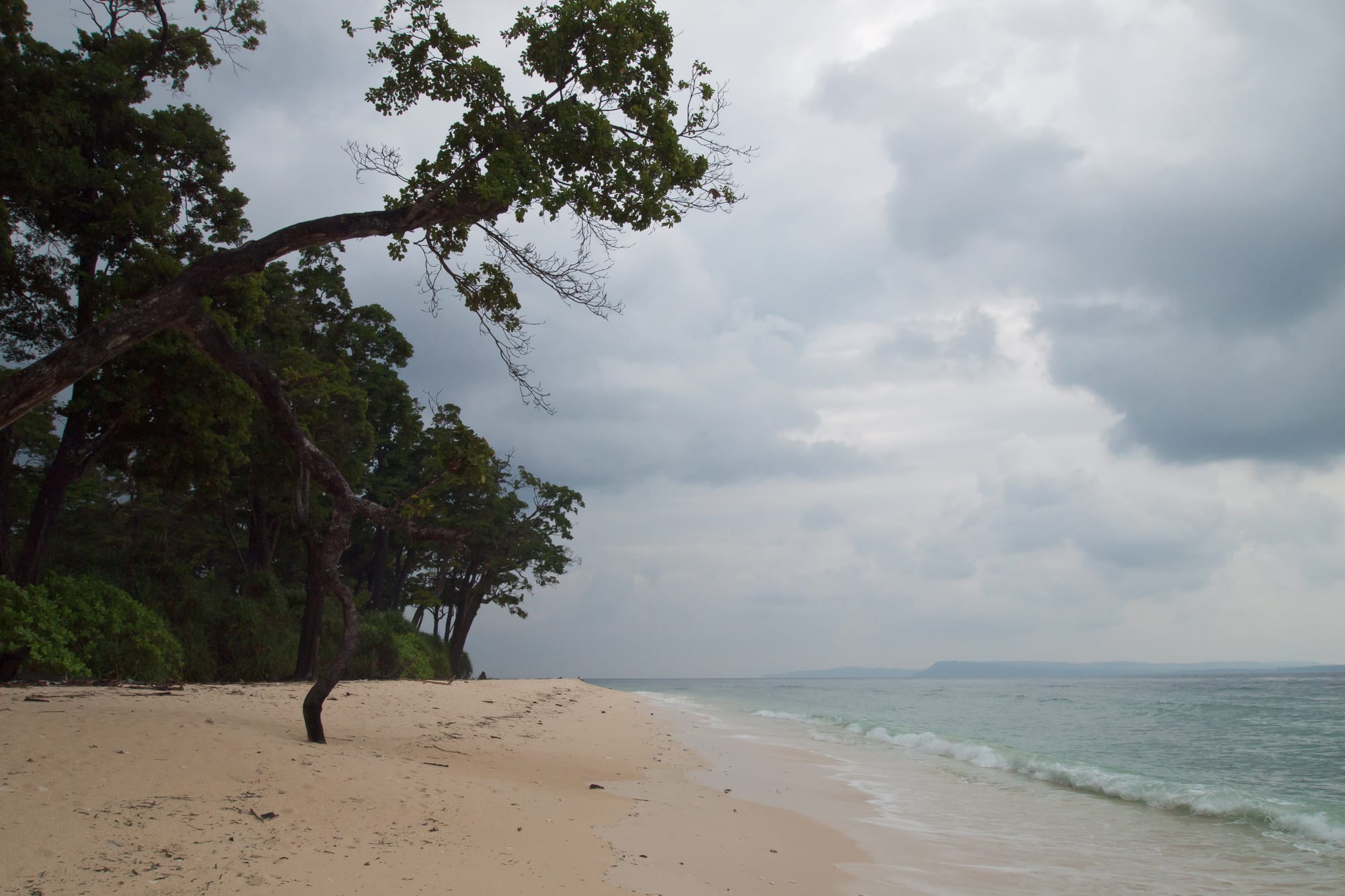
A leaning tree over an empty pale sand beach on Neil Island, with surf breaking at the water's edge under a cloudy sky

The Andaman & Nicobar Islands, India

Neil Island

Laxmanpur Beach on the west coast of Neil Island, known locally as Shaheed Dweep. (Vyacheslav Argenberg / Wikimedia Commons · CC BY 4.0)

A small, flat island in Ritchie's Archipelago, officially renamed Shaheed Dweep in 2018, about an hour and a half by boat from Port Blair. Settled from the late 1960s by Bengali farming families from East Pakistan, it grows much of the vegetables eaten in the Andamans and is known for quiet beaches, shallow reefs and a natural rock arch exposed at low tide.

Neighbourhoods

  • Neil Kendra and the jetty
    • First-time visitors
    • Close to transport
    • Markets

    The island's small centre beside the harbour, where the ferries dock and the shops, market, a few offices and most of the guesthouses and scooter hire are found. Bharatpur Beach begins a few steps away, and the roads to the other villages start here.

    Open in Maps
  • Laxmanpur
    • Beaches
    • Sunset
    • Quiet

    A farming village on the west side, about two kilometres from the jetty, fronted by a long shallow beach that looks out to the sunset. Small hotels, homestays and beach cafés are scattered along the lane down to the sand.

    Open in Maps
  • Sitapur
    • Quiet and residential
    • Sunrise
    • Beaches

    The eastern end of the island, some five kilometres from the jetty across fields of paddy and vegetables. Its beach faces the open sea and catches the sunrise, and there are only a handful of places to stay.

    Open in Maps
  • Bharatpur and Ramnagar
    • Snorkelling
    • Boat trips
    • Families

    The northern shore, where the water is shallow and calm over coral and glass-bottom boats and snorkelling trips set out. Behind it the land is farmed, and Ramnagar sits on a quieter stretch of coast to the north-west.

    Open in Maps

Things to do

Beaches and the shore

  • Bharatpur Beachbeach

    The beach beside the jetty, with calm shallow water over coral, used for snorkelling, glass-bottom boat rides and swimming.

    Open in Maps
  • Laxmanpur Beachbeach

    A wide, pale stretch of sand on the west coast backed by trees, shallow far out at low tide and the island's gathering point at sunset.

    Open in Maps
  • Sitapur Beachbeach

    An east-facing beach at the far end of the island, below low cliffs and coconut groves, quieter than the others and known for sunrise.

    Open in Maps
  • Ramnagar Beachbeach

    A rocky, tree-lined shore on the north-west coast, little visited and good for walking at low tide.

    Open in Maps
  • Natural rock bridgelandmark

    A natural limestone archway on the shore beyond Laxmanpur, reachable on foot across tidal flats and rock pools only when the tide is out.

    Open in Maps

On the water

  • Neil Kendra jettytransit hub

    The harbour where government ferries and private catamarans from Port Blair and Havelock tie up, and where fishing boats and dive boats are based.

    Open in Maps
  • Neil Island reefsattraction

    Shallow coral around the north and west of the island, with dive schools in the village running snorkelling trips and boat dives on the reefs of the archipelago.

    Open in Maps

Short trips from the island

  • Havelock Islandattraction

    The larger neighbour to the north-east, officially Swaraj Dweep, about an hour away by ferry, with Radhanagar Beach and the main diving centres of the Andamans.

    Open in Maps
  • Port Blairattraction

    The territory's capital and airport, reached in about an hour and a half by fast boat, with the Cellular Jail and the islands' museums.

    Open in Maps

Eat and drink

Long-standing places and food districts in Neil Island. Hours, ratings and directions come from your maps app, always current.

Island classics

  • Fish and seafood kitchensrestaurant

    Small restaurants near the jetty and along the Laxmanpur road grill or curry the day's catch — fish, squid and prawns — usually with rice and a vegetable dish.

    Open in Maps
  • Bengali village cookingrestaurant

    The settler families cook fish in mustard oil with turmeric and green chilli, alongside dal, rice and the vegetables grown on the island's own farms.

    Open in Maps

Markets and cafés

  • Neil Kendra marketmarket

    A short row of vegetable, fruit and general stores near the harbour, supplied largely from the island's farms and by boat from Port Blair.

    Open in Maps
  • Beach cafés at Laxmanpurcafe

    Simple open-air places behind the west-coast sand serving tea, coconut water, fruit, pancakes and thali plates to visitors waiting for the sunset.

    Open in Maps

Experience Neil Island

History

Neil Island is named after James Neill, a British brigadier general of the 1857 rebellion, a name given when the Andamans were administered from Port Blair, and it had no permanent settlement when the penal colony was founded in 1858. Ritchie's Archipelago, the chain of islands east of South Andaman to which Neil belongs, was charted by British surveyors in the nineteenth century, and the islands were left largely to forest.

The island was uninhabited until settlers arrived in the late 1960s, most of them Bengali refugees from East Pakistan. They cleared forest for paddy and vegetables and founded villages that they named after figures from the Ramayana — Bharatpur, Laxmanpur, Sitapur and Ramnagar. The flat, fertile ground suited farming better than most of the archipelago, and the island became known as a supplier of vegetables to Port Blair.

The 2004 Indian Ocean earthquake and tsunami struck the Andamans hard; the Nicobars suffered worst, but the disaster reshaped stretches of coast and disrupted shipping across the territory. Tourism arrived slowly, well after Havelock, and for years Neil was visited mainly by travellers looking for somewhere quieter. Ferry services improved, guesthouses and a few resorts opened, and visitor numbers rose through the 2010s. In 2018 the island was officially renamed Shaheed Dweep, in tribute to Subhas Chandra Bose, though both names remain in use. Farming still shares the island with tourism.

Culture & Customs

The culture of Neil is Bengali village culture transplanted to the Bay of Bengal. Bengali is spoken in most homes, with Hindi used in shops and offices and Tamil and Telugu heard in some families, and English in the tourist trade. Durga Puja and Kali Puja are the festivals that matter most, marked with pandals and community meals, and Saraswati Puja is kept in the schools; Diwali, Holi and the Bengali new year are all observed, and small temples stand in each village.

Farming shapes daily manners and the calendar as much as the sea does. Households keep cattle and goats, grow paddy, bananas and vegetables, and fish from small boats, and the island's name as the vegetable garden of the Andamans is a source of local pride. Tourism, which arrived within living memory, is a second occupation rather than the whole economy, and many families let rooms or drive autorickshaws alongside the fields.

Visitors are expected to behave as they would in any Indian village: cover up away from the beach, remove shoes at temples and in homes, ask before photographing people, and keep noise down after dark, when much of the island is asleep. Conservation rules are taken seriously, including protections on coral, shells and turtle nesting beaches, and the territory-wide laws forbidding contact with indigenous communities apply here as elsewhere.

Daily Life

Around three thousand people live on Neil, spread between five villages on an island of about fourteen square kilometres — small enough to cross by bicycle in under an hour. Neil Kendra, beside the jetty, holds the market, the school, the health centre and the shops; the rest is farmland, coconut groves and patches of forest running down to the sea.

Life runs on farming, fishing and tourism in roughly that order of age. The flat ground produces vegetables, paddy, bananas and coconuts, much of it shipped to Port Blair; fishermen work the shallow waters around the island; and guesthouses, restaurants, scooter hire, snorkelling boats and dive schools employ a growing share of younger residents. Work is strongly seasonal, and many businesses close in the monsoon when boats are unreliable and visitors stay away.

The day starts before dawn, with fields worked in the cool hours and the market busy early. Ferries arriving in the morning and midday set the rhythm of the village, bringing supplies, post and guests, and the island quietens by early evening when people gather on the west-coast sand for the sunset. Electricity and water supply are less dependable than on the mainland, mobile coverage is patchy, and freshwater shortages in the dry months, waste disposal and reef damage are the issues residents raise most often, along with the effect of rising visitor numbers on a very small place.

Food

Neil eats what it grows and what it catches. Fish is the centre of the table — landed by small boats and cooked either in the Bengali manner, in mustard oil with mustard seed, turmeric and green chilli, or grilled with masala and lime at the places that cater to visitors. Squid, prawns and, on occasion, crab appear as well, always with rice, which is also grown on the island.

The vegetables that give the island its reputation fill out every meal: gourds, aubergine, okra, pumpkin, beans and leafy greens, cooked as simple curries and fries and served with dal. A village thali of rice, dal, a vegetable, a fried item and fish is the standard midday meal, and it is what most small restaurants serve. Coconut is everywhere, drunk green from the shell, grated into chutneys and pressed for the oil used in cooking, and bananas, papaya and jackfruit grow in the groves between the villages.

Breakfasts follow the mainland traditions the settlers brought: idli, dosa and vada in some kitchens, parathas and eggs in others, with strong sweet milky tea at any hour. Bengali sweets such as rasgulla turn up in the village shops, and the beach cafés add pancakes, fruit plates and fresh lime soda for visitors. Anything imported — packaged food, bottled drinks, alcohol, which is sold only in a few licensed places — depends on the boats from Port Blair, so choice narrows in bad weather and through the monsoon.

Planning tools

Budget

Neil is cheaper than Havelock and has a wider range of simple guesthouses and homestays, though a few resorts charge much more. Meals in the village cost very little, but almost everything except vegetables and fish is shipped in, so shop prices are above the mainland. Ferry tickets, snorkelling trips and scooter hire are the other regular costs.

Daily Budget Midrange
USD 75–160 (resort or boutique hotel, restaurant meals, private catamaran tickets, a snorkelling or diving trip)
Daily Budget Shoestring
USD 20–40 (homestay or simple guesthouse, village meals, government ferry, a hired bicycle)

Bring cash from Port Blair, as the island has very few ATMs and they are often out of order or empty.

Best Time to Visit

November to April, and best of all from December to March, when seas are calm, the water is clear and rain is light. The monsoon between about May and September brings heavy showers, rough crossings and cancelled boats, although rooms are cheap and the island is at its greenest. The New Year fortnight is the busiest time of the year.

Suggested Number of Days

One or two days suit the island itself, which is small and easily covered. Four to six days allow a wider island trip at a slow pace with time for weather delays. Ferry timings, rather than the number of things to see, usually decide the length of a stay.

First Visit
1–2 days
With Surroundings
4–6 days

Transportation

The island is only a few kilometres across and served by a single main road with side lanes to the beaches. Autorickshaws wait at the jetty, scooters and bicycles can be hired in the village, and the flat terrain makes cycling practical. A few hotels send vehicles to meet the boats, and snorkelling trips leave by boat from Bharatpur.

Fuel supplies are limited, so fill a hired scooter when the chance arises; roads have no lighting, so evening travel between villages needs care.

Airport & Station Connections

Neil is reached mainly by sea, with a subsidised helicopter service from Port Blair as the only air link. Private catamarans from Port Blair take roughly an hour to an hour and a half, government ferries longer, and services from Havelock take about an hour; many sailings link the three in one route. Boats dock at Neil Kendra jetty. There is no airport on the island and the nearest is at Port Blair, and ferry tickets in the high season should be booked well ahead.

Walkability

The island is flat and small enough to make walking realistic: the jetty, the market and Bharatpur Beach are all together, and Laxmanpur is about two kilometres away along a level road. Sitapur, at around five kilometres, is a long walk in the heat, and there are no pavements or street lights, so most people cycle or hire a scooter for the far end of the island.

Safety

Neil is quiet and crime is rare. The hazards are natural and practical: sharp coral and slippery rocks on the tidal flats, currents off exposed beaches, saltwater crocodiles, which are present in Andaman waters and creeks, sunburn and dehydration, and scooter accidents on unlit roads. Medical facilities are very limited and serious cases must go to Port Blair or the mainland. Rough monsoon seas cancel boats at short notice.

Check the tide before walking out to the rock arch, wear footwear on coral and rocks, swim only at recognised beaches, and allow a spare day before an onward flight in case a ferry is cancelled. Check current official travel advice before travelling.

Climate

Tropical and humid in every season, with air temperatures that stay between the low twenties and the low thirties and a warm sea year-round. The south-west monsoon brings the heaviest rain and roughest seas from about May to September, and the north-east monsoon adds more rain late in the year.

Summer
hot and humid, about 25–32°C, turning very wet from May with rough crossings
Winter
warm and mostly dry, about 23–30°C, with calm seas and clear water from December to March

Local Customs

Most residents are Bengali-speaking descendants of the settlers of the 1960s, with Tamil and Telugu families as well, and Hindi is the common language. This is a farming and fishing community rather than a resort, so swimwear belongs on the beach and modest dress is expected in the villages and at temples, where shoes are removed. Evenings are early and quiet, and alcohol is not widely sold.

Take nothing from the reef or the tidal flats, including shells and coral, and observe the single-use plastic restrictions that apply across the islands.

Common Payment Methods

The currency is the Indian rupee. A few hotels and dive schools take cards or phone payments when the network allows, but guesthouses, restaurants, scooter hire and the market run on cash. Cash machines on the island are scarce and unreliable, so rupees should be drawn in Port Blair before crossing.