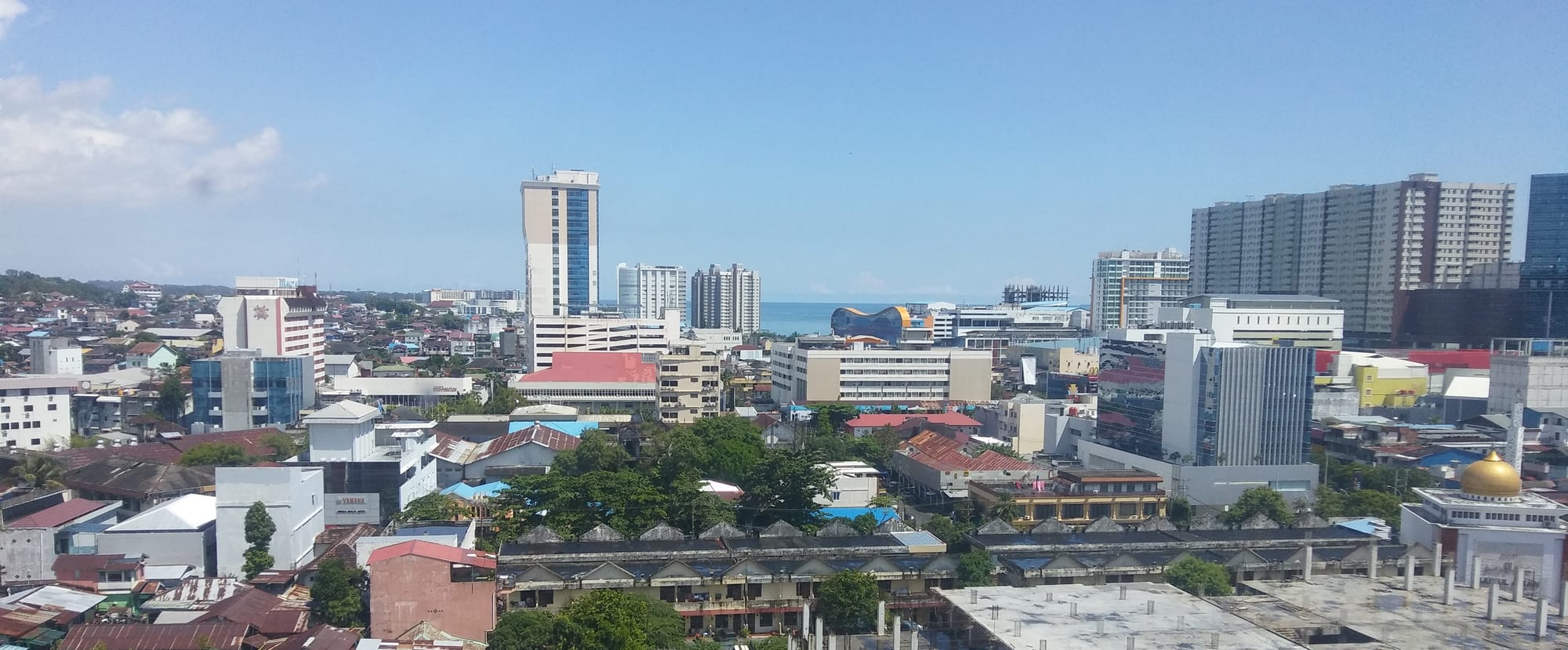
A city of low roofs and scattered white towers running down a green hillside to a blue sea under a clear sky

Kalimantan (Borneo), Indonesia

Balikpapan

Central Balikpapan sloping down towards the Makassar Strait. (consigliere ivan / Wikimedia Commons · CC0)

East Kalimantan's port and oil city, set on hills above a deep bay on Borneo's east coast. Oil drilled here from the end of the 19th century built the town, destroyed it in the Second World War and rebuilt it again; today it is the main air gateway to the province, a base for river and forest trips, and the nearest large city to the new capital under construction inland.

Neighbourhoods

  • Klandasan and the seafront
    • First-time visitors
    • Best for food
    • Shopping

    The commercial centre, strung along the coast road above the Makassar Strait, with the main hotels, shopping centres and a run of seafood restaurants. Most visits to the city are based here, within walking distance of the water.

    Open in Maps
  • Melawai
    • Nightlife
    • Street food
    • Sunsets

    A district at the western end of the seafront that fills in the evening, when food stalls set up along the shore and crowds come for grilled fish, coffee and the sunset over the bay. Small hotels, karaoke bars and shops line the streets behind.

    Open in Maps
  • Gunung Sari and the hills
    • Quiet and residential
    • Local life

    Ridges of housing rising steeply behind the centre, reached by winding roads and long flights of steps. Mostly residential, with neighbourhood warungs and markets and occasional views out over the roofs to the sea.

    Open in Maps
  • Balikpapan Baru
    • Quiet and residential
    • Best for food

    A planned district inland, laid out from the 1990s with wide roads, gated housing and rows of restaurants and cafés serving the city's oil and mining professionals. Newer hotels and serviced flats are concentrated here.

    Open in Maps
  • Sepinggan and Manggar
    • Beaches
    • Close to the airport

    The eastern edge of the city, where the airport sits and the coast runs out to Manggar's long sandy beach. Hotels near the terminal are convenient for early flights, and the beach fills with families at weekends.

    Open in Maps

Things to do

The coast and the bay

  • Balikpapan Bayattraction

    The deep inlet west of the city, working water for tankers and ferries, with Pertamina's refinery on its eastern shore and mangroves along the rest of it.

    Open in Maps
  • Kemala Beachbeach

    A sandy strip close to the centre, backed by cafés and beach bars, used for swimming, football and sunset watching.

    Open in Maps
  • Manggar Beachbeach

    A long sandy beach on the eastern edge of the city near the airport, busy with families and food stalls at weekends.

    Open in Maps
  • Melawai waterfrontneighborhood

    The evening promenade at the western end of the seafront, where stalls, grills and coffee sellers set up facing the water.

    Open in Maps

Parks, markets and city sights

  • Pasar Kebun Sayurmarket

    A market in the Kebun Sayur district selling gemstones, agate, Dayak carving, beadwork and mandau knives, the usual place to buy souvenirs of Kalimantan.

    Open in Maps
  • Mangrove forest at Kariangaupark

    Mangroves on the bay side of the city, where long-tailed macaques, crabs and waterbirds live along the channels.

    Open in Maps
  • Wain River Protected Forestpark

    A reserve of about 10,000 hectares north of the city, home to sun bears — the city's mascot — along with orangutans and proboscis monkeys.

    Open in Maps

Short trips from the city

  • Bukit Bangkiraiattraction

    An area of lowland rainforest about 45 minutes by road from the city, with a canopy walkway suspended between tall bangkirai trees.

    Open in Maps
  • Samarindaattraction

    The provincial capital on the Mahakam River, about 95 km north-east by toll road, and the usual starting point for journeys upriver.

    Open in Maps
  • Tenggarongattraction

    The old seat of the Kutai Kartanegara sultanate, on the west bank of the Mahakam upstream of Samarinda, where the former royal palace stands by the river.

    Open in Maps
  • Nusantaraattraction

    The planned new national capital being built in the hills inland from the city, in phases; Jakarta remains the capital while construction continues.

    Open in Maps
  • Sultan Aji Muhammad Sulaiman Sepinggan International Airporttransit hub

    East Kalimantan's main airport, on the eastern edge of the city, with a large terminal opened in 2014 and flights across Indonesia.

    Open in Maps

Seasonal events

  • City anniversaryFebruary

    Parades, markets and civic events mark the founding of the town, dated to the drilling of its first oil well in 1897.

  • Ramadan night marketsduring Ramadan, a month that moves earlier each year

    Stalls selling cakes, dates, fried snacks and drinks appear across the city in the late afternoon for the breaking of the fast.

Eat and drink

Long-standing places and food districts in Balikpapan. Hours, ratings and directions come from your maps app, always current.

Balikpapan classics

  • Seafood and crab restaurantsrestaurant

    Mud crab cooked in black pepper or chilli sauce, prawns, squid and grilled fish are the city's speciality, served in large open restaurants along and behind the seafront.

    Open in Maps
  • Kepiting soka and soft-shell crab stallsrestaurant

    Soft-shell crab, farmed in the mangrove creeks around the bay, is fried whole and eaten shell and all.

    Open in Maps

Markets and food streets

  • Melawai food stallsneighborhood

    The evening line of grills, rice stalls and drink carts along the western seafront, busiest after sunset.

    Open in Maps
  • Pasar Klandasanmarket

    The central wet market near the seafront, where the day's catch, tropical fruit, chillies and shrimp paste are sold from early morning.

    Open in Maps
  • Pasar Kebun Sayurmarket

    Best known for gemstones and Dayak crafts, with snack sellers and fruit stalls around the edges.

    Open in Maps

Experience Balikpapan

History

Balikpapan exists because of oil. Seepages along this coast were known to local people long before a small company called Mathilda drilled the first well on 10 February 1897, a date still kept as the city's anniversary. The Dutch firm Bataafsche Petroleum Maatschappij followed with a refinery, tank farms and a company town, and a place of a few fishing villages turned into an industrial port with imported labour from Java and elsewhere in the archipelago. The bay's depth and shelter made it valuable well beyond the oil itself.

That value made it a target. Japanese forces landed in January 1942 after the Dutch set fire to the installations, and the city spent the war as an occupied oil centre; Allied bombing flattened much of it. On 1 July 1945 the Australian 7th Division came ashore near Klandasan in Australia's largest and last amphibious operation of the war, and major fighting went on until about 21 July. The city was left in ruins, and memorials to both the Australian landings and Indonesian resistance stand in the town today.

Reconstruction was slow until the oil boom of the 1970s, when Pertamina expanded the refinery and foreign companies set up bases here for exploration offshore and in the interior. Coal followed in the 1980s and 1990s, and the city became the business and logistics capital of East Kalimantan, even though Samarinda is the provincial capital. Since 2019, when the government chose the hills inland for Nusantara, the planned new national capital, Balikpapan has been the main airport, port and construction base for the project.

Culture & Customs

Few residents can trace long ancestry here, and the city knows it. Javanese, Bugis, Banjar, Buginese-Makassarese, Toraja, Batak and Dayak communities all arrived for work, along with Chinese traders and, for more than a century, foreign oil staff, and the result is an Indonesian city rather than a regional one — Bahasa Indonesia is the common language, and food, mosques, churches and temples come from everywhere. Clan and hometown associations are strong, and people often describe themselves by the island they came from.

The oil and mining industry sets the tone: shift patterns, company housing, safety culture and a professional middle class with money to spend on restaurants and cars. Balikpapan has a national reputation for cleanliness — one of its nicknames is an acronym for clean, magnificent and comfortable — and residents take a certain pride in rules being followed here more than elsewhere — rubbish collection, green spaces and the protection of the mangroves on the bay are civic causes.

Custom is mainstream Indonesian Muslim, tempered by the mixed population. Ramadan is observed publicly, mosque loudspeakers mark the day, and dress in the city is modest even while the beaches are relaxed. Evening life is domestic and food-centred: families along the seafront, coffee with friends, fish on the grill and a slow walk once the heat has gone out of the day.

Daily Life

About 760,000 people live in the city itself, in a strip between the sea and the forested hills. The city has no farmland to speak of and imports most of its food, largely from South Sulawesi and Java. Employment runs on oil refining, gas, coal logistics, shipping, construction and the services that support them, with the Pertamina refinery on the bay the single largest presence; the building of Nusantara has added contractors, engineers and speculation about land prices.

Housing ranges from gated estates in Balikpapan Baru to dense kampung streets climbing the hills, where drainage and landslides after heavy rain are recurring problems. Wages are high by Indonesian standards and so are costs; workers on rotation to offshore rigs and inland mine sites pass through constantly, giving the hotels and the airport a rhythm of their own.

The day starts before six, with prayers, school runs and the early shift; the middle of the day is hot and quiet; and the coast road jams again in the late afternoon. Water supply, traffic and the pressure that the new capital is putting on housing and infrastructure are the persistent local concerns, alongside arguments about protecting the bay's mangroves and the forest corridors that still reach the edge of the city.

Food

Seafood is the reason people eat out here. Mud crab from the mangrove creeks is the signature — cooked in black pepper sauce, in chilli and tomato saus padang, or as kepiting soka, soft-shell crab fried whole — alongside prawns, squid and whole fish grilled over coconut husks and served with sambal, lime and rice. The large open restaurants behind the seafront specialise in it, and the Klandasan market supplies them each morning.

Everyday food is a mixture of the archipelago. Javanese warungs sell soto and gado-gado, Banjar kitchens brought soto Banjar and fish cooked masak habang across from South Kalimantan, Bugis and Makassarese cooks make coto and grilled fish with dabu-dabu sambal, and Padang restaurants are everywhere. Nasi kuning, turmeric rice with fish or egg wrapped in banana leaf, is the standard breakfast bought on the way to work.

Local snacks lean on bananas and fish. Pisang gapit is banana flattened, grilled and covered in palm-sugar sauce; amplang, crisp crackers made from fish and tapioca, are the usual gift to take home, along with mantau, steamed buns eaten with crab. Durian and its Borneo relatives appear in season, and the coffee culture is strong, from sweet iced coffee at a roadside stall to the cafés of Balikpapan Baru.

Planning tools

Budget

Balikpapan is the most expensive city in Kalimantan. Oil, gas and mining money, expatriate contractors and the construction of the new capital keep hotel rates and restaurant prices above the regional norm, though warungs and local transport remain cheap. Car hire with a driver, the usual way to reach the forest and the airport road, is the other significant cost.

Daily Budget Midrange
USD 65–140 (business or seafront hotel, seafood dinners, a car with driver for a day trip)
Daily Budget Shoestring
USD 25–45 (budget hotel, warung meals, angkot minibuses and ride-hailing motorbikes)

Hotel rooms fill during the working week with business travellers and are often easier to find at weekends.

Best Time to Visit

Rain falls in every month, so the choice is between wetter and less wet. June to September is the driest stretch, best for boat trips on the bay and forest walks, though haze can drift over the city in years when peatland fires burn inland. November to March brings heavy downpours and rougher water. Sea and air temperatures barely change through the year.

Suggested Number of Days

A day or two is enough for the city itself, which most travellers treat as an entry point rather than a destination. Three or four days allow the bay, the forest reserves and a trip towards the Mahakam. Flight times often decide the length of a stay.

First Visit
1–2 days
With Surroundings
3–4 days

Transportation

The city is spread along the coast and up the hills, and most people get around by motorbike, private car, angkot minibus or ride-hailing app, which works well here. Taxis are available at the airport and hotels. A toll road runs north-west towards Samarinda, and buses and shared cars leave for towns across East Kalimantan from terminals on the edge of the city.

Traffic on the single coast road is slow at the start and end of the working day, so allow extra time for the airport.

Airport & Station Connections

Sultan Aji Muhammad Sulaiman Sepinggan International Airport, about 8 km east of the centre, is one of the busiest in Indonesia, with frequent flights to Jakarta, Surabaya and Denpasar, a few international routes to Singapore, Malaysia and Brunei, and a journey into town of roughly 20 to 30 minutes. Ferries and passenger ships call at the port, and buses and shared cars connect Samarinda and towns to the north.

Walkability

The seafront strip through Klandasan and Melawai is walkable, with pavements for much of the way and places to stop, and the evening is the comfortable time to use it. Elsewhere the heat, the hills, heavy traffic and long distances between districts make walking impractical, and the city is built around vehicles.

Safety

Balikpapan is calm and considered one of the more orderly cities in Indonesia, with a low level of street crime and a visible municipal emphasis on cleanliness and order. Traffic, particularly motorbikes, is the main hazard, along with strong currents and sudden squalls at the beaches. Dengue occurs year-round.

Wear a helmet and only ride a scooter if experienced, avoid cheap cocktails and home-brewed spirits, dress modestly outside Bali and beach resorts, and heed volcano exclusion zones and tsunami warnings. Check current official travel advice before travelling.

Climate

Equatorial and coastal: hot, humid and wet in every month, with sea breezes making the shore more comfortable than the hills behind. Rain usually comes in heavy bursts rather than all-day drizzle, and thunderstorms are common in the afternoon.

Summer
the drier months, June–September: about 31–33°C by day and 24°C at night, with fewer storms
Winter
the wet months, November–March: about 30–32°C, very humid, with frequent heavy rain and rough seas

Local Customs

The city is mostly Muslim, with sizeable Christian, Chinese and Hindu minorities drawn by work, and it is used to outsiders — Javanese, Bugis, Banjar, Dayak and foreign oil staff have lived here for generations. Modest dress is expected away from the beaches, shoes come off indoors and at mosques, and the right hand is used for eating and handing things over. Alcohol is sold in hotels and some restaurants but is not part of everyday life.

Tipping is not expected; ask before photographing people, and remember that the port, refinery and industrial sites should not be photographed.

Common Payment Methods

The currency is the Indonesian rupiah. Hotels, malls, chain restaurants and larger shops take cards, and QR code payment is widely used; markets, warungs, angkots and beach stalls want cash. ATMs are easy to find in the centre and along the main roads.