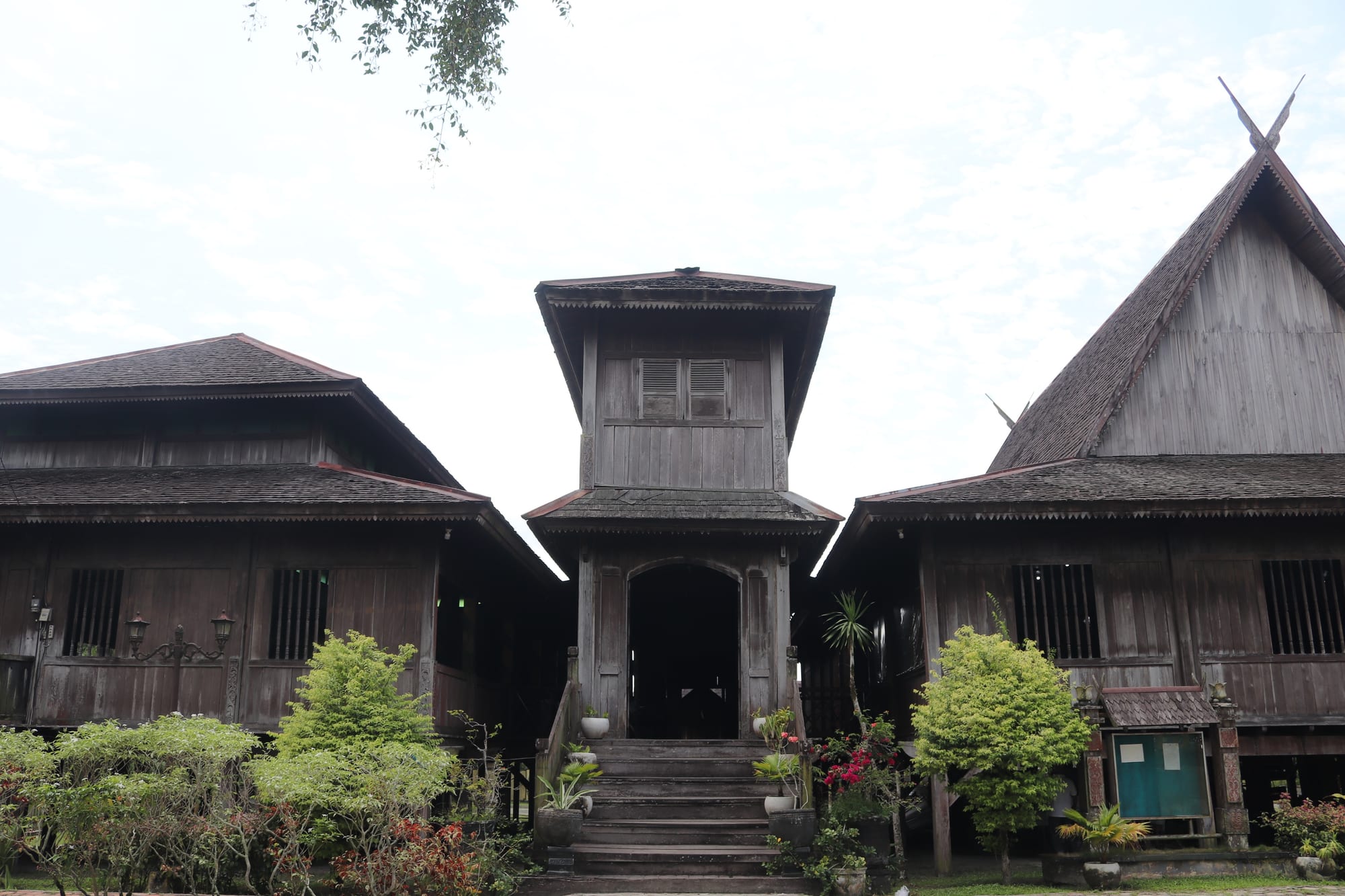
Dark timber palace buildings with steep shingled roofs and a central entrance stair, behind low shrubs

Kalimantan (Borneo), Indonesia

Pangkalan Bun

Istana Kuning, the wooden palace of the Kotawaringin sultanate in Pangkalan Bun. (Ilham Mufti Laksono / Wikimedia Commons · CC BY-SA 4.0)

A river town in Central Kalimantan, on the Arut River a short way inland from the Java Sea coast of Borneo. Once the seat of the Kotawaringin sultanate, whose wooden palace still stands, it is now the administrative and commercial centre of West Kotawaringin and the arrival point for visitors heading to Tanjung Puting National Park by boat from the nearby port of Kumai.

Neighbourhoods

  • The town centre
    • First-time visitors
    • Markets
    • Close to transport

    The grid of streets around the main market and the government offices, with most of the hotels, banks, warungs and shops. It is flat, hot and busy with motorcycles, and everything a traveller needs before a river trip is within a few blocks.

    Open in Maps
  • The Arut riverside
    • Local life
    • Scenery

    Wooden houses, jetties and small boatyards along the brown river that gave the town its reason to exist, with cargo boats loading and children swimming from the banks. The palace and the older kampung stand on the higher ground behind.

    Open in Maps
  • Kumai
    • Boat trips
    • Harbour
    • Seafood

    The port town about 25 kilometres away at the mouth of the Kumai River, where klotok houseboats and speedboats set off for Tanjung Puting and ferries leave for Java. Rows of tall windowless swiftlet houses rise above the shophouses, built to farm birds' nests.

    Open in Maps
  • The airport road
    • Quiet and residential
    • Hotels

    The strip towards Iskandar Airport on the edge of town, with newer hotels, offices and housing serving the plantation and mining companies that run much of the local economy.

    Open in Maps

Things to do

Tanjung Puting and the rivers

  • Tanjung Puting National Parkpark

    Peat-swamp and lowland forest protecting wild orangutans, proboscis monkeys and gibbons; entry is by boat with a park permit and a licensed guide or ranger.

    Open in Maps
  • Camp Leakeyattraction

    The research station founded in 1971 by Biruté Galdikas to study wild orangutans, deep inside the park at the end of the Sekonyer River.

    Open in Maps
  • The Sekonyer Riverattraction

    The narrow blackwater river that carries klotok houseboats into the park between walls of nipa palm and pandanus, with proboscis monkeys in the trees at dusk.

    Open in Maps
  • Kumai harbourtransit hub

    The working port where klotoks are moored and loaded, ferries leave for Java, and fishing boats unload beneath the swiftlet towers.

    Open in Maps

In the town

  • Istana Kuninglandmark

    The Yellow Palace, the timber seat of the Kotawaringin sultans on a rise above the town, rebuilt after a fire and holding royal regalia and old cannon.

    Open in Maps
  • Astana Alnursarilandmark

    An older royal wooden house near the palace, associated with the Kotawaringin court and kept as a heritage building.

    Open in Maps
  • Pangkalan Bun marketmarket

    The main town market, busiest early, selling river fish, vegetables, Borneo fruit in season, rattan goods and household supplies.

    Open in Maps

Short trips from the town

  • Kotawaringin Lamaattraction

    The old seat of the sultanate north-west of the town on the Lamandau River, with a wooden mosque and royal graves in a small riverside settlement.

    Open in Maps
  • Sei Cabang beachbeach

    A beach on the coast beyond Kumai where the Friends of the National Parks Foundation keeps a conservation area for green turtles, with long views over the Java Sea.

    Open in Maps

Seasonal events

  • Ramadan and Eid al-Fitrvaries with the lunar calendar

    The fasting month reshapes the town's hours, and the festival that ends it brings families home, fills the ferries and quietens business for several days.

  • Indonesian Independence Day17 August

    Marked with parades, school competitions and river and sports events in the town and along the Arut.

  • Peak orangutan seasonJune to September

    The drier months, when river levels are steadier, klotok trips run reliably and forest walks are less waterlogged.

Eat and drink

Long-standing places and food districts in Pangkalan Bun. Hours, ratings and directions come from your maps app, always current.

Pangkalan Bun eating

  • Warungs in the town centreneighborhood

    Simple kitchens serving nasi kuning for breakfast, soto Banjar, fried river fish, chicken and rice with sambal to office workers and drivers.

    Open in Maps
  • Pangkalan Bun marketmarket

    The town market, where river fish, vegetables, palm sugar and seasonal Borneo fruit such as durian and lai are sold from early morning.

    Open in Maps
  • Kumai seafoodneighborhood

    Harbour-front places in the port town cooking prawns, crab and sea fish landed that day, often with a sour-and-spicy broth.

    Open in Maps
  • Riverside coffee stallscafe

    Open-sided stalls where strong sweet coffee and fried snacks are taken slowly in the heat, a Kalimantan habit as much as a meal.

    Open in Maps

Experience Pangkalan Bun

History

The town grew out of the Kotawaringin sultanate, a Muslim principality on the south coast of Borneo whose first seat lay north-west of the present town at Kota Waringin Lama, on the east bank of the Lamandau River. The court later moved to Pangkalan Bun on the Arut River, a better anchorage for trade, and the timber palace known as Istana Kuning, the Yellow Palace, became its centre. The sultanate lived on river commerce — rattan, resin, forest products, later rubber — passing goods between the Dayak of the interior and traders from Java, Sulawesi and China.

The Dutch brought the sultanate under their control in the colonial period, leaving the ruling house in place. In the Second World War the area was occupied by Japanese forces, and on 14 January 1946 Kumai was a base for Indonesian fighters attacking the Dutch and the Japanese. Kotawaringin then existed briefly as an autonomous state within the United States of Indonesia between 1949 and 1950 before becoming a regency of the republic; the regency was divided in 1959, and Pangkalan Bun became the seat of West Kotawaringin.

The later 20th century was shaped by what could be taken out of the forest. Logging expanded through the 1970s and 1980s, followed by oil palm plantations and mining, which transformed the landscape around the town and still supply most of the regency's income. At the same time Tanjung Puting, set aside as a reserve by the Dutch colonial government in the 1930s, made a UNESCO biosphere reserve in 1977 and declared a national park in 1982, drew scientists and then visitors, and Camp Leakey, founded in 1971, made the area known internationally for orangutan research. Iskandar Airport also became one of the centres for the search and recovery operation after an airliner crashed in the nearby Karimata Strait on 28 December 2014.

Culture & Customs

This is a Muslim river town with a mixed population: Banjar and Malay families long settled on the coast, Javanese who arrived with transmigration and plantation work, Dayak communities from the interior, and Chinese traders whose shophouses and temples are part of both Pangkalan Bun and Kumai. Mosques set the rhythm of the day, Friday prayers empty the offices at midday, and Ramadan changes when and how the town eats.

The Kotawaringin court left a visible legacy. Istana Kuning and the older wooden royal houses are maintained as heritage, royal descendants still take part in ceremonies, and the sultanate's history is a source of local pride distinct from Banjarmasin or Palangka Raya. River culture runs through everything else: houses facing the water, boats as transport, and the seasonal rise and fall of the Arut and Kumai rivers ordering work and travel.

Dayak traditions are present but mostly rooted upriver and inland — carving, beadwork, the sape lute, and in some communities the Kaharingan faith with its funerary ceremonies. In Kumai, the tall concrete towers built to attract swiftlets for their nests, harvested for the Chinese market, are an unmistakable local industry and a constant background of recorded bird calls. Visitors are still relatively few and are usually here for the park, so courtesy, modest dress and a greeting go a long way in the town itself.

Daily Life

About 109,000 people live in the Pangkalan Bun urban area, all of it inside South Arut District, which makes it one of the larger towns in Central Kalimantan and the commercial centre of West Kotawaringin Regency, whose population was about 286,000 in 2025, spread across plantations, coastal villages and forest settlements. The town is low-rise and spread out, growing along the roads towards the airport and Kumai.

The economy rests on oil palm, timber and mining, with government administration, trade and transport alongside them, and tourism a small but visible addition: guides, boat crews, cooks and hotels that live off the Tanjung Puting season. Plantation companies dominate employment in the surrounding district, and the arguments that come with them — land rights, river pollution, peat fires, haze and the pressure on the park's boundaries — are constant local issues.

Days begin before dawn with prayer and the market, and much of the work is done by mid-morning before the heat. Motorcycles carry nearly everything and everyone; the river carries the rest. By evening families gather at coffee stalls and food carts along the main streets, and in the wet season the talk is of flooding in the low-lying kampungs. The town is the last place with banks, pharmacies and phone signal before the forest, which gives it a practical importance out of proportion to its size.

Food

Everyday eating follows Banjar and Malay patterns. Nasi kuning, turmeric rice with a piece of fish or chicken, serundeng — grated coconut fried with spices — and sambal, is the standard breakfast, often wrapped in banana leaf and eaten standing. Soto Banjar, a clear chicken soup spiced with star anise, clove, cassia and lemongrass and served with potato cakes and a sour, hot sambal, is the region's best-known dish and is sold in the town from morning onwards.

River fish are the heart of the cooking: haruan, the snakehead, patin catfish, and udang galah, the giant freshwater prawn, grilled, fried or simmered in a sour yellow broth. Coastal Kumai adds sea fish, crab and squid. Fermented and dried fish products flavour sambals, and cooked vegetables such as young fern tips and jackfruit appear beside the rice. Amplang, crisp crackers made from fish and tapioca, is the usual snack and a local gift.

Borneo fruit is worth timing a visit around: durian and its milder relative lai, cempedak, rambutan, langsat and mangosteen fill the markets in the fruiting season. Drinks are strong sweet coffee from open-sided stalls, sweet iced tea and fresh juices; alcohol is little seen in a largely Muslim town, and, as everywhere in Indonesia, home-distilled spirits should be avoided. On a klotok trip the cooking is done on board — rice, fish, chicken, vegetables and endless tea and coffee, eaten on deck as the forest goes by.

Planning tools

Budget

The town itself is inexpensive — simple hotels, warung meals and short motorcycle-taxi rides — but the reason most people come is not. A klotok trip into Tanjung Puting is chartered by the boat rather than the seat and includes crew, meals and a guide, so small groups pay much more per person, and the national park entrance fee is separate. Flights to Iskandar Airport are the other main cost.

Daily Budget Midrange
USD 55–140 (klotok trip with guide and meals, better hotel in town, airport transfers)
Daily Budget Shoestring
USD 20–35 (simple hotel, warung meals, ojek rides, a shared place on a klotok)

Carry enough cash for the whole river trip, as there are no ATMs beyond Kumai, and book through licensed operators who arrange park permits and guides.

Best Time to Visit

June to September is the driest and most reliable time for river travel and forest walks, and the usual peak for park visits. The wetter months from November to March bring daily downpours, high rivers and mud, though the forest is green and boats still run. In dry years, haze from peatland fires can affect the region between August and October.

Suggested Number of Days

Most visits are built around a river trip of two or three days and nights, with a night in town at either end. Four or five days allow a longer stay in the park or a trip to the coast. Longer river routes and side channels need more time and higher water.

First Visit
2–3 days
With Surroundings
4–5 days

Transportation

The town is covered by motorcycle taxis, shared minibuses and a growing number of cars; there is no formal urban bus network. Kumai, the port for the national park, is about 25 kilometres away, half an hour by road. Roads run east to Palangka Raya and west towards Ketapang, but they are long, and most long-distance travel is by air or by ferry from Kumai.

Arrange transfers between the airport, the town and Kumai through the hotel or boat operator, as taxis are not always waiting and the road out to the port has little passing traffic at night.

Airport & Station Connections

Iskandar Airport lies on the edge of the town, a few kilometres from the centre, with a small number of routes to Jakarta, Semarang and Surabaya. Passenger ferries connect Kumai with Java, a crossing of many hours, and cargo and river boats serve settlements along the coast. Road journeys to other Kalimantan cities take many hours.

Walkability

The centre is small and flat enough to cross on foot in fifteen or twenty minutes, taking in the market, the main street and the river. Pavements are uneven or missing, motorcycle traffic is constant, and the heat and humidity make midday walking hard going. Everything outside the centre — the airport, the palace area, Kumai — needs transport.

Safety

The town is calm and crime against visitors is rare. The real risks are practical: river travel in boats of variable standard, road accidents on motorcycles, mosquito-borne illness including malaria and dengue in forested areas, and haze in fire years. Medical facilities are limited, with serious cases flown to Java. Wild orangutans are strong animals and are kept at a distance on ranger instructions.

Check that a boat carries life jackets, take anti-malarial advice before travelling into the forest, use repellent at dusk, and follow guides and rangers exactly around wildlife. Wear a helmet and only ride a scooter if experienced, avoid cheap cocktails and home-brewed spirits, dress modestly outside Bali and beach resorts, and heed volcano exclusion zones and tsunami warnings. Check current official travel advice before travelling.

Climate

Equatorial: hot and humid in every month, with rain all year and no dry season in the usual sense, only wetter and drier periods. Mornings on the river are cool and misty, afternoons are heavy, and thunderstorms build quickly.

Summer
the drier months, June–September: about 31–33°C, humid, with lower rivers and sometimes haze
Winter
the wetter months, November–March: about 30–32°C, with heavy daily rain, high rivers and flooding in low-lying streets

Local Customs

The town is largely Muslim, mixed Banjar, Malay, Javanese and Dayak, with Chinese families long established in trade and in Kumai. Dress is modest by Indonesian standards: shoulders and knees covered in town, including on the river. The call to prayer sets the day, Friday midday is quiet, and alcohol is not part of public life here.

Ask before photographing people, houses or ceremonies, use the right hand to give and receive, remove shoes when entering a home, and keep a respectful distance at Dayak or Muslim rituals.

Common Payment Methods

The currency is the Indonesian rupiah. Hotels and a few larger businesses take cards, but almost everything else — warungs, markets, ojeks, boat crews and park charges — is cash. ATMs are in the town centre and at Kumai, and there are none once a boat heads upriver, so enough cash for the whole trip should be drawn before leaving.