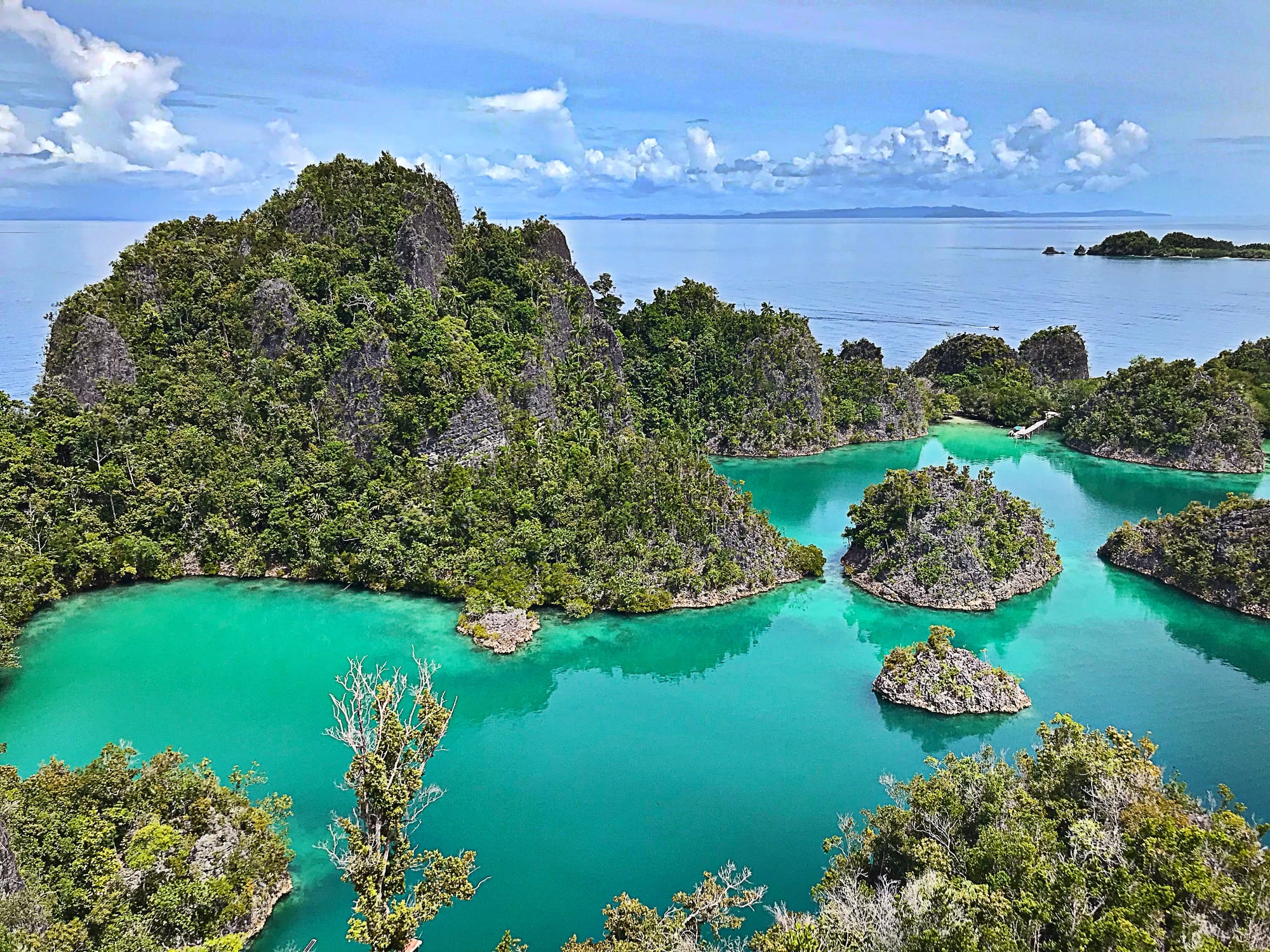
Steep green limestone islets rising from a bright turquoise lagoon, with open sea and low cloud behind

Maluku & Papua, Indonesia

Raja Ampat Islands

The lagoon and karst islets at Piaynemo in Raja Ampat. (peter harris / Wikimedia Commons · CC0)

An archipelago of four large islands and hundreds of small ones off the western tip of New Guinea, in Indonesia's Southwest Papua province. Its reefs are among the most biodiverse recorded anywhere, and its limestone islets rise from turquoise lagoons. Visitors stay in village homestays or dive resorts, reached by ferry from Sorong to the small capital, Waisai.

Neighbourhoods

  • Waisai and southern Waigeo
    • First-time visitors
    • Boats and ferries
    • Close to public transport

    The small administrative capital on Waigeo, where the ferries from Sorong arrive and the marine park permit is bought. There are shops, bank machines, offices and a handful of hotels, and boats leave from here for the homestay islands.

    Open in Maps
  • The Dampier Strait islands
    • Diving
    • Beaches
    • First-time visitors

    The channel between Waigeo and Batanta, with its strong currents and famous reefs. Kri, Gam, Mansuar and Arborek hold most of the region's village homestays and several dive resorts, all within a short boat ride of each other.

    Open in Maps
  • Piaynemo and the Fam islands
    • Viewpoints
    • Snorkelling

    A cluster of karst islets west of Waigeo, reached on day trips, with stairways to lookouts over the lagoons and shallow reefs to snorkel. A few homestays sit on the nearer islands, but most visitors come and go by boat.

    Open in Maps
  • Northern Waigeo and Wayag
    • Viewpoints
    • Quiet and residential

    The remote north, where the karst cluster of Wayag makes the best-known landscape of the archipelago. Trips are long and usually chartered, and the villages along the way are small and rarely visited.

    Open in Maps
  • Misool
    • Diving
    • Quiet and residential

    The southern island of the group, several hours by boat from Waisai, with soft-coral reefs, rock-art panels on sea cliffs and lagoons among limestone islets. Accommodation is a small number of homestays and one long-established resort.

    Open in Maps
  • Batanta and Salawati
    • Quiet and residential
    • Local life

    The two islands nearest Sorong, greener and much less visited, with waterfalls, forest birds and fishing villages. Homestays are few and transport is arranged rather than scheduled.

    Open in Maps

Things to do

Islands and viewpoints

  • Waigeoneighborhood

    The largest island of the group and the seat of its government, forested and mountainous, with deep bays cutting into its coast.

    Open in Maps
  • Misoolneighborhood

    The southern island, known for soft-coral reefs, sheltered lagoons and prehistoric hand stencils painted on its limestone rock faces.

    Open in Maps
  • Batantaneighborhood

    A long, narrow forested island between Waigeo and Salawati, with waterfalls and birdwatching in its interior.

    Open in Maps
  • Salawatineighborhood

    The southernmost of the four large islands, close to the Papuan mainland and split administratively, with only its northern part in Raja Ampat Regency and the south belonging to Sorong Regency.

    Open in Maps
  • Dampier Straitattraction

    The channel between Waigeo and Batanta, where the current-swept reefs are among the healthiest recorded in the islands and manta rays gather off Arborek.

    Open in Maps

Practicalities

  • Waisaitransit hub

    The regency capital on Waigeo, with the ferry terminal from Sorong, the marine park permit office, shops and bank machines.

    Open in Maps

Eat and drink

Long-standing places and food districts in Raja Ampat Islands. Hours, ratings and directions come from your maps app, always current.

Island eating

  • Homestay kitchensrestaurant

    Village homestays include three meals in the nightly rate — rice, fish caught that day, vegetables and instant noodles, with fritters, bananas and sweet tea in between. There is generally nowhere else to eat on the smaller islands.

    Open in Maps
  • Waisaineighborhood

    The only place in the islands with a choice — warungs around the town and the harbour serving rice and fish dishes, grilled chicken, bakso soup and coffee.

    Open in Maps
  • Papuan staplesrestaurant

    Sago in its many forms is the traditional food here, from papeda, a sticky porridge, to baked sago cakes, usually eaten with fish in a yellow turmeric and lime broth.

    Open in Maps

Experience Raja Ampat Islands

History

The name Raja Ampat, the Four Kings, comes from a story of a woman who found seven eggs, four of them hatching into the rulers of Waigeo, Salawati and the two kingdoms of Misool. The islands have long been inhabited: prehistoric hand stencils survive on the limestone of Misool, and the reefs and sago swamps supported coastal communities speaking both Austronesian and Papuan languages.

For centuries the islands lay at the eastern edge of the Maluku spice world and were tied to the sultanate of Tidore, which had close economic and political links with them in the 16th and 17th centuries and counted them part of its domain. Dutch authority followed in the nineteenth century, and missionaries arrived to a population that adopted Christianity in the north and Islam in parts of the south. The islands passed to Indonesia with the rest of western New Guinea in 1963.

Modern Raja Ampat begins with the new regency, capital at Waisai, created in 2003, and the surveys around the turn of the century that recorded more than 600 species of hard coral here — about three-quarters of those known in the world — and more than 1,700 reef fish. Diving tourism followed. A network of village homestays, encouraged by local government and conservation groups, spread the income beyond the resorts, and a visitor levy was introduced to fund the marine protected areas. Fishing controls, the loss of reef to anchors and boats, and illegal mining for nickel, which has drawn national criticism since 2019, have all been contested since. In 2025 the islands were designated a UNESCO biosphere reserve.

Culture & Customs

The people of the islands are Papuan, with villages of a few dozen to a few hundred, most of them along the shore. Clans hold rights to stretches of reef, beach and forest, and those rights govern daily life more directly than any office in Waisai: permission to fish, to build, to bring visitors to an islet or to open a homestay flows through families and village heads. Decisions are made slowly and in public, and a guest is the responsibility of the household that takes them in.

Sasi, the customary closure of an area or a species to harvest for a set period, is practised here as across Maluku and Papua. A church or mosque may declare it, poles or markers set the boundary, and the opening after months or years is an occasion. Conservation groups have worked with these customs rather than around them, which is why village-run no-take zones sit inside the wider protected area.

Christianity is strong in the north and Islam in parts of the south, and the two coexist without much friction; Sunday and Friday both empty the villages into worship. Music, drums and dancing mark weddings, church anniversaries and official openings. The homestay network has changed the islands, bringing cash, English and outside expectations into small communities, and villages differ in how much they want of it. Visitors are usually met with reserve that turns quickly to warmth once the household knows who they are.

Daily Life

About 75,000 people live in the regency, most of them in villages outside the capital, Waisai, which has a few thousand residents and the only concentration of offices, shops and services. Fishing is the base of the economy — for the household pot, for sale in Sorong, and for the live reef fish trade — alongside sago, gardens of cassava and vegetables, coconut and a growing amount of work connected to visitors.

Tourism now reaches a large share of the villages. Homestays are built and run by families, boats are owned locally, and guides, cooks and dive staff come from the islands, which makes the calm season a time of income and the windy months lean. The regency depends heavily on government transfers, and jobs in administration, schools and the health service are prized because they are paid monthly.

Days start at first light with fishing and gardens, slow in the heat of the afternoon, and end early; power comes from generators or solar panels in most villages, running for part of the evening rather than all day, and mobile signal is weak or absent away from Waisai and the main straits. Fresh water is collected from rain or wells, and supplies of rice, fuel and building materials come in by boat from Sorong. The standing public arguments concern the limits of fishing and tourism on the reefs, the terms of the visitor levy, and illegal nickel mining on some of the smaller islands.

Food

Food in the islands is fish and sago, and the fish is very fresh. Skipjack and yellowfin tuna, trevally, snapper, grouper, squid and octopus are grilled whole over coconut husk, fried, or cooked as ikan kuah kuning, a yellow broth of turmeric, ginger, lemongrass and lime that is the standard dish across Maluku and Papua. It is served with rice, boiled cassava or sweet potato, and a fierce sambal of chilli and lime.

Papeda, the sago porridge of the region, is the traditional staple: a translucent, almost flavourless paste twirled from the pot with sticks and eaten with the fish broth poured over it. Sago also comes as sagu lempeng, hard baked slabs kept for weeks, and in sweet forms mixed with grated coconut. Sambal colo-colo, chopped chilli, shallot, tomato and lime, appears on the table wherever grilled fish does, and vegetables are simple — ferns, cassava leaves and greens cooked in coconut milk.

Everything else arrives by boat, which is why homestay menus repeat: rice, noodles, eggs, tinned fish and biscuits are the imported staples, and fruit depends on the season and the island. Coffee and very sweet tea are drunk constantly, fresh coconut is easy to find, and alcohol is not sold in the villages, though some resorts serve it. Anyone with particular dietary needs should say so when booking, since kitchens cook one meal for everyone from whatever came in on the last boat.

Planning tools

Budget

Raja Ampat is expensive by Indonesian standards. Village homestays are simple but not cheap, resorts and liveaboards much more so, and everything else — boat transfers, fuel, chartered day trips, diving — is priced for distance. A marine park entry permit is required of all visitors and is an additional fixed cost. Flights to Sorong and the ferry add to the total.

Daily Budget Midrange
USD 85–230 (dive resort or better homestay, daily diving, private boats, domestic flights)
Daily Budget Shoestring
USD 30–55 (village homestay with all meals, shared boat transfers, snorkelling)

Budget separately for the marine park permit, buy it in Sorong or Waisai, and keep the card or receipt, as it is checked at jetties and dive sites.

Best Time to Visit

October to April brings the calmest seas and the best underwater visibility, and is the main season for diving and boat trips. Rain falls all year, often in short heavy bursts. July and August can be windy, with choppy crossings and some trips to the far north or to Misool cancelled, though diving in sheltered water continues.

Suggested Number of Days

The journey in and out takes a day at each end, so a week is the sensible minimum. Longer stays suit divers, anyone combining two bases, or trips that reach the far north or the south of the archipelago, where boat journeys are measured in hours.

First Visit
5–7 days
With Surroundings
10–14 days

Transportation

Everything moves by boat. A passenger ferry and faster boats cross from Sorong to Waisai, and from Waisai homestays send small outboard boats to collect guests, a transfer of anything from twenty minutes to two hours. Roads exist only around Waisai and in parts of southern Waigeo, served by shared cars and motorbikes.

Transfers are arranged in advance through the place being stayed at, since there is no on-demand boat service between islands, and fuel costs make chartering a boat the largest single expense of most trips.

Airport & Station Connections

Access is through Sorong, which has flights from Jakarta, Makassar, Manado, Ambon and Jayapura. From the city's passenger port, ferries and fast boats run to Waisai on Waigeo, with a small number of departures each day; Waisai also has a small airport with flights from Sorong and Manado. Homestay boats meet the arrivals; a stay of one night in Sorong at either end is common.

Walkability

Waisai is small enough to walk across, though the heat discourages it. Elsewhere there is nothing to walk between: homestay islands have a beach, a jetty and a path through the trees, and a few islands have stairways cut to viewpoints, steep and sharp underfoot on weathered limestone. Sturdy shoes matter more than distance here.

Safety

Raja Ampat itself is calm, with very little crime and a strong village social order. The risks are remoteness and the sea: medical facilities are minimal, the nearest hospital is in Sorong, and there is no recompression chamber in the islands, so diving injuries mean a long evacuation. Strong currents in the straits catch out inexperienced divers and snorkellers, boats can be small for open water, and malaria is present throughout Papua. Coral cuts, sunburn and dehydration are the everyday problems.

Take malaria precautions, dive within training and experience in currents, use reputable operators and insist on life jackets and a radio or phone on chartered boats. Wear a helmet and only ride a scooter if experienced, avoid cheap cocktails and home-brewed spirits, dress modestly outside Bali and beach resorts, and heed volcano exclusion zones and tsunami warnings. Check current official travel advice before travelling.

Climate

Equatorial and wet in every month, hot and humid, with daytime temperatures around 30–32°C and nights near 25°C. Sea temperatures stay warm all year. The main variable is wind rather than rain: calmer seas from about October to April, and stronger winds with rougher crossings in the middle months.

Summer
June–September: windier, with choppier seas and some cancelled boat trips, still about 31°C by day
Winter
November–March: calmer water and the best visibility for diving, around 31°C by day and 25°C at night

Local Customs

The islands are Papuan, with both Christian and Muslim villages, and homestays are family houses where guests share the rhythm of the household. Dress is modest in villages, swimwear is for the beach and the boat, and Sunday services and Friday prayers are taken seriously. Land, reefs and beaches all have customary owners, and permission matters more than any published rule.

Ask before photographing people or houses, ask before walking onto a beach or landing on an islet that may belong to a village, do not touch or stand on coral, and take all rubbish back to the mainland, as the islands cannot dispose of it.

Common Payment Methods

The currency is the Indonesian rupiah. Bank machines exist in Waisai and more of them in Sorong, but they run out of notes and homestays, boat crews and guides are paid in cash. Most visitors bring enough rupiah for the whole stay, including the marine park permit, transfers and diving, and card payment is limited to the larger resorts.