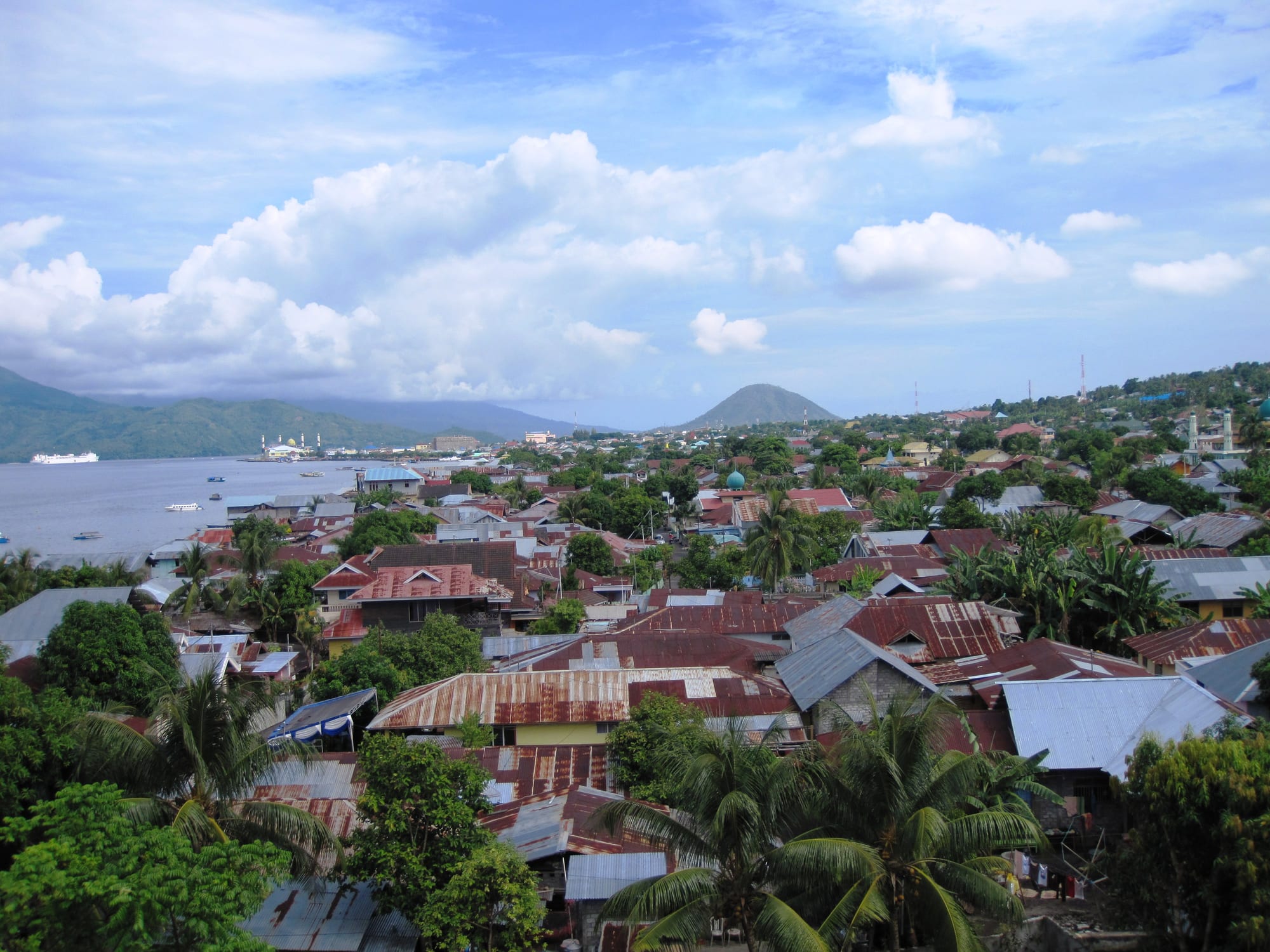
Red and silver metal roofs and palm trees spreading down to a calm bay at Ternate, with green hills and a volcanic cone across the water

Maluku & Papua, Indonesia

Ternate

Ternate city on its shore, with the sea and a volcanic island beyond. (U.S. Foreign Service Liaison Officer Tom Weinz / Wikimedia Commons · Public domain)

The largest city of North Maluku, built on a narrow coastal shelf around the base of the Gamalama volcano on a small island off Halmahera. Once the seat of a clove sultanate that European powers fought over for two centuries, it keeps a sultan's palace, Portuguese and Dutch forts and clove trees on its slopes, and works today as the region's port, airport and market town.

Neighbourhoods

  • The waterfront and the port
    • First-time visitors
    • Close to public transport
    • Evening walks

    The strip of reclaimed land along the strait holds the ferry and Pelni terminals, the landmark esplanade and most of the city's hotels. Boats for Tidore and Halmahera leave from here, and the seafront fills in the evening with food stalls and families.

    Open in Maps
  • The kedaton quarter
    • Historic district
    • Museums

    The higher ground north of the centre around the sultan's palace and the old mosque, where the streets of the former court district still carry the names of its offices. The palace museum and Fort Oranje are within walking distance of one another.

    Open in Maps
  • The market district
    • Best for food
    • Local life

    The busy blocks behind the port where the fish and produce markets, the bus terminals and the small shops sit close together. It is noisy, hot and the best place to see what the islands grow and catch.

    Open in Maps
  • The ring road and the upper slopes
    • Quiet and residential
    • Views

    A single road loops around the island below the volcano, linking villages, clove and nutmeg gardens, beaches of black sand and the crater lakes. Most people who visit the island's sights follow it, and the higher lanes look back over the city to Tidore.

    Open in Maps

Things to do

Forts and the sultanate

  • Fort Oranjelandmark

    The Dutch East India Company's fort of 1607 in the middle of the city, once the seat of the governor-general of the Indies before Batavia took over, with barracks and cannon inside its square walls.

    Open in Maps
  • Fort Tolukkolandmark

    A compact fort on a rock above the coast north of the centre, Portuguese in origin and later Dutch, with a good view along the strait.

    Open in Maps
  • Fort Kalamatalandmark

    A small coastal star fort at the southern end of the island, facing Tidore across the water, built by the Portuguese and later held by the Dutch.

    Open in Maps
  • Kedaton of the Sultan of Ternatemuseum

    The sultan's palace, built in 1813 by Sultan Muhammad Ali on a rise above the city, part residence and part museum of relics from the sultanate.

    Open in Maps
  • Sultan of Ternate Mosquelandmark

    The royal mosque of the sultanate and the largest in the city, probably built around 1606, with a five-tiered roof closer to Javanese tradition than to a dome.

    Open in Maps

The volcano and its lakes

  • Mount Gamalamaviewpoint

    The volcano that forms the whole island, with 77 eruptions documented since 1550; the forest and clove gardens on its lower slopes are reached by road from the city.

    Open in Maps
  • Tolire Lakeattraction

    A crater lake bordered by sheer cliffs in the north-west of the island, well below the level of the ring road, with a smaller lake of the same name about 200 metres away near the sea.

    Open in Maps
  • Batu Angusattraction

    A field of black lava on the northern coast, left by a past eruption of Gamalama and now crossed by paths to the shore.

    Open in Maps

Across the water

  • Tidoreattraction

    The rival clove sultanate on the next island, a short speedboat crossing away, with its own palace, forts and a volcano rising behind the town of Soasio.

    Open in Maps
  • Sulamadaha Beachbeach

    A bay of black sand on the north coast, with a walk around the headland to a clear-water inlet used for snorkelling.

    Open in Maps

Markets and the harbour

  • Bastiong harbourtransit hub

    The ferry port at the south of the city, where car ferries and speedboats leave for Tidore, Halmahera and the smaller islands.

    Open in Maps
  • Sultan Babullah Airporttransit hub

    The island's airport on the northern edge of the city, named after the sultan who expelled the Portuguese in 1575, with flights to Jakarta, Surabaya, Makassar and Manado.

    Open in Maps

Eat and drink

Long-standing places and food districts in Ternate. Hours, ratings and directions come from your maps app, always current.

Ternate classics

  • Gohu ikanrestaurant

    The city's best-known dish, sometimes called Ternate sashimi: raw tuna or skipjack cubed and dressed with lime, salt, chilli, lemon basil and hot coconut oil, served at warungs across the city.

    Open in Maps
  • Air guraka and roasted kenaricafe

    A hot drink of ginger and palm sugar, usually with kenari nuts floating in it, sold at street stalls in the evening along with fried bananas.

    Open in Maps

Markets and food streets

  • Ternate's fish and produce marketsmarket

    Tuna, skipjack and reef fish beside cloves, nutmeg, sago, chillies and island vegetables, in the covered markets and the streets around them behind the port.

    Open in Maps
  • The waterfront food stallsneighborhood

    Stalls and simple restaurants along the reclaimed seafront grill the day's fish over coconut husks and serve it with rice, cassava and colo-colo relish.

    Open in Maps

Experience Ternate

History

Cloves grew naturally on Ternate, Tidore and a handful of neighbouring islands and nowhere else on earth, and that made this small volcanic island a centre of world trade long before Europeans knew where it was. By the 15th century the Sultanate of Ternate, converted to Islam and ruled from the shore below Gamalama, controlled a maritime network that reached across Maluku to Sulawesi and the coasts of New Guinea, in constant rivalry with the neighbouring sultanate of Tidore.

The Portuguese arrived in 1512 and built a fort at Kastela, holding a trading position for sixty years until the killing of Sultan Hairun turned the islanders against them; his son Baabullah drove them out in 1575, and Ternate reached the height of its power under his rule. The Dutch East India Company built Fort Oranje in 1607, and for a few years Ternate was the administrative seat of the Dutch in the Indies before the capital moved to Batavia. Company policy then concentrated clove growing on Ambon and cut down the trees here, which impoverished the sultanate and turned it into a Dutch dependency.

The naturalist Alfred Russel Wallace rented a house here from 1858 to 1861, and the essay on natural selection that he sent to Charles Darwin, written during an attack of fever, is known as the Ternate essay, though his own journal suggests he was on neighbouring Gilolo when the idea came to him. After Indonesian independence the city became the main town of North Maluku and, when the province was created in 1999, its capital in practice until 2010, when the seat of government moved across the strait to Sofifi. Sectarian violence in 1999 and 2000 and repeated eruptions of Gamalama have shaped the decades since.

Culture & Customs

The sultanate is still the heart of local identity. The Sultan of Ternate holds no governmental power but retains ceremonial authority, and the kedaton, the palace above the city, remains a working court with its own officers, regalia and calendar. The Legu Gam festival, built around the sultan's birthday, fills the palace grounds and the streets with processions, music and traditional games, and draws people back from across North Maluku.

Ternate's culture is Maluku's, shaped by long contact with the wider Malay world. The cakalele war dance, performed in red cloth with a sword and a shield of painted wood, appears at official welcomes and festivals; the soya-soya dance recalls the fighting under Baabullah. Kora-kora, the long paddled war canoes that once carried Ternate's fleets, are built for races. Bambu gila, a performance in which a heavy bamboo pole appears to take on a life of its own against a group of men, is a well-known local spectacle.

Almost everyone is Muslim, and the old court mosque with its tiered roof shows how Islam arrived here through Javanese and Malay networks rather than directly from the Arab world; the memory of the violence of 1999–2000 has made religious peace a matter people speak about carefully. Ternate Malay, a distinct local variety, is the language of the street alongside Indonesian, and several Papuan-related languages are spoken on the island and nearby. Visitors are greeted openly, and the formality of asking after family before business is normal.

Daily Life

About 211,000 people live in the city, which takes in the whole island and a few smaller ones, making it the largest urban centre in North Maluku even though the provincial capital moved to Sofifi. Nearly all of them live on the flat ring of land between the sea and the volcano, in neighbourhoods that climb the lower slopes until the gardens begin.

The economy is built on trade, administration and the sea. Ternate is the transit point for everything moving into North Maluku: goods land at the port or the airport and go on by boat to Halmahera, Morotai and the smaller islands, and people come the other way for hospitals, universities and markets. Fishing, above all for tuna and skipjack, employs a great many families, and cloves, nutmeg and copra still come down from the slopes. The nickel boom on Halmahera and Obi has added money, workers and pressure on housing and flights.

Days start early and slow to a stop in the heat of the afternoon. The markets are busiest before eight, the angkot run all day with the windows down, and in the evening the whole city seems to move to the reclaimed seafront to eat, walk and watch the light go off Tidore. Living beneath an active volcano is routine: ashfall closes the airport and dusts the roofs every few years, evacuation routes are marked, and people speak of Gamalama with a mixture of wariness and affection.

Food

Ternate's signature is gohu ikan, raw tuna or skipjack cut into cubes and tossed with lime juice, salt, bird's-eye chilli and lemon basil, then finished with coconut oil heated with shallots and poured over at the table. It is often called Ternate's sashimi, though the citrus and basil make it something else entirely, and it is eaten as a snack as much as a meal.

Fish otherwise arrives grilled over coconut husks, with sambal dabu-dabu or colo-colo — raw chopped chilli, shallot, tomato and lime — spooned over it. Papeda, the sticky sago porridge, is still eaten with ikan kuah kuning, fish in a turmeric and lime broth, and sago also appears as hard baked slabs called sagu lempeng, dipped in coffee or eaten with fish. Cassava, plantain and taro fill out the plate more often than rice in older households, and nasi jaha, rice cooked with coconut milk in a bamboo tube, is made for celebrations.

The spice trade left its mark on what people drink. Air guraka, hot ginger with palm sugar and kenari nuts, is the evening drink of the street stalls, and cloves and nutmeg season cakes and sweets. Halua kenari, kenari nuts set in caramelised sugar, is the standard gift to take away, along with nutmeg syrup and ground cloves from the market. Fruit is abundant and cheap — durian, rambutan, langsat and mangosteen in their seasons.

Planning tools

Budget

Ternate is one of the cheaper places to stay in eastern Indonesia, because it is a working city rather than a resort. Hotels near the waterfront are plain and inexpensive, market food costs very little, and the main expenses are the flight in and hiring a car or motorbike to go round the island. Boat crossings to Tidore and the smaller islands are cheap.

Daily Budget Midrange
USD 60–140 (mid-range waterfront hotel, restaurant meals, a hired car with driver, boat trips)
Daily Budget Shoestring
USD 20–40 (simple guesthouse, warung meals, shared minibuses and public boats)

Spend on a car and driver for the ring road rather than on a hotel; the island's sights are spread around a single loop and hard to reach otherwise.

Best Time to Visit

Ternate can be visited at any time of year, which sets it apart from much of Maluku. Rain is spread through the year with no strong dry season, and the seas in the narrow straits are usually workable. The clearest conditions for views of the volcano tend to come early in the day whatever the month, and the Legu Gam celebrations around the sultanate's calendar fill the city when they are held.

Suggested Number of Days

Two days is enough for the city and a circuit of the island. Four or five suits anyone adding the neighbouring islands or using Ternate as the gateway to the rest of North Maluku.

First Visit
2 days
With Surroundings
4–5 days

Transportation

Shared minibuses, known here as angkot, run set routes through the city and around the ring road for a fixed fare, and motorcycle taxis fill the gaps. Cars with drivers and rented motorbikes are easy to arrange through hotels and are how most visitors see the island, a circuit that can be driven in a few hours. Speedboats and car ferries leave from the southern harbours.

Fix the fare before getting into a motorcycle taxi, and hire a driver rather than self-drive if unused to Indonesian roads.

Airport & Station Connections

Sultan Babullah Airport sits about 5 km from the centre on the northern edge of the city, with flights from Jakarta, Surabaya, Makassar and Manado. Pelni ships call at the port on their long eastern routes, and ferries and speedboats cross the strait to Sofifi on Halmahera and to Tidore in well under an hour. Most travellers arrive by air.

Walkability

The central strip between the port, the markets and the palace quarter is walkable, though the traffic is heavy, the pavements are broken and the heat is constant. Everything else lies along the ring road and needs transport. The seafront promenade is the one long, pleasant walk in the city, and it is busiest after sunset.

Safety

Ternate is calm and crime against visitors is uncommon, though North Maluku saw sectarian violence in 1999–2000. The real hazards are the volcano, which erupts frequently and can close the airport and force evacuations from the upper slopes, earthquakes, and the traffic. Medical facilities are basic by Indonesian standards and serious cases are flown to Manado or Makassar.

Follow the volcano observatory's exclusion zones, which change without much notice, and allow spare days for flights disrupted by ash. Wear a helmet and only ride a scooter if experienced, avoid cheap cocktails and home-brewed spirits, dress modestly outside Bali and beach resorts, and heed volcano exclusion zones and tsunami warnings. Check current official travel advice before travelling.

Climate

Equatorial and wet through the year, with high humidity and daytime temperatures that vary little — generally around 30 to 32°C by day and in the mid-20s at night. Rain tends to come in heavy afternoon bursts rather than steady days, and the slopes of Gamalama are cooler and cloudier than the coast.

Summer
June–September is warm and humid, around 30–32°C, with rain in most weeks and breezier seas
Winter
December–March is similar in temperature, around 30°C, and often the wetter, stiller half of the year

Local Customs

Ternate is strongly Muslim and the sultanate still holds a respected ceremonial place in city life. Dress covering shoulders and knees is expected away from the beach, shoes are removed at mosques and houses, and the right hand is used for eating and giving. Alcohol is not widely sold. People are used to visitors and will greet them, and the palace and mosque have their own rules about entry and photography.

Ask before photographing people, the palace interior or prayers, dress modestly in the city, and expect a slower pace during Ramadan, when daytime eating places are limited.

Common Payment Methods

The currency is the Indonesian rupiah. Ternate has banks and ATMs and is the place to draw cash before heading to Halmahera, Morotai or the smaller islands, where machines are scarce. Cards work in the larger hotels and supermarkets but almost nowhere else, so markets, angkot fares, boats and warungs all need small notes.