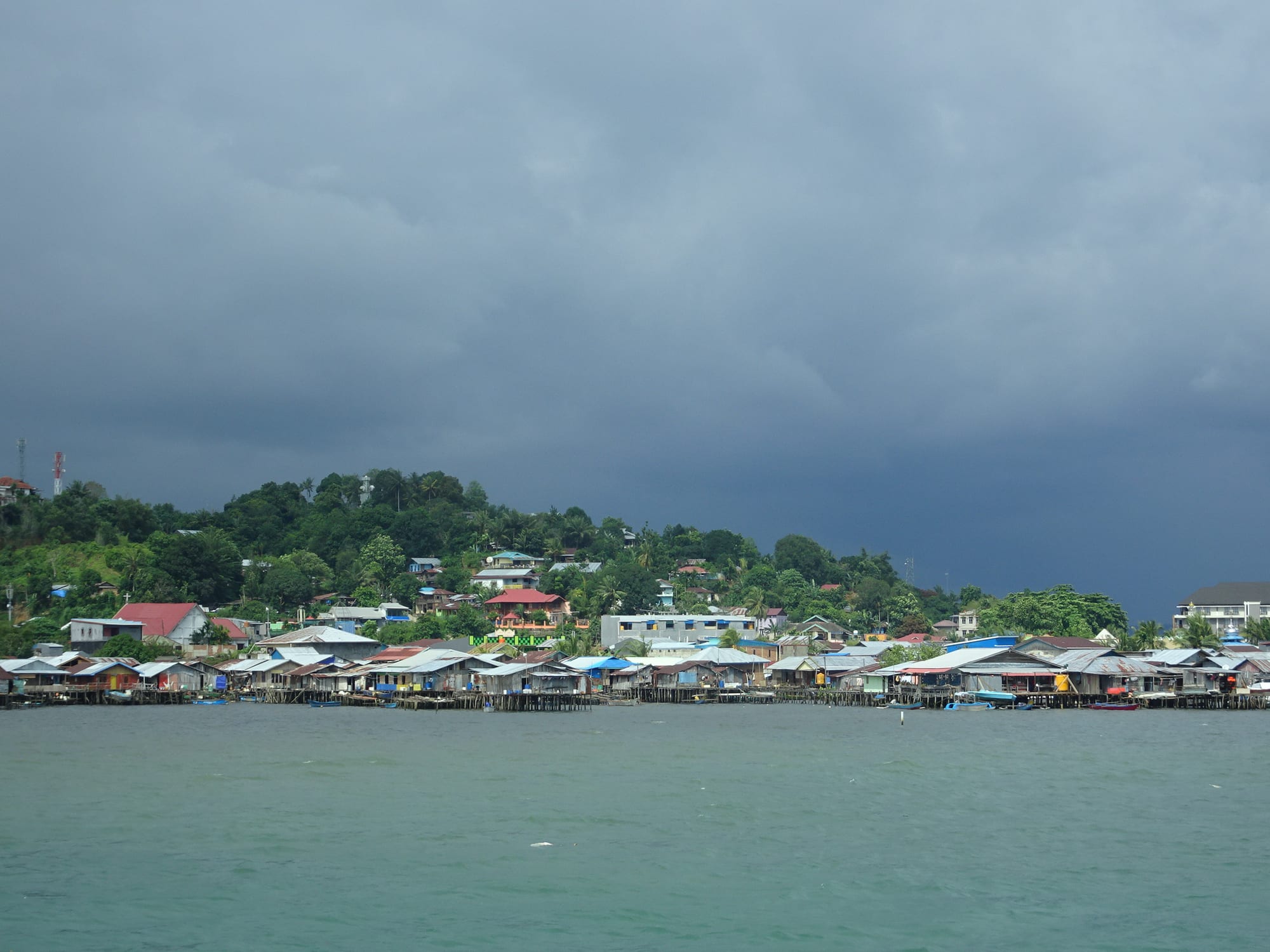
A shoreline of low buildings below wooded hills, seen from the water under a heavy grey sky

Maluku & Papua, Indonesia

Sorong

The waterfront of Sorong seen from the sea. (Lord Mountbatten / Wikimedia Commons · CC BY-SA 4.0)

A port city on the north-western tip of the Bird's Head Peninsula in Papua, built up around oil in the 20th century and now the capital of Southwest Papua province. It is the largest city in the province and the place almost every visitor to Raja Ampat passes through, with ferries and fast boats crossing to Waisai from its passenger harbour.

Neighbourhoods

  • The city centre
    • First-time visitors
    • Markets
    • Close to public transport

    The blocks inland from the passenger harbour, where the hotels, banks, shops and government offices are, strung along a few busy streets. Minibuses run from here in every direction, and most travellers stay within walking distance of the port.

    Open in Maps
  • The harbour and Remu
    • Local life
    • Best for food

    The working waterfront and the market district behind it, with the passenger terminal, the fish and produce markets and rows of warungs. Noisy, crowded in the morning and the part of the city that shows what it does for a living.

    Open in Maps
  • Doom Island
    • Historic district
    • Quiet and residential

    A small island a few minutes offshore by boat, the administrative centre in Dutch times and still lined with older houses and colonial-era buildings. Life there is slow, the lanes are walkable, and boats cross regularly from the city.

    Open in Maps
  • Malanu and the airport road
    • Quiet and residential
    • Close to public transport

    The newer suburbs spreading inland along the road towards the airport, with housing estates, schools, churches and larger shops. Convenient for early flights rather than interesting in itself.

    Open in Maps
  • Tanjung Kasuari
    • Beaches
    • Quiet and residential

    The cape north-west of the centre, where the city runs out into sandy beaches and stands of casuarina. Families come at weekends, and there are a few simple places to eat by the water.

    Open in Maps

Things to do

In and around the city

  • Domine Eduard Osok Airporttransit hub

    The city's airport, named after a pastor from Sorong, and the main air gateway to western Papua and Raja Ampat.

    Open in Maps
  • Doom Islandneighborhood

    The old Dutch administrative island offshore, with weathered timber houses, a promenade and views back across the water to the city.

    Open in Maps

The Raja Ampat gateway

  • Raja Ampat Islandsattraction

    The archipelago off the coast, with reefs regarded as among the most biodiverse on Earth, reached by ferry or fast boat to Waisai.

    Open in Maps
  • Waisaitransit hub

    The capital of Raja Ampat on Waigeo, where the boats from Sorong arrive and the marine park permit is issued.

    Open in Maps

Islands and coast nearby

  • Salawatineighborhood

    The large island immediately across the strait, with fishing villages, forest and a coastline visible from the city's western beaches.

    Open in Maps
  • Batantaneighborhood

    A forested island north of Salawati with waterfalls and birdwatching, sometimes visited on the way to or from Raja Ampat.

    Open in Maps
  • Bird's Head Peninsulaattraction

    The north-western arm of New Guinea, with lowland rainforest, birds of paradise and Papuan villages inland from the city.

    Open in Maps

Seasonal events

  • Christmas and New YearDecember and January

    The biggest season of the year in a largely Christian city, with church services, decorated streets, family gatherings and crowded ferries as people travel home.

  • Indonesian Independence Day17 August

    Flag ceremonies, school parades and street games across the city, followed by boat and canoe races in some coastal districts.

Eat and drink

Long-standing places and food districts in Sorong. Hours, ratings and directions come from your maps app, always current.

Sorong classics

  • Papuan fish and sagorestaurant

    Warungs around the market serve ikan kuah kuning, fish in a yellow turmeric and lime broth, with rice or papeda, the sticky sago porridge of the region.

    Open in Maps
  • Grilled fish by the waterneighborhood

    Places along the waterfront and at Tanjung Kasuari grill skipjack, snapper and squid over coconut husk and serve them with rice and a raw chilli, tomato and lime relish.

    Open in Maps
  • Makassar and Javanese kitchensneighborhood

    Migration has brought coto and konro soups from South Sulawesi, Javanese fried rice and noodles, and Padang food to the streets around the centre.

    Open in Maps

Markets

  • Remu marketmarket

    The city's main market, selling fish, sago, vegetables, betel nut and household goods, busiest early in the morning.

    Open in Maps
  • The harbour fish marketmarket

    Tuna, reef fish and squid landed beside the passenger port and sold from the quay, much of it bound for the city's grills.

    Open in Maps

Experience Sorong

History

The coast around Sorong has been inhabited by Papuan peoples for thousands of years, with the Moi as the customary landowners of the area the city now occupies. For centuries the whole Bird's Head coast lay within the tributary reach of the sultanate of Tidore, which claimed the Papuan shores and drew tribute through local intermediaries, while the Dutch presence remained thin and coastal into the nineteenth century.

The modern city is an oil town. In the 1930s a Dutch-led petroleum company began exploring the Bird's Head, striking oil inland at Klamono, and set up its operations on Doom Island and the mainland opposite, building housing, wharves and workshops where there had been villages. Japanese forces occupied the area during the Second World War, and Allied bombing and the fighting along the coast damaged the installations. After the war the Dutch, who kept western New Guinea until 1962, ran the local administration from Doom.

Oil production shifted and declined, but the port, the airfield and the labour force remained, and Sorong grew into the commercial gateway of the region, taking in migrants from Sulawesi, Maluku and Java as well as Papuans from the interior. Logging, plantation crops, fishing and shipping replaced petroleum as the main earners. From the early 2000s the rise of Raja Ampat tourism gave the city a new role as a transit point, and in 2022, when Papua was divided into more provinces, Sorong became the capital of the new province of Southwest Papua.

Culture & Customs

Sorong is a meeting point rather than a single culture. The Moi and other Papuan peoples of the Bird's Head hold customary rights over land in and around the city, asserted in negotiations over development and plantations, and their languages, dances and feast traditions continue in the villages close by. Alongside them live long-settled Bugis and Makassarese traders, Butonese and Ambonese families, Javanese transmigrants and Chinese-Indonesian shopkeepers, and the everyday language of the streets is Papuan Malay.

Church life is central for many residents — Protestant, Catholic and Pentecostal congregations all have a strong presence, with choirs, youth groups and long Sunday services — while mosques serve the substantial Muslim community, particularly among migrants from Sulawesi. Christmas and the New Year dominate the calendar, and Ramadan and Eid are marked in the same streets a few months apart. Relations are generally practical and neighbourly, though the balance between Papuans and newcomers is a live issue.

Music is everywhere: church choirs, guitars on verandas in the evening, and the Papuan pop and reggae played from shops and minibuses. Betel nut is chewed widely and sold at market stalls. Visitors are usually greeted with curiosity, and the city's own attitude to them is matter-of-fact, since most people passing through are contractors, officials or divers waiting for a boat rather than tourists staying to look around.

Daily Life

About 286,000 people live in the city of Sorong, the largest in Southwest Papua province and the main hub in the west of the island. It works as a hub: the port handles cargo and passengers for the whole region, the airport connects western Papua to the rest of Indonesia, and wholesalers, hardware shops, fuel depots and shipping agents fill the streets behind the harbour. Government employment grew after the city became a provincial capital, and construction has followed.

Beyond that, the economy runs on fishing and fish processing, logging and timber handling, palm oil from plantations inland, services for the oil and gas industry, and the trade generated by Raja Ampat, from ferry tickets and hotels to boat fuel and supplies. Many households also depend on small-scale selling — market stalls, food carts, motorbike taxis.

Mornings start early, with the markets busy before dawn and the ferries loading soon after; the middle of the day is hot and slow, and the evening brings people out to the waterfront and the food stalls. Housing spreads inland up the hills and along the airport road, with areas of stilt housing over the water at the shoreline. The recurring problems are familiar ones for a fast-growing Papuan city: water supply, drainage and flooding after heavy rain, waste, the cost of imported goods, and disputes over customary land as the city expands.

Food

Sorong eats from the sea. Tuna, skipjack, snapper, grouper, squid and octopus come in daily, and the standard treatments are ikan bakar, grilled whole over coconut husk, and ikan kuah kuning, poached in a broth yellow with turmeric and sharp with lime and lemon basil. Sambal colo-colo, raw chopped chilli, shallot, tomato and lime, is spooned over both. With it comes rice, or papeda, the translucent sago porridge that is the traditional staple of Papua and Maluku, twirled from the pot with sticks and eaten with the broth.

Sago appears in other forms too — baked into hard slabs called sagu lempeng, mixed with coconut into sweet cakes, or sold as flour in the market — and sweet potato, cassava and bananas fill out the Papuan side of the table. The city's migrant kitchens supply the rest: coto and konro soups and grilled fish with dabu-dabu from Sulawesi, Padang food ladled from window displays, Javanese fried rice, noodles and bakso, and Chinese-Indonesian dishes in the older shops near the centre.

Markets sell betel nut, tropical fruit, bundles of greens and fresh sago alongside imported rice and packaged goods, and the price difference between local and shipped food is obvious. Drinks are sweet tea, strong coffee, and fresh coconut; sopi, a palm spirit common in eastern Indonesia, circulates in some communities but is not sold openly. Street stalls in the evening deal in fried snacks, grilled corn, martabak and sweet pancakes.

Planning tools

Budget

Sorong is more expensive than western Indonesia because almost everything arrives by ship or plane, but far cheaper than the islands it serves. Hotels aimed at business travellers and contractors are the main cost, and most visitors spend only a night or two either side of a boat. The Raja Ampat marine park permit is usually bought here, and is an extra fixed cost on top of the ferry.

Daily Budget Midrange
USD 85–230 (business hotel, restaurant meals, taxis, ferry and domestic flights)
Daily Budget Shoestring
USD 25–45 (simple hotel or guesthouse, warung meals, shared minibuses)

Draw cash here rather than in the islands, where machines are few, and allow for a hotel night at either end of a Raja Ampat trip, since flights and boats rarely connect on the same day.

Best Time to Visit

The city can be visited at any time, and its weather varies little. Most people come between October and April, when seas in Raja Ampat are calmest and boats run reliably. The middle of the year is windier, with rougher crossings, and rain is heavy in any month.

Suggested Number of Days

Most visits are a night either side of a boat to the islands. A day is enough for the city itself and the island across the water; anyone travelling inland on the peninsula, or waiting on a flight or ferry connection, needs to allow more.

First Visit
1 day
With Surroundings
2–3 days

Transportation

Shared minibuses, called angkot, run fixed routes across the city for a flat fare, and motorcycle taxis and ride-hailing apps cover the rest. Taxis wait at the airport and the harbour. Small boats cross to Doom Island from the waterfront, and the passenger port is the departure point for Raja Ampat and for Pelni ships along the coast.

Fares for motorbike rides and taxis are agreed in advance rather than metered, and traffic between the airport, the centre and the port is slow at the start and end of the day, so connections need a margin.

Airport & Station Connections

Domine Eduard Osok Airport is about 8 km from the centre, with flights to Jakarta, Denpasar, Makassar, Manado, Jayapura, Timika and Manokwari. Pelni passenger ships call at the port on their long-distance routes, and ferries and fast boats leave the passenger harbour for Waisai in Raja Ampat.

Walkability

The centre and the harbour district are flat and can be walked, and the market area is best seen on foot, but pavements are uneven or missing, traffic is constant and the heat and humidity are draining. Beyond the centre the city spreads out along the main roads, and almost everyone uses a minibus or a motorbike.

Safety

Sorong is among the calmer parts of Papua, and ordinary crime — theft from rooms, bag-snatching in crowds, disputes late at night around bars — is the main concern. Papua as a whole is affected by a long-running separatist conflict, concentrated in the central highlands rather than here, and access to some areas can close at short notice or require permission from the authorities. Malaria is common, and road and boat travel carry the usual risks.

Take malaria precautions, travel in the highlands only with a reputable local guide, and follow any restrictions from the authorities. Wear a helmet and only ride a scooter if experienced, avoid cheap cocktails and home-brewed spirits, dress modestly outside Bali and beach resorts, and heed volcano exclusion zones and tsunami warnings. Check current official travel advice before travelling.

Climate

Equatorial, hot and wet all year, with days around 31–32°C, nights near 24°C and very high humidity. Rain falls in every month, often as sudden heavy downpours, and there is no reliable dry season; winds rather than rainfall decide how comfortable the sea crossings are.

Summer
June–September: still about 31°C, windier, with choppier seas on the Raja Ampat crossing
Winter
November–March: about 31°C by day and 24°C at night, with heavy rain but calmer water

Local Customs

Sorong is a mixed city: Papuan communities alongside large numbers of settlers from Sulawesi, Maluku and Java, and both churches and mosques are prominent. Dress is modest by the standards of Bali or Jakarta, Sunday mornings are quiet, and betel chewing is common in markets. Papuan identity and the politics around it are sensitive subjects, discussed cautiously in public.

Ask before photographing people, markets or anything official, avoid photographing police, military or port installations, and leave questions about Papuan politics to local people to raise.

Common Payment Methods

The currency is the Indonesian rupiah. Banks and cash machines are easy to find in the centre and at the airport, and hotels and larger shops take cards, but markets, minibuses, boats and warungs are cash only. This is the last convenient place to draw money before Raja Ampat, where machines are scarce and often empty.