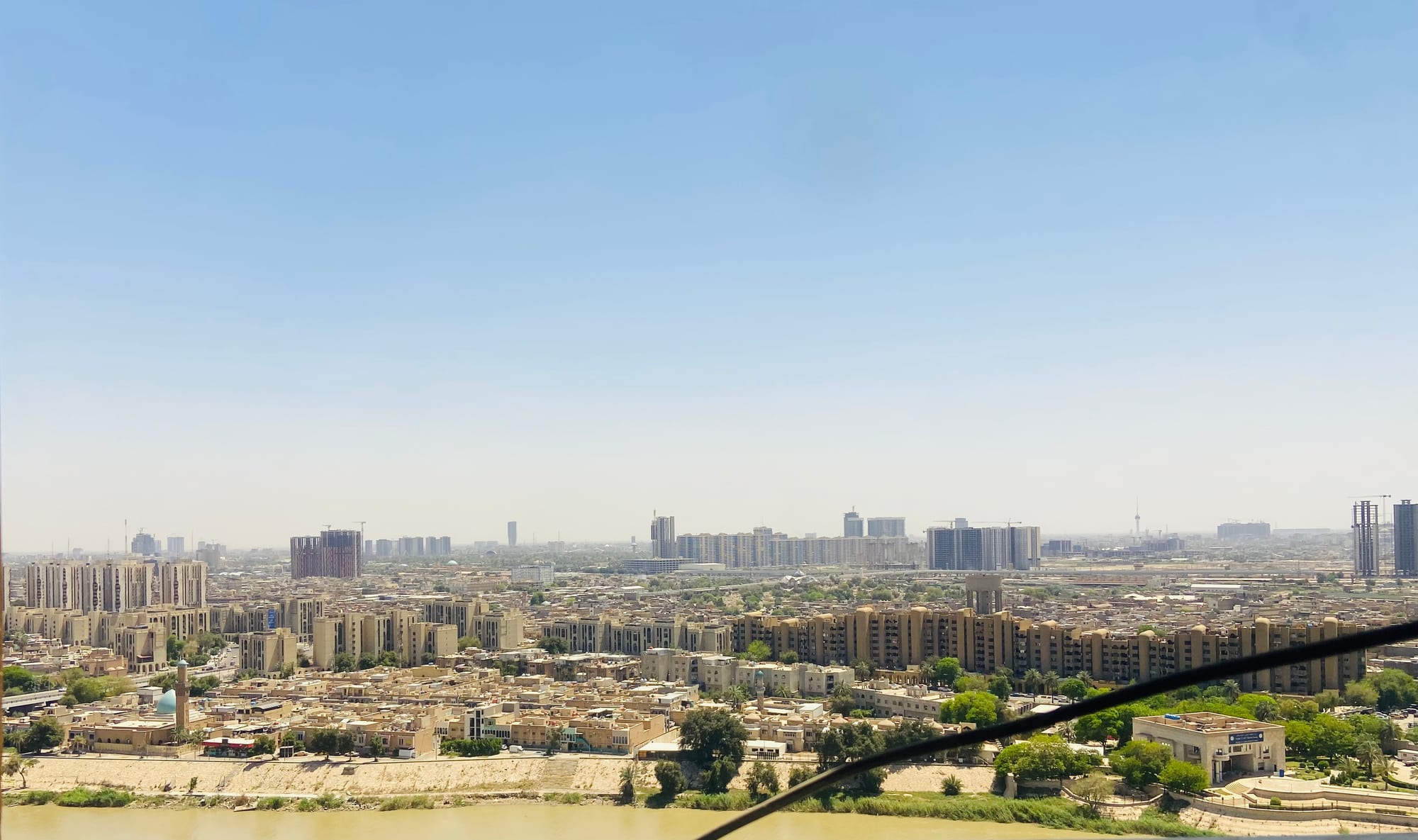
A wide view over the flat rooftops and apartment blocks of Baghdad with the brown Tigris in the foreground under a pale sky

Baghdad, Mosul & Central Iraq, Iraq

Baghdad

Baghdad seen across the Tigris from the Medical City complex. (Mohammed Qays / Wikimedia Commons · CC BY-SA 4.0)

Iraq's capital, founded on the Tigris in 762 as the Abbasid Round City and for a time the largest city in the world. Sacked by the Mongols, ruled by Ottomans and then British, it became the capital of modern Iraq in 1921 and carries the marks of four decades of war. This page is written to explain the city, not to encourage travel.

Neighbourhoods

  • Karrada
    • First-time visitors
    • Best for food
    • Shops

    A peninsula of the east bank wrapped in a bend of the Tigris, and the city's main commercial district. Its long shopping streets hold restaurants, sweet shops, electronics stores and many of the newer hotels, and it stays busy into the evening.

    Open in Maps
  • Rusafa and Al-Rashid Street
    • Historic district
    • Bookshops
    • Architecture

    The old east-bank core, laid out around Al-Rashid Street, the boulevard of colonnaded shopfronts cut through the city by the Ottoman administration in 1914. Mutanabbi Street, the Mustansiriya madrasa, the copper and cloth markets and the riverside sit within a short walk of each other.

    Open in Maps
  • Karkh
    • Local life
    • Markets

    The west bank, whose markets traded outside the walls of the caliph's Round City. Today it is a spread of residential districts, government buildings and busy roads, with the Al-Zawraa park and zoo near its centre.

    Open in Maps
  • Kadhimiya
    • Religious sites
    • Local life

    A northern district of the west bank built around the gold-domed shrine of the seventh and ninth Shia imams. Covered lanes of jewellers, perfume sellers and sweet shops lead to the shrine courtyard, and pilgrims fill the area during the religious calendar's main commemorations.

    Open in Maps
  • Adhamiyah
    • Historic district
    • Quiet and residential

    Across the river from Kadhimiya on the east bank, grown up around the tomb and mosque of Abu Hanifa, founder of one of Sunni Islam's four schools of law. Streets of older courtyard houses and cafés run down towards the Tigris.

    Open in Maps

Things to do

Famous landmarks

  • Al-Mustansiriya Madrasahlandmark

    A brick college beside the Tigris, founded by the caliph al-Mustansir in 1227 and opened for study in 1233, with a courtyard of pointed arches and one of the finest surviving landmarks of Abbasid Baghdad.

    Open in Maps
  • Abbasid Palacelandmark

    A brick courtyard building near the eastern bank of the Tigris, its corridors opening onto the courtyard through pointed arches and vaulted with muqarnas, generally dated to the late twelfth or early thirteenth century.

    Open in Maps
  • Al-Kadhimiya Mosquelandmark

    The shrine of the imams Musa al-Kadhim and Muhammad al-Jawad, with twin gold domes and four minarets, one of the major pilgrimage sites of Shia Islam.

    Open in Maps
  • Abu Hanifa Mosquelandmark

    The mosque and tomb of the eighth-century jurist Abu Hanifa in Adhamiyah, one of the most important Sunni sites in Iraq.

    Open in Maps
  • Al-Shaheed Monumentlandmark

    A split turquoise dome on an island in an artificial lake, designed by the sculptor Ismail Fatah al-Turk and opened in 1983 as a memorial to Iraq's war dead.

    Open in Maps
  • Victory Archlandmark

    Two pairs of enormous forearms holding crossed swords over a parade ground, raised in 1989 to mark the end of the Iran–Iraq War.

    Open in Maps

Museums

  • National Museum of Iraqmuseum

    The country's central collection of Sumerian, Assyrian, Babylonian and Islamic antiquities, looted in 2003 and reopened after years of recovery work and restoration.

    Open in Maps
  • Baghdadi Museummuseum

    A museum of old Baghdad life on the riverbank, using life-size figures to show trades, weddings, cafés and street scenes of the late Ottoman and early modern city.

    Open in Maps

Streets, markets and the riverside

  • Mutanabbi Streetmarket

    The booksellers' street off Al-Rashid Street, named for the tenth-century poet, where stalls and shops spill onto the pavement and poets, writers, students and booksellers gather from early morning until late at night.

    Open in Maps
  • Freedom Monumentlandmark

    Bronze figures on a travertine wall above Tahrir Square by Jewad Selim and his wife Lorna Selim, who finished it after his death for its opening in 1961. It reads from right to left, like Arabic verse, from the 1958 revolution to independence.

    Open in Maps
  • Shorjamarket

    The city's oldest and largest wholesale market, a dense grid of lanes selling spices, cloth, household goods and almost everything else.

    Open in Maps
  • Al-Zawraa Parkpark

    A large public park in Karkh with gardens, a funfair and the Baghdad Zoo, and the city's main open space for family outings.

    Open in Maps

Short trips from the city

  • Ctesiphonlandmark

    The Parthian and Sasanian capital about 35 km south-east, where the vast brick arch of Taq Kasra still spans the ruins of a throne hall.

    Open in Maps
  • Dur-Kurigalzulandmark

    The Kassite city known as Aqar Quf, west of Baghdad, whose eroded ziggurat of mud brick and reed matting rises above the plain.

    Open in Maps
  • Babylonlandmark

    The Mesopotamian capital of Hammurabi and Nebuchadnezzar II near Hillah, about 85 km south, with reconstructed walls and a UNESCO World Heritage listing.

    Open in Maps
  • Great Mosque of Samarralandmark

    The ninth-century mosque north of Baghdad whose spiral Malwiya minaret is part of a UNESCO World Heritage Site.

    Open in Maps

Seasonal events

  • Ramadanvaries with the lunar calendar

    A month of daytime fasting that empties the streets by afternoon and fills them after sunset, when restaurants, cafés and markets stay open late.

  • Ashurathe month of Muharram, varies with the lunar calendar

    Ten days of mourning for Imam Hussein, marked in Kadhimiya and other districts with black banners, processions and free food handed out in the street.

  • Arba'eenforty days after Ashura

    One of the world's largest gatherings, when pilgrims walk south from Baghdad and beyond towards Karbala and roadside tents feed them along the way.

  • Eid al-Fitrat the end of Ramadan

    Several days of family visits, new clothes and crowded parks and funfairs, with kleicha and date pastries offered to every guest.

Eat and drink

Long-standing places and food districts in Baghdad. Hours, ratings and directions come from your maps app, always current.

Baghdad classics

  • The masgouf grills of Abu Nuwas Streetneighborhood

    Riverside restaurants where carp is split, salted and propped upright around an open wood fire, then finished over the embers and eaten with bread, onion and tomato.

    Open in Maps
  • Shabandar Cafécafe

    The old tea house at the end of Mutanabbi Street, its walls covered in photographs of Baghdad, long a meeting place for writers and booksellers.

    Open in Maps

Markets and food districts

  • Shorja marketmarket

    Spice merchants, dried limes, pickles, nuts and dates sold by the sack in the lanes of the old wholesale market.

    Open in Maps
  • Karrada's restaurants and sweet shopsneighborhood

    The city's main eating-out district, with grills, kebab houses, juice bars and shops selling baklava, zalabia and ice cream.

    Open in Maps
  • The lanes around the Kadhimiya shrineneighborhood

    Covered alleys of sweet sellers, tea stalls and simple kitchens serving pilgrims rice, stew and dates through the day.

    Open in Maps

Experience Baghdad

History

Baghdad was founded in 762 by the Abbasid caliph al-Mansur as Madinat al-Salam, the City of Peace, laid out as a perfectly round walled city on the west bank of the Tigris where the two rivers run close together and old canals crossed the plain. Within a century it was among the largest cities on earth, the seat of Harun al-Rashid, a centre of translation and scholarship associated with the House of Wisdom, and the place where paper-making reached the Arab world. Floods, civil wars between the caliph's sons and the removal of the court to Samarra between 836 and 892 wore the Round City away; nothing of it survives above ground.

The Mongol army of Hulagu took the city in 1258, killed the last Abbasid caliph and destroyed its libraries and canal works. Under Ottoman and Persian rule Baghdad became a provincial capital, prosperous in a smaller way, with a mixed population of Sunni and Shia Muslims, a large Jewish community, Christians and Kurds. British forces took it in 1917, and in 1921 it became the capital of the new Kingdom of Iraq. Oil money after 1958 paid for boulevards, bridges and concrete housing, and the population multiplied.

The Iran–Iraq War of the 1980s, the 1991 Gulf War and the 2003 invasion each cut deeper: infrastructure failed, the National Museum was looted, and the sectarian violence that followed rebuilt whole districts behind blast walls and divided Sunni and Shia quarters. ISIS came close to the city in 2014. Mass protests in Tahrir Square in 2019 brought down a government. Since 28 February 2026 the war between the United States and Israel and Iran and its allies has reached Iraq, with drone strikes reported around the airport.

Culture & Customs

Baghdad's oldest boast is literary. "Cairo writes, Beirut publishes, Baghdad reads" is repeated across the Arab world, and the city's proof is Mutanabbi Street, where booksellers have traded for generations and the pavements fill with poets, students and second-hand dealers; it was rebuilt after a bombing in 2007. The tea houses along and behind it, filled with cigarette smoke, backgammon and photographs of the old city, are where that culture meets.

Music here means the maqam al-Iraqi, a formal vocal tradition sung with a small ensemble of santur, joza and percussion, alongside the popular songs and choubi dancing heard at weddings. Modern Iraqi art largely began in Baghdad: Jewad Selim and Faiq Hassan led a generation that mixed Mesopotamian motifs with European training, and Selim's Freedom Monument, a frieze of cast bronze figures, still faces Tahrir Square.

The city is mixed. It is now mainly Shia, with long-established Sunni districts such as Adhamiyah, small Christian and Mandaean communities, and Kurdish and Turkmen families; a Jewish community numbering tens of thousands before 1950 has almost entirely gone. Manners are formal and warm: guests are pressed to eat, invitations are repeated, and hospitality is a matter of honour. Football is the common ground, followed intensely, and street football fills any flat surface in the evening.

Daily Life

About eight million people live in Baghdad and its suburbs, roughly a fifth of Iraq's population, spread over both banks of the Tigris and out into new districts on the desert edge. The city runs on the state: ministries, the security forces and state companies employ enormous numbers, and private work is concentrated in trade, construction, transport and small workshops. Rents in central districts are high, and young families move outwards.

The day begins early, before the heat. Offices and schools finish in the early afternoon, shops close and reopen in the cooler evening, and the parks, the riverside and the shopping streets of Karrada fill after dark. Summer power cuts are the defining frustration: the national grid supplies only part of the day, and most households also pay a neighbourhood generator for a fixed number of amperes. Water quality, dust storms and the heat itself shape the summer.

Traffic is the other constant. Checkpoints, closed roads and concrete blast walls, many of them removed in recent years, make journeys unpredictable, and the bridges over the Tigris are choke points. Beneath it all Baghdad has been rebuilding: new malls, cafés and riverfront projects have appeared, young people fill them, and returning families have reopened shuttered houses. Corruption, jobs for graduates and the reliability of water and power dominate public argument.

Food

Masgouf is the city's dish: a large carp from the Tigris, split down the back, rubbed with salt and tamarind or turmeric, set upright on stakes around a wood fire to cook slowly, then laid over the embers and served on a tray with flat bread, onion, tomato and lemon. The grills along Abu Nuwas Street have cooked it in view of the river for decades.

Breakfast is a Baghdad institution. Kahi, a flaky layered pastry baked and soaked in syrup, is eaten with geymar, the thick clotted cream made from buffalo milk, and washed down with sweet tea. The heavier option is pacha, sheep's head, trotters and stomach stuffed and simmered for hours, sold in specialist shops in the old quarters. Samoon, the diamond-shaped bread baked against the wall of a stone oven, comes hot out of bakeries all day.

At home the standards are tepsi baytinjan, a tray of aubergine, minced meat and tomato baked together; dolma, vine leaves and hollowed vegetables stuffed with spiced rice; quzi, slow-cooked lamb over rice with nuts and raisins; and stews of okra or white beans poured over rice, sharpened with noomi Basra, dried black lime. Kebab and grilled chicken shops line every commercial street.

Dates appear at every stage, fresh in late summer, dried year round, pressed into dibis syrup and baked into kleicha, the date-filled cookies made for Eid. Sweets run to baklava, zalabia and halawat sha'riya, and tea is drunk strong and very sweet from small istikan glasses, with cardamom coffee after a meal.

Planning tools

Budget

Baghdad is the most expensive place in Iraq to sleep: the hotels used by foreign visitors charge well above what the building would fetch elsewhere, while simple local hotels are cheap. Food, taxis and museum entry cost little. The largest single expense for most visitors is a car with a driver, hired by the day, since crossing the city otherwise is slow.

Daily Budget Midrange
USD 120–250 (better Baghdad hotel, private car and driver, guide)
Daily Budget Shoestring
USD 50–90 (simple local hotel, street food and kebab houses, shared taxis)

Bring US dollars in cash and change some into dinars; foreign cards rarely work, and the price of a day's car hire should be agreed in advance.

Best Time to Visit

November to March, when days are mild and the heat and dust have gone. Spring and early summer bring dust storms, and July and August are punishing. Since February 2026 the war between the United States and Israel and Iran and its allies has disrupted flights and travel across the Middle East, so current conditions matter more than the season.

Suggested Number of Days

Two or three days covers the museums, the old centre and the shrines. Traffic and checkpoints eat into each day, so plan fewer stops than the map suggests. Adding the ancient sites within reach of the city, or the shrine cities to the south, takes the total to four to six.

First Visit
2–3 days
With Surroundings
4–6 days

Transportation

Almost all movement is by road. Shared and private taxis and ride-hailing apps cover the city, and buses and minibuses run the main corridors, but there is no metro and traffic is heavy, with queues at checkpoints and river bridges. Most foreign visitors travel with a local operator's car and driver, which also simplifies checkpoints. A slow passenger railway links Baghdad with Basra.

Carry passport and visa copies for checkpoints, agree taxi fares before setting off, and allow far more time than the distance suggests.

Airport & Station Connections

Baghdad International Airport lies about 16 km west of the centre and has flights to the Gulf, Turkey, Europe and other Iraqi cities, though schedules have changed at short notice since the war that began in February 2026. Road access to the terminal runs through security screening, so transfers take longer than the distance implies. Highways run north to Samarra and Mosul and south to Hillah, Karbala, Najaf and Basra.

Walkability

Individual districts walk well — Mutanabbi Street and Al-Rashid Street, the Kadhimiya lanes, the Abu Nuwas riverside and the Karrada shopping streets are all best seen on foot. Between districts it is another matter: the city is spread over both banks of the Tigris, pavements are broken or blocked, crossings are few, blast walls close some routes, and summer heat makes any distance hard. Most visitors walk a district and drive between them.

Safety

Globeway covers this city so that it can be understood. Most Western governments advise against all or all-but-essential travel to Iraq, including Baghdad, although the capital is visited on tours and increasingly independently. Risks include militia activity, kidnapping, occasional rocket and drone fire, demonstrations that can turn violent, and crowd crushes at large religious gatherings. Since the regional war began in February 2026, drone attacks on military sites, including around Baghdad International Airport, have been reported repeatedly.

Follow the current government travel advisories, use a local operator, keep away from border areas and demonstrations, and never stray off cleared ground near former front lines. In the city, keep away from protests and official convoys, do not photograph checkpoints, security buildings or soldiers, and agree an itinerary and contact plan with a local host. Check current official travel advice before travelling.

Climate

Hot desert climate with a very long summer. Rain falls only between November and April and amounts to little; spring and early summer bring dust storms that close the airport for hours at a time, and the Tigris does little to soften the heat.

Summer
extreme and dry — June to September days of 43–50°C, with nights that stay above 30°C
Winter
mild and short — days of 14–18°C, cold nights near freezing, and a few days of rain

Local Customs

Iraqi hospitality is insistent: tea will be offered everywhere and refusing it outright is awkward. Modest dress is expected for both men and women, with long sleeves and long trousers or skirts; women cover their hair at shrines, where black abayas are usually lent at the entrance, and non-Muslims are not admitted to some shrine interiors. Greetings are unhurried, and the right hand is used for eating and giving.

Ask before photographing people, and never photograph checkpoints, bridges, soldiers or government buildings. Tipping is not obligatory but small amounts are appreciated. Alcohol is sold in licensed shops and served in some hotels, but drinking in public is not acceptable; during Ramadan, eating, drinking or smoking in daylight in public should be avoided.

Common Payment Methods

The currency is the Iraqi dinar, and almost everything is paid for in cash. Foreign cards work in very few places and ATMs that accept them are scarce and unreliable, so visitors bring clean, undamaged US dollars and change them at exchange offices. Large dinar notes are the norm, and keeping small notes for taxis and tea is useful.