History
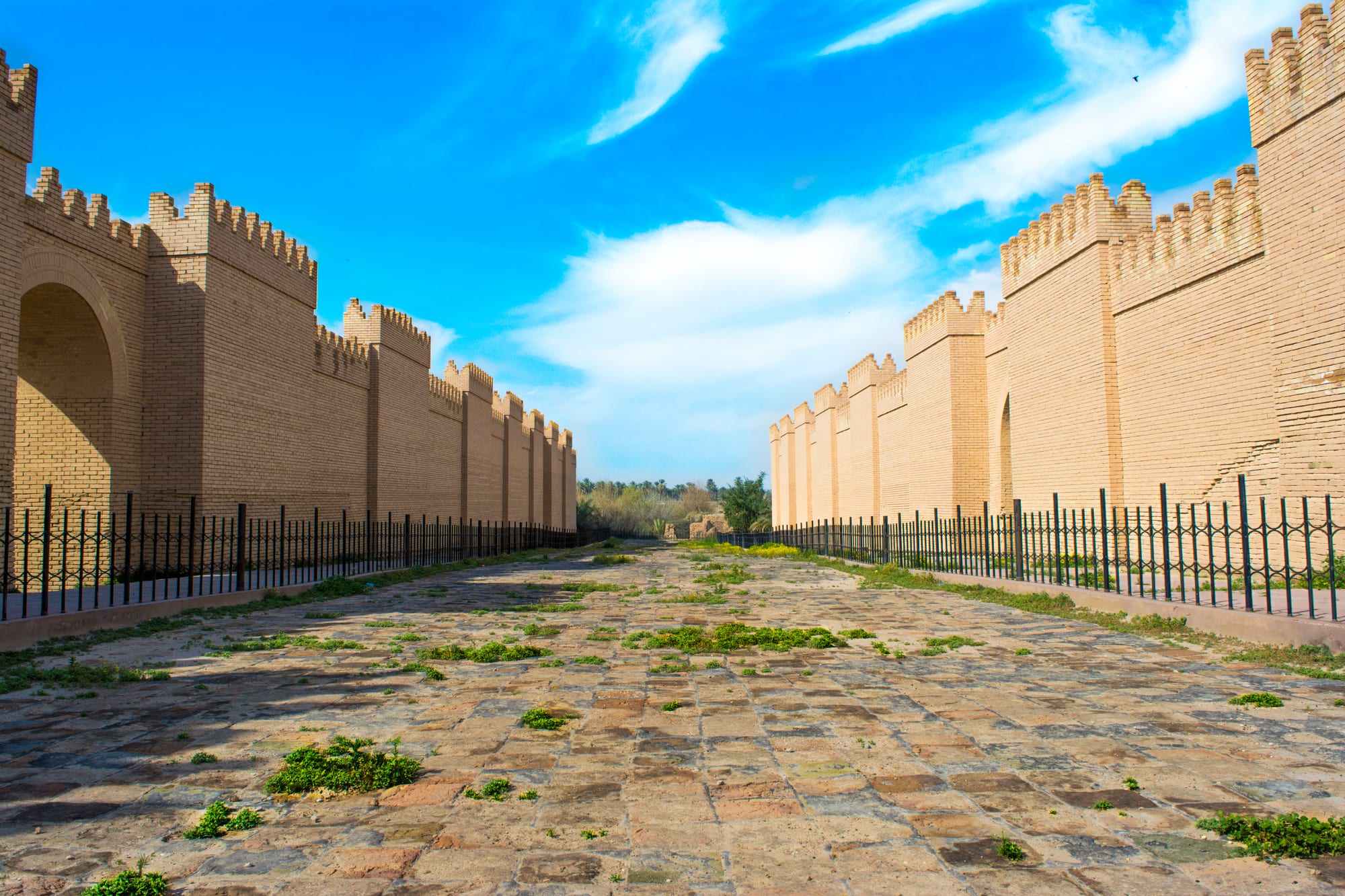
The land between the Tigris and Euphrates here held some of the great capitals of antiquity. Babylon, on the Euphrates, rose under Hammurabi in the 18th century BC and again under Nebuchadnezzar II in the 6th, whose walls, Ishtar Gate and hanging gardens made it a legend. To the north, Assur on the Tigris gave its name to the Assyrians, whose kings ruled from Nimrud and then Nineveh, opposite modern Mosul, until the Babylonians and Medes destroyed it in 612 BC. The Parthian and Sasanian empires ruled from Ctesiphon, south of Baghdad, and Hatra flourished as a desert caravan city.
After the Arab conquest, Kufa, in today's Najaf province, was an early capital, and the battle of Karbala in 680, where Imam Hussein was killed, founded Shia Islam's great act of mourning. In 762 the Abbasid caliph al-Mansur built the Round City of Baghdad on the Tigris, and the caliphs moved to Samarra from 836 to 892. The Mongol sack of Baghdad in 1258 ended the golden age, and after centuries of Persian and Ottoman rivalry, the Ottomans governed from Baghdad and Mosul.
In the modern era Baghdad became the capital of the British-backed kingdom in 1921, and Kirkuk's oil was struck at Baba Gurgur in 1927. Saddam Hussein came from near Tikrit. After 2003 the region bore the worst of the insurgency and the sectarian war, which the 2006 bombing of Samarra's al-Askari shrine inflamed. In 2014 ISIS took Mosul and much of Anbar, Salah ad-Din and Nineveh, destroying Nimrud and Hatra's statues and murdering and enslaving Yazidis at Sinjar; Mosul was retaken in 2017 after months of fighting that left its old city in ruins.