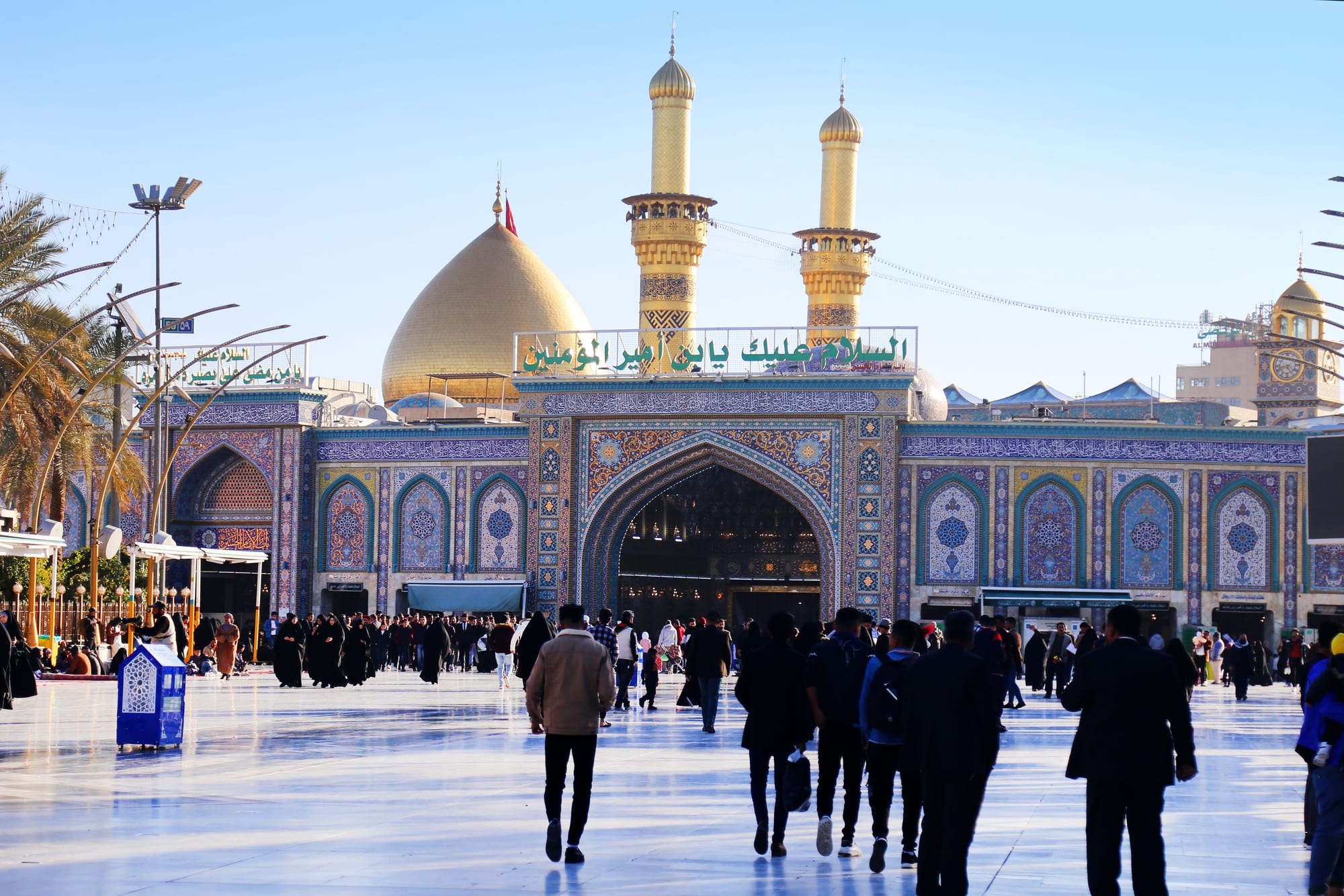
A tiled shrine gateway with a golden dome and two gold minarets behind it, seen across a wide paved plaza with pilgrims walking towards it

Baghdad, Mosul & Central Iraq, Iraq

Karbala

One of Karbala's two shrines seen across the marble plaza that links them. (Safa.daneshvar / Wikimedia Commons · CC BY-SA 4.0)

A city on the desert edge south-west of Baghdad, grown up around the place where Imam Hussein was killed in 680 and buried. Its two gold-domed shrines face each other across a marble plaza and draw millions of pilgrims each year, above all at Ashura and Arba'een. This page is written to explain the city, not to encourage travel.

Neighbourhoods

  • Bayn al-Haramayn and the shrine core
    • First-time visitors
    • Religious sites

    The marble plaza between the two shrines and the streets immediately around it, closed to cars and lit through the night. Almost everything a pilgrim needs is within a few minutes' walk, and the crowd never entirely thins.

    Open in Maps
  • The old bazaars
    • Markets
    • Local life

    Covered lanes running outwards from the shrine gates, selling prayer stones and rosaries, perfume, cloth, gold, dates and sweets. Tea stalls and small kitchens sit between the shops, and the alleys are busiest in the evening.

    Open in Maps
  • Bab Baghdad and the northern approach
    • Close to public transport
    • Quiet and residential

    The district along the road in from Baghdad and Musayyib, where the garages, bus stands and many of the larger pilgrim hotels stand. It is a short ride from the shrines and much quieter at night.

    Open in Maps
  • The outer city and the date gardens
    • Quiet and residential
    • Local life

    Beyond the ring road the city gives way to blocks of family housing, workshops and the palm and orchard belt that has watered Karbala for centuries, with the desert and Lake Razzaza further west.

    Open in Maps

Things to do

The shrines

  • Imam Husayn Shrinelandmark

    The mausoleum of Hussein ibn Ali, grandson of the Prophet Muhammad, killed at Karbala in 680, rebuilt many times around a golden dome, mirrored halls and a vast courtyard.

    Open in Maps
  • Al-Abbas Shrinelandmark

    The tomb of Hussein's half-brother Abbas ibn Ali, who died in the same battle carrying water to the camp, facing the Husayn shrine across the plaza.

    Open in Maps

Around the city

  • Lake Razzazaattraction

    An artificial lake in the desert west of the city, filled by water from the Euphrates diverted out of Lake Habbaniyah, salty and shallow, and listed as a wetland of international importance.

    Open in Maps
  • Hindiya Barragelandmark

    A barrage on the Euphrates north-east of Karbala, designed by the British engineer William Willcocks and built between 1911 and 1913 after the Hillah branch of the river silted up; a replacement dam was built upstream in the 1980s.

    Open in Maps

Short trips from the city

  • Al-Ukhaidir Fortresslandmark

    A large rectangular fortified palace of 775, built for Isa ibn Musa, nephew of the caliph as-Saffah, and standing almost intact in the desert about 50 km south of Karbala, with courtyards, a great iwan and a mosque.

    Open in Maps
  • Ain al-Tamrattraction

    An oasis town about 67 km west of Karbala near Lake Razzaza, its villages known for palm orchards, dates and mineral water, and long a stop on the old pilgrimage route.

    Open in Maps
  • Al-Kifllandmark

    A small town on the Euphrates east of Karbala built around the shrine traditionally identified as the tomb of the prophet Ezekiel, with an old brick minaret and a covered bazaar.

    Open in Maps
  • Babylonlandmark

    The Mesopotamian capital of Hammurabi and Nebuchadnezzar II near Hillah, with reconstructed walls and a UNESCO World Heritage listing, about 40 km east.

    Open in Maps

Seasonal events

  • Ashurathe tenth of Muharram, varies with the lunar calendar

    The commemoration of Hussein's death on the ground where it happened, with black banners over the whole city, mourning processions and re-enactments, and enormous crowds.

  • Arba'eenforty days after Ashura

    One of the largest gatherings on earth, when millions walk to Karbala, many of them on the road from Najaf, and roadside tents feed and shelter them free of charge.

  • Mid-Sha'banthe fifteenth of Sha'ban, varies with the lunar calendar

    The birthday of the twelfth imam, marked with lights, decorated streets and another large pilgrimage to the shrines.

  • Ramadan and Eid al-Fitrvaries with the lunar calendar

    Days of fasting followed by nights when the shrine plaza and the bazaars stay open and busy until very late, ending in several days of family celebration.

Eat and drink

Long-standing places and food districts in Karbala. Hours, ratings and directions come from your maps app, always current.

Karbala classics

  • Qeemaneighborhood

    A thick stew of finely minced meat and chickpeas, cooked in huge pots and ladled over rice; during Muharram it is made in vast quantities and given away in the street.

    Open in Maps
  • Dates and kleichamarket

    Karbala province is date country, and shops around the shrines sell them loose, pressed into dibis syrup and baked into kleicha, the date-filled cookies made for Eid.

    Open in Maps

Markets and food streets

  • The bazaars around the shrinesneighborhood

    Kebab grills, rice and stew kitchens, juice stalls and sweet shops packed into the covered lanes, serving pilgrims from early morning until long after dark.

    Open in Maps
  • Tea houses of the shrine plazacafe

    Small rooms and pavement stalls pouring sweet black tea into istikan glasses, the standard pause between visits to the two shrines.

    Open in Maps

Experience Karbala

History

Karbala's history begins with a battle. On the tenth of Muharram in the year 680, Hussein ibn Ali, grandson of the Prophet Muhammad, was killed with most of his family and companions on the plain here after refusing to recognise the Umayyad caliph Yazid. The dead were buried where they fell, and within a few years pilgrims were coming to the graves. A settlement grew around them, watered by a canal from the Euphrates, and the two tombs — Hussein's and that of his half-brother Abbas — became the fixed points of the town's plan.

The shrines were repeatedly enlarged, destroyed and rebuilt: the Abbasid caliph al-Mutawakkil had the tomb levelled and the ground flooded in the ninth century, and later Buyid, Safavid, Ottoman and Qajar rulers paid for domes, gold plating, tilework and walls. Wahhabi raiders from the Arabian peninsula sacked the city in 1802, and Ottoman troops besieged and stormed it in January 1843, killing thousands, after a long standoff with the local factions. Persian, Indian and Turkish endowments made it wealthy, and its seminaries rivalled those of Najaf.

In modern times the city has often been at the centre of Iraqi politics. It was one of the seats of the 1920 revolt against British rule, and after the 1991 Gulf War the Shia uprising that spread here was put down with heavy force. Pilgrimage was restricted under the Baath government and resumed on an enormous scale after 2003, though bombings repeatedly targeted the crowds in the years that followed. Today Karbala is one of the most visited cities in the Islamic world, and much of it has been rebuilt to handle the numbers.

Culture & Customs

Karbala's culture is the culture of mourning for Hussein, and it sets the rhythm of the year. During Muharram the city is hung with black cloth, husayniyya halls fill for nightly recitations of the battle, and processions move through the streets with drums, chants and the striking of chests. Poets compose new laments in Arabic and the passion play known as the ta'ziya re-enacts the events on the plain. Forty days later, at Arba'een, the walk from Najaf brings millions of people along a road lined with mawakib, volunteer tents that hand out food, tea, foot massages and floor space to sleep.

Hospitality here is close to an industry and a point of religious pride: families compete to feed strangers, and the free kitchens run day and night during the commemorations. Alongside the mourning, Mid-Sha'ban and the imams' birthdays bring lights, sweets and celebration, and the same streets look entirely different.

The city's other identity is scholarly. Its seminaries and libraries have taught for centuries, second in Iraq only to Najaf's, and religious publishing, prayer stones made from Karbala's soil, and the trade in rosaries and devotional objects all depend on that reputation. The permanent population is almost entirely Shia Arab, but the streets are full of Iranian, Pakistani, Indian, Lebanese, Gulf and African pilgrims, and the shopkeepers switch between several languages as a matter of course.

Daily Life

About 800,000 people live in Karbala, and on the biggest pilgrimage days that number is dwarfed by visitors. The pilgrim economy dominates: hotels, hostels and guesthouses, restaurants, transport, religious goods, gold and money-changing, along with construction work to widen streets and build new accommodation. The two shrine administrations are major institutions in their own right, employing thousands and running hospitals, schools, farms and building projects.

Around the city, agriculture still matters. Karbala province grows dates in large palm groves, along with vegetables and grain on Euphrates water, though drought, falling river flows and salinity have hurt farmers, and Lake Razzaza to the west has lost most of its fish to salt and changing water levels. Water and electricity shortages bite in summer here as everywhere in Iraq, and households rely on neighbourhood generators.

The day starts early with dawn prayers and the first arrivals at the shrines, and the shrine plaza never really empties. Shops close through the worst of the afternoon heat and reopen in the evening, when families come out to the pedestrian streets and the ice-cream and juice stalls. Traffic, housing costs driven up by the pilgrim trade, jobs for young people and the management of the enormous seasonal crowds are the issues that occupy the city.

Food

Karbala's signature dish is qeema, a stew of very finely minced meat and chickpeas cooked down to a thick, spiced sauce and served over rice. It is a Muharram tradition above all: enormous cauldrons are set up in the streets, the meat is pounded by hand, and the result is handed out free to anyone passing. Hareesa, wheat and meat pounded together into a smooth porridge, is cooked and shared the same way, and both are associated with vows and charitable giving.

The everyday food is the food of central Iraq. Kebab and grilled chicken shops surround the shrines, tashreeb layers torn bread under stewed lamb and broth, dolma stuffs vine leaves and vegetables with spiced rice, and biryani-style rice with meat and raisins is cooked in quantity for pilgrim kitchens. Samoon, the diamond-shaped bread, comes hot from stone ovens through the day, and breakfast is often kahi pastry with geymar clotted cream, or a bowl of pacha for those with an appetite for it.

Dates are Karbala's own crop and its souvenir: eaten fresh in late summer, dried the rest of the year, boiled into dibis syrup and folded into kleicha. Sweet shops pile up baklava, zalabia and sesame halva. Tea, strong and very sweet, is poured into small istikan glasses everywhere, and cardamom coffee is offered at the end of a meal or a visit.

Planning tools

Budget

Karbala is built for pilgrims, so simple hotels and cheap food are everywhere and costs are low by Iraqi standards. Prices rise steeply, and rooms disappear altogether, around Ashura, Arba'een and Mid-Sha'ban. The main expense for a foreign visitor is a car and driver, whether coming from Baghdad or Najaf or heading out to the desert sites.

Daily Budget Midrange
USD 110–220 (better hotel near the shrines, private car and driver, guide)
Daily Budget Shoestring
USD 35–70 (pilgrim hotel, local kitchens and street food, shared taxis)

Bring US dollars in cash and change some into dinars; book far ahead or avoid the city entirely during the great commemorations, when accommodation is scarce.

Best Time to Visit

November to March, when days are mild and walking between the shrines is comfortable. Ashura and Arba'een are the reason many people come and the reason others stay away, since the city is overwhelmed. Since February 2026 the war between the United States and Israel and Iran and its allies has disrupted flights and travel across the Middle East, so current conditions matter more than the season.

Suggested Number of Days

A day or two covers the two shrines and the bazaars around them. Three or four allows the desert fortress and oasis to the west and the river towns to the east. Religious commemorations change everything, lengthening journeys and filling every street.

First Visit
1–2 days
With Surroundings
3–4 days

Transportation

Everything moves by road. Shared taxis and minibuses run constantly to Baghdad, Najaf and Hillah from garages on the edge of the city, and taxis cover local trips. The shrine core is closed to vehicles, so arrivals are dropped at the edge of the pedestrian zone. Most foreign visitors use a local operator's car and driver, which also eases checkpoints.

Carry passport and visa copies for checkpoints, agree taxi fares before setting off, and expect roads into the city to be closed or diverted during religious commemorations.

Airport & Station Connections

Karbala has no airport of its own. Most visitors arrive by road from Baghdad, roughly two hours to the north-east, or from Najaf, about an hour to the south, whose international airport handles a large share of pilgrim flights. Basra and Baghdad are also linked by a slow passenger railway, and Karbala's road links run east to Hillah and Babylon.

Walkability

The centre is one of the most walkable places in Iraq: the plaza between the shrines and the surrounding lanes are pedestrian, flat, paved and lit all night, and shoes are left at the shrine entrances. Beyond that core the city is ordinary Iraqi urban sprawl with heavy traffic and poor pavements, and summer heat makes walking any distance unwise before evening.

Safety

Globeway covers this city so that it can be understood. Most Western governments advise against all or all-but-essential travel to Iraq, though Karbala is visited by millions of pilgrims and is reached on tours and increasingly independently. The particular risks here are crowd crushes during the great commemorations, extreme summer heat, and the wider country's militia activity, kidnapping risk and occasional rocket and drone fire. Since the regional war began in February 2026, drone and missile activity has been reported across Iraq.

Follow the current government travel advisories, use a local operator, keep away from border areas and demonstrations, and never stray off cleared ground near former front lines. In the city, treat the shrines as places of mourning rather than sightseeing, follow stewards' instructions in crowds, and avoid the densest gatherings if uneasy in packed spaces. Check current official travel advice before travelling.

Climate

Hot desert climate on the edge of the western desert, drier and dustier than the river towns. Rain falls only in winter and rarely amounts to much, and spring and early summer bring dust storms off the desert.

Summer
extreme and dry — June to September days of 43–48°C, with warm nights and glaring sun on the marble plaza
Winter
mild days of 14–19°C, cold nights, and a few spells of rain

Local Customs

This is a place of pilgrimage before it is a destination, and behaviour in and near the shrines matters. Women wear an abaya and cover their hair, usually borrowed at the entrance; men wear long trousers and sleeves. Shoes are removed and left with attendants, and men and women use separate entrances and sections. Phones and cameras are restricted inside, and bags are searched at every gate.

Ask before photographing people, especially mourners, and never photograph checkpoints or security staff. Alcohol is not sold here and should not be brought. Non-Muslim visitors are admitted to the shrine courtyards at the discretion of the staff, so it is worth asking rather than assuming, and quiet, modest behaviour is expected throughout.

Common Payment Methods

The currency is the Iraqi dinar and cash is used for almost everything. Foreign cards are accepted in very few places, and reliable ATMs for foreign cards are scarce, so visitors bring clean US dollars and change them at exchange offices, of which there are many near the shrines because of the pilgrim trade.