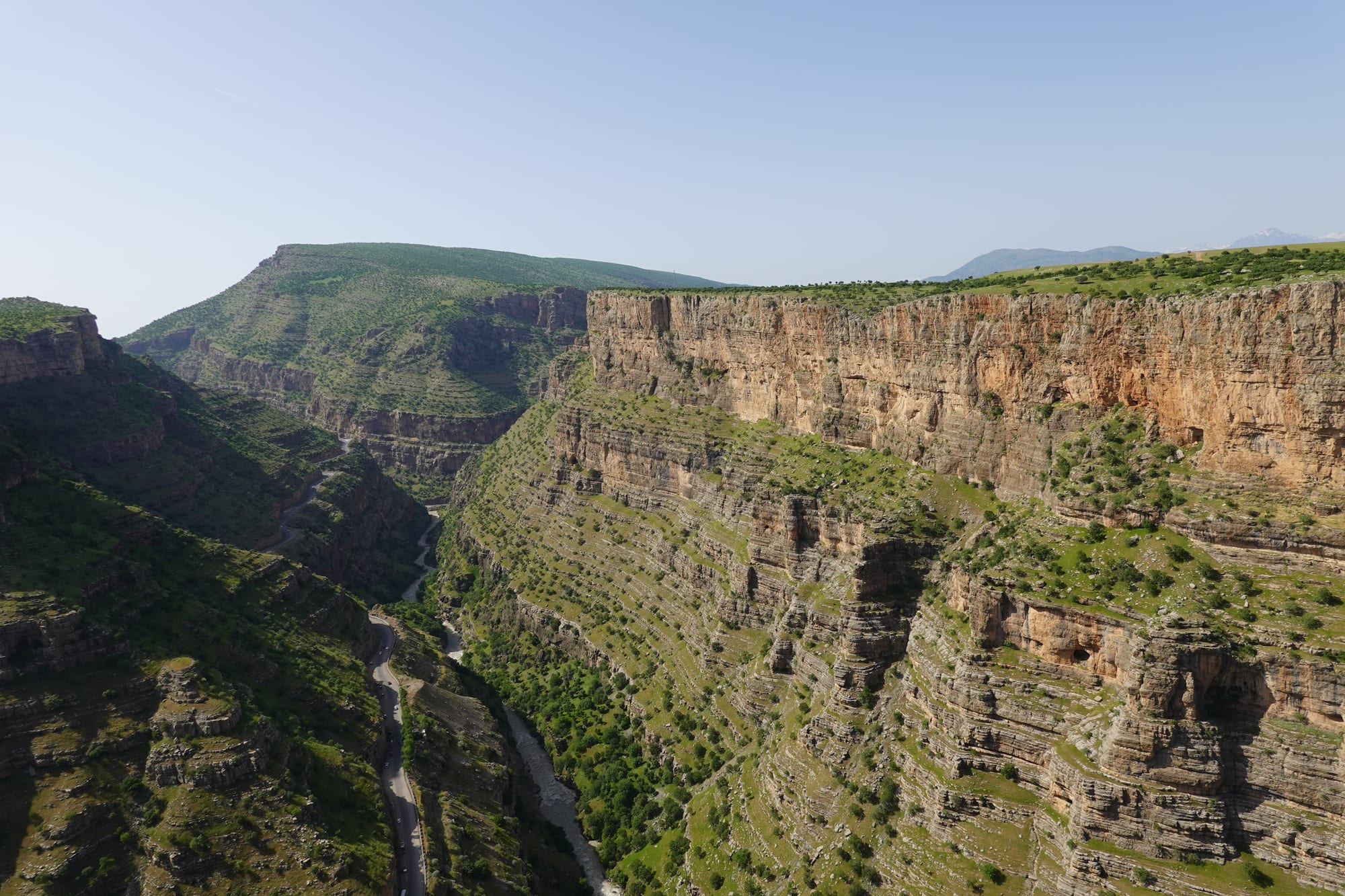
A deep green canyon with sheer orange limestone cliffs, a road and river winding along the valley floor

Iraq

The Kurdistan Region

The Rawanduz gorge in the mountains of Erbil province. (Khoshhat / Wikimedia Commons · CC BY 4.0)

The autonomous Kurdish north of Iraq, running from the plains around Erbil up into the Zagros and Taurus ranges on the Iranian and Turkish borders, with its own government and language, centred on Erbil, Sulaymaniyah and Dohuk. This page is written to explain the region, not to encourage travel to it.

Explore The Kurdistan Region

History

The mountains and foothills of the north have been settled since the Stone Age: Shanidar Cave, in the mountains of Erbil province, held Neanderthal burials tens of thousands of years old. Erbil, ancient Arbela, was an important Assyrian city with a temple of Ishtar on the mound that is now the citadel, and Alexander's victory over Darius III in 331 BC is also called the Battle of Arbela. The region later lay on the frontier between Rome and the Persians, and the Assyrian Church of the East spread through its villages.

In the Islamic period the Kurds were ruled by local dynasties and emirates. In the 12th and 13th centuries Erbil flourished under the atabeg Muzaffar al-Din Gökböri, who built its minaret. Under the Ottomans, Kurdish principalities — Soran at Rawanduz, Bahdinan at Amedi and Baban, whose prince founded Sulaymaniyah in 1784 — kept much autonomy until the 19th century.

After the First World War Britain added the region to the new state of Iraq, putting down revolts led by Sheikh Mahmud Barzanji in Sulaymaniyah in the 1920s. Mustafa Barzani led Kurdish uprisings from the 1940s onward. Under Saddam, the Anfal campaign of 1988 destroyed some 1,200 villages, and in 1988 a chemical attack on Halabja, near Sulaymaniyah, killed thousands in a day. After the 1991 uprising and a Western no-fly zone the Kurds gained self-government, recognised in Iraq's 2005 constitution. The region fought ISIS from 2014 and held an independence referendum in 2017, after which Baghdad took back Kirkuk and other disputed areas.

Culture & Customs

The region is Kurdish-speaking, but not in one dialect: Sorani, written in Arabic script, is spoken around Erbil and Sulaymaniyah, while Dohuk speaks Badini, a form of Kurmanji. Politics follow the same line: the Kurdistan Democratic Party, led by the Barzani family, dominates Erbil and Dohuk, and the Patriotic Union of Kurdistan, founded by Jalal Talabani, dominates Sulaymaniyah. The two fought a civil war in the 1990s, and the rivalry remains.

Most Kurds are Sunni Muslims, often worn lightly, and the region is home to Assyrian and Chaldean Christians, especially in Erbil's Ankawa district and around Dohuk, Turkmen in Erbil, and Yazidis, whose holy valley is at Lalish. Many Yazidis and Christians who fled ISIS in 2014 took refuge here, many in camps around Dohuk.

Newroz, the new year on 21 March, is the great festival, marked with bonfires on the hills, dancing and family picnics. Kurds love a picnic, and on Fridays and holidays families drive to the mountains, springs and waterfalls. Men may wear the shal u shapik suit of jacket and gathered trousers with a sash, and the halparke, a circle dance led by dancers twirling handkerchiefs, comes out at every celebration. Sulaymaniyah considers itself the region's cultural capital, with a strong tradition of poets and a more liberal feel.

Daily Life

Erbil, the regional capital, has grown rapidly, with malls, hotels and new suburbs spreading around the citadel. Sulaymaniyah is the other large city, and Dohuk, Zakho and Rawanduz are among the smaller towns.

Oil, exported by pipeline through Turkey, funds the regional government, whose payroll employs a large share of workers; disputes with Baghdad over oil sales and the budget have repeatedly delayed public salaries. Trade with Turkey and Iran, construction and tourism from the rest of Iraq add to the economy, while the mountain villages grow wheat, tobacco, fruit, walnuts and honey.

Daily life is more relaxed than further south: women drive and work in public jobs, alcohol is sold in Christian districts, and the evening stroll in the parks and bazaars is a fixture. Summer brings crowds of Arab Iraqis escaping the southern heat. Jobs for the young, emigration, unpaid salaries and corruption are the frequent complaints.

Food

Kurdish cooking shares much with the rest of Iraq and with Iran and Turkey but has its own character. Dolma, vegetables and vine leaves stuffed with rice and cooked in a sour sauce, is the favourite family dish, and qozi, rice with lamb and nuts, is served to guests. Bread in many forms comes with every meal.

Kebabs, kubba and biryani show the Iraqi side of the table, while sawar, boiled, sun-dried and pounded wheat, is a farmers' staple. The hills supply honey, walnuts, pomegranates, figs and grapes.

To drink there is mastaw, a salted yoghurt drink, strong sweet tea from the teahouses and, in Christian districts, arak and beer. Man u salwa, a nougat sweet made with manna, a sweet secretion gathered from oak leaves, and nuts, is a speciality of Sulaymaniyah.

Attractions & Natural Wonders

Erbil's citadel, a UNESCO World Heritage Site, rises above the modern city, with a restored gateway, a textile museum and old houses being restored; the covered Qaysari bazaar and the Mudhafaria minaret lie nearby. Ankawa has its churches and the Shanidar Cave lies far to the north-east near Barzan.

North-east of Erbil, the Hamilton Road climbs through the Rawanduz gorge, past the Gali Ali Beg and Bekhal waterfalls, towards the high mountains on the Iranian border, where Halgurd is among Iraq's highest peaks. Sulaymaniyah has Amna Suraka, the Slemani Museum and Goizha mountain above the city; Lake Dukan lies to the north-west.

In the north-west, Dohuk sits among hills beside its dam, and Lalish lies in a valley in Shekhan district, which belongs to Nineveh governorate but is one of the disputed territories of northern Iraq, claimed by the Kurdistan Region. Beyond, Amedi stands on its plateau, and the Zakho bridge crosses the Khabur near the Turkish border, below the mountains that run along the frontier.

Cities in The Kurdistan Region

Planning basics

Budget

The Kurdistan Region is the easiest and best-value part of Iraq to visit. Erbil has the widest choice, from simple hotels near the citadel to international chains, and Sulaymaniyah and Dohuk are a little cheaper. Shared taxis between cities are inexpensive; a car and driver for the mountains is the main cost. Cash in dinars and dollars is essential.

Daily Budget Midrange
USD 110–230 (good hotel, restaurants, car and driver for day trips)
Daily Budget Shoestring
USD 40–75 (simple hotel or hostel, local restaurants, shared taxis)

Carry US dollars and change them into dinars in the bazaars; foreign cards work in few places outside the bigger hotels.

Safety

Globeway covers this region so it can be understood. The Kurdistan Region is the part of Iraq most visited by independent travellers and is relatively safe, though some governments still advise caution or against travel. Turkish and Iranian military operations against armed Kurdish groups affect the border mountains; drone and missile strikes linked to regional tensions have occasionally hit Erbil; and old minefields remain in border areas.

Follow the current government travel advisories, keep well away from the Turkish and Iranian border zones, stay on marked paths in the mountains, and avoid demonstrations. Check current official travel advice before travelling.

Climate

The north is far greener and cooler than the rest of Iraq. Erbil, on the plain, has hot dry summers and mild wet winters; Sulaymaniyah and Dohuk, higher and closer to the mountains, are cooler, and the ranges along the Iranian and Turkish borders have deep winter snow that closes some roads. Spring brings rain and wildflowers.

Summer
hot and dry, 38–45°C in Erbil, cooler in the mountains at Amedi and Rawanduz
Winter
cool and wet, 3–14°C in the cities; snow in the mountains and on higher passes

Transportation

Erbil and Sulaymaniyah have international airports, and since 2025 a single Iraqi e-visa covers both federal Iraq and the Kurdistan Region. Good highways link Erbil with Sulaymaniyah (about three hours) and Dohuk (about two and a half), with shared taxis from each city's garage; the mountain sights need a car. Land crossings lead to Turkey near Zakho and to Iran, and the internal boundary with federal Iraq has its own checkpoints.

Carry a passport at all times for checkpoints, and confirm before setting out whether a road to federal Iraq is open to foreigners.

Best Time to Visit

March to May, when the hills are green and the Newroz festival on 21 March fills the valleys with bonfires and picnics, and September to November for the harvest and mild days. Summer is hot on the plains but pleasant in the mountains, where Iraqis from the south come to escape the heat.