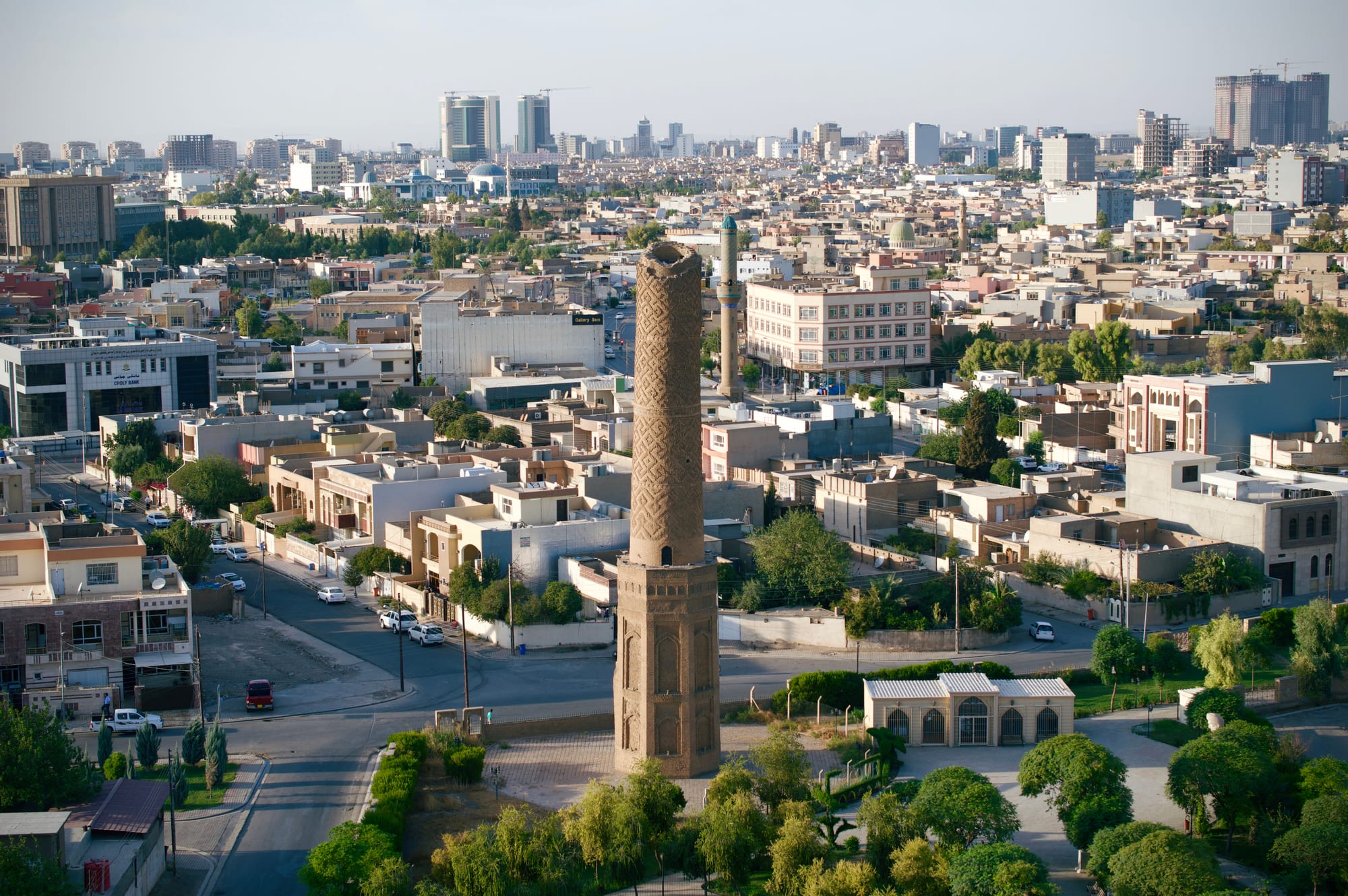
A tall brick minaret with patterned brickwork standing in a green park, with the low houses and distant towers of Erbil spreading behind it

The Kurdistan Region, Iraq

Erbil

The Mudhafaria Minaret and the city of Erbil seen from above the centre. (Levi Clancy / Wikimedia Commons · CC0)

The capital of Iraq's Kurdistan Region, on the plain between the Zagros foothills and the Great Zab, built in rings around a mounded citadel that is among the longest continuously inhabited places on Earth. Below the mound are covered bazaars and a fountain square; beyond them lie ring roads, malls and the Christian district of Ankawa. This page is written to explain the city, not to encourage travel.

Neighbourhoods

  • The citadel and the bazaars
    • First-time visitors
    • Historic district
    • Markets

    The oval mound of the citadel rises about thirty metres above the plain, with a restored gate, lanes of old houses and long views. Directly below it are the fountain square and the covered Qaysari bazaar, where cloth, spices, tea, gold and household goods are sold, and tea rooms fill the alleys.

    Open in Maps
  • Ankawa
    • Best for food
    • Nightlife
    • Churches

    A historically Assyrian and Chaldean Catholic district about eight kilometres north-west of the centre, now also home to many foreign residents and to families displaced from the Nineveh Plains. Churches, restaurants, bars and shops selling alcohol give it a different atmosphere from the rest of Erbil.

    Open in Maps
  • Gulan Street and the ring roads
    • Hotels
    • Shopping
    • Close to public transport

    Erbil's modern spine runs west from the centre, lined with hotels, offices, banks and shopping malls, and crossed by the ring roads that structure the city. Most international hotels and company offices are here, and taxis are the practical way to move along it.

    Open in Maps
  • The parks quarter
    • Families
    • Green space
    • Evenings

    West and north-west of the centre, around Minare Park and Sami Abdulrahman Park, are the city's biggest open spaces, with lawns, lakes, cable-car and fairground rides and cafés. Families come out in numbers after sunset, particularly in spring and autumn.

    Open in Maps
  • Ainkawa-side new suburbs
    • Quiet and residential

    Gated compounds, villa estates and apartment towers built during the boom years spread north and west towards the airport. They are quiet, car-dependent and largely residential, with malls and supermarkets in place of street life.

    Open in Maps

Things to do

Famous landmarks

  • Erbil Citadellandmark

    A tell of stacked settlement layers topped by a walled quarter of 19th and early 20th-century houses, inscribed by UNESCO as a World Heritage Site in 2014 and the subject of a restoration project begun in 2007.

    Open in Maps
  • Mudhafaria Minaretlandmark

    A brick minaret of about thirty-six metres built in the late 12th or 13th century under the atabeg Muzaffar al-Din Gökböri, standing in Minare Park west of the citadel.

    Open in Maps
  • Qaysari Bazaarmarket

    The covered market immediately below the citadel's south gate, a warren of alleys selling cloth, spices, tea, gold, tools and carpets.

    Open in Maps
  • Jalil Khayat Mosquelandmark

    The largest mosque in the city, completed in 2007 on 60 Metre Street, its domes and minarets a modern reading of Abbasid and Ottoman styles.

    Open in Maps

Museums

  • Erbil Civilization Museummuseum

    The city's archaeological museum, holding material from prehistory to the late Abbasid period and the second largest collection in the Kurdistan Region.

    Open in Maps
  • Kurdish Textile Museummuseum

    A museum inside a restored house on the citadel showing Kurdish rugs, kilims and costume, and training weavers in the old techniques.

    Open in Maps
  • Syriac Heritage Museummuseum

    A museum in Ankawa devoted to the history, language and church life of Iraq's Syriac Christian communities.

    Open in Maps

Parks and squares

  • Sami Abdulrahman Parkpark

    A large park laid out on the site of a former army base, with lakes, lawns and paths, named after Sami Abdul Rahman, a deputy prime minister of the Kurdistan Regional Government killed in a bombing in 2004.

    Open in Maps
  • Khanzad Castlelandmark

    A stone fortress on the road north-east towards Shaqlawa, built in the late 16th century by Mir Xanzad, a ruler of the Kurdish Soran Emirate.

    Open in Maps
  • Shaqlawaneighborhood

    A hill town at the foot of Safeen mountain about 50 kilometres from Erbil, full of orchards, summer houses and Erbil families escaping the heat.

    Open in Maps
  • Rawanduzneighborhood

    A town on a spur above deep gorges, long held by the Soran emirate, reached by the Hamilton Road through the mountains.

    Open in Maps
  • Shanidar Caveattraction

    A large cave in the mountains north-east of the city where Neanderthal burials tens of thousands of years old were excavated from the 1950s.

    Open in Maps

Seasonal events

  • Newroz21 March

    The Kurdish new year, marked with bonfires on the hills around the city, dancing, new clothes and family picnics in the parks and countryside.

  • Ramadan and Eid al-Fitrmoves through the seasons with the Islamic calendar

    Daytime fasting quietens the city and evenings fill the restaurants and bazaar tea rooms; the Eid holiday at the end brings visiting, sweets and crowded parks.

  • Christmas and Easter in AnkawaDecember and spring

    The Christian district keeps its church calendar publicly, with lit trees, church services and family gatherings, watched with interest by the rest of the city.

  • Summer holidays from the southJune to September

    Iraqis from Baghdad and the hot southern provinces come north for the cooler evenings, filling Erbil's malls, parks and hotels.

Eat and drink

Long-standing places and food districts in Erbil. Hours, ratings and directions come from your maps app, always current.

Erbil classics

  • Kebab and quzi houses around Shar Parkrestaurant

    Grill houses in the streets below the citadel serving minced-lamb kebab, tikka, and quzi — lamb slow-cooked and heaped on rice with nuts and raisins — with bread, salad and yoghurt.

    Open in Maps
  • Dolma kitchensrestaurant

    Family restaurants serving the Kurdish favourite of vine leaves, aubergines, peppers and onions stuffed with rice and meat and cooked in a sour sauce.

    Open in Maps

Bazaars and tea

  • Qaysari Bazaarmarket

    Spices, dried limes, nuts, honey, raisins, tea and sweets sold in the covered lanes below the citadel, alongside cloth and gold.

    Open in Maps
  • Teahouses below the citadelcafe

    Rooms and courtyards of benches where men drink strong sweet tea from small waisted glasses over dominoes and backgammon, some of them long-standing fixtures of the bazaar.

    Open in Maps

Ankawa

  • Ankawa's restaurants and barsneighborhood

    The Christian district has the city's widest choice of food, from Assyrian and Lebanese kitchens to international menus, and is where alcohol is sold and drunk openly.

    Open in Maps

Experience Erbil

History

The mound at the centre of Erbil has been built on for perhaps six or seven thousand years, each settlement raising the level of the next, which is why the citadel now stands well above the plain. As Arbela it was a significant city of the Assyrian empire, famous for its temple of Ishtar, and it kept its importance under the Persians: the battle in which Alexander defeated Darius III in 331 BC, fought some way to the west, is often called the Battle of Arbela. Under the Parthians it was the seat of a small kingdom, Adiabene, whose ruling family converted to Judaism, and it later became an early and important centre of the Church of the East.

Arab armies took the city in the 7th century. Its best-remembered medieval ruler is the atabeg Muzaffar al-Din Gökböri, a brother-in-law and ally of Saladin, who governed from the late 12th century, built outside the walls and is credited with developing the public celebration of the Prophet's birthday; the Mudhafaria Minaret survives from his time. The Mongols sacked the city in the 13th century, and afterwards it declined into a provincial town under Ottoman rule.

Modern Erbil grew after Iraq's formation, and became the seat of the Kurdistan Regional Government after the Kurds gained self-rule in the 1990s. The 1990s also brought fighting between the two main Kurdish parties. From 2003 the city boomed: oil money, foreign companies and construction filled the ring roads with towers, malls and compounds, while the citadel above was emptied of its residents in 2007 for a restoration project. The war against the Islamic State from 2014 filled the city with displaced Iraqis and Syrian refugees, about 118,000 of the former at one point. UNESCO inscribed the citadel as a World Heritage Site in 2014.

Culture & Customs

Erbil is a Kurdish city that has long held other communities: Turkmen families in the old quarters, Assyrian and Chaldean Christians in Ankawa, and Arab Iraqis who came north for work or safety. The everyday language is Sorani Kurdish, written in the Arabic script; Arabic and English are common in business. Most people are Sunni Muslims, generally undemonstrative about it, and the city is politically dominated by the Kurdistan Democratic Party and the Barzani family.

The calendar turns on Newroz, the new year on 21 March, when bonfires are lit on the hills, families drive out to the countryside and dancers form the halparke, a line dance led by a handkerchief. Traditional dress appears at weddings and festivals: for men the shal u shapik, a jacket and gathered trousers gathered by a wide sash, and for women long bright dresses with sequins. Weddings are large, public and loud, with convoys of cars and dancing that spills into the street.

Daily sociability happens in the tea houses of the bazaar, where men sit over small glasses of sweet tea, dominoes and backgammon, and in the parks in the evening, where whole families gather to eat sunflower seeds and let children run until late. Picnics are close to a national pastime, and any Friday in spring empties the city towards the mountains. Erbil is conservative in dress and manners but easy-going with visitors, and hospitality — tea first, questions later — is a matter of pride.

Daily Life

Well over a million people live in Erbil and its suburbs, and the city has grown rapidly since 2003, both from the oil boom and from waves of displaced Iraqis and Syrians. Growth shows in the plan: the old core around the citadel is ringed by successive boulevards, and beyond them lie villa compounds, apartment towers and malls built in the boom years, some of them left unfinished when money tightened.

The Kurdistan Regional Government is the largest employer, and public salaries — and the disputes with Baghdad over oil sales and the budget that repeatedly delay them — are a constant subject. Oil, construction, trade with Turkey and Iran, telecoms and domestic tourism from the rest of Iraq make up much of the rest of the economy. Foreign consulates, companies and aid organisations have a substantial presence, many of them in Ankawa.

The day starts early, the bazaar is busiest in the morning, and the middle of a summer afternoon empties the streets. Life resumes after dark, when the parks, restaurants and malls fill and traffic thickens. Electricity comes from a mix of public supply and neighbourhood generators, and water shortages are a worry as the region's rainfall becomes less reliable. Young people complain about jobs, housing costs and the pull of emigration, and many families have relatives abroad.

Food

Erbil's cooking is Kurdish, with a strong Iraqi and Turkish accent. Dolma is the dish families are proudest of: vine leaves, aubergines, peppers, onions and courgettes stuffed with spiced rice and meat, packed into a pot and cooked in a sour sauce. Quzi, lamb cooked until it falls from the bone and set over rice with almonds and raisins, is the food of guests and weddings, and biryani here means rice with meat, noodles, nuts and raisins rather than the South Asian dish.

Grilled meat is everywhere: kebab of minced lamb pressed onto skewers, tikka of cubed meat, and whole lamb ribs, served with flat bread from a clay oven, raw onion, tomatoes and sumac. Soups and stews carry the winter — lentil soup, beans, okra, and sour dishes sharpened with dried black lime. Kubba, shells of bulgur or rice around spiced meat, come fried or in soup. Breakfast is bread with honey, white cheese, eggs, and geymar, the thick buffalo-milk cream, with date syrup.

To drink there is tea, strong and very sweet in small waisted istikan glasses, served all day; mastaw, salted yoghurt thinned with water; and cardamom coffee for guests. The hills supply honey, walnuts, pomegranates and figs, sold in the bazaar along with pressed fruit rolls and nut sweets. In Ankawa arak and beer are sold openly, which is not the case in most of the city.

Planning tools

Budget

Erbil offers the widest choice in Iraq, from simple hotels near the bazaar to international chains on Gulan Street, and is good value by regional standards. Food from local grill houses is cheap; hotel rooms and a car with a driver for mountain trips are the main costs. Cash in dinars and dollars is essential.

Daily Budget Midrange
USD 110–230 (good hotel, restaurants, car and driver for day trips)
Daily Budget Shoestring
USD 40–75 (simple hotel or hostel, local restaurants, shared taxis)

Carry US dollars and change them into dinars in the bazaars; foreign cards work in few places outside the bigger hotels.

Best Time to Visit

March to May, when the plain is green and Newroz on 21 March fills the hills with bonfires and picnics, and September to November for mild days. Summer on the plain is very hot, though the mountains nearby stay pleasant. Since February 2026 the war between the United States and Israel and Iran and its allies has disrupted flights and travel across the Middle East, so current conditions matter more than the season.

Suggested Number of Days

Two days cover the centre comfortably. Four or five allow the mountains, gorges and hill towns within reach by road. Checkpoints, heat and the distances involved in mountain trips all lengthen the days.

First Visit
2 days
With Surroundings
4–5 days

Transportation

Erbil is laid out in rings around the citadel, and most movement is by car: taxis are cheap and plentiful, ride-hailing apps are used widely, and city buses cover some routes. Shared taxis and minibuses leave from garages for Sulaymaniyah, about three hours away, and Duhok, about two and a half. The mountain sights need a car and driver for the day. A passport is carried for checkpoints on every road out of the city.

Carry a passport at all times for checkpoints, and confirm before setting out whether a road to federal Iraq is open to foreigners.

Airport & Station Connections

Erbil International Airport lies a few kilometres west of the centre, a short taxi ride away, with flights to Baghdad, Turkey, the Gulf and Europe, though air travel across the region has been disrupted since the war that began in February 2026. Overland, roads run from Turkey by way of the Ibrahim Khalil crossing near Zakho, and from Baghdad and Kirkuk across the internal boundary. Since 2025 a single Iraqi e-visa covers both federal Iraq and the Kurdistan Region.

Walkability

The historic core is walkable: the citadel, the fountain square, the bazaar and the parks around the minaret sit within a kilometre or two of each other, and much of it is flat. Beyond that ring the city is built for cars, with wide boulevards, long blocks and little shade, so taxis are used for anything further. Summer heat rules out walking in the middle of the day.

Safety

The Kurdistan Region is the part of Iraq most visited by independent travellers and is relatively safe, though some governments still advise caution or against travel. Street crime against visitors is uncommon and the city is heavily policed. Erbil International Airport and the United States consulate general in the city were struck in the first days of the regional war in February 2026, and drone attacks on American positions in the region followed.

Follow the current government travel advisories, keep well away from the Turkish and Iranian border zones, stay on marked paths in the mountains, and avoid demonstrations. Traffic is the everyday hazard: crossing wide roads on foot needs care. Check current official travel advice before travelling.

Climate

A hot semi-arid climate on the plain, with a long dry summer and a short cool winter. Rain falls from November to April, and the surrounding hills turn green in spring before drying to brown by June. Dust storms occur in spring and early summer.

Summer
hot and dry, commonly 38–45°C by day, with warm evenings and little rain
Winter
cool and wet, around 3–14°C, with occasional snow and snow on the nearby mountains

Local Customs

Erbil is Kurdish-speaking, with Sorani the everyday language and Arabic and English widely understood. It is more relaxed than southern Iraq: women work and drive, and alcohol is sold in Ankawa and some hotels, though public drunkenness is frowned on. Modest dress is expected of everyone, with shoulders and knees covered, and hospitality is pressed on guests.

Ask before photographing people, and do not photograph checkpoints, soldiers, police or government buildings. Remove shoes at mosques and in homes, and greet older people first; a small gift is usual when invited to a home.

Common Payment Methods

The currency is the Iraqi dinar, and US dollars are held and changed everywhere, above all in the money-changer stalls of the bazaar. Cards are accepted in international hotels and some malls but rarely elsewhere, and ATMs are limited, so visitors carry clean, undamaged dollar notes and change them as they go.