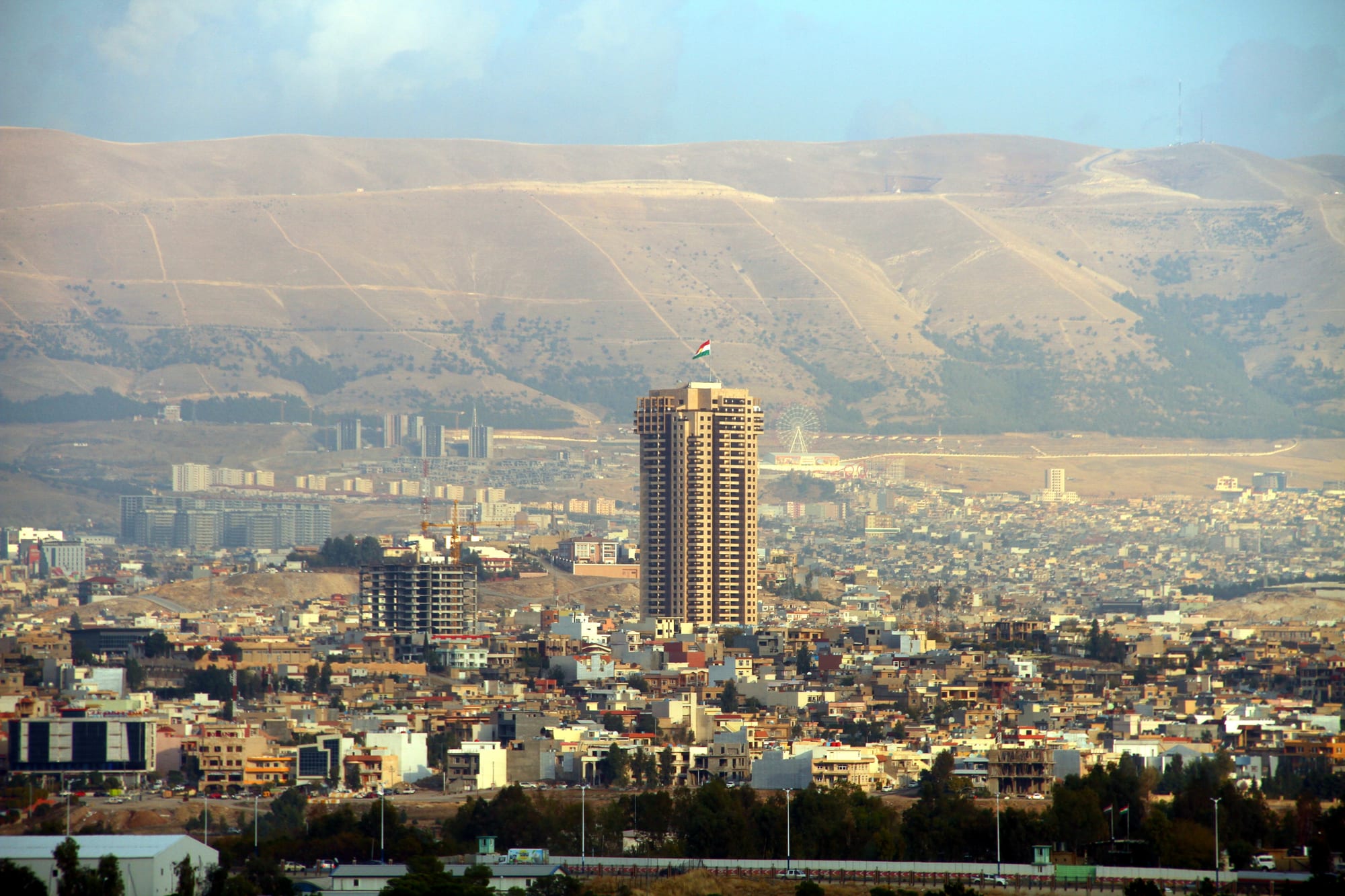
Low city blocks and a single tall tower flying a Kurdish flag, with bare brown mountain slopes rising behind the town

The Kurdistan Region, Iraq

Sulaymaniyah

Sulaymaniyah spread below the bare ridges that ring the city. (Diyar Muhammed / Wikimedia Commons · CC BY-SA 4.0)

The second city of Iraq's Kurdistan Region, founded in 1784 as the capital of the Baban principality and set in a bowl of mountains near the Iranian border. Higher and cooler than the Iraqi plains, it is known for its bazaar, its museums of Kurdish history and persecution, and a reputation for poetry, publishing and political argument. This page is written to explain the city, not to encourage travel.

Neighbourhoods

  • The bazaar and Sara Square
    • First-time visitors
    • Markets
    • Local life

    The old commercial core, a grid of covered and open market lanes selling cloth, gold, spices, tea, tobacco and household goods, with tea rooms, money changers and shared-taxi ranks around it. It is the busiest part of the city by day and the place most visitors start.

    Open in Maps
  • Salim Street
    • Cafés
    • Shopping
    • Walks

    The long central street running from the bazaar area past shops, bookshops, restaurants and cafés. It carries much of the city's everyday life and is where students and office workers eat and meet.

    Open in Maps
  • The museum quarter
    • History
    • Museums

    The streets around the Slemani Museum and Amna Suraka, the former security headquarters turned memorial, hold the city's main sights within a short walk of one another, alongside government offices and parks.

    Open in Maps
  • Under Goizha and Azmar
    • Quiet and residential
    • Views
    • Green space

    Newer housing climbs the northern edge of the city towards the mountain slopes, with parks, an amusement park and viewpoints above. Families drive up in the evenings for the cooler air and the lights of the city below.

    Open in Maps
  • The university and western districts
    • Students
    • Quiet and residential

    West of the centre are the university campuses, hospitals, hotels and residential blocks strung along wide boulevards. There is little to see, but much of the city's professional life and many of its hotels are here.

    Open in Maps

Things to do

Museums and memorials

  • Amna Surakamuseum

    The former Baʿathist intelligence headquarters, its bullet-scarred buildings kept as a museum of the Kurds' persecution, with cells, a hall of broken mirrors commemorating the victims of the Anfal campaign.

    Open in Maps
  • Sulaymaniyah Museummuseum

    The second-largest museum in Iraq, opened in 1961, holding material from prehistory through the Sumerian, Assyrian and Islamic periods of the surrounding region.

    Open in Maps

Markets and streets

  • Sulaymaniyah bazaarmarket

    The market at the centre of the city, where spices, dried fruit, nuts, honey, cloth, gold and tobacco are sold in a mix of covered lanes and open streets.

    Open in Maps

Short trips from the city

  • Halabjaneighborhood

    A city south-east of Sulaymaniyah, now the capital of its own governorate, where at least 5,000 people were killed in a chemical attack in March 1988; a memorial and museum record it.

    Open in Maps
  • Lake Dukanpark

    A large reservoir in the hills north-west of the city, ringed by resorts, picnic spots and fish restaurants.

    Open in Maps
  • Dukan Damlandmark

    An arch dam on the Little Zab, completed in 1959, which formed the lake and supplies water and power to much of the region.

    Open in Maps
  • Shahrizorattraction

    The broad fertile plain between the mountains and the Iranian border, farmed for millennia and dotted with archaeological mounds.

    Open in Maps
  • Darbandikhanneighborhood

    A town beside the reservoir on the Diyala river, with lakeside restaurants and picnic places among steep hills.

    Open in Maps
  • Darbandikhan Damlandmark

    An embankment dam on the Diyala completed in 1961, repaired repeatedly over the years after slope failures and war damage.

    Open in Maps
  • Jarmolandmark

    An excavated Neolithic farming village whose oldest levels are carbon-dated to about 7000 BC, among the earliest known in the Middle East.

    Open in Maps
  • Chamchamalneighborhood

    A town on the road west of Sulaymaniyah, at the edge of the hills where the Kurdistan Region meets the plain.

    Open in Maps
  • Ranyaneighborhood

    A town on the plain at the northern end of Lake Dukan, remembered for its part in the 1991 uprising against Saddam Hussein's government.

    Open in Maps

Seasonal events

  • Newroz21 March

    The Kurdish new year, marked with bonfires on the mountains around the city, dancing in the streets, new clothes and picnics in the hills.

  • Halabja commemorationMarch

    The anniversary of the 1988 chemical attack is marked each year with ceremonies in Halabja and across the region.

  • Ramadan and Eid al-Fitrmoves through the seasons with the Islamic calendar

    Fasting quietens the daytime city and fills the evenings; the Eid holiday brings visiting, sweets and crowded parks and mountain roads.

  • Summer in the mountainsJune to September

    Iraqis from the hot southern provinces fill the hill resorts and lakesides around the city, and evening life moves outdoors.

Eat and drink

Long-standing places and food districts in Sulaymaniyah. Hours, ratings and directions come from your maps app, always current.

Sulaymaniyah classics

  • Kebab and quzi grillsrestaurant

    Grill houses across the centre serving minced-lamb kebab, tikka and quzi, lamb slow-cooked over rice with nuts and raisins, with flat bread, sumac-dressed onion and yoghurt.

    Open in Maps
  • Dolma and home-style kitchensrestaurant

    Family restaurants serving the Kurdish standard of stuffed vine leaves and vegetables in a sour sauce, alongside bean and okra stews and soups thickened with bulgur.

    Open in Maps

The bazaar

  • Sulaymaniyah bazaarmarket

    Honey, walnuts, pomegranates, figs, dried fruit, nuts and the manna-based nougat known as man u salwa, a speciality of the city, sold among the cloth and gold stalls.

    Open in Maps
  • Bazaar teahousescafe

    Rooms of benches and low tables where men drink strong sweet tea in small waisted glasses over dominoes, backgammon and long conversations about politics.

    Open in Maps

Cafés and streets

  • Salim Street cafésneighborhood

    The central street's cafés and juice bars, where students and writers sit over coffee, tea and pastries — part of the city's reputation for reading and argument.

    Open in Maps

Experience Sulaymaniyah

History

Sulaymaniyah is a planned city with a precise birthday: it was founded in 1784 by Ibrahim Pasha Baban, who moved the seat of the Baban principality here and named it after his father, Sulayman Pasha. The Babans ruled a frontier territory between the Ottoman and Persian empires, playing one against the other, and their court attracted poets and scholars, which set the city's literary reputation early. Nali, Salim and Kurdi, whose writing became the foundation of standard Sorani Kurdish, belonged to this circle. The Ottomans removed the last Baban ruler in 1850 and governed the town directly.

After the First World War, Sheikh Mahmud Barzanji was appointed governor by the British, declared a Kurdish kingdom with Sulaymaniyah as its capital, and rose repeatedly against British and Iraqi authority until 1932, when the Royal Air Force and British-trained Iraqi forces captured him and he was exiled to southern Iraq. The city remained the intellectual centre of Kurdish nationalism, and from the 1970s it was the base of the Patriotic Union of Kurdistan, founded by Jalal Talabani, later president of Iraq.

The Baʿathist years were brutal here. The security headquarters in the middle of the city, Amna Suraka, held and tortured prisoners; the Anfal campaign of 1988 destroyed villages across the province; and in March 1988 a chemical attack on Halabja, south-east of the city, killed thousands in a day. After the 1991 uprising and the Western no-fly zone the Kurds gained self-rule, though the 1990s brought civil war between the two main Kurdish parties. Since 2003 the city has grown quickly, with new universities, a publishing industry, an airport opened in 2005, and large numbers of people displaced from elsewhere in Iraq.

Culture & Customs

Sulaymaniyah regards itself as the cultural capital of Iraqi Kurdistan, and the claim is widely accepted. Poetry has been central since the Baban court, and the city produced or sheltered many of the writers who shaped modern Kurdish literature; its bookshops, publishers, newspapers and theatre companies are more numerous than anywhere else in the region. Political argument is a form of public entertainment, conducted in cafés and tea houses, and the city has a tradition of protest and of independent media.

Sorani Kurdish is the language of the street, and the Sulaymaniyah dialect is the one most often heard in Kurdish broadcasting and publishing. Most people are Sunni Muslims, generally relaxed about it; there are also Kaka'i and other minority communities in the province. Politically the city and its province are the stronghold of the Patriotic Union of Kurdistan, in a long rivalry with the Erbil-based Kurdistan Democratic Party.

Newroz on 21 March is the great festival, with bonfires on Goizha and Azmar, dancing and mass picnics; traditional dress comes out, the men in the shal u shapik suit with a sash, the women in long bright dresses. Picnics, mountain outings and weekend drives to lakes and waterfalls are close to a civic habit. The memory of Anfal and Halabja is present in public life — in museums, monuments and annual commemorations — and visitors are expected to treat it seriously.

Daily Life

Several hundred thousand people live in Sulaymaniyah and its immediate surroundings, making it the second city of the Kurdistan Region. It has grown outwards from the bazaar into the mountain slopes and along the western boulevards, with university campuses, hospitals and apartment blocks filling ground that was farmland a generation ago, and villages absorbed into the edges.

Public employment dominates: the regional government, schools, universities, hospitals and the security forces pay a large share of salaries, and the disputes with Baghdad and with Erbil over oil revenue and budget transfers that delay those salaries are a recurring crisis discussed in every tea house. Trade with Iran through the border crossings, construction, small manufacturing, publishing and domestic tourism make up much of the rest.

The rhythm of the day is early: the bazaar opens soon after dawn, business slows in the afternoon heat of summer, and evenings belong to the cafés, parks and the roads up Azmar, where families park to look down on the lights. Winter brings rain, mud and snow on the mountains, and power cuts covered by neighbourhood generators. Water shortages after poor winters, unemployment among graduates and emigration are the standing worries, and protests over unpaid salaries and services are a familiar part of the city's politics.

Food

Kurdish cooking here is home cooking before it is restaurant cooking. Dolma is the dish families make for guests and holidays: vine leaves, aubergines, peppers, onions and courgettes stuffed with spiced rice and meat, packed tight in a pot and cooked in a sour sauce. Quzi, lamb cooked until it falls apart and served over rice with nuts and raisins, is the other celebration dish, and biryani in this region means rice with meat, noodles, almonds and raisins.

Grilled meat is the everyday restaurant meal — minced-lamb kebab, tikka and ribs with flat bread, sumac-dressed onion, tomatoes and yoghurt. Kubba, shells of bulgur or rice filled with spiced meat, come fried or in soup, and shifta, flattened spiced patties, are common. Sawar, wheat that is boiled, dried and pounded, is the old staple of the farming villages, served with stews of beans, okra or aubergine. Bread comes from a clay oven with almost every meal, and breakfast is bread with honey, white cheese, eggs and geymar, thick clotted cream, with date syrup.

The mountains supply the city's best-known products: honey, walnuts, pomegranates, figs and grapes, sold in the bazaar with dried fruit and nut pastes. Man u salwa, a nougat made with manna gathered from oak leaves and studded with nuts, is a speciality of Sulaymaniyah. Tea is drunk all day, strong and very sweet in small waisted glasses; mastaw, salted yoghurt thinned with water, cools a summer meal.

Planning tools

Budget

Sulaymaniyah is a little cheaper than Erbil, with simple hotels near the bazaar and a few larger ones on the western boulevards. Food from grill houses and bazaar kitchens costs very little, and the main expense is a car with a driver for the mountains, Halabja or the lake. Cash in dinars and dollars is essential.

Daily Budget Midrange
USD 110–230 (good hotel, restaurants, car and driver for day trips)
Daily Budget Shoestring
USD 40–75 (simple hotel or hostel, local restaurants, shared taxis)

Carry US dollars and change them into dinars in the bazaars; foreign cards work in few places outside the bigger hotels.

Best Time to Visit

March to May, when the hills are green and the Newroz festival on 21 March fills the valleys with bonfires and picnics, and September to November for mild days. Summer is hot but drier and more bearable than on the plains, and winter brings snow to the surrounding mountains. Since February 2026 the war between the United States and Israel and Iran and its allies has disrupted flights and travel across the Middle East, so current conditions matter more than the season.

Suggested Number of Days

Two days are enough for the centre, its museums and the bazaar. Around four allow the mountains, the lake and the plain to the south-east as well. Mountain roads, heat in summer and checkpoints all slow movement.

First Visit
2 days
With Surroundings
4 days

Transportation

Taxis are the usual way to move around the city and are inexpensive; ride-hailing apps are widely used, and some city buses run along the main boulevards. Shared taxis and minibuses leave from garages for Erbil, about three hours away, and for Halabja, Dukan and the towns of the province. The mountains and the lake need a car and driver for the day, and a passport is carried for checkpoints on every road out of the city.

Carry a passport at all times for checkpoints, and confirm before setting out whether a road to federal Iraq is open to foreigners.

Airport & Station Connections

Jalal Talabani International Airport, renamed from Sulaymaniyah International Airport in 2026, lies about 14 kilometres west of the city, with flights to Baghdad, Turkey and the Gulf, though air travel across the region has been disrupted since the war that began in February 2026. Most visitors arrive by road from Erbil, about three hours north-west, or from Kirkuk and Baghdad across the internal boundary. Since 2025 a single Iraqi e-visa covers both federal Iraq and the Kurdistan Region.

Walkability

The centre is walkable and comparatively compact: the bazaar, Salim Street and the main museums lie within a kilometre or so of each other, and the ground is fairly flat. Pavements are uneven, traffic is heavy and crossings are few, and the residential districts and mountain edges are spread out enough to need a taxi.

Safety

Globeway covers this city so that it can be understood. The Kurdistan Region is the part of Iraq most visited by independent travellers and is relatively safe, though some governments still advise caution or against travel. Street crime against visitors is uncommon. Turkish and Iranian military operations against armed Kurdish groups affect the border mountains east and north of the city, drone attacks on positions in the region followed the start of the regional war in February 2026, and old minefields remain in border areas and in some hills.

Follow the current government travel advisories, keep well away from the Turkish and Iranian border zones, stay on marked paths in the mountains, and avoid demonstrations. Check current official travel advice before travelling.

Climate

Higher and cooler than the rest of Iraq, with a hot dry summer, a wet cool winter and a short green spring. Most rain falls between November and April, and snow settles on the surrounding mountains most winters.

Summer
hot and dry, commonly 35–42°C by day, though evenings cool quickly in the hills
Winter
cool and wet, around 2–12°C, with occasional snow in the city and more on the mountains

Local Customs

The city speaks Sorani Kurdish and has a reputation within the region for being liberal and literary, with a strong tradition of poets, publishers and political debate. Women work and study in large numbers, and alcohol is sold more openly than in southern Iraq, though modest dress is still expected of everyone and public drunkenness is frowned on.

Ask before photographing people, and do not photograph checkpoints, soldiers, police or government buildings. Remove shoes at mosques and in homes, accept tea when it is offered, and take a small gift when invited to a family's house.

Common Payment Methods

The currency is the Iraqi dinar, and US dollars are held and changed widely, above all at the money changers in the bazaar. Cards are accepted in larger hotels and a few shops but rarely elsewhere, and ATMs are limited, so visitors carry clean, undamaged dollar notes and change them as they go.