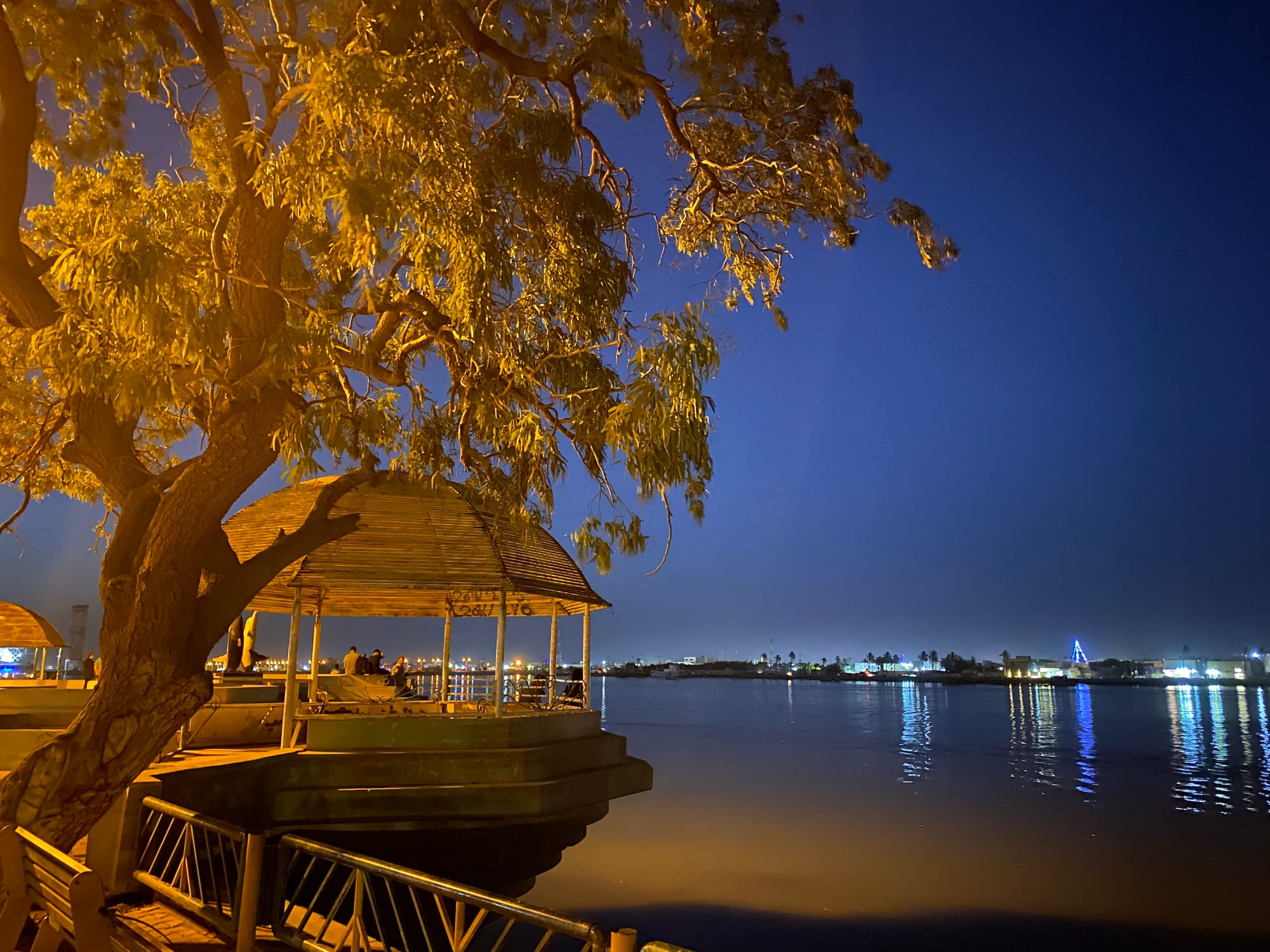
A lit riverside terrace with a thatched pavilion under a large tree beside the still water of the Shatt al-Arab at dusk, city lights on the far bank

Basra & the South, Iraq

Basra

The riverside corniche on the Shatt al-Arab in Basra at dusk. (Ali Maytham Nadhim / Wikimedia Commons · CC BY-SA 4.0)

Iraq's port city, founded as an Arab garrison in 636 and grown rich on ships, dates and oil, set on the Shatt al-Arab where the Tigris and Euphrates run together towards the Gulf. Canals, palm groves and old merchant houses with carved wooden balconies survive among a hot, hard-working modern city. This page is written to explain the city, not to encourage travel.

Neighbourhoods

  • Al-Ashar and the corniche
    • First-time visitors
    • Best for food
    • Markets

    The commercial heart of the city, on the canal of the same name where it meets the Shatt al-Arab. Banks, markets, hotels and the riverside promenade are here, and evening crowds come out along the water.

    Open in Maps
  • Old Basra
    • Historic district
    • Architecture

    The quarter of canals and old merchant houses inland from the river, where brick facades carry shanasheel, the projecting wooden balconies with lattice screens that the city is known for. Many stand empty or half-collapsed, and some have been restored.

    Open in Maps
  • Al-Ma'qil
    • Close to public transport
    • Local life

    The northern riverside district built around the port and its railway, with quays, warehouses, shipping offices and streets of older company housing among newer building.

    Open in Maps
  • Al-Zubayr
    • Local life
    • Markets

    A separate old town south-west of the centre, once a desert trading settlement with strong Najdi links and now joined to Basra by sprawl, known for its market, its shrine and the oilfields beyond it.

    Open in Maps

Things to do

The city

  • Basra Museummuseum

    A museum of Mesopotamian antiquities housed in a former palace by the Shatt al-Arab, developed with British help, whose first gallery opened in 2016 and which opened fully in March 2019.

    Open in Maps
  • Shatt al-Arabattraction

    The broad river formed where the Tigris and Euphrates join, running past the city's corniche towards the Gulf and forming the border with Iran downstream.

    Open in Maps
  • Basra International Stadiumattraction

    A large stadium on the edge of the city, wrapped in a design based on palm trunks, and the home of major football matches in southern Iraq.

    Open in Maps

Around the city

  • Al-Zubayrneighborhood

    An old town south-west of Basra grown up around the tomb attributed to Zubayr ibn al-Awwam, a companion of the Prophet Muhammad, with a long trading history across the desert.

    Open in Maps
  • Umm Qasrtransit hub

    Iraq's deep-water port south of Basra, on the canalised Khawr az-Zubayr, part of the estuary that leads out to the Gulf.

    Open in Maps
  • Al-Fawattraction

    The town at the tip of the peninsula where the Shatt al-Arab reaches the Gulf, fought over in the Iran–Iraq War and surrounded by date groves and mudflats.

    Open in Maps

Short trips from the city

  • Al-Qurnahlandmark

    The town about 74 km north-west of Basra where the Tigris and Euphrates meet, with a riverside enclosure around a tree that local tradition links to the Garden of Eden.

    Open in Maps
  • Hawr al-Hammarattraction

    The large shallow lake and marsh north-west of Basra, part of the Mesopotamian marshes listed by UNESCO, reached by boat from its villages.

    Open in Maps
  • Mesopotamian Marshesattraction

    Reed beds, open water and floating islands where Marsh Arabs herd buffalo and build vaulted reed guesthouses, drained in the 1990s and partly reflooded since.

    Open in Maps

Seasonal events

  • Ramadanvaries with the lunar calendar

    A month of daytime fasting in which the city stops through the afternoon heat and the corniche, markets and cafés fill after sunset until very late.

  • Eid al-Fitrat the end of Ramadan

    Days of family visiting and outings to the riverside and the parks, with klecha and date sweets in every house.

  • Ashurathe month of Muharram, varies with the lunar calendar

    Mourning for Imam Hussein observed across this overwhelmingly Shia city, with black banners, night recitations, processions and free food handed out in the street.

  • Arba'eenforty days after Ashura

    Pilgrims set out from Basra for the long walk north to Karbala, and roadside tents along the route feed and shelter them free of charge.

Eat and drink

Long-standing places and food districts in Basra. Hours, ratings and directions come from your maps app, always current.

Basra classics

  • Zubaidi and river fishneighborhood

    Silver pomfret, known here as zubaidi, and the shad called sbour are fried or grilled and served with rice; masgouf, carp cooked upright beside an open fire, is grilled on the riverbank as in Baghdad.

    Open in Maps
  • Dates and dibismarket

    Basra's groves grow dozens of varieties, sold fresh in late summer and dried year round, pressed into dibis syrup and baked into klecha, the date-filled pastry made for Eid.

    Open in Maps

Markets and food streets

  • The Ashar marketsmarket

    Spice merchants, dried black lime, fish stalls, bakeries and sweet shops packed into the lanes behind the canal in the old commercial quarter.

    Open in Maps
  • Corniche cafés and juice stallscafe

    Tea houses and stalls along the Shatt al-Arab pouring sweet tea in istikan glasses, cardamom coffee and fresh juice, busiest in the cool of the evening.

    Open in Maps

Experience Basra

History

Basra was founded in 636 as a garrison town for the Arab armies, on a site inland from the present centre near what is now Al-Zubayr. Within a century it had become a great port and a centre of learning, where the grammarian Sibawayh codified Arabic, the writer al-Jahiz produced his essays, the ascetic al-Hasan al-Basri taught, and the Mu'tazila school of theology took shape. Ships traded to India, East Africa and China, and the voyages behind the Sinbad stories are associated with its quays.

Wealth had a brutal foundation. Enslaved African labourers drained the salt marshes around the city, and their revolt, the Zanj rebellion of 869 to 883, devastated southern Iraq and briefly took Basra itself. Later the port declined and shifted downstream towards the Shatt al-Arab, and the Portuguese, Safavids and Ottomans all contended for it; under Ottoman rule it was a provincial capital where British, Persian and Indian merchants traded, and the East India Company kept an agency.

British forces landed in 1914 and made Basra the base of the Mesopotamian campaign. Oil, the port and the date trade made it prosperous into the 1970s, with a reputation as Iraq's most cosmopolitan city. The Iran–Iraq War of 1980 to 1988 put it on the front line, and the Faw peninsula changed hands twice; the 1991 uprising against the government was crushed here; and after the 2003 invasion British forces were based in the city. Since then oil revenues have grown while public services have not, and protests over water, power and jobs have repeatedly filled its streets.

Culture & Customs

Basra's character comes from the sea. Centuries of trade with the Gulf, India and East Africa left a port city more mixed and more outward-looking than inland Iraq, and it shows in the music, the food and the old merchant houses whose carved wooden shanasheel balconies lean over the canals. The city was a byword for cosmopolitan life in the mid-twentieth century, with cinemas, clubs and a large foreign community, a memory older residents keep alive.

It is a city of poets. Badr Shakir al-Sayyab, born in nearby Jaykur and one of the founders of modern Arabic free verse, wrote the rain and the palm groves of the south into Arabic poetry, and his statue stands on the corniche. Basra's older literary and religious scholarship, from Arabic grammar to Sufi teaching, is still a source of local pride.

The population is overwhelmingly Shia Arab, with tribal affiliations that carry real weight in the countryside and in politics, and small Christian and Mandaean communities, the latter famous as silversmiths, though most have emigrated. Muharram is the great public season, with processions in every district. Hospitality is emphatic: guests are fed first and questioned later, and refusing food or tea takes practice. Football is followed passionately, and the city's stadium has become a symbol of its recovery.

Daily Life

More than a million people live in Basra, Iraq's third largest city, in a province that produces the great majority of Iraq's oil exports. The city's economy is the port, the oilfields that ring it, shipping and customs, government employment and trade; the international companies working the southern fields bring in expatriate staff who mostly live in compounds outside town. For all that wealth, unemployment among young people is high and the gap between the oil economy and everyday life is the city's central grievance.

Water is the other. Salt water pushes up the Shatt al-Arab as the rivers' flow falls, the palm groves that once lined the banks have thinned, and in 2018 contaminated water left tens of thousands of people needing treatment and set off months of protest. Electricity fails in the summer, and households pay neighbourhood generators to fill the gaps.

The daily rhythm is built around the heat. Work and markets start very early, the middle of the day is spent indoors, and life returns in the evening to the corniche, the markets and the cafés, which stay busy until late. Families take the river air on the promenade, and the cooler months bring picnics in the date groves and trips out to the marshes. Jobs, water, power and the management of oil money dominate public argument.

Food

Basra eats from the river, the Gulf and its palms. Zubaidi, the silver pomfret, is the prize fish, fried or grilled and served with rice; sbour, a shad, is eaten in season; and shrimp from the Gulf and river fish appear in spiced stews and in rice dishes that show generations of trade with India — turmeric, cardamom and chilli are used more freely here than in northern Iraq. Masgouf, carp split and cooked upright beside an open fire, is grilled on the riverbank as in Baghdad.

Noomi Basra, the dried black lime named after the city, gives stews and rice their sour edge, dropped in whole or ground to a powder. Rice is the staple, above all the fragrant anbar grown up the Euphrates, served with okra, white bean or aubergine stews, with dolma, and with quzi, lamb cooked slowly over rice with nuts and raisins. Bread comes from the tannour oven, and geymar, the thick clotted cream made from marsh buffalo milk, is eaten at breakfast with honey and kahi pastry.

Dates are the city's signature crop, grown in dozens of varieties along the Shatt al-Arab in what was once the world's largest date palm forest. They are eaten with coffee, boiled into dibis syrup, blended into drinks and baked into klecha for Eid. Sweet shops sell baklava, halva and milk puddings, and tea in istikan glasses and cardamom coffee close every visit.

Planning tools

Budget

Basra's hotels are aimed at the oil industry and cost more than their quality suggests, though simpler places exist and food, taxis and local transport are cheap. A car and driver is the main expense, particularly for trips out to the marshes, the confluence or the port towns, and boat hire is priced separately.

Daily Budget Midrange
USD 110–230 (business hotel, private car and driver, marsh boat and guide)
Daily Budget Shoestring
USD 45–75 (simple hotel, local restaurants, shared taxis)

Bring US dollars in cash and change some into dinars; agree the price of a car or a marsh boat trip before setting out.

Best Time to Visit

November to March, when the heat breaks, the marshes are fuller and migrating birds arrive; October and April are warm but manageable. The date harvest runs from late summer into autumn. Summer is punishing. Since February 2026 the war between the United States and Israel and Iran and its allies has disrupted flights and shipping across the Gulf, so current conditions matter more than the season.

Suggested Number of Days

A day or two is enough for the city itself. Three to five allows the waterways, marshes and port towns of the province, all of which need a car, a boat or both. Summer heat shortens every day's useful hours.

First Visit
1–2 days
With Surroundings
3–5 days

Transportation

Local journeys are made by taxi and minibus; there is no metro or urban rail. Shared taxis run to Nasiriyah, Amarah, Najaf and Baghdad from garages on the edge of the city, a slow passenger railway links Basra with Baghdad, and boats are the only way into the marshes. Traffic is heavy, with checkpoints on the main approaches, and most foreign visitors travel with a local operator's car and driver.

Carry passport and visa copies for checkpoints, agree fares before setting off, and keep well away from the Iranian and Kuwaiti border areas.

Airport & Station Connections

Basra International Airport, west of the centre, has flights to Baghdad, Erbil and the Gulf, though air travel across the region has been disrupted since the war that began in February 2026 and schedules change at short notice. Baghdad is a long day's drive or an overnight train to the north-west, and Kuwait's border lies about two hours south.

Walkability

The corniche and the Ashar market lanes are pleasant on foot in the cooler months, and the old canal quarter is best seen walking. Beyond those areas Basra is spread out along wide roads with broken pavements and heavy traffic, distances are long, and for much of the year the heat and humidity make walking any distance in daylight unwise.

Safety

Globeway covers this city so that it can be understood. Most Western governments advise against all or all-but-essential travel to Iraq, though visitors do reach Basra, the marshes and the southern sites with local operators. Risks include militia and tribal clashes, kidnapping risk, demonstrations, which have turned violent here in the past, and old minefields and unexploded ordnance near the Iranian border and on the Faw peninsula. Since the regional war began in February 2026 shipping in the Gulf has been attacked, including in Iraqi waters. Heat is a real danger.

Follow the current government travel advisories, use a local operator, keep away from border areas and demonstrations, stay on known roads and paths, and carry plenty of water. In the city, avoid protests and the areas around oil installations and ports, and do not photograph checkpoints, bridges or security staff. Check current official travel advice before travelling.

Climate

One of the hottest inhabited places on earth in summer, and humid with it, since the Gulf is close and the rivers wide. Rain falls only in winter and is light, spring and early summer bring dust storms, and the air is heavy with salt and dust near the water.

Summer
extreme and humid — June to September days of 45–50°C, with nights that stay hot and stifling
Winter
mild and short — days of 17–21°C, cool nights, and occasional rain

Local Customs

Basra is a mainly Shia Arab city with a long trading connection to the Gulf, India and East Africa, and tribal ties matter in the countryside around it. Dress modestly: long trousers and sleeves for men, loose clothing and a scarf to hand for women, with hair covered at shrines. Hospitality is pressing, tea is offered everywhere, and refusing outright is awkward.

Ask before photographing people, and never photograph checkpoints, ports, oil facilities or soldiers. Alcohol is restricted and drinking in public is unacceptable; during Ramadan, eating, drinking or smoking in daylight in public should be avoided. In the marshes, ask permission before entering a village or photographing houses and buffalo herds.

Common Payment Methods

The currency is the Iraqi dinar and cash is used for nearly everything. Foreign cards work in very few places and ATMs that accept them are unreliable, so visitors bring clean, undamaged US dollars and change them at exchange offices. Small notes are useful for taxis, tea and boatmen.