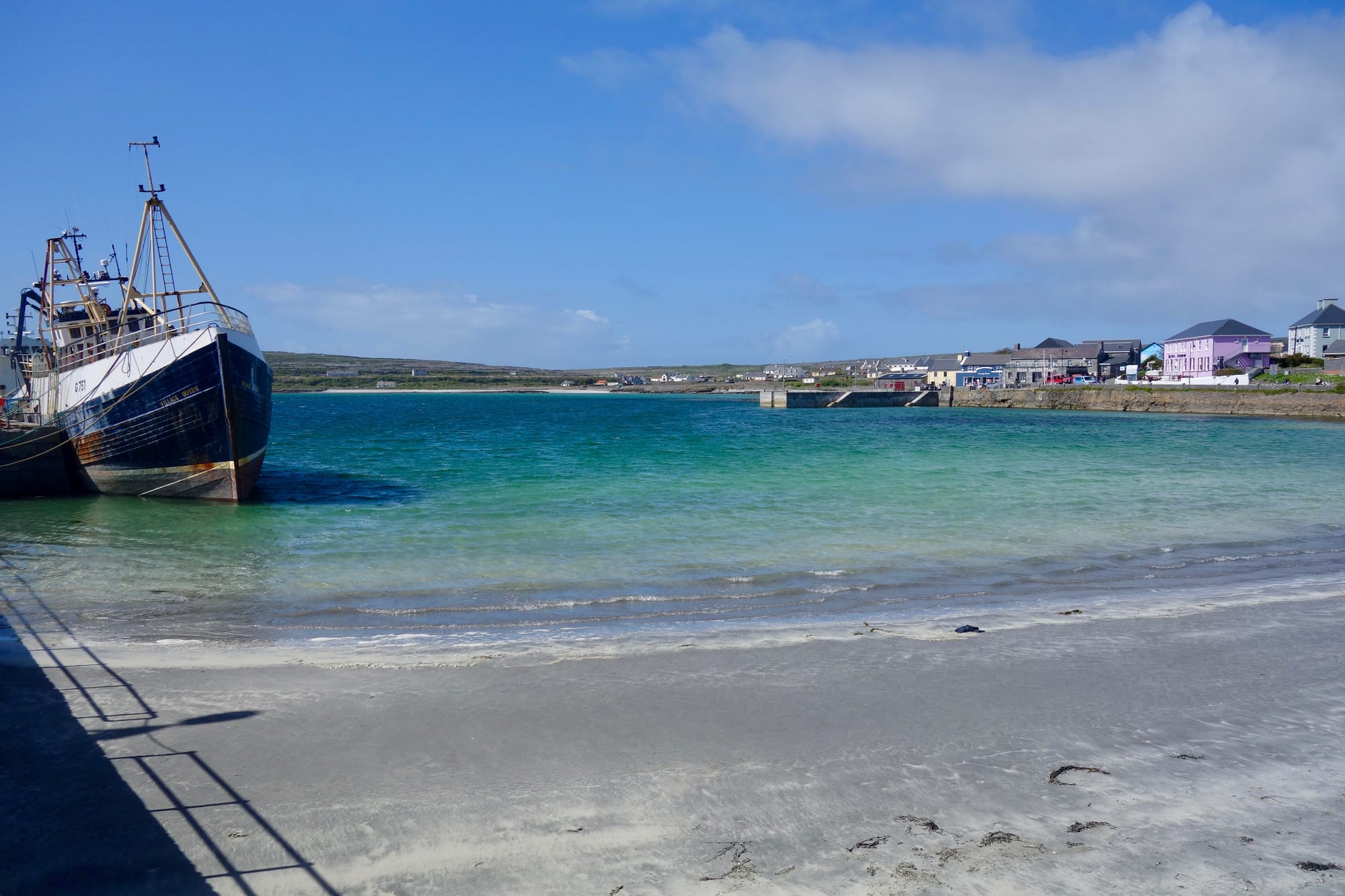
A fishing boat moored on clear turquoise water at Kilronan harbour, with the village's houses and pier across the bay

Galway, Donegal & the Wild Atlantic West, Ireland

Inishmore

The harbour at Kilronan, the main village of Inishmore. (Sonse / Wikimedia Commons · CC BY 2.0)

The largest of the Aran Islands at the mouth of Galway Bay, a bare limestone extension of the Burren criss-crossed by stone walls, with Kilronan as its port and main village. Irish is the everyday language, prehistoric forts such as Dún Aonghasa stand on its cliffs, and tourism and fishing now support its few hundred residents.

Neighbourhoods

  • Kilronan
    • First-time visitors
    • Pubs and music
    • Close to the ferry

    Cill Rónáin, the island's main village, around the ferry pier. The pubs, cafés, bike hire, a supermarket, shops selling Aran jumpers and most of the B&Bs are within a short walk of the harbour, and there are small beaches beside it.

    Open in Maps
  • Kilmurvey and the west
    • Prehistoric sites
    • Beaches
    • Quiet stays

    The villages towards the west end, reached by the island's three lanes, with a sheltered beach at Kilmurvey and the visitor centre below Dún Aonghasa. Quieter than Kilronan once the day-trippers leave, it is closest to the cliffs and the forts.

    Open in Maps
  • Killeany and the east
    • Quiet and residential
    • Ruins and walks

    Cill Éinne, at the east end near the airfield, where Enda founded the island's first monastery. Arkin's Castle, Teampall Bheanáin on its ridge and the Black Fort on the cliffs are all close by, and the area sees fewer visitors than the west.

    Open in Maps

Things to do

Forts and cliffs

  • Dún Aonghasalandmark

    The best-known of the Aran forts, dating back to 1100 BC, with walls standing at the edge of a 100-metre cliff above the Atlantic and reached by a steep path from the visitor centre.

    Open in Maps
  • Dún Dúchathairlandmark

    The Black Fort, a large stone fort of unknown age on the cliffs at Killeany, now left on a rocky promontory by erosion, with massive walls on its landward side.

    Open in Maps
  • Inishmore Lighthouse and Dún Eochlaviewpoint

    The decommissioned lighthouse on the highest point of the island, replaced in 1857 by lights at each end of the islands, with the circular ring fort of Dún Eochla close by.

    Open in Maps
  • Poll na bPéistattraction

    The Wormhole, a remarkably rectangular natural pool on the south coast connected to the sea by underwater channels, which has hosted Red Bull Cliff Diving events.

    Open in Maps

Churches and ruins

  • Teampall Bheanáinlandmark

    A tiny roofless oratory high on a ridge near Kilronan, marking the monastery founded by Benen, a disciple of St Patrick, with tall gables that stand out against the sky.

    Open in Maps
  • The Seven Churcheslandmark

    Na Seacht dTeampaill, a complex dedicated to the 5th-century St Brecan and once a popular destination for pilgrims, with two ruined churches, Teampall Bhreacáin and the later Teampall an Phoill, and their outbuildings.

    Open in Maps
  • Arkin's Castlelandmark

    The ruin of a 13th-century castle beside the shore at Killeany, whose remains include part of a wall and a water-gate, a tower and a bartizan.

    Open in Maps

The village and short trips

  • Aran Sweater Marketmarket

    A shop and exhibition in Kilronan that traces the culture and history of the Aran jumper, the off-white cabled knit named after the islands.

    Open in Maps
  • Inishmaanattraction

    The middle Aran island and the least populous of the three, reached on some ferry sailings that call between the islands.

    Open in Maps
  • Inisheerattraction

    The smallest and most easterly of the three islands, reached by inter-island ferry on most summer days.

    Open in Maps

Eat and drink

Long-standing places and food districts in Inishmore. Hours, ratings and directions come from your maps app, always current.

Inishmore classics

  • Tigh Joe Macrestaurant

    The pub in Kilronan where islanders drink, open for about a century and once nicknamed the 'American Bar' because emigrants took a last pint there before leaving Ireland.

    Open in Maps
  • The Galleyrestaurant

    A fish and chips takeaway beside the supermarket in Kilronan.

    Open in Maps
  • Minnie's Cafecafe

    A café in the middle of the island near the old lighthouse, a stop for walkers and cyclists.

    Open in Maps

Pubs and cafés

  • Kilronan's pubs and cafésneighborhood

    The few pubs and cafés around the harbour, where Irish is spoken and traditional music is played, with seafood on many menus.

    Open in Maps

Experience Inishmore

History

People have lived on Inishmore since prehistory, building a line of stone forts on its cliffs; Dún Aonghasa dates back to 1100 BC. Early settlers made soil by spreading seaweed and sand from the shore over the bare rock. Around AD 490 Enda of Aran founded a monastery at Killeany, and in time there were a dozen monasteries on the island alone, among them the foundations of St Brecan and of Benen, a disciple of St Patrick. Raiders from the Isles plundered Aran in 1015, carrying off captives.

During the Cromwellian conquest, after 1653, the New Model Army used Inishmore as a prison for Catholic priests, the last of them released after the Restoration in 1662. A signal tower was built on the highest point in 1806–08 to watch for a Napoleonic attack, and the island's first lighthouse later used the site until 1857, when lights at each end of the islands replaced it. The name Inishmore itself appears to have been coined by the Ordnance Survey for its map of 1839.

In the 1820s kelp harvesting helped pay the rents, but the population of the islands has fallen steadily since 1841, when it was about 3,500. From 1898 the playwright John Millington Synge spent his summers on the islands, and Robert Flaherty's film Man of Aran (1934) won the top prize for best foreign film at the Venice festival. Today fishing and tourism are the main industries.

Culture & Customs

Inishmore is part of the Gaeltacht, and Irish is the language of homes, signs and the pub, though everyone also speaks English. The island has produced writers out of proportion to its size: Liam O'Flaherty was born at Gort na gCapall in 1896, and Máirtín Ó Direáin, one of the most important modern poets in Irish, came from the island. Synge's journal The Aran Islands, published in 1907, and Flaherty's Man of Aran are among the best-known works about the islands.

Craft traditions run deep. Aran knitters were famously skilled, and the Aran jumper, an off-white knit with cable patterns on the body and sleeves, takes its name from the islands. Islanders built currachs, light boats of canvas stretched over thin laths and covered in tar, for fishing.

More recently the island has been a film set. Martin McDonagh used it for The Banshees of Inisherin and set his play The Lieutenant of Inishmore here, and scenes of Leap Year were filmed on the island. Since 2007 Ted Fest has brought admirers of the sitcom Father Ted, many in costume, to watch episodes and take part in competitions. Visitors come above all to see the ruins, hear Irish spoken and music played in the island's few pubs, and walk the cliffs.

Daily Life

About 820 people lived on Inishmore at the 2016 census, making it the most populous of the Aran Islands, whose three islands had about 1,350 people in 2022. Kilronan is the main settlement, and fishing and tourism are its main industries, with B&Bs scattered across the island and minibuses, bicycles and pony traps carrying the summer crowds from the pier to the forts.

The rhythm of the year follows the visitors and the weather. In summer ferries arrive several times a day and the lanes are busy; in winter crossings are fewer, storms can cut the island off, and life turns inward around school, church and pub. Farming is limited by the thin soil, but the stone-walled fields still provide grazing for cattle and sheep.

The island depends on its links to the mainland: passenger ferries from Rossaveal and Doolin, unscheduled boats for cars and heavy goods, and small planes from Connemara Airport, built in 1992 partly to help keep the island communities viable.

Food

The island's food comes from the sea and the thin soil. Irish cuisine is founded on the crops and animals of a temperate climate and on fish and seafood from the surrounding Atlantic, and chowder is popular around the coasts. On Inishmore, islanders long made fields by layering sand and seaweed over the rock, a method used to grow potatoes and other vegetables, and the same seaweed-built ground gave grazing for cattle and sheep inside the stone walls.

Fishing from currachs was part of traditional island life, and fish and seafood are still central to what Kilronan's few pubs, cafés and its fish and chips takeaway serve. The heritage park near the old lighthouse includes a traditional thatched cottage and a poteen distillery. Eating out is simple: pub meals, a café in the middle of the island, takeaway by the harbour and Irish breakfasts in the guesthouses, with the main supermarket by the pier for picnics on the bike.

Planning tools

Budget

The island is an easy day trip, and the ferry or flight is the first fixed cost. Rooms are in B&Bs, guesthouses, a hostel and a glamping site, and they fill in July and August. Choice in shops and restaurants is limited, so prices are higher than on the mainland.

Daily Budget Midrange
USD 160–280 (B&B, pub and restaurant dinners, return ferry or flight, a pony trap or minibus tour)
Daily Budget Shoestring
USD 80–125 (hostel bed or camping, takeaway and pub food, ferry and bike hire)

Hiring a bicycle at the pier is the cheapest and most flexible way to see the island; visit Dún Aonghasa early in the day, before the day-trippers arrive.

Best Time to Visit

May to September, when ferries run most often, inter-island trips are possible most days and the long evenings suit cycling. July and August are the busiest months. Winter crossings are fewer and more often disrupted by weather, and inter-island trips are rare.

Suggested Number of Days

A day trip covers the main fort, but an overnight stay sees the island after the day visitors have gone. Allow three or four days to include the other two islands; bad weather can stop ferries and flights, so leave some slack.

First Visit
1–2 days
With Surroundings
3–4 days

Transportation

There are no taxis, hire cars or scheduled buses on the island. Visitors get around by bicycle, hired near the pier, by private minibus or by pony trap, or on foot. A main road runs west from Kilronan towards Kilmurvy, with a quieter lane along the north coast and another towards the south. Away from the lanes the ground is bare, uneven rock.

Cycling is easy but there are hills and often a stiff breeze; bring a car only if there is a real need, as ferries carry foot passengers.

Airport & Station Connections

Passenger ferries sail from Rossaveal in Connemara, about 37 km from Galway city, all year, with a crossing of about 40 minutes and a shuttle bus from Galway. Ferries also run from Doolin in County Clare from spring to autumn. Small planes fly from Connemara Airport at Inverin, 28 km west of Galway, in about 10 minutes. Boats arrive at Kilronan; the airfield is near Killeany.

Walkability

Kilronan is small and easy to walk. The island is about 31 square kilometres, and walking the lanes to the forts at the west end is a long day; the final path up to Dún Aonghasa is about a kilometre of hard rock, slippery when wet. Off the lanes, the limestone pavement is cracked and rough, so proper boots are needed.

Safety

Ireland is a very safe country, with low levels of violent crime. On Inishmore the dangers are the cliffs and the sea: there is no fence at the edge of Dún Aonghasa, the blow-holes near the east tip are unfenced, winds can be strong, and the rock paths are slippery after rain.

Keep well back from cliff edges and hold on to children, wear sturdy shoes and allow for ferries or flights being cancelled in storms. Check current official travel advice before travelling.

Climate

Mild, wet and windy, with the Atlantic on every side. Across the Aran Islands, snow is rare, and the mild winters give one of the longest growing seasons in Ireland or Britain.

Summer
cool and breezy — average air temperatures across the Aran Islands are about 15°C in July
Winter
mild, wet and stormy — average air temperatures across the Aran Islands are about 6°C in January

Local Customs

The island is part of the Gaeltacht and Irish is the everyday language; everyone also speaks English, but place names and signs are in Irish, and Árainn is the island's only legal name. Pubs are the social centre, and music sessions are part of evening life. Several of the island's monastic sites have old graves and crosses.

A few words of Irish are appreciated, close any gate in the stone walls behind, and treat graves and holy wells with respect.

Common Payment Methods

The currency is the euro. Cards are accepted in most outlets, but carry some cash for bike hire, pony traps, small shops and takeaways. There is a supermarket near the pier in Kilronan.