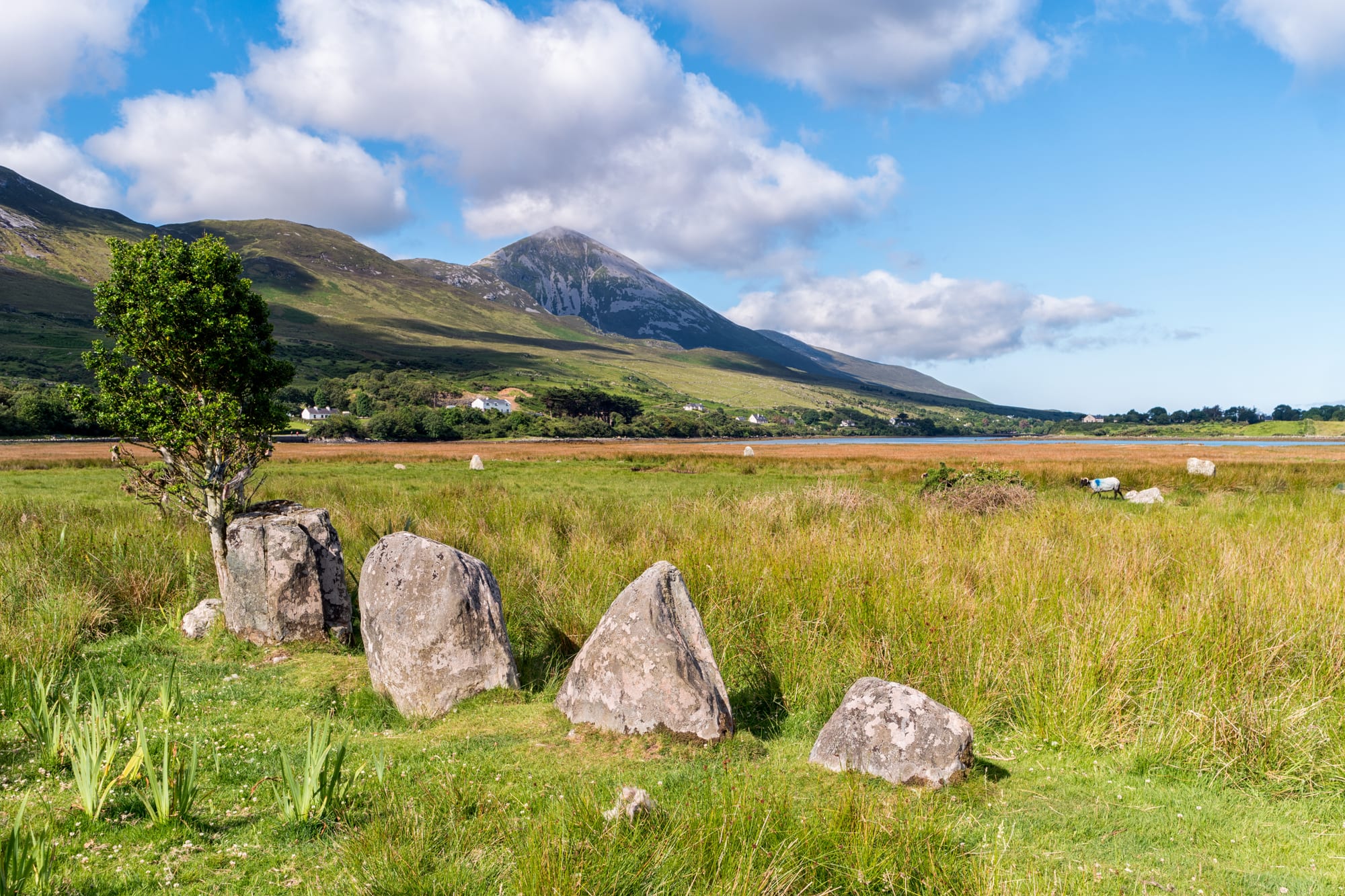
Grey standing stones and a small tree in long marsh grass, with the cone-shaped peak of Croagh Patrick behind

Ireland

Galway, Donegal & the Wild Atlantic West

Standing stones on the salt marsh at Murrisk on Clew Bay, County Mayo, below Croagh Patrick. (MickReynolds / Wikimedia Commons · CC BY-SA 4.0)

The Republic's Atlantic northwest, from Galway city and Connemara through Mayo, Sligo and the lake country of Roscommon and Leitrim to the cliffs and glens of Donegal — the least populated, most Irish-speaking part of the country, shaped by famine and emigration and by a coastline of islands, bogs and mountains.

Explore Galway, Donegal & the Wild Atlantic West

History

The west holds some of Ireland's oldest human landscapes. The Céide Fields in north Mayo preserve Neolithic stone field walls beneath the bog, and the Carrowmore cemetery near Sligo is one of the largest groups of megalithic tombs in the country. Rathcroghan in Roscommon was the royal seat of Connacht, home in legend to Queen Medb, who launched the Cattle Raid of Cooley. Early monks settled on the Aran Islands and the offshore rocks, and the O'Donnells of Donegal and the O'Connors of Connacht became the dominant Gaelic dynasties.

The Anglo-Norman de Burgo family founded Galway in the 13th century, and it grew into a merchant town ruled by fourteen families, the "Tribes", trading wine with Spain and France. Gráinne Mhaol, or Grace O'Malley, commanded ships from Clew Bay in the 16th century. After the defeat at Kinsale, the Gaelic lords of Ulster left from Rathmullan on Lough Swilly in the Flight of the Earls of 1607, and Cromwell's settlement later pushed dispossessed Catholic landowners west of the Shannon — "to Hell or to Connacht". A French force landed at Killala in 1798 and routed the government troops at Castlebar before surrendering.

The Famine hit Connacht hardest of all, and the west lost people for more than a century afterwards. Michael Davitt founded the Land League in Castlebar in 1879, launching the campaign that transferred land to tenant farmers. Partition in 1921 left Donegal in the Free State but cut off from Derry, its natural market town.

Culture & Customs

This is the heartland of spoken Irish. The Connemara Gaeltacht, the largest in the country, runs west from Galway city to Carna and out to the Aran Islands, with the national Irish-language radio station and television channel based there, and there are Gaeltacht districts in Mayo, on Achill and across west Donegal, from Gweedore to Tory Island, which still names a "king". Sean-nós singing, unaccompanied and highly ornamented, belongs above all to Connemara.

Traditional music is everywhere: Galway's pub sessions, the Sligo fiddle style, and Gweedore, home to Clannad, Enya and Altan. W. B. Yeats spent childhood summers in Sligo and is buried at Drumcliff beneath Ben Bulben. Galway city is young, bohemian and student-heavy, and its July arts festival and the Galway Races at Ballybrit are fixtures of the national summer.

Faith is visible in the landscape. Pilgrims climb Croagh Patrick on Reek Sunday, many barefoot; Knock in Mayo has been a Marian shrine since a reported apparition in 1879; and Lough Derg in south Donegal holds a three-day penitential pilgrimage on Station Island. Crafts include Aran knitwear, Donegal tweed woven around Ardara and Donegal town, and the Claddagh ring from the old fishing village beside Galway.

Daily Life

Galway, with about 85,000 people, is the only city in the region, with a university and a cluster of medical-device manufacturers. Letterkenny in Donegal and Sligo each have around 20,000, and Castlebar, Ballina, Westport, Roscommon and Carrick-on-Shannon are market towns. Leitrim is the least populated county in Ireland.

The rural economy is sheep and suckler cattle on poor land, fishing — Killybegs is home to Ireland's largest trawlers — fish farming, turf-cutting for home fires, and tourism along the Wild Atlantic Way. Remote working has brought some younger families back since 2020, but emigration and ageing still mark many villages, and the Aran Islands and Tory depend on ferries and subsidised services.

A current issue in Donegal and Mayo is the defective-blocks scandal: thousands of homes built with blocks containing too much mica are crumbling, and their owners have campaigned for years for full state redress. Donegal's life also runs across the border, with thousands commuting daily to Derry and beyond.

Food

Galway Bay is known for its native flat oysters, celebrated each September at festivals in Galway city and nearby Clarenbridge, often with a pint of stout. Mussels farmed in Killary Harbour, crab, lobster, mackerel and smoked salmon from Connemara smokehouses fill the menus, and Killybegs is home to the country's largest trawlers. Seaweeds such as dulse are eaten dried, and carrageen moss is set with milk into a soft, pale pudding.

Lamb raised on the mountains of Connemara and Achill, which grazes on heather and salt grass, is prized. Boxty, a pancake of grated raw and mashed potato, belongs to Leitrim, Sligo and Mayo — "boxty on the griddle, boxty in the pan", as the rhyme runs — along with brown soda bread and potato cakes.

Poitín, the clear spirit once distilled illegally from barley or potato in the Connemara hills, is now also produced commercially under a protected geographical indication. Craft breweries and new distilleries in Galway, Mayo, Sligo and Donegal make beer, whiskey and seaweed-flavoured gin.

Attractions & Natural Wonders

Galway city centres on the Latin Quarter, Shop Street, the Spanish Arch and the promenade at Salthill. West of it, Connemara runs through Oughterard, the Maam Cross bogs and the Twelve Bens to Roundstone and Clifden, with Kylemore Abbey by its lake, Connemara National Park at Letterfrack and Killary Harbour on the Mayo border. The Aran Islands — Inis Mór, Inis Meáin and Inis Oírr — offer Dún Aonghasa, stone-walled fields and bike tracks.

In Mayo, Westport is a planned Georgian town at the foot of Croagh Patrick, with Westport House and the Great Western Greenway running to Achill, whose Keem Bay, Minaun cliffs and Slievemore deserted village lie across a bridge. North Mayo has the Céide Fields and Downpatrick Head's sea stack; Knock and the Clare Island ferry lie within reach.

Sligo has Carrowmore, Knocknarea's cairn, Ben Bulben, Lough Gill with Innisfree and the surf beaches of Strandhill and Mullaghmore; Leitrim has Glencar Waterfall and Shannon cruising from Carrick-on-Shannon; Roscommon has Rathcroghan, Strokestown's famine museum and Lough Key. Donegal's Slieve League cliffs rise above the sea near Teelin, and Glenveagh National Park and castle lie beside Errigal, with Malin Head, the Inishowen peninsula, Fanad Head and the Grianán of Aileach in the north.

Cities in Galway, Donegal & the Wild Atlantic West

Planning basics

Budget

The west is generally cheaper than Dublin or Kerry, with good-value B&Bs, hostels and self-catering cottages. Galway city is the exception on festival and race weeks, when rooms become scarce and expensive, and Westport, Clifden and the Aran Islands fill in July and August. Donegal, Leitrim and Roscommon are among the cheapest parts of the country.

Daily Budget Midrange
USD 160–300 (B&B or small hotel, restaurant dinners, a hire car, ferries and paid sights)
Daily Budget Shoestring
USD 75–120 (hostel, pub and café food, buses, bike hire on the islands and greenways)

Book Galway well ahead for the arts festival and race week in late July, and hire a bike rather than a van tour on the Aran Islands.

Safety

The west is very safe, with little crime beyond occasional car break-ins at beaches and trailheads. The real hazards are the Atlantic and the weather: strong rips on exposed beaches, unfenced cliffs at Slieve League and on the Aran Islands, fog and wind on Croagh Patrick, where the upper slope is loose scree, and single-track roads with sheep and tractors.

Swim only at lifeguarded beaches, wear proper boots on Croagh Patrick and keep back from cliff edges in wind. Check current official travel advice before travelling.

Climate

The wettest and windiest part of Ireland, facing straight onto the Atlantic: rain falls on most days of the year in Connemara, west Mayo and Donegal, and gales strike the coast in winter. It is also mild, with frost rare by the sea, and light changes by the minute. Donegal is a little cooler than Galway, and summer evenings in the far north stay light very late.

Summer
cool to mild, generally 14–19°C, showery and breezy, with long light evenings
Winter
mild but wet and stormy on the coast, 4–9°C; colder inland, snow on the Donegal and Mayo hills in some years

Transportation

Trains run from Dublin to Galway, Westport and Sligo, each in roughly two and a half to three and a half hours, and Ireland West Airport at Knock and Donegal Airport serve the north of the region. Donegal has no railway, and buses from Dublin or Galway take many hours; many drivers reach it through Northern Ireland. A car is close to essential for Connemara, Achill and the Donegal coast. Aran ferries leave from Rossaveal in Connemara, with small planes from Connemara Airport.

Allow for slow, winding roads: Galway to Donegal town takes around three hours or more, and rural fuel stations may close early.

Best Time to Visit

May to September, when ferries to the islands run most often, the greenways and mountains are at their best and the evenings are long. Galway's arts festival and races fill late July, Reek Sunday falls on the last Sunday of July, and September's oyster festival opens the shellfish season. Winter is quiet and atmospheric, but many island services and rural attractions close or cut back.