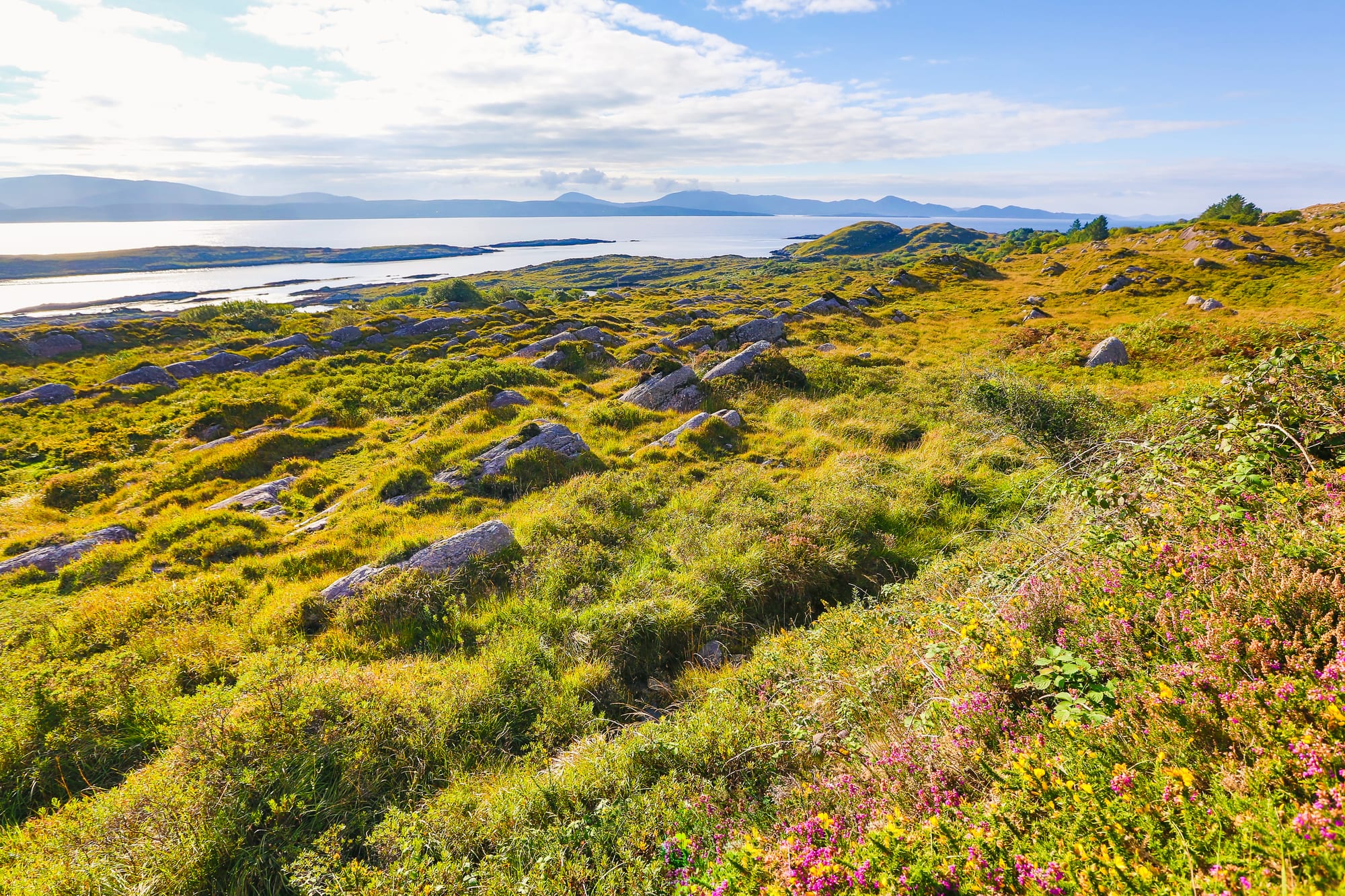
Heather and grass among grey rock outcrops above a sunlit bay, with low islands and distant mountains beyond

Ireland

Cork, Kerry & the Southwest

Heath and rocky ground above the sea on the Ring of Kerry, County Kerry. (Tony Webster / Wikimedia Commons · CC BY 2.0)

The Republic's southern province of Munster, from the Shannon estuary and the Burren of Clare down to the long peninsulas of Kerry and West Cork and east to Waterford — a region of mountains and Atlantic headlands, rich dairy land, fiercely contested hurling, Irish-speaking Gaeltacht villages and the cities of Cork, Limerick and Waterford.

Explore Cork, Kerry & the Southwest

History

Munster was one of the ancient provinces of Ireland, ruled for centuries by the Eóganacht kings from the Rock of Cashel until Brian Boru's Dál gCais dynasty of Clare rose to the high kingship around 1000. In 1101 the rock was handed to the Church, which built the Romanesque Cormac's Chapel and later the cathedral. Monks reached the edge of the known world on Skellig Michael, and Vikings founded Waterford, Limerick and Cork as trading ports in the 9th and 10th centuries.

Strongbow's Normans captured Waterford in 1170, and there he married Aoife, daughter of the king of Leinster, and families such as the FitzGeralds of Desmond came to dominate the southwest. Their rebellions against Elizabeth I ended in the plantation of Munster, and the Spanish landing at Kinsale in 1601 ended in a defeat that finished the old Gaelic order. Limerick endured two Williamite sieges before the Treaty of Limerick in 1691 closed the Williamite war.

The Famine struck the west of the region hard, and Cobh, then Queenstown, became the port from which millions emigrated; it was also the Titanic's last call in 1912. Cork, the "Rebel County" since a 1491 rising, lived up to the name in the War of Independence: Crown forces burned the city centre in December 1920, and Michael Collins was killed in an ambush at Béal na Bláth in 1922. Kerry's Daniel O'Connell, from Derrynane, had earlier won Catholic Emancipation in 1829.

Culture & Customs

Corkonians call their city the "real capital" and speak with a sing-song lilt that the rest of Ireland imitates. Kerry is known for its storytellers and footballers — the county has won more All-Ireland football titles than any other — while hurling rules Cork, Tipperary, Limerick, Clare and Waterford, and the Munster championship produces some of the fiercest matches in the game. The GAA itself was founded in Thurles, County Tipperary, in 1884. Munster rugby's home is Thomond Park in Limerick.

Irish is still a community language in several Gaeltacht areas: Corca Dhuibhne on the Dingle Peninsula, Múscraí in the hills west of Cork, Cape Clear Island, and An Rinn in County Waterford. The Blasket Islands, evacuated in 1953, produced a small shelf of Irish-language classics, including memoirs by Tomás Ó Criomhthain and Peig Sayers.

Festivals are old and odd. At Killorglin's Puck Fair in August a wild goat is crowned king for three days; Lisdoonvarna in Clare holds a matchmaking festival each September; Tralee chooses its Rose; Listowel runs Writers' Week; and on St Stephen's Day wren boys still go from house to house in parts of Kerry and Dingle. Clare is a heartland of traditional music, with sessions in Doolin, Ennis and Miltown Malbay.

Daily Life

Cork is Ireland's second city, with about 225,000 people in the city itself; its harbour at Ringaskiddy and Little Island holds a large cluster of pharmaceutical plants, and Apple has its European headquarters on the city's edge. Limerick, with around 100,000, has shed an old image of dereliction, grown its university and rebuilt its riverfront; Waterford has about 60,000. Tralee, Ennis, Killarney, Clonmel and Dungarvan are the main towns.

Outside the cities the southwest is dairy country: the Golden Vale of Limerick, Tipperary and north Cork is some of the richest grassland in Ireland, feeding the creameries and cooperatives that grew into big food companies such as the Tralee-based Kerry Group. Shannon Airport and its duty-free zone underpin employment in Clare, and tourism dominates Kerry and West Cork.

Rural life follows milking times, the mart and the Sunday match. West Cork and the Kerry peninsulas have attracted artists and foreign settlers since the 1970s, but many small villages are ageing, and holiday homes and short-term lets price out young locals.

Food

This is Ireland's larder. West Cork's farmhouse cheesemakers began in the 1970s: Milleens from the Beara Peninsula, Gubbeen, Durrus and the Gouda-style Coolea, while Tipperary makes Cashel Blue. Ballymaloe House in east Cork, and its cookery school at Shanagarry, did much to build Irish country cooking's modern reputation, and Kinsale has long marketed itself as a gourmet town.

Cork keeps its own old dishes: drisheen, a soft blood pudding; tripe cooked in milk with onions; crubeens, boiled pigs' trotters; and spiced beef at Christmas, alongside Clonakilty black pudding. Waterford's blaa is a soft, floury white bread roll with protected status, traditionally eaten at breakfast. The coast supplies crab, mussels, scallops and smoked salmon, and Kerry and the Burren raise mountain lamb.

Cork brews its own stouts, Murphy's and Beamish, as rivals to Guinness, and the distillery at Midleton produces Jameson and other Irish whiskeys. Newer distilleries in Dingle and elsewhere make whiskey and gin, and Tipperary and Waterford have craft breweries and cider orchards.

Attractions & Natural Wonders

Kerry has the greatest concentration of scenery. Killarney sits beside Killarney National Park, with Muckross House, Ross Castle, Torc Waterfall and boat trips across the lakes, and the Gap of Dunloe cuts through the Macgillycuddy's Reeks, whose peak Carrauntoohil is Ireland's highest mountain. The Ring of Kerry circles the Iveragh Peninsula past Kenmare, Sneem, Derrynane and Cahersiveen, with Valentia Island and the boats from Portmagee to Skellig Michael. North of it, Dingle town is the base for Slea Head, the Blasket Islands, Gallarus Oratory and the Conor Pass.

Cork city has the English Market, St Fin Barre's Cathedral and the bells of Shandon, with Blarney Castle, Fota and Cobh's harbour and Spike Island nearby. West Cork runs through Kinsale, Clonakilty and Baltimore to Mizen Head, and the Beara Peninsula is quieter than Iveragh.

Clare's Cliffs of Moher rise over the Atlantic south of Doolin, with the Burren's limestone pavements, the Poulnabrone dolmen and Loop Head to the south. Limerick has King John's Castle on the Shannon, and Bunratty Castle and Folk Park lie between it and Shannon Airport. Inland, the Rock of Cashel, Cahir Castle, Holy Cross Abbey and the Glen of Aherlow fill Tipperary. Waterford has the Viking Triangle and Reginald's Tower, the House of Waterford Crystal, the Copper Coast and the Waterford Greenway to Dungarvan.

Cities in Cork, Kerry & the Southwest

Planning basics

Budget

Prices are a step below Dublin, but Kerry in July and August is expensive and busy, with Killarney, Kenmare, Dingle and Kinsale charging the most. Limerick, Waterford, Tipperary's towns and the inland farm country offer better value, and hostels and farmhouse B&Bs are plentiful along the peninsulas. A hire car is the main extra cost.

Daily Budget Midrange
USD 170–320 (B&B or country hotel, restaurant dinners, a hire car, boat trips and paid sights)
Daily Budget Shoestring
USD 80–130 (hostel, pub and market food, buses and some cycling)

Book Kerry and Kinsale accommodation early for summer, and base in Killarney or Cork city for public transport.

Safety

The southwest is very safe. The main dangers are natural: unfenced cliff edges at Moher, Slea Head and the Kerry headlands, strong Atlantic currents on exposed beaches, fast-changing weather on Carrauntoohil and the Reeks, and narrow coast roads shared with coaches, cyclists and sheep. Thefts from cars at trailheads and viewpoints do occur.

Keep well back from cliff edges in wind, swim only at lifeguarded beaches, and carry proper gear in the mountains. Check current official travel advice before travelling.

Climate

The mildest corner of Ireland: the Gulf Stream keeps frost rare along the Kerry and West Cork coasts, where palms, fuchsia hedges and subtropical gardens thrive. It is also wet, especially in the Kerry mountains, which are among the rainiest places in the country, while the Golden Vale of Limerick and Tipperary is drier. Atlantic gales hit the Clare and Kerry headlands in winter.

Summer
mild, generally 16–20°C, with showers and sunny spells; fog and wind on the headlands
Winter
mild and wet, 5–10°C on the coast, colder inland; snow on the Kerry summits in some years

Transportation

Cork, Shannon and Kerry airports serve the region, and a ferry runs from Ringaskiddy near Cork to Brittany. Trains link Dublin with Cork in about two and a half hours, and with Limerick, Tralee, Killarney and Waterford, while buses connect the towns. The peninsulas, the Burren and West Cork are best done by car or with a day tour, as rural buses are infrequent. Tour coaches usually drive the Ring of Kerry anticlockwise.

Allow a full day for the Ring of Kerry, and treat Skellig Michael landings as weather-permitting: have a backup day.

Best Time to Visit

May, June and September give long days, fewer coaches on the Ring of Kerry and good walking. July and August bring the Puck Fair at Killorglin and the Rose of Tralee festival, and the Skellig Michael landing boats run only in summer and are often cancelled by the swell. October has the Cork Jazz Festival; winter is quiet, stormy and good for pub music in Doolin and Dingle.