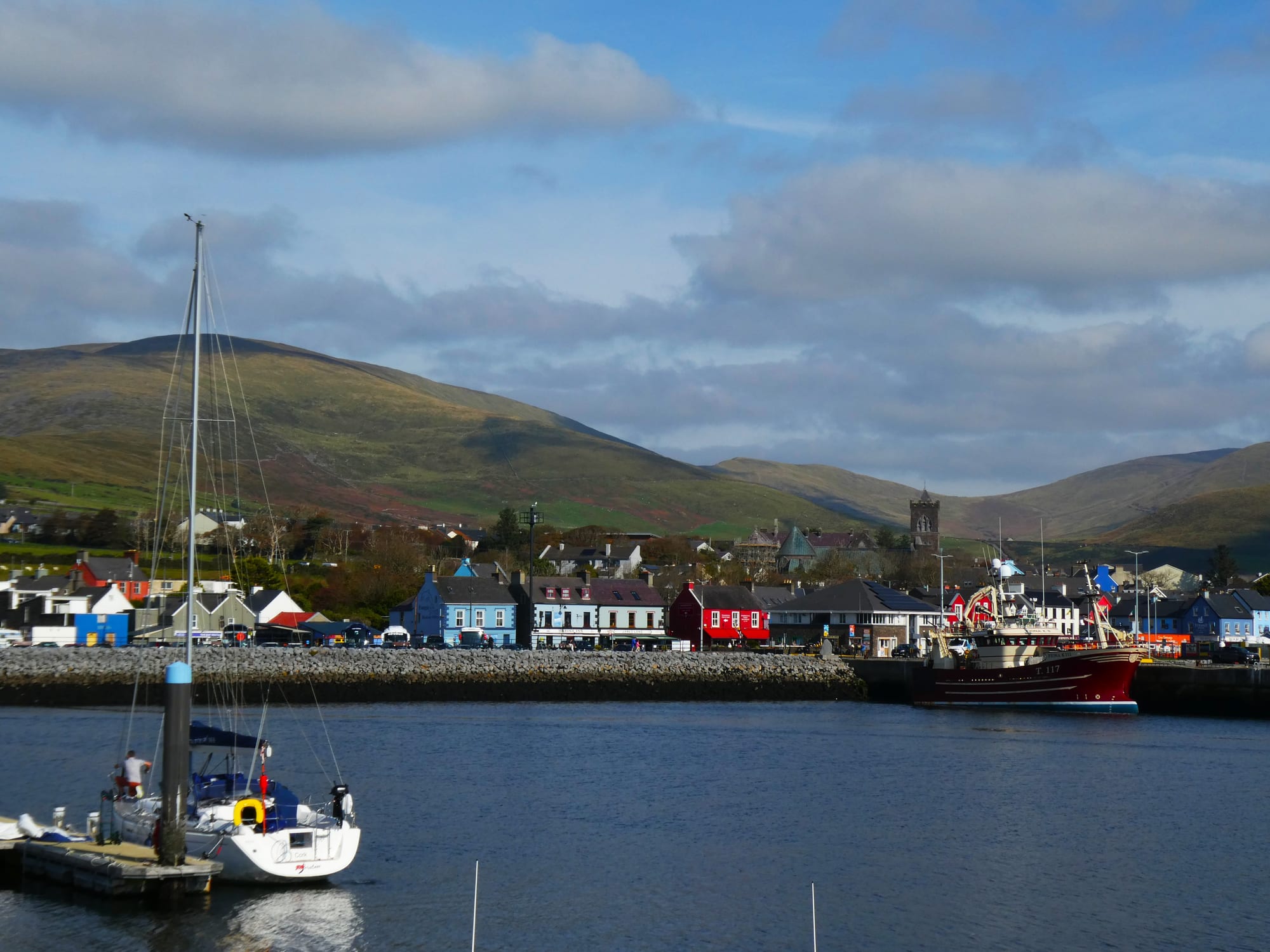
Dingle harbour with a yacht and a red fishing trawler in front of brightly painted houses, a church tower and green hills

Cork, Kerry & the Southwest, Ireland

Dingle

Dingle harbour and town, with St Mary's Church and the hills towards the Conor Pass behind. (Maoileann / Wikimedia Commons · CC BY-SA 4.0)

The only town on the Dingle Peninsula in County Kerry, a small Gaeltacht harbour town on the Atlantic coast. A medieval trading port with strong links to Spain, it later lived from linen and fishing; today tourism, fishing and farming support a town of colourful streets, traditional music pubs and boat trips, the base for Slea Head, the Blaskets and Gallarus.

Neighbourhoods

  • The harbour and the Mall
    • First-time visitors
    • Waterfront
    • Boat trips

    The working fishing harbour and marina, where trawlers tie up beside the boats that run trips round the bay and out to the Blaskets. The tourist office, the aquarium, food kiosks and seafood restaurants line the waterfront, and a plaque recalls Fungie the dolphin.

    Open in Maps
  • Main Street and Green Street
    • Pubs and music
    • Historic district
    • Shopping

    The streets climbing from the harbour, where the old pattern of narrow burgage plots survives behind brightly painted shopfronts, traditional pubs, galleries and craft shops. St Mary's Church and the An Díseart cultural centre stand on Green Street.

    Open in Maps
  • Milltown and the western edge
    • Quiet and residential
    • Distillery

    The outskirts at Milltown, where the Dingle Distillery occupies a converted sawmill and farmland quickly takes over from houses.

    Open in Maps

Things to do

In the town

  • St Mary's Church and the Harry Clarke windowslandmark

    A neo-Gothic church begun in 1862 and later radically reordered; the Chapel of the Sacred Heart beside it has six double-lancet stained-glass windows by Harry Clarke, installed in 1924.

    Open in Maps
  • Oceanworld Aquariumattraction

    The town's aquarium, with a walk-through tunnel, touch pools and animals including sharks, penguins and otters.

    Open in Maps
  • Dingle Distilleryattraction

    A whiskey distillery founded in 2012 in a converted sawmill at Milltown on the edge of town, which also makes gin and vodka and offers tours.

    Open in Maps

Slea Head Drive

  • Ventrybeach

    A Gaeltacht village 7 km west of Dingle whose Irish name, Fionntrá, means 'white beach', after its long sandy strand.

    Open in Maps
  • Dunbeg Fortlandmark

    An Iron Age promontory fort on a cliff-edge headland near Ventry, partly lost to erosion, with a visitor centre nearby.

    Open in Maps
  • Slea Headviewpoint

    The promontory at the western end of the peninsula, a well-known viewpoint with a full view of the Blasket Islands; Dunmore Head, the westernmost point of Ireland, lies just beyond.

    Open in Maps
  • Blasket Islandsattraction

    An island group off the end of the peninsula, abandoned in 1954 and known for the Irish-language writers who lived there; boats sail from Dingle, Ventry and Dunquin, where a museum tells their story.

    Open in Maps

Early Christian sites

  • Gallarus Oratorylandmark

    A drystone building shaped like an upturned boat above Smerwick Harbour, of uncertain date and purpose, with Mount Brandon behind it.

    Open in Maps
  • Kilmalkedarlandmark

    A medieval church site and National Monument with the ruin of a 12th-century church, a sundial and an Ogham stone.

    Open in Maps

Beaches and mountains

  • Inch Strandbeach

    A 5-km sand spit and dune system reaching into Dingle Bay on the road towards Killarney, part of a Special Area of Conservation.

    Open in Maps
  • Conor Passviewpoint

    One of the highest mountain passes in Ireland served by a paved road, on the narrow R560 over the mountains from Dingle to the north coast of the peninsula.

    Open in Maps
  • Mount Brandontrail

    At 952 metres, the highest Irish mountain outside the MacGillycuddy's Reeks, reached from the west by the last stage of an old pilgrimage route, the Saints' Road.

    Open in Maps

Seasonal events

  • Dingle MarathonSeptember, with a half-marathon in May

    A full and half marathon held since 2009, the full course starting and finishing in the town and taking in Slea Head.

  • West Kerry Agricultural ShowJuly

    The peninsula's farming show, held at Dingle Mart on the edge of town.

  • Dingle Racessecond weekend in August

    A weekend of horse and pony races on a grass circuit.

  • Dingle Regattalate August

    Races for traditional Irish currachs, known on the peninsula as naomhóga.

  • Wren Day26 December

    The old St Stephen's Day custom of the wren boys, which survives or has been revived in a few southern towns, Dingle among them.

Eat and drink

Long-standing places and food districts in Dingle. Hours, ratings and directions come from your maps app, always current.

Dingle classics

  • Harbour seafood restaurantsneighborhood

    Seafood bistros, pub restaurants serving chowder, and fish and chips from takeaways and kiosks by the pier, supplied by the town's fishing fleet.

    Open in Maps
  • Murphy's Ice Creamcafe

    A café serving coffee and homemade ice cream made with milk from Kerry cattle.

    Open in Maps

Pubs

  • Main Street and Green Street pubsneighborhood

    Small traditional pubs with live music most evenings in summer, including a few that still double as shops — one keeps a hardware counter on one side and a bar on the other.

    Open in Maps

Experience Dingle

History

Long before the town existed, a large group of Ogham stones was set up in an enclosure at Ballintaggart in the 4th and 5th centuries AD. Dingle itself grew as a port after the Norman invasion. By the 13th century more goods were exported through it than through Limerick, and in 1257 Henry III imposed customs on its trade; wine imports were a major business by the 14th century. By the 16th century it was one of Ireland's main trading ports, exporting fish and hides and importing continental wine. In 1529 the Earl of Desmond and the envoy of Emperor Charles V signed the Treaty of Dingle. Pilgrims sailed from here to Santiago de Compostela, and the parish church was rebuilt with Spanish patronage and dedicated to St James.

In July 1579 James FitzMaurice FitzGerald landed at Dingle with a small fleet, launching the Second Desmond Rebellion; his fleet later anchored near Smerwick, leading to the siege there in 1580. A royal charter of 1607 made Dingle a borough and allowed it to build walls; traces survive, and the street plan still follows its burgage plots. The town was burned or sacked several times in the Nine Years' War and the Wars of the Three Kingdoms.

The Fitzgeralds, Knights of Kerry, revived it in the 18th century with a linen industry that flourished by 1755 and collapsed by 1837. A fishing industry grew from about 1830, Manx and Lowestoft fleets came for mackerel and herring in the 1870s, and the railway from Tralee, opened in 1891, carried fish across the country until it closed in 1953.

Culture & Customs

Dingle sits in the Corca Dhuibhne Gaeltacht, and the language shapes its identity. In 2005 the English name was dropped from official signs in favour of An Daingean, and a heated row followed: a plebiscite on a bilingual name was held in 2006, and in 2011 the law made "Dingle" the English name and Daingean Uí Chúis the Irish one, though Gaeltacht road signs still show only the Irish. Summer Irish-language schools bring students to the peninsula, and the Blasket Islands offshore produced a celebrated shelf of Irish-language memoirs.

Traditional music is played in several of the town's pubs, especially in the summer season, and the peninsula is a stronghold of old customs: Dingle is one of the few towns where Wren Day, the St Stephen's Day procession of the wren boys, has survived or been revived. The six Harry Clarke windows in the Chapel of the Sacred Heart, installed in 1924, are among the town's artistic treasures, and the old convent beside St Mary's is now the An Díseart cultural centre.

For 37 years the town's most famous resident was Fungie, a bottlenose dolphin first seen in the harbour in 1983, who sought out swimmers, kayakers and boats until he disappeared in October 2020; a plaque at the harbour recalls him. Gaelic football is the local sport, with the Dingle club competing in the Kerry championship, and the Dingle Marathon, first run in 2009, takes runners around Slea Head.

Daily Life

Dingle had 1,671 people at the 2022 census, fewer than in 2016, and the oldest average age of any town in Ireland, at 44.4 years. In 2016 about 14 per cent of residents spoke Irish every day. It is the only town on the peninsula, so it serves a wide rural area with schools — three primary and two secondary — a hospital, shops and the Dingle Mart, the livestock market for the surrounding farms.

Tourism, fishing and agriculture are the main industries. The harbour remains a fishing port, the distillery and small craft businesses add employment, and the Sacred Heart University of Connecticut runs an Irish studies centre in the town.

The town's population fell between 2016 and 2022. With no railway since 1953, it depends on the roads to Tralee and Killarney and on rural buses that run only a few times a day. The Dingle GAA club fields Gaelic football teams in the Kerry championship, and an Irish-language summer school brings students to the town each year.

Food

The harbour sets the menu. Dingle has been a fishing port since about 1830, and its restaurants, pub kitchens and takeaways serve seafood landed close by — chowder in the pubs, seafood bistros along the waterfront, and fish and chips from the takeaways and kiosks by the pier.

Murphy's Ice Cream, a café in the town, makes its own ice cream with milk from Kerry cattle. Drink has become a local industry too. The Dingle Distillery, set up in 2012 in a converted sawmill on the edge of town, released its first whiskeys in late 2016, makes gin and vodka as well, and in 2017 became the first independent Irish distillery in decades to release a single pot still whiskey. A micro-brewery has worked in a converted 19th-century cowshed in town since 2017, and the West Kerry Brewery operates near Ballyferriter.

Evenings centre on the pubs of Main Street, Green Street and the Mall, some of which still combine a bar with a shop counter.

Planning tools

Budget

Rooms in the town fill early in July and August. Hostels and farmhouse B&Bs are spread along the peninsula, and the Slea Head Drive, the beaches and most of the early Christian sites cost little or nothing to see. Boat trips, the aquarium, distillery tours and a hire car are the main extra costs.

Daily Budget Midrange
USD 180–330 (town B&B or guesthouse, seafood dinners, a boat trip and tours, a hire car)
Daily Budget Shoestring
USD 85–140 (hostel bed, pub food and chipper suppers, bike hire or local buses)

Book summer rooms well ahead, or stay out of season; hiring a bike suits the Slea Head loop on a fine day.

Best Time to Visit

May, June and September give long days for the coast road and the mountains, with fewer coaches than high summer. July and August bring the agricultural show, the races and the regatta, and the most music in the pubs. Winter is quiet and wet, and Wren Day enlivens the town on 26 December.

Suggested Number of Days

Two or three days give time for the town and a full circuit of the peninsula's western end. Allow longer for island trips, hill walking and the north side of the peninsula; Atlantic weather often cancels boats, so a spare day helps.

First Visit
2–3 days
With Surroundings
3–5 days

Transportation

The town is small and walkable. Local Link buses run a few times a day from Dingle to Ventry, Ballyferriter and Dunquin and on loops to Ballydavid, but services are infrequent; bikes, including electric ones, can be hired in town. All roads further west loop back through Dingle, and a car or a bike is the practical way to see the peninsula.

The Conor Pass road is narrow and twisting and closed to long and heavy vehicles; on the Slea Head Drive, pull in to let oncoming traffic pass.

Airport & Station Connections

The nearest railway station is at Tralee, about 50 km to the north-east, with trains and buses from Dublin, Cork and Limerick; Bus Éireann runs from Tralee to Dingle in about an hour, and a Local Link bus takes about an hour and a half from Killarney. Bus routes also link the town with Kerry Airport. By car the N86 runs along the south side of the peninsula from Tralee, and the R560 crosses the mountains by the Conor Pass.

Walkability

Very good. Everything in town — the harbour, Main Street, Green Street and the pubs — is within a few minutes' walk, though the streets climb steeply from the waterfront. The distillery is on the edge of town. The beaches, the forts and the early Christian sites are out along the coast roads and need a car, bike or bus.

Safety

Ireland is a very safe country, with low levels of violent crime. In and around Dingle the dangers are natural: unfenced cliff edges at Slea Head and along the coast, strong Atlantic currents on exposed beaches, sudden mist on Mount Brandon, and narrow roads shared with coaches, cyclists and farm animals.

Keep well back from cliff edges in wind, swim only at lifeguarded beaches, and check the forecast before hill walks and boat trips. Check current official travel advice before travelling.

Climate

Mild, wet and changeable, with abundant rain and no temperature extremes. In nearby Tralee the warmest months are July, August and September, and the wettest run from October to January, with rainfall all year round.

Summer
mild and showery — July to September are the warmest months, with temperatures of around 17–18°C in nearby Tralee
Winter
mild, wet and windy — mean daily temperatures across Ireland are 4–7°C in January and February, coasts being milder than inland, and October to January are the wettest months in nearby Tralee

Local Customs

Dingle is in the Corca Dhuibhne Gaeltacht, where Irish is a community language: road signs in the Gaeltacht show place names in Irish only, and the town's Irish name, Daingean Uí Chúis, is official alongside the English. A few words of Irish are appreciated. Tipping is not a general habit in Ireland, but 10–15 per cent is standard in restaurants; it is not expected in pubs.

Smoking is banned inside pubs and restaurants. Some small pubs take cash only; respect private land and farm gates when visiting forts and ruins on the peninsula.

Common Payment Methods

The currency is the euro. Cards are accepted in most outlets, and there are ATMs in the centre, but some small traditional pubs are cash only, and cash is useful further out on the peninsula.