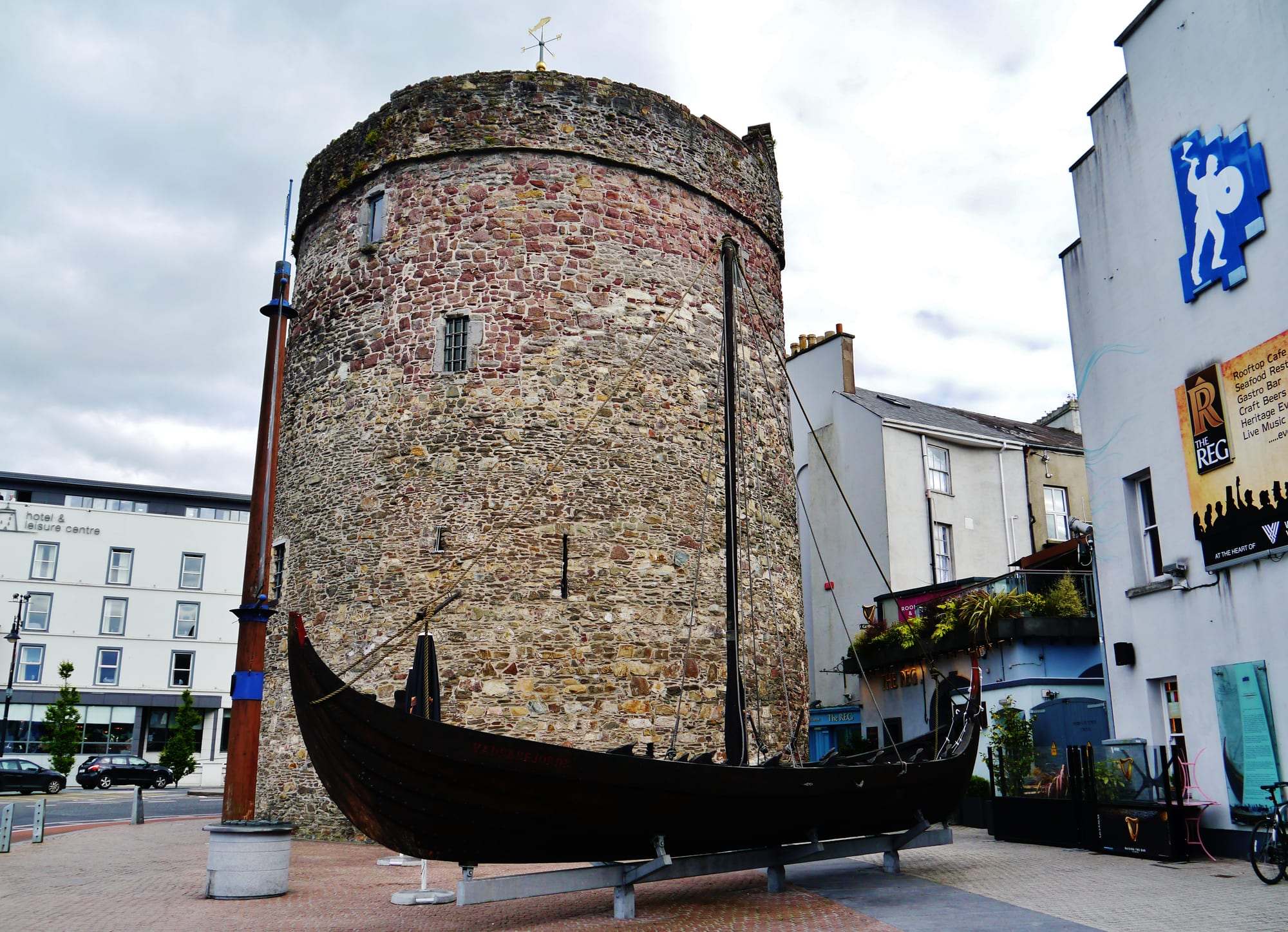
The round stone bulk of Reginald's Tower with a dark wooden replica Viking longship displayed in front of it on a paved square

Cork, Kerry & the Southwest, Ireland

Waterford

Reginald's Tower and a replica Viking longship on the quays in Waterford. (Zairon / Wikimedia Commons · CC BY 4.0)

Ireland's oldest city, founded by Vikings on the River Suir at the head of Waterford Harbour and for most of the Middle Ages the country's second city. Medieval walls, Reginald's Tower and a cluster of museums fill its Viking Triangle; Waterford Crystal, a long port history and the floury blaa roll shape its identity today.

Neighbourhoods

  • The Viking Triangle
    • First-time visitors
    • Historic district
    • Museums

    The oldest part of the city, enclosed by the original tenth-century walls and shaped like a triangle with Reginald's Tower at its point. Once the busy Viking town, it is now a quieter quarter of narrow streets, medieval buildings, Christ Church Cathedral and the Waterford Treasures museums, with the Waterford Crystal visitor centre just to the south on the Mall.

    Open in Maps
  • The Quay and the Mall
    • Architecture
    • Close to public transport
    • Theatre

    The mile-long quay along the Suir, once called 'the noblest quay in Europe', holds the bus station and runs to Reginald's Tower, where the Mall, a Georgian street built to extend the city southwards, begins. City Hall, the Theatre Royal and some of Waterford's finest Georgian buildings line the Mall, with the People's Park nearby.

    Open in Maps
  • John Roberts Square and the Apple Market
    • Shopping
    • Nightlife
    • Best for food

    The modern commercial heart of the city. The pedestrianised square, known locally as Red Square for its paving, sits where Barronstrand, Broad and George's streets meet; a short walk west, the Apple Market, once a market area, is Waterford's nightlife district of bars, restaurants and clubs, partly pedestrianised and roofed in the mid-2010s.

    Open in Maps
  • Ballybricken
    • Local life
    • Historic district

    An inner-city neighbourhood just outside the western walls, thought to have been Waterford's Irishtown, centred on a hill that was once a large open market square. The hill is now a green civic space, where the Bull Post, at which livestock was bought and sold, still stands.

    Open in Maps
  • Ferrybank
    • Quiet and residential
    • Close to the railway station

    Waterford's only suburb north of the river, with a village centre of its own. The railway station lies across Rice Bridge on this side of the Suir.

    Open in Maps

Things to do

The Viking Triangle

  • Reginald's Towermuseum

    Ireland's oldest civic building and the only urban monument in the country to keep a Norse name, a round tower of the 13th or 14th century on the site of a Viking fort, now the Waterford Viking Museum.

    Open in Maps
  • Waterford Treasuresmuseum

    A group of museums around the Viking Triangle — the Medieval Museum, with its 13th-century Choristers' Hall and Henry VIII's cap of maintenance, the Georgian Bishop's Palace, and newer museums of silver, clocks and the Irish wake.

    Open in Maps
  • Waterford Crystalattraction

    The visitor centre and factory in the Viking Quarter where Waterford Crystal resumed production in 2010, after the closure of the old works on the edge of the city in 2009.

    Open in Maps
  • Christ Church Cathedrallandmark

    The Church of Ireland cathedral, rebuilt to a design of 1774 by the local architect John Roberts on a site with a church since the 11th century.

    Open in Maps
  • Cathedral of the Most Holy Trinitylandmark

    The Catholic cathedral on Barronstrand Street, designed by John Roberts in 1793 and the oldest post-Reformation Catholic cathedral in Ireland.

    Open in Maps
  • French Churchlandmark

    The ruins of Greyfriars, a Franciscan friary built in 1241 and one of the first in Ireland.

    Open in Maps

Arts and the city

  • Theatre Royal Waterfordattraction

    A U-shaped Victorian theatre of 1876 on the Mall, seating about 600 and home to the city's November festival of light opera since 1959.

    Open in Maps
  • Garter Lane Arts Centreattraction

    An arts centre on O'Connell Street in two 18th-century buildings, one a Quaker meeting house of 1792 that now holds a small theatre.

    Open in Maps
  • People's Parkpark

    The city's largest park, laid out on drained marshland in the 19th century, with a Victorian bandstand and the site of Ireland's first velodrome.

    Open in Maps

Walks, rides and the river

  • Waterford Greenwaytrail

    Ireland's longest greenway, a 46-kilometre walking and cycling route on a former railway with viaducts and a tunnel, running from the city to Dungarvan past part of the Copper Coast.

    Open in Maps
  • Waterford Suir Valley Railwayattraction

    A charity-run narrow-gauge railway along the River Suir between Kilmeadan and the edge of the city, sharing its route with the Greenway.

    Open in Maps
  • Mount Congrevepark

    An 18th-century Georgian estate and mansion near Kilmeaden by the John Roberts who designed much of Waterford, with a halt on the Suir Valley Railway.

    Open in Maps

Short trips from the city

  • Tramorebeach

    A seaside town whose name means 'big beach', about 13 kilometres from the city, popular for surfing and water sports on its large, sheltered bay.

    Open in Maps
  • Dunmore Eastattraction

    A fishing and holiday village on the west side of Waterford Harbour, with a cliff path of about 7 kilometres to Portally and Ballymacaw.

    Open in Maps
  • Copper Coast Geoparkpark

    About 25 kilometres of County Waterford coast from Kilfarrasy to Stradbally, the first geopark designated in Ireland.

    Open in Maps
  • Hook Lighthouselandmark

    One of the oldest lighthouses in the world, at the tip of the Hook Peninsula across the harbour in County Wexford.

    Open in Maps
  • Curraghmoreattraction

    A historic house and estate near Portlaw, seat of the Marquess of Waterford, on land granted to the le Poer family in 1177.

    Open in Maps

Seasonal events

  • St Patrick's Day parade17 March

    The city's annual parade through the centre.

  • Waterford Viking MarathonJune

    The city's marathon.

  • SpraoiAugust bank holiday weekend

    A three-day festival of international street theatre and world music in the city centre, held since 1992 and now Waterford's largest festival.

  • Waterford WallsAugust

    An annual street art event for which artists are invited to paint the city's walls.

  • Waterford International Festival of Light OperaNovember

    A music festival held at the Theatre Royal every year since 1959.

  • Wintervalbefore Christmas

    An annual Christmas festival in the city centre.

Eat and drink

Long-standing places and food districts in Waterford. Hours, ratings and directions come from your maps app, always current.

Waterford classics

  • Waterford blaamarket

    The city's floury square white roll, protected by the EU since 2013, still baked by four bakeries, among them Walsh's Bakehouse and Hickey's Bakery, and best eaten within a few hours.

    Open in Maps
  • T & H Doolan'srestaurant

    Waterford's oldest pub, licensed since the 18th century in a building believed to be about five hundred years old, with part of the original city wall visible in its lounge.

    Open in Maps

Food districts

  • The Apple Marketneighborhood

    The former market area that is now the city's main cluster of bars, restaurants and nightclubs, partly pedestrianised and roofed.

    Open in Maps
  • John Roberts Squareneighborhood

    The pedestrianised 'Red Square' and the shopping streets around it, with cafés and lunch places at the heart of the commercial centre.

    Open in Maps

Experience Waterford

History

Waterford's English name comes from the Old Norse Veðrafjǫrðr, "ram fjord"; its Irish name, Port Láirge, means "Lárag's port". Viking raiders first settled near the site in 853, were driven out around 902, and returned in 914 under Jarl Ottar and then Ragnall ua Ímair, building what would become Ireland's first city. In 1170 the deposed King of Leinster, Diarmait Mac Murchada, and Cambro-Norman mercenaries under Strongbow took the town after a desperate defence; Strongbow's marriage to Diarmait's daughter Aoife is remembered at Reginald's Tower, and Henry II landed at Waterford in 1171. Through the Middle Ages it was Ireland's second city after Dublin.

In the 15th century Waterford repelled two pretenders to the English throne, Lambert Simnel and Perkin Warbeck, and Henry VII gave it the motto Urbs Intacta Manet, "the untaken city". It remained Catholic after the Reformation and joined the Confederation of Kilkenny, until Henry Ireton took it for Cromwell in 1650; in 1690 the Jacobite army surrendered it after the Boyne. The 18th century brought great prosperity and the Georgian buildings of John Roberts, and glassmaking began in 1783. In the 19th century shipbuilding thrived; the Malcomson family's Neptune yard built and ran the largest fleet of iron steamers in the world between the mid-1850s and the late 1860s.

John Redmond, later leader of the Irish Parliamentary Party, represented the city from 1891 to 1918, and in July 1922 Waterford saw fighting in the Civil War. The crystal works closed in 2009 after the receivership of Waterford Wedgwood, and the recession that followed hit the city hard, but a new visitor centre and factory opened in the Viking Quarter in 2010 and production resumed.

Culture & Customs

Waterford's culture is rooted in its long history and its theatre. The Theatre Royal on the Mall, a Victorian house of 1876, hosts the International Festival of Light Opera every November, as it has since 1959; Garter Lane Arts Centre houses a theatre, a gallery and a dance studio; and Red Kettle, founded by the Waterford playwright Jim Nolan, and the street theatre company Spraoi are based here. Spraoi's festival of street theatre and world music, held every August bank holiday weekend since 1992, is the city's largest event and has drawn audiences of more than 80,000. Waterford Walls invites street artists to paint the city each August, and the Waterford Collection of Art, founded in 1939, holds works by Jack B. Yeats, Paul Henry and Mainie Jellett.

Music runs deep too: the composer William Vincent Wallace is commemorated by a plaza near Reginald's Tower, and the local radio station WLR FM is a fixture of daily life. In sport the city has a strong Gaelic games tradition, with clubs such as Mount Sion, De La Salle and Ballygunner, as well as Waterford FC in football and Waterford Boat Club, founded in 1878 and the city's oldest active sports club.

Faith shaped the city's landmarks and its schools. Waterford has two cathedrals by the same architect, and Edmund Ignatius Rice, who founded the Christian Brothers, is remembered at Mount Sion. People take pride in being from Ireland's oldest city, and the Viking past is everywhere, from the Viking Triangle's museums to the replica longship beside Reginald's Tower.

Daily Life

About 60,000 people lived in the city and suburbs at the 2022 census, making Waterford the fifth-largest city in the Republic and the main city of the south-east. Ferrybank, with a village centre of its own, is the only suburb north of the river, and Ardkeen, on the Dunmore Road, has a shopping centre and the local radio stations. The South East Technological University, formed in 2022 from the merger of Waterford Institute of Technology and IT Carlow, brings students to the city.

The port has been central to Waterford for more than a thousand years. Waterford Port is Ireland's closest deep-water port to mainland Europe and handles about 12 per cent of the country's external trade by value. Crystal-making employed thousands for generations, and the dairy co-operatives of the surrounding farmland, later part of Glanbia, were another pillar. The recession from 2008 hit hard, with the closure of several multinational employers and high unemployment. A coworking community opened offices in the Viking Quarter in 2013, and a new railway station is proposed as part of the North Quays project.

Weekdays centre on the shopping streets around John Roberts Square; evenings and weekends bring crowds to the Apple Market's bars. City and county are run by Waterford City and County Council, formed by a merger in 2014, which elects a mayor each year, an office that dates from 1377.

Food

Waterford's signature food is the blaa, a soft, square, floury white bread roll. Blaas come soft — slightly sweet, with a malt flavour — or crusty, and are eaten mainly at breakfast with butter or filled with anything from rashers to the luncheon meat locals call "red lead"; the breakfast blaa, with egg, bacon and sausage, is more common in the city than the breakfast roll. Some say the Huguenots brought it at the end of the 17th century, though that is disputed, and in 2013 the Waterford blaa won Protected Geographical Indication status. Only a few bakeries still make it, among them Walsh's Bakehouse and Hickey's Bakery.

The farmland around the city has long supplied dairy: the co-operative at Kilmeadan, about 5 kilometres away, made Kilmeadan cheddar, which won medals at the World Cheese Awards in 2005. The harbour and coast provide seafood, and Irish seafood dishes — mackerel, hake, mussels, crab and chowder, popular around the coasts — appear on local menus alongside representative Irish dishes such as Irish stew and bacon and cabbage.

For drinking, Waterford's pubs range from the late-night bars of the Apple Market to T & H Doolan's on George's Street, the city's oldest pub, where a section of the original city wall, almost 1,000 years old, can be seen in the lounge. Stout and Irish whiskey are the standard orders.

Planning tools

Budget

Waterford offers better value than Kerry or Kinsale, though rooms fill and prices rise on festival weekends, above all Spraoi in August. Museum tickets and the crystal tour are the main sightseeing costs, while the walls, quays, cathedrals and parks are free. A hire car or bus fares add to the bill for the coast.

Daily Budget Midrange
USD 160–290 (city hotel or B&B, restaurant dinners, museum and crystal tickets, a day on the coast)
Daily Budget Shoestring
USD 80–130 (hostel or budget room, blaas, pub food, buses and a hired bike for the Greenway)

Book early for the August bank holiday weekend, when Spraoi fills the city.

Best Time to Visit

May to September, when the weather is at its mildest, the Greenway and beaches are at their best and the city's summer festivals run, with Spraoi in August. Autumn brings arts festivals and the light opera festival in November, and Winterval lights up the centre before Christmas. October to January is the wettest and dullest stretch.

Suggested Number of Days

Two days cover the city and its museums. Four or five allow time for the coast and countryside around it, by bike, bus or car. Festival weekends in August and November are worth planning around.

First Visit
2 days
With Surroundings
4–5 days

Transportation

The centre is compact and best seen on foot. City bus services run through the suburbs, and all regional buses leave from the bus station on the quay. The Greenway is the best route for cycling out of the city. Roads lead in every direction: the M9 to Dublin, the N24 to Limerick and the N25 to Cork, which crosses the Suir on the cable-stayed River Suir Bridge, the longest single span in Ireland, and continues to Rosslare Harbour.

Bus Éireann route 370 runs to Rosslare Harbour for ferries, replacing the railway that closed to passengers in 2010.

Airport & Station Connections

Waterford Plunkett station, across Rice Bridge on the north side of the river, has eight daily return trains to Dublin and a Monday-to-Saturday service to Limerick Junction for connections across the country. Bus Éireann and private companies run coaches to Irish cities and a daily service to London by way of South Wales. Waterford Airport is about 9 kilometres from the centre but had no scheduled commercial flights as of 2025, so most visitors arrive by way of Dublin or Cork airports.

Walkability

Very good. The Viking Triangle, the quay, the Mall, John Roberts Square and the Apple Market are all within a few minutes' walk of each other, and the railway station is just across Rice Bridge. Waterford keeps more of its medieval walls than any Irish city except Derry, and they make a good walk around the centre.

Safety

Ireland is a very safe country, with low levels of violent crime. The centre of Waterford is safe by day and night; around the Apple Market at weekends, revellers are noisy rather than threatening. Take ordinary care with valuables and with traffic on the busy quay.

Keep bags and phones close in crowds at festivals and in late-night bars, and use a lit route across the river after dark. Check current official travel advice before travelling.

Climate

Mild, changeable and maritime, with rain spread through the year and few extremes; the counties around Waterford are often called the 'Sunny Southeast'. October to January is considerably wetter and duller than the rest of the year.

Summer
mild — June, July and August are the warmest months, with average daytime highs of around 19–21°C
Winter
mild, wet and grey — across Ireland, mean daily temperatures in January and February are 4–7°C, and here the wettest, dullest months fall between October and January

Local Customs

Waterford people are proud of their city's age and its Viking past. Tipping is not expected in pubs, while 10–15 per cent is standard in restaurants. Ask for a blaa at breakfast — a breakfast blaa with egg, rasher and sausage is more common here than the breakfast roll.

Be quiet and respectful in the cathedrals during services, and ask before photographing people at street events.

Common Payment Methods

The currency is the euro. Cards are accepted in most outlets, and cash machines are easy to find in the centre; a little cash is handy for bakeries and market stalls.