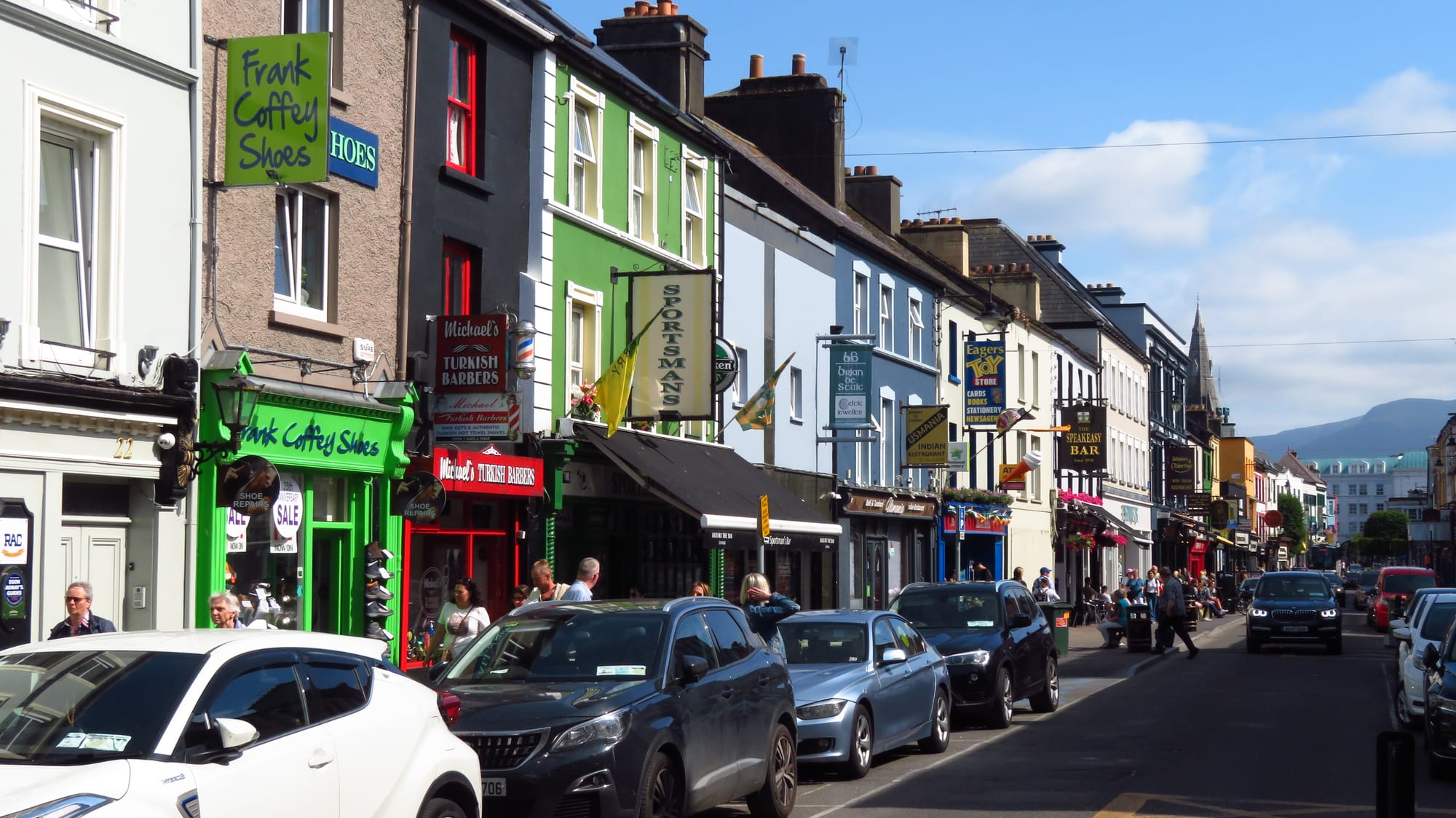
Brightly painted shopfronts and hanging signs along High Street in Killarney, with parked cars and a mountain in the distance

Cork, Kerry & the Southwest, Ireland

Killarney

Looking south along High Street, the main shopping street of Killarney. (Colin Park / Wikimedia Commons · CC BY-SA 2.0)

A County Kerry town on the north-eastern shore of Lough Leane, at the edge of Killarney National Park and below Ireland's highest mountains. Its landlords began promoting the lakes to visitors in the 18th century and the railway arrived in 1853; tourism has shaped it ever since, and it remains the classic base for the lakes and the Ring of Kerry.

Neighbourhoods

  • Town centre
    • First-time visitors
    • Pubs and music
    • Close to public transport

    The grid of 19th-century low-rise streets — High Street, Main Street, New Street and College Street — packed with pubs, restaurants, shops and guesthouses. The railway and bus stations stand side by side in the centre, and it is busy with traffic and visitors through the summer.

    Open in Maps
  • Kenmare Place and the park edge
    • Parks
    • Walks
    • Jaunting cars

    The southern end of the centre around Kenmare Place, on the side of town nearest Killarney House, whose gardens now form part of the national park. Jaunting cars trot visitors from the town out to Ross Castle and Muckross, and the parkland stretches to the lake shore.

    Open in Maps
  • Muckross Road
    • Hotels and guesthouses
    • Close to the national park

    The N71 running south from the centre towards Muckross and Kenmare, lined with hotels, B&Bs and an events arena. It is the approach to Muckross House, Muckross Abbey and Torc Waterfall, and the road the Ring of Kerry follows clockwise out of town.

    Open in Maps
  • Aghadoe
    • Views
    • Quiet and residential
    • Historic ruins

    A rural townland on the hill north-west of the town, known for its views over the lakes and islands towards the mountains. The ruins of a 13th-century castle and a Romanesque church stand here, and a cluster of hotels looks out over the water.

    Open in Maps

Things to do

In the town

  • St Mary's Cathedrallandmark

    The neo-Gothic cathedral of the Diocese of Kerry at the western end of New Street, completed in 1855.

    Open in Maps
  • Killarney Houseattraction

    The former seat of the Earls of Kenmare, on a site chosen by Queen Victoria during her visit in 1861, now the national park's visitor centre, with formal gardens at the edge of town.

    Open in Maps

Killarney National Park

  • Ross Castlelandmark

    A 15th-century tower house of the O'Donoghue chiefs on the edge of Lough Leane, open seasonally for guided tours; summer boat trips on the lakes leave from the jetty beside it.

    Open in Maps
  • Innisfallenattraction

    An island in Lough Leane with the ruins of a 7th-century monastery, where the medieval chronicle known as the Annals of Innisfallen was compiled; boat trips visit it.

    Open in Maps
  • Muckross Housemuseum

    A Tudor-style mansion of the 1840s between Muckross Lake and Lough Leane, given to the nation in 1932 with its estate to form Ireland's first national park; the Muckross Traditional Farms show rural Kerry life in the 1930s.

    Open in Maps
  • Muckross Abbeylandmark

    A roofless Franciscan friary founded in 1448 and burned by Cromwellian forces in 1654, whose cloister surrounds a huge yew tree.

    Open in Maps
  • Torc Waterfallpark

    A 20-metre cascade on the Owengarriff River at the foot of Torc Mountain, with walking trails climbing beside it.

    Open in Maps

Mountains and viewpoints

  • Ladies Viewviewpoint

    A viewpoint on the Kenmare road inside the national park, ranked among the most photographed places in Ireland.

    Open in Maps
  • Gap of Dunloetrail

    A narrow mountain pass between MacGillycuddy's Reeks and the Purple Mountain group, travelled by pony and trap, bicycle or on foot along a narrow public lane.

    Open in Maps
  • Carrauntoohiltrail

    Ireland's highest mountain, at 1,038.6 metres, in the MacGillycuddy's Reeks west of the town, usually climbed by the steep Devil's Ladder route.

    Open in Maps

Sport

  • Fitzgerald Stadiumattraction

    The GAA stadium opened in 1936 and named after the footballer Dick Fitzgerald, home championship venue of the Kerry senior football team.

    Open in Maps
  • Killarney Racecourseattraction

    A racecourse just outside the centre, with racing in Killarney since 1822 and both Flat and jump meetings.

    Open in Maps

Seasonal events

  • Rally of the LakesMay bank holiday weekend

    An international road rally run since 1979, starting from Killarney and crossing County Kerry, which draws very large crowds to the town.

  • Killarney Regattafirst or second Sunday in July

    Ireland's oldest surviving regatta, raced on the lakes by the town's six rowing clubs, including in traditional wide wooden six-person boats.

  • Ring of Kerry Cyclefirst Saturday in July

    A charity bicycle ride of about 175 km around the Ring of Kerry, the circuit that begins and ends in Killarney.

  • Puck Fair10–12 August

    One of Ireland's oldest fairs, held in Killorglin on the Ring of Kerry, at which a wild goat is crowned king.

Eat and drink

Long-standing places and food districts in Killarney. Hours, ratings and directions come from your maps app, always current.

Killarney classics

  • High Street and College Street restaurantsneighborhood

    The town's main eating streets, with seafood bars and grills, pub restaurants serving traditional Irish dishes, and Japanese cooking.

    Open in Maps
  • New Street and Main Streetneighborhood

    Old-style pub restaurants with traditional Irish fare, family-friendly restaurants and burger kitchens on the streets running west towards the cathedral.

    Open in Maps

Pubs

  • Town-centre pubsneighborhood

    Pubs on High Street, Main Street and New Street, one in business since 1891, with live music from traditional sessions to rock, and a whiskey bar on New Street with a huge range.

    Open in Maps

Experience Killarney

History

Religious settlement came first. St Finian the Leper founded a monastery on Innisfallen, an island in Lough Leane, in 640; it was occupied for about 850 years, until the monks were dispossessed under Elizabeth I in 1594, and tradition holds that Brian Boru was educated there. After the Anglo-Norman invasion the Normans built Parkavonear Castle at Aghadoe, above the present town. The O'Donoghues built Ross Castle on the lake shore in the late 15th century, and Donal McCarthy Mor founded the Franciscan friary at Muckross in 1448; Cromwellian forces burned it in 1654.

The town itself grew from the 1740s, when Thomas Browne, the fourth Viscount Kenmare, set out to revive his debt-laden estate by founding linen mills, planting trees and promoting the lakes, islands and ruins to travellers who had begun to seek out wild scenery. Boatmen, guides and buglers made a living from visitors, and Killarney has been called the birthplace of Irish tourism. The railway arrived in July 1853, hotels multiplied, and Queen Victoria's visit in 1861 made the town internationally known. The Herberts built Muckross House in the 1840s, and in 1932 its later owners gave the 11,000-acre estate to the state, creating Ireland's first national park.

Killarney was strongly republican in the War of Independence; the Headford Ambush of March 1921 near the town was one of the IRA's largest actions against British forces. In 1958 the German crane maker Liebherr chose the town for its first overseas factory, which grew into one of the town's principal employers alongside tourism.

Culture & Customs

Tourism is the town's culture as much as its economy. Around 70 licensed jaunting cars — horse-drawn carriages driven by local families known as jarveys — still operate from the town and the national park, and the boat trips across the lakes continue a trade that goes back to the 18th century, when Lord Kenmare fixed the hire charges for the boatmen. Early 20th-century songs romanticising Ireland returned to Killarney again and again, and the town is named in songs recorded by Bing Crosby and in Van Morrison's "Fair Play".

Gaelic football matters intensely. The Kerry county team plays its home championship matches at Fitzgerald Stadium, opened in 1936, and the town's three clubs include Dr Crokes, All-Ireland club champions in 1992. Rowing is the other passion: six clubs share the history of the Killarney Regatta, held each July on the lakes and the oldest surviving regatta in Ireland, and Muckross Rowing Club has produced Olympic rowers. Rallying, racing, golf and the charity Ring of Kerry Cycle fill the rest of the calendar.

Civic pride is visible in the streets. Killarney was named Ireland's tidiest town in 2011 and its tidiest large town again in 2023, and in 2023 it became the first town in Ireland to ban single-use coffee cups. The Sliabh Luachra uplands on the Cork–Kerry–Limerick border have a musical style of their own, making heavy use of the polka and the slide.

Daily Life

Killarney had 14,412 residents at the 2022 census, making it the second-largest town in County Kerry, but in summer its people are outnumbered by visitors. Roughly 1.1 million tourists come each year, generating around €410 million, and the town has an estimated 10,600 tourist beds, more than anywhere else in the state outside Dublin; a 2010 survey found nine in ten local businesses depended directly or indirectly on tourism.

Industry gives the town an unusual second pillar. The Liebherr plant on the edge of town builds ship-to-shore container cranes for ports around the world and employed 931 people by May 2026, and the Tricel plastics group, founded locally in 1973, has a base here, as do offices of two government departments. The town council was replaced by Killarney Municipal District under Kerry County Council in 2014.

Pressure on space is the recurring issue. Visitor numbers strain roads and parking in summer, and from 2022 the housing of Ukrainian refugees and international protection applicants in the town's hotels and guesthouses became a subject of local debate. In February 2026, after lobbying from the tourism industry, the government reversed a planned restriction on short-term holiday lettings in towns of Killarney's size; critics argued the change favoured tourism over housing supply.

Food

Eating out in Killarney is shaped by its visitors: High Street, Main Street, New Street and College Street hold a dense run of pub restaurants, seafood bars and grills, alongside burger kitchens and Japanese cooking. Traditional Irish dishes are a staple of the town's menus. Irish stew, traditionally made with lamb or mutton, potatoes and onions simmered slowly, is the classic, and boxty — a potato pancake of finely grated raw potato fried on a griddle, associated above all with the north midlands — appears on some traditional menus here too.

Kerry's food economy rests on dairy. The county's creameries and co-operatives grew into Kerry Group, a food company whose farmer-suppliers still hold a significant interest in it. Seafood from the Kerry coast is served in the town's seafood bars.

Drink centres on the pubs, one of them in business since 1891, where live music ranges from traditional sessions to rock, and a whiskey bar on New Street keeps a huge range.

Planning tools

Budget

Killarney has more hotel and guesthouse beds than any Irish town outside Dublin, so rooms are easier to find than elsewhere in Kerry, but prices climb in July and August and on big weekends such as the Rally of the Lakes. The national park itself has no gates or entry fees; Muckross House, Ross Castle, boat trips, jaunting cars and guided tours are the main costs, along with a hire car for the Ring of Kerry.

Daily Budget Midrange
USD 180–330 (B&B or town hotel, restaurant dinners, a lake boat trip and house tours, a hire car)
Daily Budget Shoestring
USD 80–130 (hostel bed, pub food and supermarket picnics, bike hire into the park)

Book summer rooms early; hiring a bike is the cheapest and easiest way to reach Ross Castle, Muckross and Torc from the town.

Best Time to Visit

May, June and September give long days and good walking with fewer coaches than high summer. July and August are the busiest months, with the regatta, the Ring of Kerry Cycle and the Puck Fair nearby. Spring brings the Rally of the Lakes. Winter is quiet and wet, and some boat trips and house tours run only in season.

Suggested Number of Days

Two or three days cover the town and the national park around the lakes. Allow four to six to include the Ring of Kerry, a hill walk and the neighbouring peninsulas. Rain and mountain weather often cost a day, so a spare one helps.

First Visit
2–3 days
With Surroundings
4–6 days

Transportation

The town is compact and walkable, and the national park begins at its edge. A local bus circles the town hourly and runs out to Ross Castle and Muckross Abbey, bikes can be hired in the centre, and taxis wait at the railway station and on College Street. Jaunting cars — horse-drawn carriages driven by jarveys — trot visitors out to Ross Castle and Muckross. Coach tours of the Ring of Kerry leave from the town; a car is needed to explore the wider county independently.

Coach tours drive the Ring of Kerry anticlockwise; independent drivers starting from Killarney often go clockwise to avoid being stuck behind them.

Airport & Station Connections

Kerry Airport at Farranfore, between Killarney and Tralee, has Ryanair flights from Dublin, London and several European cities, and trains run from nearby Farranfore station to Killarney. Many visitors fly into Cork, Shannon or Dublin instead. Trains link Killarney with Tralee, Cork and Dublin, usually changing at Mallow, and buses run to Limerick, Tralee, Cork, Kenmare and Skibbereen. The railway and bus stations are side by side in the town centre.

Walkability

Excellent in the town itself, where everything is within a few minutes' walk, though the main streets carry heavy traffic. Paths and quiet roads lead from the centre into the national park — Ross Castle is an easy walk — but Muckross, Torc Waterfall and Ladies View are further, and most people reach them by bike, jaunting car or car.

Safety

Ireland is a very safe country, with low levels of violent crime. Killarney's risks are mostly natural and practical: fast-changing weather on Carrauntoohil and the Reeks, the narrow Gap of Dunloe lane shared by cars, bikes and pony carts, busy pubs on festival and rally weekends, and thefts from cars at trailheads and viewpoints.

Carry proper gear and a map on the mountains and turn back if the mist comes down; leave nothing visible in parked cars. Check current official travel advice before travelling.

Climate

Mild, wet and changeable, with high rainfall and frequent light showers all year. In Killarney National Park, beside the town, mean daily temperatures range from about 6°C in January to about 15°C in July, about 1,260 mm of rain falls a year, and more than 1 mm falls on about 223 days.

Summer
cool and showery — July is the warmest month, with a mean daily temperature of about 15°C in the national park beside the town
Winter
mild and wet — January has a mean daily temperature of about 6°C, with about 40 frost days a year in the national park

Local Customs

Tourism has been the town's business for more than two and a half centuries, and visitors are generally welcomed; jarveys and boatmen from long-established local families are part of the scene. Gaelic football is followed with devotion — Kerry's matches at Fitzgerald Stadium fill the town. Tipping is not a general habit in Ireland, but 10–15 per cent is standard in restaurants and it is not expected in pubs.

Smoking is banned inside pubs, restaurants and enclosed public places. Killarney banned single-use coffee cups in 2023, so carry a reusable one.

Common Payment Methods

The currency is the euro. Cards are accepted in most outlets, and there are ATMs in the town centre. Carry some cash for jaunting cars, small boat operators and parking in the countryside.