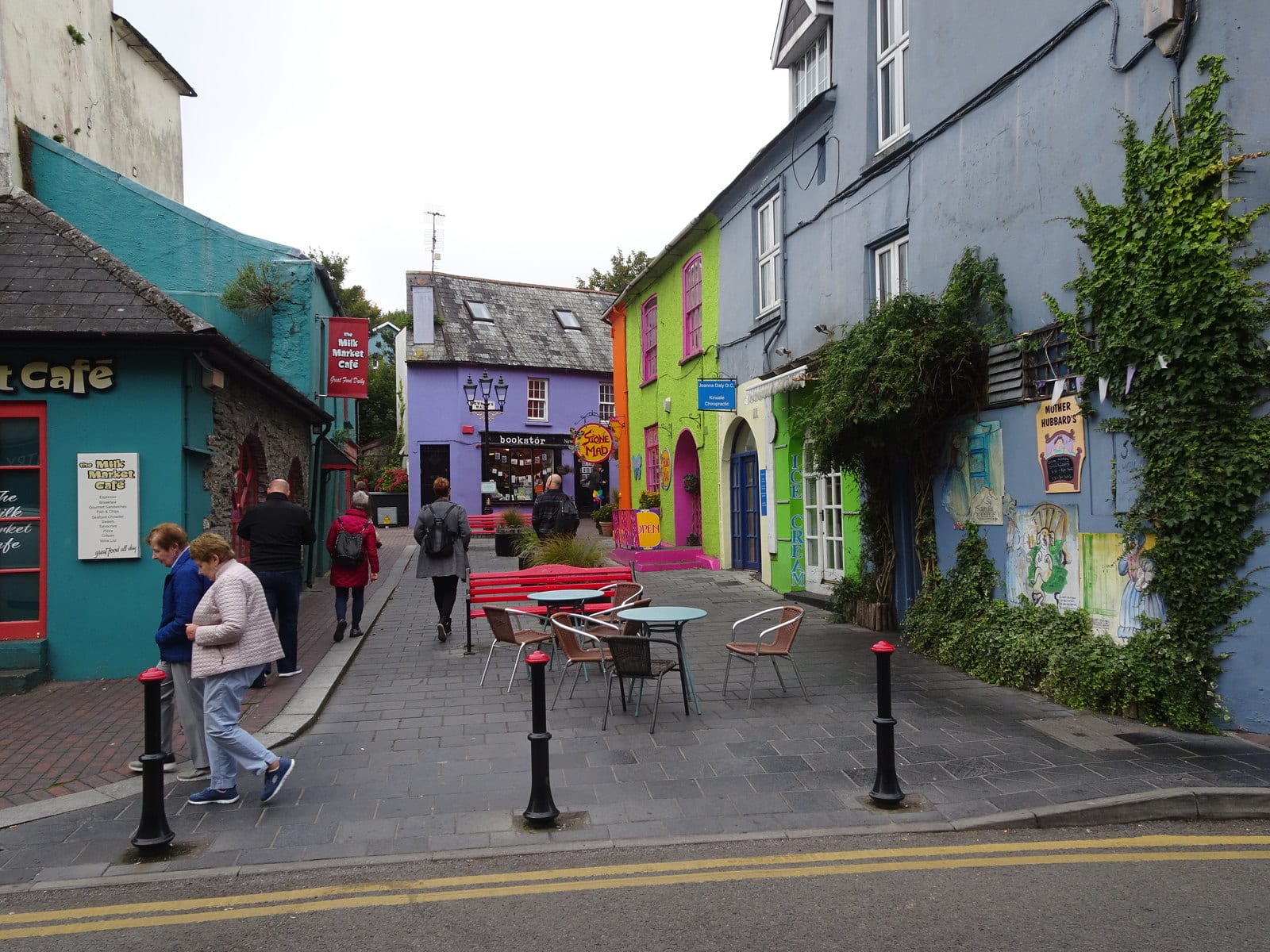
A paved lane of brightly painted houses and shops in teal, lilac, lime green and blue, with café tables in the street

Cork, Kerry & the Southwest, Ireland

Kinsale

Colourful houses and shopfronts on a lane in the centre of Kinsale. (Nigel Thompson / Wikimedia Commons · CC BY-SA 2.0)

A historic port and fishing town at the mouth of the River Bandon, about 25 kilometres south of Cork. Its harbour made it a prize in the wars of the 17th century, when the siege of 1601 and two great forts shaped its story; today its narrow, colourful streets, sailing and many restaurants draw holidaymakers from Ireland and abroad.

Neighbourhoods

  • Town centre
    • First-time visitors
    • Best for food
    • Historic district

    A compact grid of narrow old streets lined with colourful houses, running up from the harbour and Pier Road around Market Square, Main Street and Market Street. Most of the restaurants, pubs and shops are here, along with Desmond Castle, the Church of St Multose and the bus stop by the town car park.

    Open in Maps
  • Scilly and Summer Cove
    • Harbour views
    • Quiet and residential
    • Walks

    The peninsula and village east of the town along the harbour shore. Scilly has an old-world pub with food, and the road continues to Summer Cove, a small waterside village at whose southern end Charles Fort guards the harbour mouth.

    Open in Maps
  • Castlepark
    • Sailing
    • Beaches
    • Walks

    The peninsula across the river from the town, reached over the bridge. The visitor marina stands on the site of the old navy dockyard, a small sandy beach lies across the isthmus, and the ruins of James's Fort crown the end of the headland.

    Open in Maps

Things to do

Forts and history

  • Charles Fortlandmark

    A bastion fort with a star-shaped section of outer wall, completed in 1682 at the end of Summer Cove to guard the harbour, a British military base until 1921 and partly restored since the 1970s.

    Open in Maps
  • James's Fortlandmark

    A pentagonal bastion fort of the early 17th century on the Castlepark peninsula, built after the siege of 1601 and left derelict after Charles Fort replaced it; its ruins are open to walk around.

    Open in Maps
  • Desmond Castlelandmark

    A tower house built around 1500 as the town's custom house, later a naval prison known as the 'French Prison', where a fire killed 54 prisoners in 1747, and afterwards the town jail.

    Open in Maps
  • Church of St Multoselandmark

    A cruciform Church of Ireland church whose oldest parts date from the 1190s, where Prince Rupert of the Rhine proclaimed Charles II king in 1649.

    Open in Maps
  • Kinsale Regional Museummuseum

    A small museum of local history, founded by the priest and antiquarian Patrick MacSwiney, in the town where the inquest into the sinking of the Lusitania was held.

    Open in Maps

The harbour and the coast

  • Kinsale Yacht Clubattraction

    The town's sailing club, which runs racing in keelboat, catamaran and cruiser classes and junior sailing, the heart of Kinsale's life on the water.

    Open in Maps
  • Old Head of Kinsaleviewpoint

    A headland south-west of town with a ruined castle of 1223 and a lighthouse, the nearest land to where the Lusitania was sunk in 1915; access beyond the castle is restricted.

    Open in Maps

Short trips from the town

  • Corkattraction

    Ireland's second-largest city, about 25 kilometres north, reached by an hourly bus that also serves Cork Airport.

    Open in Maps
  • Ballinspittleattraction

    A village about 8 kilometres south-west of Kinsale on the R600, near the Blue Flag beaches of Garrylucas and Garrettstown.

    Open in Maps

Seasonal events

  • Kinsale SevensMay

    A rugby sevens tournament on the grounds of Kinsale Rugby Football Club that draws international teams and thousands of spectators.

  • Kinsale Arts Weekendmid-July

    A weekend of arts events around the town.

  • Kinsale Gourmet Food Festivalearly October

    The best known of the town's gourmet food festivals.

  • Kinsale Jazz Festivalthe last weekend of October

    Jazz and blues concerts in pubs and hotels across the town over the October bank holiday weekend.

Eat and drink

Long-standing places and food districts in Kinsale. Hours, ratings and directions come from your maps app, always current.

Kinsale classics

  • Bastionrestaurant

    A restaurant on the corner of Market Street and Main Street that received a Michelin star in 2020.

    Open in Maps

Food districts

  • Market Street and Main Streetneighborhood

    The core of the town centre, where Kinsale's concentration of restaurants, from seafood and steak houses to French-Irish and Italian kitchens, sits among its pubs.

    Open in Maps
  • Summer Coveneighborhood

    The waterside village near Charles Fort, with places serving seafood and seasonal produce by the harbour.

    Open in Maps

Experience Kinsale

History

Kinsale's name, Cionn tSáile, means "head of the brine", and its sheltered harbour at the mouth of the Bandon made it a trading port from the Middle Ages. Around 1500 the 9th Earl of Desmond built a tower house as the custom house after Henry VII granted his family the customs of the port.

In 1601 a Spanish expedition — the last of the Armadas launched against England — landed at Kinsale to join the Irish rebels of the Nine Years' War. The siege of Kinsale ended with the defeat of Hugh O'Neill and Red Hugh O'Donnell by English forces under Lord Mountjoy, the ultimate battle in England's conquest of Gaelic Ireland. James's Fort was built after the battle and completed by 1607, and Charles Fort followed across the harbour, begun in the reign of Charles II and completed in 1682. In 1649 Prince Rupert of the Rhine proclaimed Charles II king at St Multose's Church, and in 1689 James II landed here with French support, leaving from Kinsale for exile in France after his defeat at the Boyne in 1690.

From 1694 Kinsale was a supply base for the Royal Navy, but the sandbar at the river mouth limited it to smaller ships, and in 1805 the navy moved its victualling centre to Cork harbour. Its railway branch closed in 1931, at a low point in the town's fortunes. When the Lusitania was sunk off the Old Head in May 1915, some of the bodies and survivors were brought to Kinsale and the inquest was held in its courthouse.

Culture & Customs

Kinsale's identity is bound up with the sea. Kinsale Yacht Club, founded in the early 1950s, runs racing for keelboats, catamarans and cruisers and junior sailing through the year, and the harbour is popular with sea anglers. Ashore, the town's narrow streets of brightly painted houses have made it one of the best-known holiday towns in Ireland; Condé Nast Traveler named it among the 20 most beautiful villages in the UK and Ireland in 2020.

The year is marked by festivals. The jazz festival on the last weekend of October fills the pubs and hotels with jazz and blues bands, including on the bank holiday Monday; the gourmet food festivals celebrate the town's restaurants; and the Kinsale Sevens, held at the rugby club's grounds, draws international teams and thousands of spectators. Kinsale GAA plays Gaelic games in the Carrigdhoun division of Cork, and won the county intermediate football championship in 2011, its first since 1915. The steel sculpture The Great Wall of Kinsale by Eilis O'Connell, installed in 1988, stands by Pier Road and the Town Park.

Writers and artists have long settled here. The Ulster poet Derek Mahon lived in Kinsale for many years, as did the poets Desmond O'Grady and Padraic Fallon, the dramatist Lennox Robinson and the artist Robert Gibbings, and the television chef Keith Floyd lived nearby. The community is also known for civic projects: it won the Tidy Towns competition outright in 1986, became Ireland's second Fair Trade Town in 2005 and was the country's first Transition Town.

Daily Life

The town had a population of 5,991 at the 2022 census, rising in summer when tourism peaks. Tourism is central to the local economy, and Cork, about 25 kilometres north, is linked by an hourly bus. The town lies in the Cork South-West constituency and elects members to Cork County Council through the Bandon–Kinsale area; its own town council was abolished in 2014.

Housing has spread beyond the old centre. The former convent of the Sisters of Mercy on Ramparts Lane has been converted into apartments with new houses in its grounds, and the Abbey Fort development at the north end of town added hundreds of homes. Scilly, Summer Cove and Castlepark, across and along the harbour, keep the feel of small waterside villages. The community school has won national recognition, and Kinsale College offers further education courses.

The rhythm of the town follows the seasons: in summer the streets, marinas and restaurants are crowded and the harbour busy with yachts and cruise boats; in winter the town is quieter and its life turns inward to the pubs, the sports clubs and community groups.

Food

Kinsale has a reputation as a food town out of proportion to its size. For a small place it has a surprising number of gourmet restaurants, and it holds several annual gourmet food festivals, the best known in early October. Bastion, on Market and Main streets, received a Michelin star in 2020, and the town's kitchens run from French-Irish and modern European cooking to Italian, steak houses and harbourside seafood, with fish and chips for something simpler.

Seafood is the heart of it. Irish seafood includes mackerel, cod, hake, haddock, mussels, oysters, lobster and crab, and chowder, a creamy fish soup, is popular around the coasts. Smoked salmon and smoked trout are common Irish foods, and the loaf on the table is brown bread, as it is called in the south. Representative Irish dishes such as Irish stew, made with lamb or mutton, and bacon and cabbage appear in the pubs, and black pudding, made from blood, grain (usually barley) and seasoning, remains a staple of the Irish breakfast.

To drink, there is stout — Murphy's and Beamish as well as Guinness — and Irish whiskey, and spirits made locally can be sampled in pubs around the town. An Irish coffee, made with strong black coffee, whiskey, sugar and whipped cream, ends many dinners.

Planning tools

Budget

Kinsale is one of the most expensive towns in the south-west in July and August, when rooms are scarce and its restaurants are full. Pubs, fish and chips and simple cafés keep costs down, and the forts, walks and old streets are free to explore from the outside. Cork, an hour away by bus, is a cheaper base.

Daily Budget Midrange
USD 190–330 (B&B or town-centre hotel, restaurant dinners, a harbour cruise, fort tickets)
Daily Budget Shoestring
USD 90–140 (hostel bed or a room in Cork, pub food and fish and chips, the bus)

Book accommodation early for summer and for the jazz and food festival weekends in October.

Best Time to Visit

May to September, for sailing, harbour cruises, long evenings and walks to the forts; the Kinsale Sevens fill the town in May and the arts weekend comes in July. October brings the gourmet food festival and the jazz weekend. Winter is quiet and wet, with fewer boats running.

Suggested Number of Days

A day or two covers the town, its forts and harbour. Three or four days allow time for the coast and the nearby city as well. A festival weekend or a sailing course adds more.

First Visit
1–2 days
With Surroundings
3–4 days

Transportation

Walking should get a visitor everywhere in town. Bus Éireann route 226 runs hourly to Cork, with most buses stopping at Cork Airport, and Local Link buses run to Bandon and to Clonakilty by way of Ballinspittle, with a few services a day to Charles Fort. A car is useful for the coast; the R600 crosses the River Bandon south-west of the town on the Archdeacon Duggan Bridge.

The bus terminus and the tourist office are by the town car park on Pier Road, at the foot of Market Square.

Airport & Station Connections

Cork Airport, about 6.5 kilometres south of Cork city centre, is the nearest airport, and the hourly bus from Cork takes about an hour, calling at the airport and at Cork's railway and bus stations on the way. By road the route from Cork is the N27 towards the airport and then the R600. Trains from Dublin run to Cork.

Walkability

The town centre is small and easily walked, though its streets are narrow and some climb steeply from the harbour. James's Fort is only about 200 metres from town across the water but about 3 kilometres on foot by way of the bridge, a popular walk; Charles Fort is reached along the harbour road through Scilly and Summer Cove.

Safety

Ireland is a very safe country, with low levels of violent crime. In Kinsale the main hazards are traffic on narrow streets and harbour roads without pavements, the water around the quays and marinas, and exposed beaches west of the Old Head that can be too rough for swimming.

Take care on the harbour road to Charles Fort, where there is little room for walkers, and swim only at lifeguarded beaches. Check current official travel advice before travelling.

Climate

Mild, oceanic and changeable, with plenty of rain and few extremes. In nearby Cork, temperatures below 0°C or above 25°C are rare, and Cork Airport records rain on about 218 days a year.

Summer
mild and changeable — in nearby Cork, temperatures above 25°C are rare
Winter
mild and wet — in nearby Cork, temperatures below 0°C are rare and lying snow very rarely occurs in the city

Local Customs

Kinsale is a sailing and dining town with a relaxed, informal feel. Tipping is not expected in pubs, while 10–15 per cent is standard in restaurants. The town competes in the Tidy Towns competition, which it won outright in 1986, and was Ireland's first Transition Town.

Smokers use the heated outdoor areas and beer gardens that some pubs provide; carry a jacket for outdoor tables, as evenings by the harbour can be cool and breezy.

Common Payment Methods

The currency is the euro. Cards are accepted in most outlets, and there are cash machines in town; a little cash is useful for small shops.