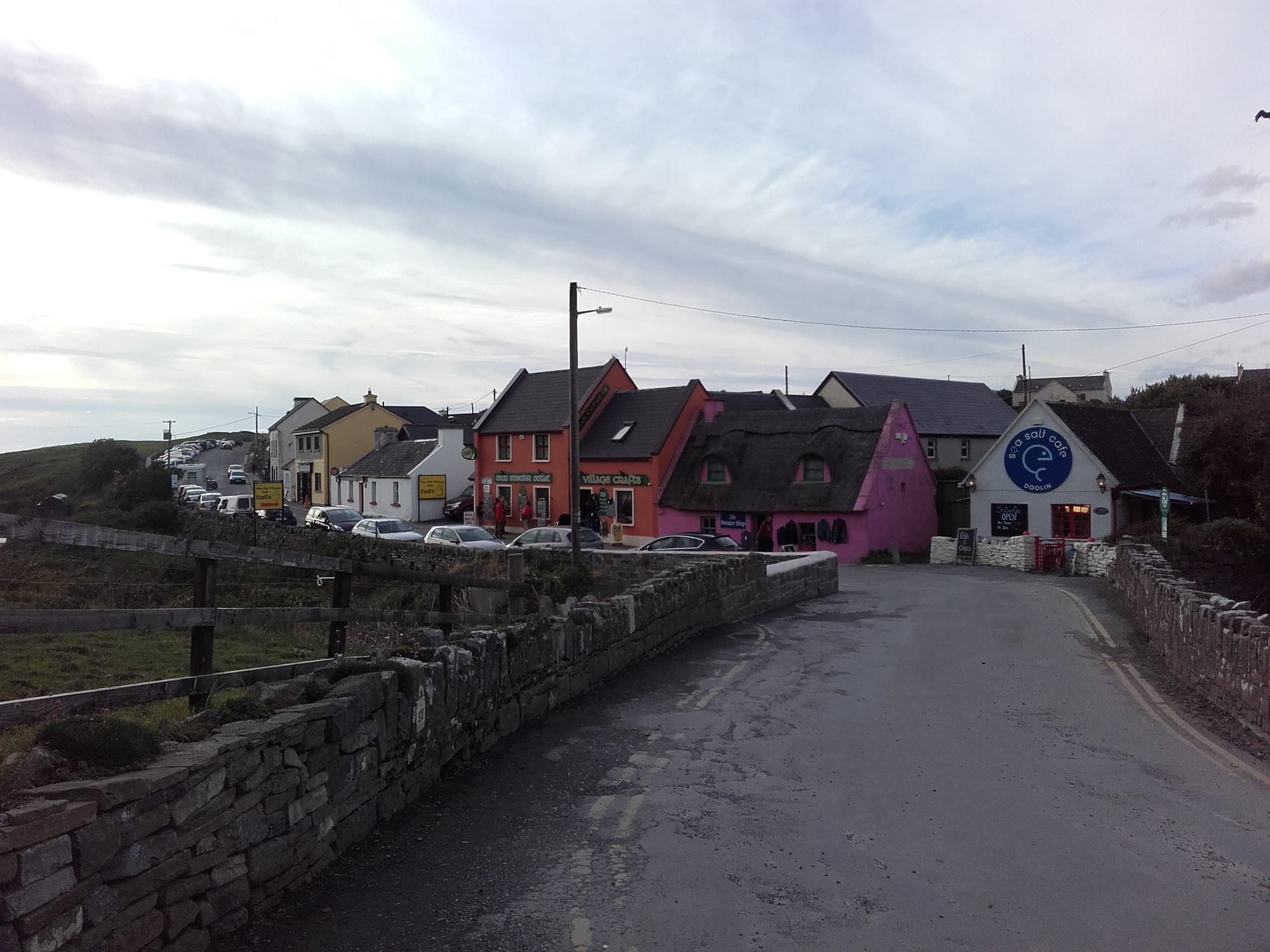
A stone-walled lane leading to brightly painted shops and a pink thatched cottage on Fisher Street under a cloudy sky

Cork, Kerry & the Southwest, Ireland

Doolin

Fisher Street, the lane of shops and pubs that runs up from the harbour in Doolin. (Chairego apc / Wikimedia Commons · CC BY-SA 4.0)

A scattered coastal village in north County Clare, on the western edge of the Burren and a few kilometres from the Cliffs of Moher. Doolin's pubs are a noted centre of traditional Irish music, played there nightly, and its pier sends seasonal ferries out to the Aran Islands and boat trips beneath the cliffs, making the village a busy base in summer.

Neighbourhoods

  • Fisher Street and the Harbour
    • First-time visitors
    • Music pubs
    • Ferries

    Doolin has no single centre, and this is the end nearest the sea. The harbour is where boats leave for the Aran Islands and the Cliffs of Moher, and Fisher Street, leading up from it, has Gus O'Connor's pub, craft shops, hostels and a small grocery, with Crab Island offshore.

    Open in Maps
  • Roadford and Fitz's Cross
    • Music pubs
    • Best for food
    • Quiet and residential

    The inland clusters of the village, about one and two kilometres from the sea along the Aille River. Roadford has McGann's and McDermott's pubs, several restaurants, hostels and B&Bs, and is where trips to Doolin Cave are run from; Fitz's Cross has a campsite, a hostel and another pub.

    Open in Maps
  • Lisdoonvarna
    • Quiet and residential
    • Shops and services

    A small spa town a short drive inland, with a population of 934 at the 2022 census. It has a supermarket and the Burren Smokehouse, is famous for its music and festivals, and makes a quieter base for the Burren.

    Open in Maps

Things to do

In and around the village

  • Doolin Caveattraction

    A limestone show cave on the western edge of the Burren, discovered by English cavers in 1952 and opened to visitors in 2006, whose Great Stalactite is the longest known free-hanging stalactite in Europe.

    Open in Maps
  • Doonagore Castlelandmark

    A round 16th-century sandstone tower house on a hill about a kilometre south of the village, used as a landmark by boats approaching the pier; it is a private holiday home, seen from the lane outside.

    Open in Maps

Cliffs and coast

  • Cliffs of Moherviewpoint

    Sea cliffs running for about 14 kilometres and reaching 214 metres just north of O'Brien's Tower, built in 1835; one of the most visited sites in Ireland, reached on foot along the clifftops or seen from below on boat trips from Doolin Pier.

    Open in Maps
  • Burren Waytrail

    A 114-kilometre waymarked trail from Lahinch to Corofin that crosses the limestone Burren, made up of roads, old droving tracks, paths and forest tracks.

    Open in Maps

Short trips from the village

  • Inisheerattraction

    The smallest and most easterly of the Aran Islands, with 343 residents at the 2022 census, reached by seasonal foot-passenger ferry from Doolin Pier in about half an hour.

    Open in Maps
  • The Burrenpark

    A bare karst landscape of about 530 square kilometres between Lisdoonvarna, Corofin, Gort and Kinvara, known for its plants, caves and prehistoric monuments.

    Open in Maps
  • Poulnabrone dolmenlandmark

    The best known of the Burren's dolmens, a Neolithic portal tomb of three standing stones and a capstone, under which the remains of about 33 people buried between 3800 and 3200 BC were found.

    Open in Maps
  • Aillwee Caveattraction

    A privately owned cave system in the Burren, whose name means 'yellow cliff', visited together with a birds of prey centre.

    Open in Maps
  • Burren National Parkpark

    Ireland's smallest national park, opened in 1991, covering 1,500 hectares of limestone hills, bogs, grassland and woods in the heart of the Burren.

    Open in Maps

Seasonal events

  • Micho Russell Festival Weekendeach year after the last Friday in February

    A traditional music weekend in the village held in memory of the tin whistle player Micho Russell, who was born in Doonagore.

  • Doolin Folk Festivalmid-June

    A three-day folk music festival in the village.

Eat and drink

Long-standing places and food districts in Doolin. Hours, ratings and directions come from your maps app, always current.

Doolin classics

  • Gus O'Connor'srestaurant

    The pub on Fisher Street near the harbour, serving food, with traditional music every night.

    Open in Maps
  • McGann'srestaurant

    A pub in Roadford with traditional music, as well known for its cooking as for its sessions.

    Open in Maps
  • McDermott'srestaurant

    A small Roadford pub with live music most nights and home cooking.

    Open in Maps

Local produce

  • Burren Smokehousemarket

    A smokehouse and shop in nearby Lisdoonvarna selling smoked salmon, mackerel and other smoked fish.

    Open in Maps
  • Roadford's restaurantsneighborhood

    The inland cluster of the village, with several restaurants beside its two pubs.

    Open in Maps

Experience Doolin

History

In the late Middle Ages the O'Connors built strongholds on the hills above the Doolin coast. Doonagore Castle, a round tower house on a hill south of the village, stands on or near the site of a 14th-century castle of Tadhg MacTurlough MacCon O'Connor, and the present tower probably dates from the middle of the 16th century; unusually for the region it is built of sandstone rather than limestone. Inland, Ballinalacken Castle, on a limestone outcrop above the roads to Lisdoonvarna and Fanore, was most likely begun in the 15th century. In the 1580s much of the land passed to Turlough O'Brien of Ennistymon, and Doonagore soon fell to the MacClancys, hereditary lawyers to the O'Briens.

In September 1588 a ship of the Spanish Armada was wrecked below Doonagore. About 170 survivors were caught by the High Sheriff of Clare, Boetius Clancy, and hanged at the castle or on a nearby barrow known as Cnocán an Crochaire, Hangman's Hill. After the rebellion of 1641 the land was regranted in the Cromwellian settlement, and by 1837 Doonagore had again fallen into disrepair; it was restored in the 1970s as a private home.

For most of its history Doolin was a farming and fishing district, Irish-speaking and counted part of the West Clare Gaeltacht until the 1950s. In 1952 English cavers discovered the cave beneath its hills that later became Doolin Cave. The village became known for traditional music — the local tin whistle player Micho Russell won the All-Ireland title in 1973 — and today its music pubs, tourism, the ferries to the Aran Islands and trips to the Cliffs of Moher now support most of the community.

Culture & Customs

Doolin is known above all for traditional Irish music, played nightly in its pubs. The musicians most associated with it include the Russell brothers — Micho, Packie and Gussie — and players who have lived in the village or played its pubs such as Sharon Shannon, Davy Spillane and Steve Wickham of The Waterboys. Micho Russell, who was born in Doonagore in 1915, taught himself the tin whistle by ear from the age of eleven and played until his death in a car accident in 1994, and a festival weekend in his memory is held each year after the last Friday in February. A three-day folk festival follows in June.

The village has an outdoor culture too. Doolin is a noted surfing spot: Aill na Searrach, a break just off the Cliffs of Moher, produces Ireland's biggest wave and appears in the film Waveriders, and Crab Island off the harbour is also surfed. Climbers use the village as a base for the limestone cliffs of Ailladie, about eight kilometres away, and the Burren's caves draw cavers, while walkers follow the clifftop path towards the Cliffs of Moher.

Doolin has found its way into wider popular culture as well. It is the main setting of the 2007 PlayStation 3 game Folklore, in which the village is the only gateway to the world of the dead, and the Celtic band Gaelic Storm named a fiddle tune "The Devil Went Down to Doolin". Irish heritage remains visible in its place names and bilingual signs, and in the link by sea with the Irish-speaking Aran Islands.

Daily Life

Doolin is a small, scattered community rather than a single village street. Its houses, pubs and B&Bs are spread along the Aille River between three clusters — the harbour and Fisher Street, Fitz's Cross and Roadford — and out across the surrounding farms and hills. Lisdoonvarna, a few kilometres inland, provides a supermarket and other services, while Ennis and Galway are the nearest large towns.

Tourism shapes the year. From April to October ferries sail from the pier to the Aran Islands and boat trips run beneath the Cliffs of Moher, which receive around 1.5 million visits a year, and coaches, cyclists and walkers pass through the village on the way. Hostels, campsites and B&Bs fill, and the pubs are busy from lunchtime to late at night. In winter many visitors stay away, the ferries stop and life returns to a quieter round of farming, the pubs and local sessions.

The pier is also a working harbour, with an Irish Coast Guard station, and the Bus Éireann 350 route links the village with Galway, Ennis and the towns of north Clare several times a day. Mobile coverage reaches the village and its approach roads, but there is no cash machine, so many residents and visitors still carry cash.

Food

The food of Doolin is the food of the Irish west coast: seafood, brown bread and pub cooking. Chowder, a creamy fish and shellfish soup, is popular around the Irish coast, and Irish seafood runs from mackerel, salmon and haddock to crab, mussels and lobster. In nearby Lisdoonvarna the Burren Smokehouse smokes and sells salmon, mackerel and other fish.

All the pubs serve food through the day, and three of the best known are part of the village's music scene: Gus O'Connor's on Fisher Street near the harbour, and McGann's and McDermott's in Roadford, where several restaurants cluster too. Doolin also has fine dining: the restaurant Homestead Cottage received a Michelin star in 2023. Representative Irish dishes include Irish stew, made with lamb or mutton, bacon and cabbage, and brown bread, as it is called in the south.

To drink, there is stout — Guinness and Murphy's — and Irish whiskey, and on a cold evening an Irish coffee, made with strong black coffee, whiskey, sugar and whipped cream. Seaweeds have long been part of the Irish diet, and dillisk, also called dulse, and carrageen moss remain popular, used in many Irish seafood dishes.

Planning tools

Budget

Doolin is a small place with hostels, campsites and many B&Bs, and its pubs serve food all day, so it suits travellers on most budgets. Rooms fill and prices rise in July and August, when day-trippers to the Cliffs of Moher and the Aran Islands pass through. Ferry tickets, boat trips and cave tours are the main extra costs, and a car adds more.

Daily Budget Midrange
USD 170–300 (B&B, pub and restaurant dinners, a ferry or cliff cruise, a hire car)
Daily Budget Shoestring
USD 80–130 (hostel bunk or campsite, pub food, the bus and a hired bike)

Bring cash: several places in the village take only cash and there is no cash machine in Doolin.

Best Time to Visit

April to October, when the ferries to the Aran Islands and the boat trips beneath the Cliffs of Moher run from the pier and the long evenings suit cliff walks. June brings the folk festival. Winter is quiet and often stormy, but the pubs still play music every night.

Suggested Number of Days

A night or two is enough for the village, its music and the nearby coast. Three or four days allow time for day trips by boat and by road as well. Ferries depend on the weather, so a spare day helps anyone set on reaching the islands.

First Visit
1–2 days
With Surroundings
3–4 days

Transportation

The village is strung out along about two kilometres of road from the harbour to Roadford, and Lisdoonvarna and the Cliffs of Moher are each about six kilometres away. Bus Éireann route 350 calls at the village, the pier and the cliffs several times a day. Two regional roads serve Doolin: the R479 north along the coast and to Lisdoonvarna, and the R459 to the Cliffs of Moher. North Clare is good cycling country, and bikes can be hired in the village.

Ferries from the pier carry foot passengers only, and the islands also have ferries from County Galway, so a one-way crossing is possible.

Airport & Station Connections

Most visitors drive, turning off the N67 between Ennistymon and Lisdoonvarna. Bus Éireann route 350 links Doolin with Galway and Ennis by way of the coast, with onward trains and buses at both. Shannon Airport, the nearest international airport, lies between Ennis and Limerick, about 14 kilometres from Ennis.

Walkability

Each cluster of the village is easy on foot, and it is a walk of about a kilometre between them along a road with little room for pedestrians. A clifftop path leads south from the village towards the Cliffs of Moher. Lanes are narrow and unlit at night.

Safety

Ireland is a very safe country, with low levels of violent crime. In Doolin the dangers are natural: unfenced cliff edges along the coast, strong Atlantic swell at the pier and on the rocks, sudden changes in the weather and narrow roads shared with coaches and cyclists.

Keep well back from cliff edges, especially in wind, and leave caving to trained groups, as the Burren's caves can flood quickly in wet weather. Check current official travel advice before travelling.

Climate

Mild, moist and changeable, with weather coming straight in off the Atlantic. In nearby Galway, temperatures below 0°C or above 30°C are rare.

Summer
mild and showery — in nearby Galway the average July temperature is about 16°C
Winter
mild, wet and often windy — in nearby Galway the average January temperature is about 6°C

Local Customs

The pub session is the heart of village life: traditional music is played in the pubs every night. Irish is part of local heritage, as Doolin was counted part of the West Clare Gaeltacht until the 1950s, and road signs are bilingual. Tipping is not a general habit in pubs; 10–15 per cent is usual in restaurants.

Ask before photographing or filming musicians at a session, and do not climb over field walls or into private land on walks.

Common Payment Methods

The currency is the euro. Cards are accepted in most outlets, but several pubs and shops in Doolin take only cash and there is no cash machine in the village, so bring enough from Ennis, Galway or elsewhere.