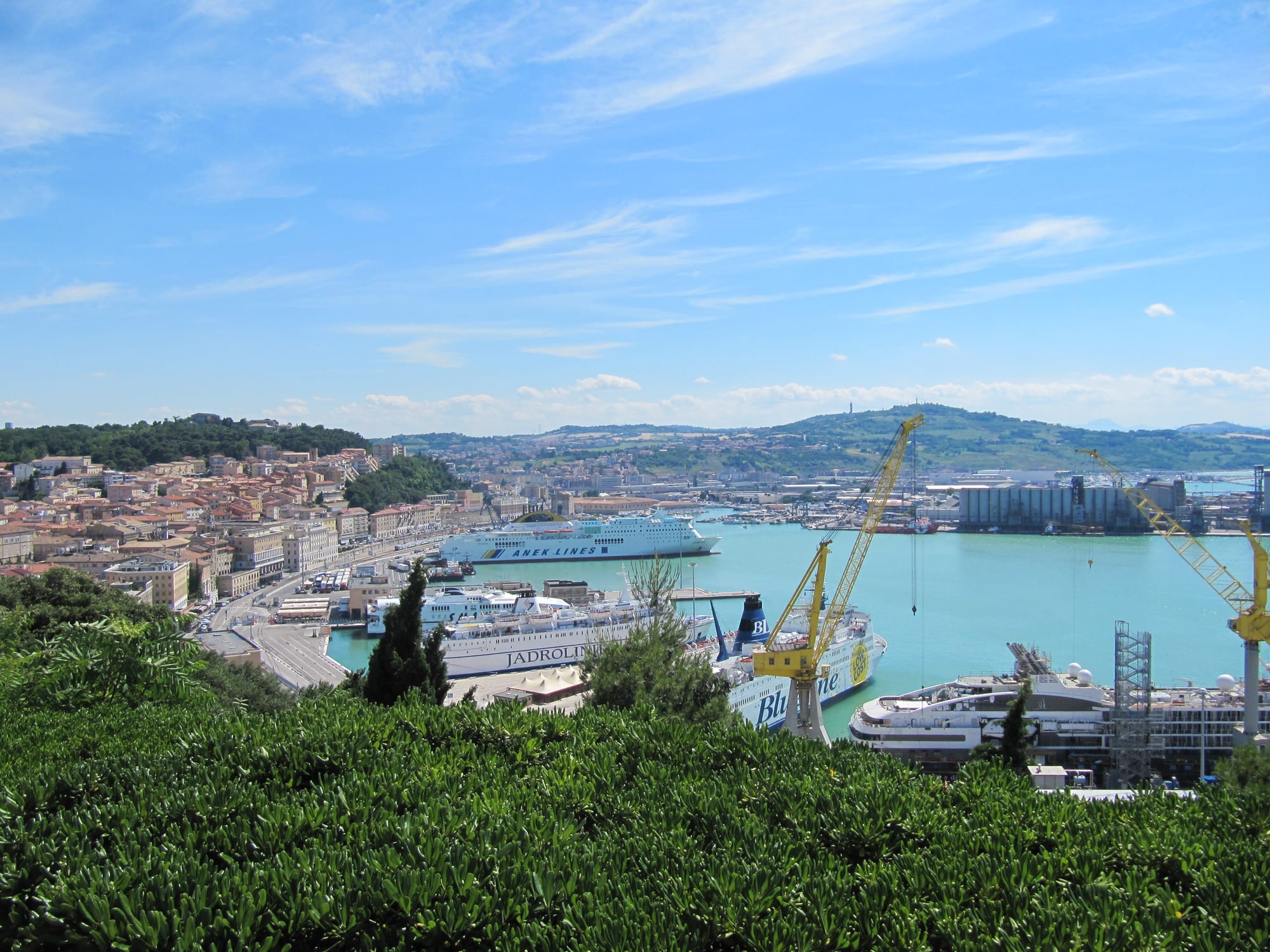
Ancona's harbour with ferries and cranes on turquoise water, the city's houses on the left and green hills behind

Marche, Italy

Ancona

The port of Ancona, with ferries at the quays and the city spread along the hills around the harbour. (Bucaramango / Wikimedia Commons · Public domain)

The capital of the Marche and its main port, built on a promontory at the northern foot of Monte Conero whose elbow-shaped headland gave the Greek colony its name. A maritime republic that rivalled Venice, then a papal port, it is now a working city of ferries to Croatia, Albania and Greece, a hilltop Romanesque cathedral and white cliffs on its eastern edge.

Neighbourhoods

  • Colle Guasco and the old town
    • Historic district
    • Views
    • First-time visitors

    The hill at the tip of the promontory, crowned by the cathedral on the site of the ancient acropolis, with the remains of the Roman amphitheatre between it and the Cappuccini hill. Steep lanes and stairs lead down through the oldest part of the city to the port and the medieval churches near the waterfront.

    Open in Maps
  • The centre and the corsi
    • Best for food
    • Shopping
    • Close to public transport

    The flatter heart of the city between Piazza della Repubblica, with the Teatro delle Muse facing the port, and Piazza Cavour. Corso Garibaldi, Corso Mazzini and Corso Stamira hold the shops and cafés, and Piazza del Plebiscito is the old square where people gather in the evening.

    Open in Maps
  • The port and the Mole
    • Ferries
    • Waterfront
    • Architecture

    The harbour that has made the city since Greek times, with Trajan's arch on the old quay, the pentagonal Lazzaretto on its artificial island, shipyards, and the docks for ferries across the Adriatic.

    Open in Maps
  • Viale della Vittoria and the Passetto
    • Quiet and residential
    • Beaches
    • Walks

    The broad avenue laid out in the 1920s and 1930s across the promontory, lined by the residential Adriatico district, ends at the Monument to the Fallen, where stairs drop to the white rocks and sea caves of the Passetto.

    Open in Maps

Things to do

Famous landmarks

  • Ancona Cathedrallandmark

    The cathedral of San Ciriaco on the Guasco hill, a Greek-cross church mixing Romanesque, Byzantine and Gothic elements, standing on the site of the ancient acropolis with wide views over the port.

    Open in Maps
  • Arch of Trajanlandmark

    A tall, narrow marble arch of 114–115 at the head of the harbour wall, raised in honour of the emperor who enlarged Ancona's harbour and once topped by bronze figures that served as a landmark for ships.

    Open in Maps
  • Lazzaretto (Mole Vanvitelliana)landmark

    Luigi Vanvitelli's pentagonal quarantine station of the 1730s on an artificial island in the port, now a cultural centre with exhibitions, an auditorium and the Museo Omero, a tactile museum.

    Open in Maps
  • Loggia dei Mercantilandmark

    The merchants' hall near the port, begun in 1442, whose facade by the Dalmatian architect Giorgio da Sebenico carries statues of Hope, Fortitude, Justice and Charity.

    Open in Maps
  • Santa Maria della Piazzalandmark

    A medieval Romanesque church with an elaborate arcaded facade dated 1210.

    Open in Maps
  • San Francesco alle Scalelandmark

    A Franciscan church reached by a flight of steps, with a carved portal by Giorgio da Sebenico.

    Open in Maps

Museums and history

  • National Archaeological Museum of the Marchesmuseum

    Housed in the late-Renaissance Palazzo Ferretti, with the richest collection of the Picene civilisation, Greek ceramics and finds from Ancona's Greek necropolis.

    Open in Maps
  • Roman amphitheatreattraction

    The ruins of the Roman amphitheatre between the Guasco and Cappuccini hills, also visible from the park beside the old lighthouse.

    Open in Maps
  • Pinacoteca Civica Francesco Podestimuseum

    The municipal art gallery in Palazzo Bosdari, with paintings by Carlo Crivelli, Titian, Lorenzo Lotto, Sebastiano del Piombo and Guercino, and a large collection of works by Francesco Podesti.

    Open in Maps

The coast and parks

  • Passetto and the Monument to the Fallenviewpoint

    A monument above the cliffs at the end of Viale della Vittoria, whose great stairway leads down to white rocks used for swimming, with a pine wood and park beside it.

    Open in Maps
  • Grotte del Passettoattraction

    Hundreds of small caves cut into the base of the cliffs since the mid-19th century to shelter boats and serve as summer retreats, kept by local families.

    Open in Maps

Short trips from the city

  • Monte Coneropark

    The promontory directly south of the port, 572 metres high and the only coastal high point on the Adriatic between Trieste and the Gargano.

    Open in Maps
  • Siroloattraction

    A small town on the Conero coast, with several beaches a short walk from its main square.

    Open in Maps
  • Numanaattraction

    A seaside town at the southern end of the Conero promontory, with a small harbour and beaches.

    Open in Maps
  • Loretoattraction

    A hill town south of Ancona whose basilica holds the Holy House, which legend says angels carried from Nazareth, a popular Catholic pilgrimage site.

    Open in Maps
  • Frasassi Cavesattraction

    A karst cave system near Genga, where Ancona cavers discovered the Grotta Grande del Vento in 1971, with about 13 km of passages.

    Open in Maps

Eat and drink

Long-standing places and food districts in Ancona. Hours, ratings and directions come from your maps app, always current.

Ancona classics

  • Mercato delle Erbemarket

    The city's covered food market, an early 20th-century Liberty-style building of cast iron and glass.

    Open in Maps
  • Fish restaurants near the portneighborhood

    Trattorias around the harbour and the Mole serve brodetto all'anconetana, stoccafisso all'anconitana, the city's signature stockfish dish, and moscioli, wild mussels gathered from the natural rocks of the coast.

    Open in Maps

Cafés and bars

  • Piazza del Plebiscitoneighborhood

    The old square below the Guasco hill, lined with restaurants and bars where people meet in the evening.

    Open in Maps
  • Corso Garibaldi and Corso Mazzinineighborhood

    The main shopping streets, with long-established cafés serving coffee by day and aperitifs in the evening.

    Open in Maps

Experience Ancona

History

Picene communities lived here before Greek settlers from Syracuse founded the city in about 387 BC, part of Dionysius I's plan to extend Syracusan influence in the Adriatic. They named it Ankon, the "elbow", after the curved headland that sheltered the harbour, and the city is still called the "Doric city". Under Rome it kept the Greek language and its own coins for about a century, served as a naval station, and grew into Rome's main port facing Dalmatia; Trajan enlarged the harbour with his architect Apollodorus of Damascus, and the Senate raised his marble arch on the quay in 115.

After 1000 Ancona became an independent maritime republic, governed by six Elders from its three districts, allied with Ragusa and Byzantium and often clashing with Venice. Greek, Ottoman and Jewish merchants made it a centre of trade with the Levant, and the city's Jewish community grew as refugees arrived from Germany, Spain, Sicily and Portugal. In 1532 Ancona lost its independence to the Papal States under Clement VII; a ghetto was established in 1556. In the 1730s Clement XII extended the quay and had Vanvitelli build the Lazzaretto.

From 1797, when the French took it, the city was an important fortress, and it joined Italy in 1860 after a siege. Austro-Hungarian warships bombarded it in 1915, and in 1944 Polish troops took it in the battle of Ancona. The city's population peaked in 1971; then came an earthquake in 1972 and a landslide in the Posatora district in 1982, after an earlier flood in 1959. The Teatro delle Muse reopened in 2002 and the large Cardeto park in 2005, and traffic with the Balkans and Greece has grown steadily through the port.

Culture & Customs

Ancona's identity is maritime. The Greek past survives in the nickname Dorici and in the cathedral on the old acropolis, and the city's monuments line the waterfront: Trajan's arch, the pentagonal Lazzaretto and the Loggia dei Mercanti, where the Dalmatian Giorgio da Sebenico left a facade that, with his portals for San Francesco alle Scale and Sant'Agostino, marks the city's Adriatic Renaissance. The Lazzaretto now holds exhibitions and the Museo Omero, a museum designed to be explored by touch.

A distinctly local custom is the caves of the Passetto: about five hundred small caves cut into the base of the cliffs since the mid-19th century to shelter boats and serve as summer retreats, kept by families known as grottaroli. The Monument to the Fallen above them, with its stairway to the sea, has become one of the symbols of the city, and the walk "from sea to sea" across the promontory is a favourite stroll. Because the city looks onto the Adriatic both east and west, both sunrise and sunset can be seen over the sea.

The Teatro delle Muse, with a neoclassical facade carved with the nine Muses, Apollo and Palaemon, god of harbours, is the city's main stage. The Jewish cemetery on Monte Cardeto, with tombstones from 1552 onwards, is one of the largest in Europe.

Daily Life

About 99,500 people lived in Ancona in 2025. Ancona is the regional capital, with the regional government, a university, hospitals and the port at the core of its economy. The port is one of the busiest in Italy for international passenger traffic, with ferries to Croatia, Albania and Greece.

The population fell from its 1971 peak after the 1972 earthquake and the 1982 landslide, reached a low of about 98,000 in 1999, and has since recovered with immigration. Most residents live in the districts that spread over the hills behind the centre and along the coast; the Adriatico district and Viale della Vittoria date from the expansion of the 1920s and 1930s.

Life is that of a working city rather than a tourist town: commuters on the corsi in the morning, long lunches, and an evening walk towards the Passetto or along Corso Garibaldi. In summer the city empties towards the Conero beaches and the Passetto rocks.

Food

Ancona's cooking comes from the sea. Brodetto is the Adriatic fish stew, made in different styles in different ports, Ancona's among them. Stoccafisso all'anconitana, Ancona-style stockfish, is the recognised symbol of the city's cooking, and moscioli are wild mussels gathered from the natural rocks rather than farmed. Fish trattorias cluster around the port and the Mole.

From the wider Marche come olive all'ascolana, green olives stuffed with meat and fried; vincisgrassi, a pasta dish similar to lasagna; and crescia, a thin flatbread. The Mercato delle Erbe, an early 20th-century market hall of cast iron and glass in the Liberty style, sells the fish, vegetables and cheese of the province.

Rosso Conero, the red wine named after the promontory, is the city's own wine, and Verdicchio dei Castelli di Jesi, made inland in the province, is the local white. Cafés on Corso Garibaldi and Corso Mazzini serve coffee by day and aperitifs in the evening.

Planning tools

Budget

Ancona is a working port city rather than a resort, and prices for rooms and meals are moderate by Italian standards. Fish restaurants are good value, and the main sights are cheap or free to see from outside. Prices on the Conero coast to the south rise in July and August, when parking at the beaches fills early.

Daily Budget Midrange
USD 140–240 (central hotel, fish dinners, museum tickets, buses or a hire car for the Conero)
Daily Budget Shoestring
USD 65–100 (guesthouse or budget hotel, market food and trattoria meals, city buses)

Anyone catching a ferry should allow time to get from the central station to the port, about 2 km away.

Best Time to Visit

May, June and September are the most pleasant months, warm enough for swimming off the Passetto rocks and the Conero beaches without the August crowds. July and August are the beach season and the busiest time for ferries. Winters are cool and damp but mild enough for sightseeing.

Suggested Number of Days

One or two days are enough for the city itself. Three to five days allow time for the Conero coast, the shrine towns and the caves inland. Many visitors pass through for a night before or after an Adriatic ferry.

First Visit
1–2 days
With Surroundings
3–5 days

Transportation

Ancona is hilly and spread along its promontory, so buses run by Conerobus link the central station with the centre, the Passetto and the outer districts. In summer a free shuttle loops between the ferry ticket office and the docks. Taxis are available at the station, the port and the airport, and a car is useful for the Conero coast.

Buy bus tickets before boarding where machines are available, and stay central, since the hilly outer districts are not always well connected by bus.

Airport & Station Connections

Ancona Airport, named after Raffaello Sanzio, is in Falconara Marittima, about 12 km west of the city, with buses and trains into Ancona. The central station has direct trains to Rimini, Bari and Rome. Ferries run from the port to Split and Zadar in Croatia, Durrës in Albania, and Igoumenitsa and Patras in Greece.

Walkability

The centre, the port and the Guasco hill are walkable, but the city is steep, and climbing to the cathedral means stairs or a winding road. The walk "from sea to sea", along the three main corsi and Viale della Vittoria from the port quays to the Passetto, covers about 2 km across the promontory. The central station lies about 2 km from the port, a long walk with luggage.

Safety

Italy is generally safe, with low levels of violent crime against visitors. Ancona has little crime that affects visitors. The usual care is needed with bags around the station and the ferry port, and with steep steps and rocks at the Passetto and on the paths to the Conero coves.

Keep to marked paths on the Conero, heed rockfall signs at the base of cliffs, and keep valuables close in the station and port areas. Check current official travel advice before travelling.

Climate

A humid subtropical climate on the border between Mediterranean and more continental conditions. Winters bring frequent rain and fog, summers are warm and humid, and winds from the south or west off the Apennines can push temperatures towards 35–40°C.

Summer
warm and humid — July averages about 22.5°C
Winter
cool, with rain and fog — January averages about 5°C

Local Customs

Anconetani are sometimes called Dorici, from the city's Greek origins, and the city's identity is bound to the sea, from the port to the families who keep the caves of the Passetto. Life follows the Italian rhythm of a long lunch and an evening stroll along the corsi. Coffee is drunk standing at the bar, and cappuccino is a morning drink.

Cover shoulders and knees in the cathedral and churches; swimwear belongs at the beach, not in the streets of the centre.

Common Payment Methods

The currency is the euro. Cards are accepted almost everywhere, but some cash is useful for small bars and buses bought on board. There are cash machines throughout the centre, at the station and at the port.