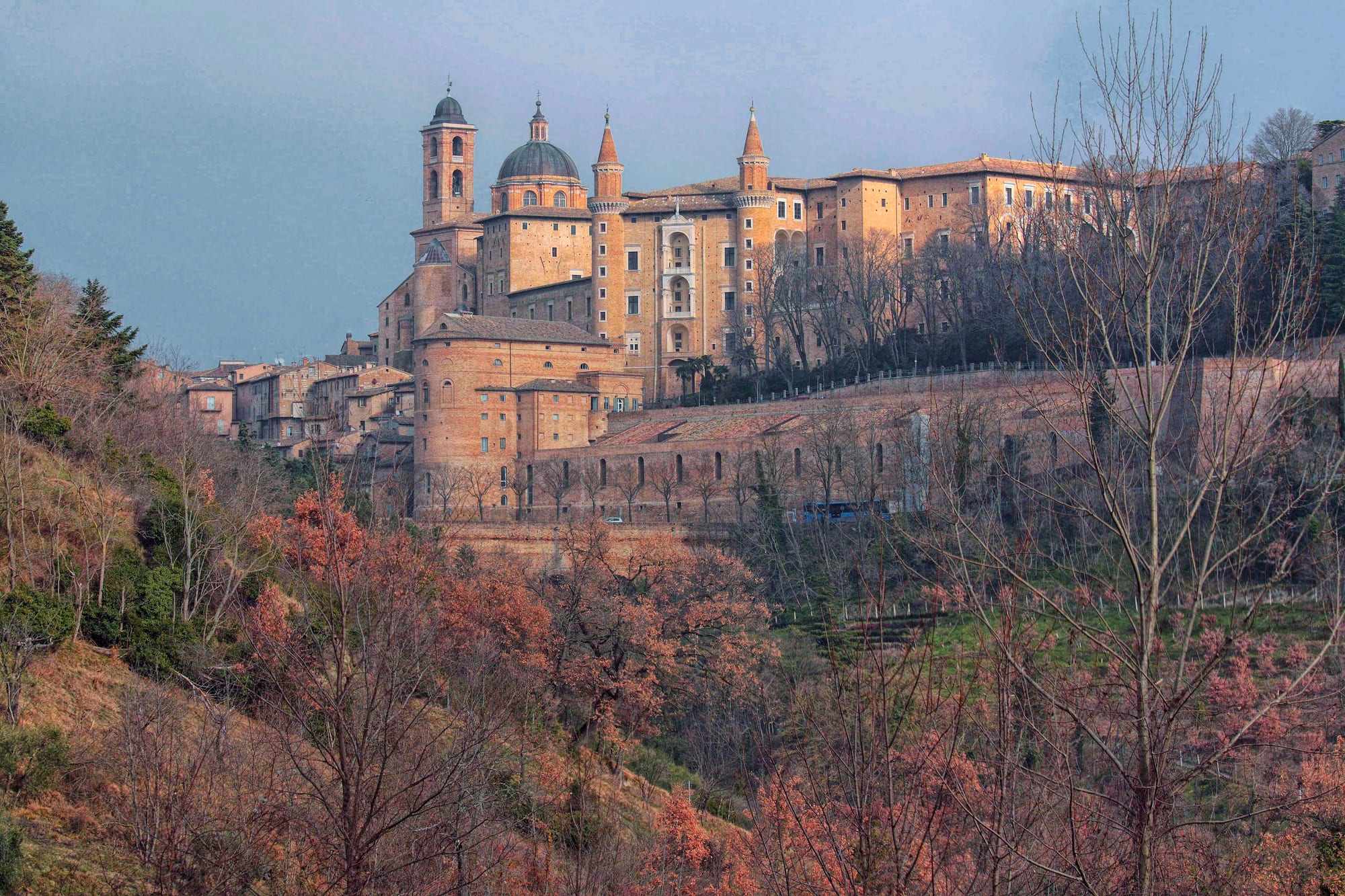
The brick Ducal Palace of Urbino with its twin turrets and the cathedral dome above a wooded hillside

Marche, Italy

Urbino

The Ducal Palace and its twin Torricini towers, with the cathedral dome beside them, seen from the Strada Rossa. (Francesco Maria Garbugli / Wikimedia Commons · CC BY-SA 3.0)

A walled hill town south-west of Pesaro in the north of the Marche, built around the Ducal Palace of Federico da Montefeltro, whose 15th-century court made it one of the Renaissance's great centres. Raphael was born here. Today it is a UNESCO-listed town of brick lanes and steep streets, kept lively by its university, founded in 1506.

Neighbourhoods

  • Piazza Duca Federico and the Ducal Palace
    • First-time visitors
    • Museums
    • Historic district

    The heart of the Renaissance town, where the Ducal Palace and the cathedral face each other across a small square. The palace's twin-towered facade looks out over the valley, and the university's old buildings and many oratories lie in the lanes around it.

    Open in Maps
  • Piazza della Repubblica and Corso Garibaldi
    • Best for food
    • Cafés
    • Close to public transport

    The town's meeting place, a 19th-century square where five streets converge, with a fountain at its centre. Corso Garibaldi, arcaded on its valley side, runs from here past the Teatro Sanzio, and cafés and bars fill with students in term time.

    Open in Maps
  • Via Raffaello and the Monte
    • Historic district
    • Walks
    • Views

    A steep street climbing from Piazza della Repubblica past Raphael's birthplace to the monument to the painter at the top of the hill, with the Albornoz fortress and its park above the town.

    Open in Maps
  • Lavagine
    • Quiet and residential
    • Local life

    A district on the eastern side of the old town, along the steep Via Cesare Battisti up to Porta Lavagine, with small churches and oratories in its lanes.

    Open in Maps
  • Borgo Mercatale
    • Close to public transport
    • Parking

    The open square below the Ducal Palace, where buses and cars arrive. A multi-storey car park built beneath it in the 1970s and a restored spiral ramp lead up into the town.

    Open in Maps

Things to do

Famous landmarks

  • Ducal Palace and the National Gallery of the Marchemuseum

    Federico da Montefeltro's palace, with his inlaid studiolo, and the national gallery it holds, with Piero della Francesca's Flagellation, works by Raphael and Paolo Uccello and a late Resurrection by Titian.

    Open in Maps
  • Urbino Cathedrallandmark

    First built in 1021 to replace an older cathedral outside the walls, and rebuilt in Neoclassical style by Giuseppe Valadier after an earthquake toppled its dome in 1789; it stands beside the palace.

    Open in Maps
  • Raphael's Housemuseum

    The house on Via Raffaello where Raphael was born in 1483, the son of the painter Giovanni Santi, now a museum.

    Open in Maps
  • University of Urbinolandmark

    Founded in 1506 and spread through old and new buildings in the centre, including colleges by the architect Giancarlo De Carlo on the hills outside the walls.

    Open in Maps

Oratories and churches

  • Oratory of St John the Baptistlandmark

    A 14th-century prayer hall covered in a late Gothic fresco cycle of 1416 by the brothers Lorenzo and Jacopo Salimbeni, showing the life of John the Baptist and a Crucifixion.

    Open in Maps
  • Oratory of St Josephlandmark

    A pair of 16th-century oratories built from 1503 to 1515, holding Federico Brandani's Nativity scene of 1545.

    Open in Maps

Walks and viewpoints

  • Albornoz Fortressviewpoint

    The 14th-century fortress built by the papal legate Albornoz above the town, enclosed by new walls in 1507–1511, with a park and views over Urbino's rooftops.

    Open in Maps
  • Helical rampattraction

    A spiral ramp by Francesco di Giorgio Martini beneath the theatre, restored in the 1970s as the way up from the Mercatale.

    Open in Maps

Short trips from the town

  • Furlo Passpark

    A gorge on the old Roman Via Flaminia, cut by the Candigliano river and protected as a state nature reserve since 2001.

    Open in Maps
  • Urbaniaattraction

    A small town on the river Metauro known for its ceramics and maiolica, with a ducal hunting lodge, the Barco Ducale, just outside.

    Open in Maps
  • Gradaraattraction

    A walled village with a castle near the coast, linked to the story of Paolo and Francesca in Dante.

    Open in Maps
  • Pesaroattraction

    The provincial seat on the Adriatic, where the Della Rovere moved their court in 1523, with the house where Rossini was born, now a museum.

    Open in Maps

Seasonal events

  • Festa dell'Aquilonefirst weekend of September

    A kite-flying contest between the town's districts, held every year since 1955.

Eat and drink

Long-standing places and food districts in Urbino. Hours, ratings and directions come from your maps app, always current.

Urbino classics

  • Cresciarestaurant

    The thin flatbread of the Marche and Umbria, probably sharing an ancestry with the piadina, eaten hot in Urbino with prosciutto crudo, cheese or sausage.

    Open in Maps
  • Casciotta d'Urbinomarket

    The local cheese, made from mostly sheep's milk with some cow's milk in the province of Pesaro and Urbino, sold in delicatessens in town.

    Open in Maps

Cafés and bars

  • Piazza della Repubblicaneighborhood

    Cafés and bars around the main square and along Corso Garibaldi, busy with students from the university.

    Open in Maps
  • Via Raffaello and Via Mazzinineighborhood

    The streets climbing from the main square hold trattorias, pizzerias and bars, many of them in old cellars.

    Open in Maps

Experience Urbino

History

Urbino's commune enjoyed some independence until around 1200, when it passed to the House of Montefeltro. The townspeople rebelled and allied with Rimini in 1228, but the Montefeltro returned and held the town until 1508, leading the Ghibelline, pro-imperial party in the Marche and Romagna. The papal legate Albornoz built a fortress on the hilltop in the 14th century.

The town's golden age came under Federico da Montefeltro, a condottiero who ruled as duke from 1444 to 1482. He rebuilt the family residence as the Ducal Palace, begun by the Dalmatian architect Luciano Laurana, and filled his court with painters, scholars and books; Raphael was born here in 1483, the son of the court painter Giovanni Santi. Cesare Borgia seized the duchy in 1502, and from 1508 it passed to the Della Rovere dukes, who added new walls, encouraged the maiolica workshops and in 1523 moved the court to Pesaro, beginning a long decline. The university was founded in 1506. In 1626 Pope Urban VIII absorbed the duchy into the Papal States, and much of the palace's art left as the dowry of Vittoria della Rovere when she married into the Medici.

On 8 September 1860 Piedmontese troops entered the town and the last papal soldiers surrendered, and Urbino joined Italy. During the Second World War about 10,000 works from Italian museums were hidden from the Nazis in the fortress of Sassocorvaro nearby, and the town was freed in August 1944. From the 1950s the architect Giancarlo De Carlo worked with the university and the town on a plan that rescued the decaying centre and built new colleges on the surrounding hills. The town is listed as a UNESCO World Heritage Site for its Renaissance legacy.

Culture & Customs

Urbino's culture is still that of its Renaissance court and its university. The Ducal Palace, with Federico's studiolo inlaid with wood and its twinned Christian chapel and pagan Temple of the Muses, is the centre of the town's identity, and the National Gallery of the Marche inside it holds Piero della Francesca's Flagellation, works by Raphael and Paolo Uccello, Van Wassenhove's Last Supper with portraits of the Montefeltro court, and a late Resurrection by Titian. Small oratories hide frescoes and stucco work, from the Salimbeni brothers' 1416 cycle in the Oratory of St John to Federico Brandani's Nativity of 1545 in the Oratory of St Joseph.

The town has a long craft tradition. Simple wares were made here in the 15th century, but after 1520 the Della Rovere dukes encouraged a maiolica industry that exported across Italy, first in the istoriato style, painted with narrative scenes taken from engravings. In the early 20th century the Scuola del Libro, a school of book arts, added to the town's artistic life.

The university, founded in 1506, shapes daily life, filling the bars of Piazza della Repubblica in term time. The town's best-loved festival is the Festa dell'Aquilone, a kite contest between the districts held on the first weekend of September since 1955.

Daily Life

About 14,000 people live in the comune of Urbino, which is also joint capital of the province of Pesaro and Urbino and the seat of an archbishop. In term time thousands of students swell the town, and the university is central to the local economy. Housing shortages for students have been a recurring issue since the university began to grow in the early 20th century.

Most residents live in the newer districts and villages outside the walls, while the old town holds the university buildings, offices, shops, bars and student flats. Life follows the academic calendar as much as the seasons: crowded and young from autumn to spring, quieter in summer when the students leave and visitors arrive. The town lies in the southern Montefeltro, an area of medium-high seismic risk, and dozens of earthquakes have been recorded here over the centuries; one in 1789 brought down the cathedral dome. Beyond the walls, the student colleges that Giancarlo De Carlo designed near the Capuchin church, completed in the early 1980s, are often cited as architecture that merges with the landscape.

Food

Urbino's everyday food is the crescia, a thin flatbread made in the Marche and Umbria that probably shares an ancestry with the piadina of Romagna. Urbino's version is made with flour, eggs, water, lard, salt and pepper, and eaten hot with ham, cheese, sausage or wild herbs. The local cheese is casciotta d'Urbino, a mild cheese made in the province from about 70–80 per cent sheep's milk and the rest cow's milk; local legend says its name came from a civil servant's mispronunciation of caciotta.

Ciauscolo, a very soft salume typical of the Marche that can be spread on bread, is a regional speciality, and truffles come from Acqualagna, one of Italy's main truffle centres, not far away. Wines from Verdicchio, the white grape grown mainly in the Marche, and the region's reds are poured in the town's bars and trattorias, many of them in old cellars along the streets that climb from the main square.

Planning tools

Budget

Urbino is good value by the standards of Italian art towns, and its large student population keeps cafés, bars and casual food cheap. Rooms in the walled centre are limited, and agriturismi in the surrounding hills are the other choice. The main costs are the palace and gallery tickets and a car for the countryside.

Daily Budget Midrange
USD 140–240 (hotel in the old town or agriturismo nearby, restaurant dinners, palace and gallery tickets, a hire car)
Daily Budget Shoestring
USD 65–100 (guesthouse or room in town, crescia and trattoria meals, buses from Pesaro)

Allow a good half-day for the Ducal Palace and gallery alone, and wear shoes with grip for the steep brick-paved streets.

Best Time to Visit

May, June and September are the most comfortable months, with mild weather on the hilltop and the town in full university swing. The kite contest fills the first weekend of September. Summer is quieter once the students leave, and winter can be cold and damp, with occasional snow.

Suggested Number of Days

One full day covers the palace and the old town at an unhurried pace, and a night lets the town be seen after day visitors leave. Three or four days suit those adding the gorges, the ceramic towns and the coast, which is far easier with a car.

First Visit
1–2 days
With Surroundings
3–4 days

Transportation

Urbino has no railway. Borgo Mercatale, below the Ducal Palace, has a large car park beneath it and a taxi rank, and there is another rank in Piazza della Repubblica. The walled centre is small and best covered on foot, and a car is the practical way to reach the hill towns and gorges around it.

Park at Borgo Mercatale and walk up; much of the old town is closed to general traffic.

Airport & Station Connections

Buses run frequently from the railway station at Pesaro, a ride of about 45 minutes. By road Urbino is about 60 km from Rimini and about 100 km from Ancona, and about 270 km from Rome.

Walkability

The old town is hilly, so walking means steep climbs and descents on brick and stone paving, but distances are short: the palace, the main square and Raphael's house are a few minutes apart. Walks along the walls and up to the fortress park give wide views over the Montefeltro hills.

Safety

Italy is generally safe, with low levels of violent crime against visitors. Urbino is a quiet university town where crime rarely touches visitors. The main hazards are steep, slippery streets in rain or ice, and the town lies in an area classed as medium-high seismic risk.

Take care on the steepest streets in wet or icy weather, and follow local instructions if there is an earthquake. Check current official travel advice before travelling.

Climate

A hilltop climate, with warm summers and cold, damp winters. Spring and autumn are mild and changeable.

Summer
warm to hot — summers in nearby Pesaro are hot and humid, with a record high of 39.2°C
Winter
cold and damp — in nearby Pesaro January averages 3–4°C

Local Customs

Urbino is a university town, and students set much of the rhythm: busy bars in term time, a quieter town in the summer holidays. Life follows the Italian pattern of a long lunch and an evening stroll around the main square. Coffee is drunk standing at the bar, and cappuccino is a morning drink.

Cover shoulders and knees in the cathedral and oratories, and keep voices low during services.

Common Payment Methods

The currency is the euro. Cards are widely accepted, but a little cash is handy for small bars and crescia counters. There are cash machines around the main square.