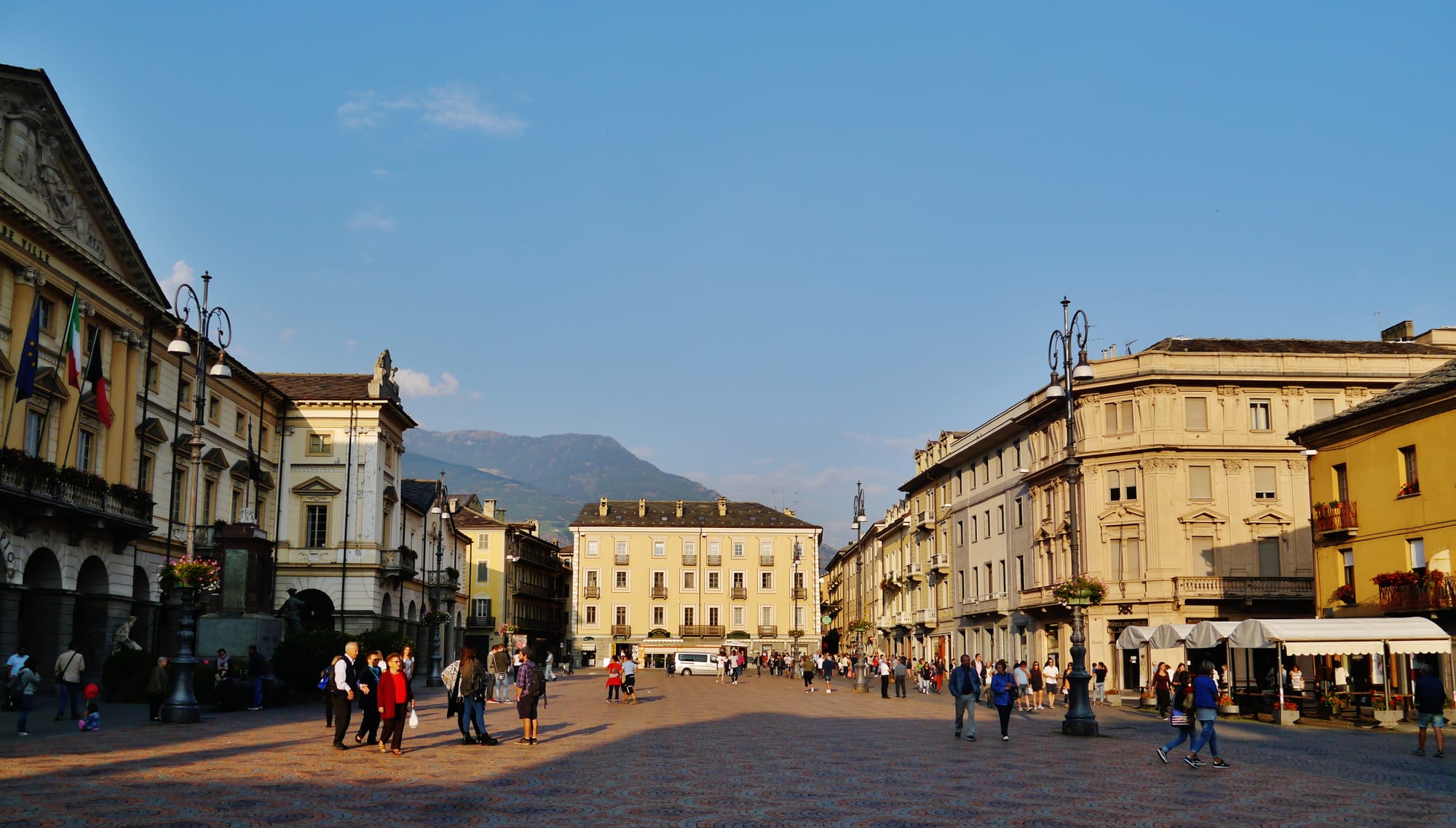
A wide paved square lined with pale 19th-century buildings and café awnings, with a wooded mountain rising behind

Aosta Valley, Italy

Aosta

Piazza Émile Chanoux, the main square of Aosta. (Zairon / Wikimedia Commons · CC BY-SA 4.0)

The capital of the Aosta Valley, at the meeting of the Buthier and the Dora Baltea and the junction of the Great and Little St Bernard routes. Founded by Rome as Augusta Praetoria, it keeps its Roman walls, gates, theatre and street grid; today it is a bilingual Alpine city of about 33,000 people, with mountains on every side.

Neighbourhoods

  • Centro storico
    • First-time visitors
    • Historic district
    • Close to public transport

    The old city inside the Roman walls, still laid out on the Roman grid. Via Sant'Anselmo, the traffic-free main street, runs from the Arch of Augustus through the Porta Praetoria to Piazza Émile Chanoux and the town hall, with the cathedral, the theatre and the station all a short walk away.

    Open in Maps
  • Quartiere Cogne
    • Local life
    • Quiet and residential

    The residential district built in the 20th century to house the workers of the Ansaldo steelworks — a working neighbourhood of flats and local shops rather than a sightseeing area.

    Open in Maps
  • Pila
    • Skiing
    • Hiking
    • Mountain views

    A small, family-oriented ski resort on the mountainside above the city, in the municipality of Gressan, reached by a gondola that climbs about 1,200 metres from the valley floor. In summer it is a base for walks.

    Open in Maps

Things to do

Roman Aosta

  • Arch of Augustuslandmark

    A triumphal arch outside the eastern walls, raised in honour of Augustus to celebrate the Roman victory over the Salassi.

    Open in Maps
  • Porta Praetorialandmark

    The double eastern gate of the Roman city, from the 1st century AD, with two rows of three arches enclosing a small square, preserved in its original form apart from its lost marble facing.

    Open in Maps
  • Roman Theatrelandmark

    A theatre from the late reign of Augustus that held up to 4,000 spectators, whose 22-metre southern façade still stands above the rooftops.

    Open in Maps
  • Cryptoporticuslandmark

    The underground covered gallery of the Roman forum, beside the cathedral.

    Open in Maps
  • Roman walls and towerslandmark

    Walls enclosing a rectangle of 724 by 572 metres, preserved almost in their entirety, with surviving towers such as the Tour du Lépreux and the Tower of Bramafan, built over a Roman bastion.

    Open in Maps

Churches and museums

  • Aosta Cathedrallandmark

    The cathedral of Santa Maria Assunta, on the site of a 4th-century church replaced in the 11th century, beside the old Roman forum.

    Open in Maps
  • Sant'Orsolandmark

    The Romanesque-Gothic collegiate church of Saint Ursus, best known for its cloister, entered through a hall to the left of the façade.

    Open in Maps
  • Megalithic Area of Saint-Martin-de-Corléansmuseum

    An archaeological site and museum on the west side of the city, with dolmen and cist tombs and carved stelae dating from the Neolithic to the Bronze Age.

    Open in Maps
  • Regional Archaeological Museummuseum

    The Museo archeologico regionale, the MAR, displaying the finds of Roman and earlier Aosta.

    Open in Maps

Mountains and short trips

  • Aosta–Pila gondolatransit hub

    The gondola from the lower station at Charvensod, just south of the railway station, up to the Pila ski area.

    Open in Maps
  • Pont d'Aëllandmark

    A single-arched Roman bridge-aqueduct about 8 km west of the city, with a covered passage for foot travellers and an open footpath above.

    Open in Maps
  • Fénis Castlelandmark

    A castle of the Challant family down the valley, given its many towers and battlemented walls between 1320 and 1420, with a staircase and balconies around its inner courtyard.

    Open in Maps
  • Gran Paradiso National Parkpark

    The national park established in 1922 on land first protected to save the Alpine ibex, south of the city; the Paradisia Alpine Botanical Garden near Cogne lies inside it.

    Open in Maps
  • Courmayeurattraction

    The resort at the foot of Mont Blanc at the head of the valley, linked with Chamonix by the Mont Blanc Tunnel.

    Open in Maps

Seasonal events

  • Fiera di Sant'Orso30–31 January

    A crafts and food fair held in the town centre for about a thousand years, today with more than a thousand craftspeople taking part.

  • Bataille des Reines finala Sunday in October

    The final of the season's cow fights, in which cows compete for the title of Queen of horns, held in the Croix-Noire arena.

  • Marché Vert Noëllate November to 6 January

    The traditional Christmas market in Piazza Émile Chanoux.

Eat and drink

Long-standing places and food districts in Aosta. Hours, ratings and directions come from your maps app, always current.

Aosta classics

  • Valdostan restaurants of the old townneighborhood

    Restaurants around Via Sant'Anselmo and the squares serve fonduta, carbonade and polenta, the mountain cooking of the valley.

    Open in Maps
  • Cafés on Piazza Émile Chanouxcafe

    The terraces of the main square, a meeting place in the heart of the city.

    Open in Maps

Food shops

  • Cheese and cured-meat shopsneighborhood

    Shops in the old town sell fontina, lardo d'Arnad, jambon de Bosses, mocetta and génépy.

    Open in Maps

Experience Aosta

History

The site was settled in prehistoric times — a megalithic cult area and Neolithic tombs survive at Saint-Martin-de-Corléans — and later became a centre of the Salassi, a Celtic people who controlled the Alpine passes. In 25 BC the Romans defeated them, killing many or selling them into slavery, and Terentius Varro founded the colony of Augusta Praetoria Salassorum for 3,000 retired veterans. Laid out like a military camp at the junction of the Great and Little St Bernard routes, it became the capital of the Alpes Graiae province, and its walls, gates, theatre and street grid still define the centre.

After Rome the city passed to the Burgundians, the Ostrogoths, the Byzantines and the Lombards before the Franks drove them out. Under Charlemagne it grew in importance as a post on the Via Francigena, the road from Aachen to Italy, and Sigeric of Canterbury recorded it as a stage in 990. After a period in the Kingdom of Burgundy it passed after 1032 to Humbert I of Savoy. Its people were granted the privilege of an assembly of the estates in 1189, and an executive council chosen from it governed from 1536 until 1802. Anselm, the future Archbishop of Canterbury, was born here.

In the 20th century heavy industry transformed the city. The Ansaldo steelworks drew workers from other parts of Italy, and the Quartiere Cogne was built to house them. After the Second World War the valley gained special autonomous status, with Aosta as its capital, and since 1946 Italian and French have been its official languages.

Culture & Customs

Aosta's identity is Alpine, bilingual and proud of its difference from the rest of Italy. Italian is the everyday language, French is co-official and taught in schools, and patois, the Valdôtain form of Franco-Provençal, is officially recognised and widely used. The main square is named after Émile Chanoux, and the town hall faces it.

The great event of the year is the Fiera di Sant'Orso, held on 30 and 31 January for about a thousand years, when craftspeople from across the valley fill the old streets with carved wooden utensils, toys and local food and wine. In October the Croix-Noire arena hosts the final of the Bataille des Reines, the cow fights of the mountain farming year, and from late November the Marché Vert Noël Christmas market fills Piazza Émile Chanoux.

Religious heritage is everywhere, from the cathedral beside the old forum to the collegiate church of Sant'Orso and its Romanesque cloister. The city also has its own university, the University of the Aosta Valley, and the Splendor theatre, opened in 2013 in a converted cinema. Sport follows the mountains — skiing at Pila on the city's doorstep — and the Tour de France has passed through Aosta.

Daily Life

Aosta had 33,127 inhabitants in 2026, the region's largest city, and seniors make up 29 per cent of residents. In 2025 about 88 per cent of residents whose country of birth was known had been born in Italy; the largest groups born abroad came from Morocco, Romania and Albania. At 583 metres above sea level, it is one of the highest regional capitals in mainland Italy.

As the capital of an autonomous region, the city is a centre of public-sector employment, alongside tourism, industry and the shops and services used by the surrounding valleys. The University of the Aosta Valley adds a student population.

Daily life follows the seasons. Winter weekends turn towards the slopes of Pila, reached by gondola from the edge of the city; summer brings walkers and through traffic heading for the tunnels into France and Switzerland. Rail links are limited: direct trains run only as far as Ivrea, and the branch line up the valley towards Courmayeur, as far as Pré-Saint-Didier, closed in 2015.

Food

Aosta's cooking is Alpine rather than Mediterranean, built on cheese, cured meat, rye bread and maize polenta rather than wheat. Fontina, the cow's-milk cheese of the valley, is made locally and is melted into fonduta, fontina whipped with milk and eggs, and layered into seupa à la vapelenentse, a dish of bread, cabbage and fontina. Carbonade is beef cooked in red wine and eaten with polenta.

Cured meats include lard d'Arnad, cured pork fat brined in wooden tubs of chestnut, oak or larch; jambon de Bosses, a mountain ham; and mocetta, dried meat. Tegole are thin almond-paste wafers.

After dinner comes caffè alla valdostana, coffee with spirit, sugar and lemon peel, flamed so that the sugar caramelises on the rim of the shared cup, and génépy, a strong herbal liqueur of Alpine wormwood, usually drunk neat. The valley has the highest vineyards in Europe, and its wines include the white Blanc de Morgex et de La Salle and the reds Torrette and Fumin.

Planning tools

Budget

Aosta itself is moderately priced compared with the valley's ski resorts, and makes a good, cheaper base for trips into the side valleys by bus. Prices rise in the ski season and in midsummer, and around the Sant'Orso fair at the end of January. A ski pass or the cable cars of the high resorts are the biggest extra costs.

Daily Budget Midrange
USD 160–320 (central hotel, restaurant dinners, a day on the Pila slopes or the cable cars)
Daily Budget Shoestring
USD 80–130 (hostel or simple guesthouse, picnic lunches, buses, hiking)

The Roman walls, gates and the Arch of Augustus can be seen from the street at no cost; mountain huts on the high trails need booking in July and August.

Best Time to Visit

June to September for walking, the high passes and long days; December to April for skiing at Pila and the bigger resorts up the valley. The end of January brings the Sant'Orso fair, and October the cow-fighting final and autumn colour. Spring and late autumn are quieter, and the weather changes quickly.

Suggested Number of Days

One or two days cover the Roman city and its churches. Four or five allow for the castles, the national park and the high resorts of the valley; skiing or hiking holidays naturally run longer.

First Visit
1–2 days
With Surroundings
4–5 days

Transportation

The centre is compact and largely traffic-free. The main bus hub is near the railway station, with buses to the side valleys and further afield to Turin, Milan, Chamonix and Martigny. The gondola to Pila leaves from Charvensod, just south of the station. A car makes the side valleys and castles easier.

Carry snow chains or fit winter tyres in winter, when they are compulsory on many mountain roads.

Airport & Station Connections

Aosta station is on the Chivasso–Ivrea–Aosta railway; direct trains run only as far as Ivrea, where travellers change for Turin. The A5 motorway links the city with Turin and Courmayeur, and roads continue to the Mont Blanc and Great St Bernard tunnels. Aosta's own airport has no scheduled flights; the nearest are Turin Airport, about 65 km south, and Geneva, about 109 km north-west.

Walkability

The old city is flat and compact, about 724 by 572 metres inside its Roman walls, and the main sights sit along or just off the pedestrian Via Sant'Anselmo. The station is at the southern edge of the centre. Pavements can be icy in winter.

Safety

Italy is generally safe, with low levels of violent crime against visitors. Aosta is a quiet city; the real risks are mountain ones — sudden weather changes, rockfall, avalanches off-piste and icy winter roads.

Check the weather and avalanche bulletins before heading into the mountains, and hire a guide for glacier routes. Check current official travel advice before travelling.

Climate

Sheltered in the rain shadow of the Mont Blanc massif, Aosta is relatively dry all year, with cool to very cold winters and hot summers. The Föhn wind can bring sudden warm spells, even in winter.

Summer
hot — June and July highs are normally around 32–33°C, with mornings near 15°C
Winter
cold — in December and January nights are almost always well below 0°C and daytime highs usually only just above 0°C, and snowfalls can be frequent

Local Customs

The valley is officially bilingual: Italian is the everyday language, French is co-official and many place names are French, and many people also speak patois, the local Franco-Provençal dialect. Valdostans have a strong sense of separate identity. Restaurants often add a cover charge, the coperto, and tipping is not expected.

A friendly bonjour is as welcome as buongiorno; cover shoulders and knees in churches, and respect the rules of mountain huts and farm pastures.

Common Payment Methods

Italy uses the euro. Cards are widely accepted in Aosta's shops, hotels and restaurants; carry some cash for small purchases, mountain huts and rural farm-stays.