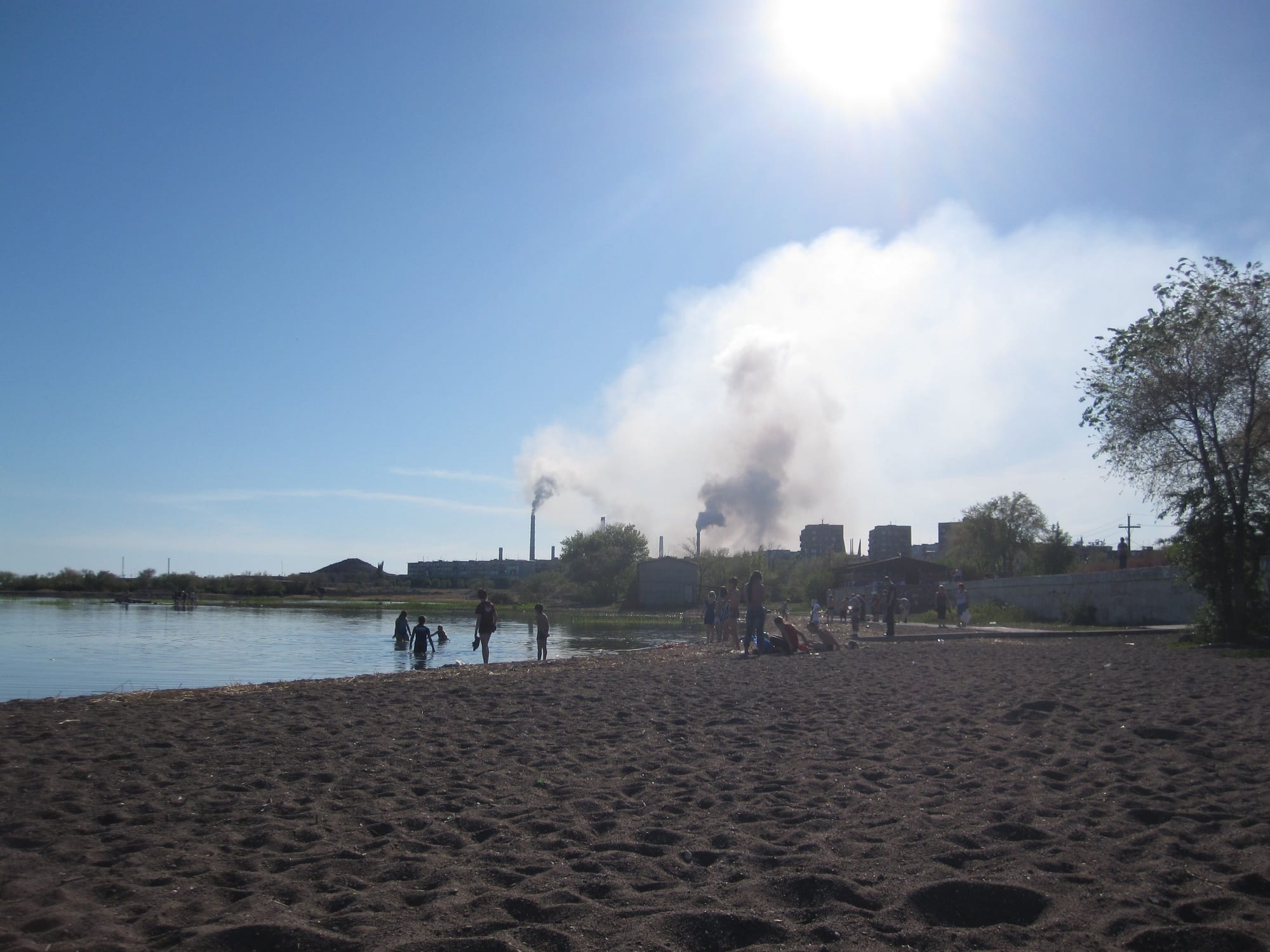
A sandy beach and shallow water on Lake Balkhash with bathers, and smoking chimneys of the copper works behind the low town

Karaganda & Central Kazakhstan, Kazakhstan

Balkhash

The town beach on Lake Balkhash, with the chimneys of the Balkhash copper works behind. (Dsmith890 / Wikimedia Commons · CC BY-SA 3.0)

A Soviet company town on the northern shore of Lake Balkhash, built in the 1930s around a large copper smelter and the open pit at Kounrad. Around 70,000 people live between the works and the water, and the town is the usual place to see a lake that is fresh at its western end and salty in the east.

Neighbourhoods

  • The centre
    • First-time visitors
    • Close to public transport
    • Restaurants

    The planned core laid out in the 1930s and 1940s between the works and the lake, with low blocks of flats, a main square, the cultural palace, the market and most of the town's hotels and cafés within a few streets of each other.

    Open in Maps
  • The lakeshore and beaches
    • Beaches
    • Family visits
    • Summer

    A strip of sand, promenade and swimming spots along the northern shore at the edge of town. In July and August it fills with families from Balkhash and Karaganda; out of season it is wind-blown and empty, with fishermen working the shallows.

    Open in Maps
  • Konyrat
    • Industrial history
    • Local life

    A separate residential district north of the centre, built for workers at the Kounrad open-pit mine and reached by town bus. It is plain and functional, and shows how closely the town is tied to the copper it was founded on.

    Open in Maps

Things to do

The lake

  • Lake Balkhashattraction

    One of the largest lakes in Asia, stretching some 600 kilometres across the steppe and desert, fresh in its western basin where the Ili flows in and brackish to salty in the east.

    Open in Maps

Desert and steppe

  • Bektauataattraction

    A weathered granite massif rising from the desert less than 70 kilometres north of the town, protected as a state nature sanctuary and a long-standing destination for local excursions.

    Open in Maps

Elsewhere on the lake

  • Priozerskattraction

    A closed city further west on the lake's northern shore, the administrative centre of the Sary Shagan missile test site; it remains closed to visits by foreign citizens.

    Open in Maps

Getting around

  • Balkhash Airporttransit hub

    An airport about 6 kilometres north-east of the town; civil aircraft now use it rarely and it serves mainly the military and a local flying club, so most travellers arrive by road or rail.

    Open in Maps

Seasonal events

  • Nauryzlate March

    The spring new year, marked with yurts, concerts and nauryz kozhe on the central square, still cold this far north on the lake.

  • Metallurgist's DayJuly

    The holiday of the metals industry, the company town's main celebration, with awards at the smelter and concerts in the centre.

  • The beach seasonJuly and August

    The weeks when the lake is warm enough for swimming and the shore fills with visiting families, boats and fish stalls.

Eat and drink

Long-standing places and food districts in Balkhash. Hours, ratings and directions come from your maps app, always current.

Balkhash classics

  • Lake fishrestaurant

    Zander, carp, bream and catfish from the lake are fried, baked or smoked and sold in cafés and at stalls along the roads out of town; smoked fish is the souvenir people carry back to Karaganda.

    Open in Maps
  • Kazakh and Russian canteensrestaurant

    Simple canteens and cafés in the centre serve beshbarmak, manty, plov, borscht and cutlets at low prices, the everyday food of a working town.

    Open in Maps

Markets

  • The town bazaarmarket

    The covered and open market sells fish, steppe meat and kazy, dairy, kurt, melons in season and Korean-style salads.

    Open in Maps

Experience Balkhash

History

The lake was a landmark of the nomad world long before there was a town here: Kazakh clans of the Middle Horde grazed the northern shore, and the water divided pastures rather than joining them. Balkhash itself is entirely a creation of Soviet industry. Prospectors led by the geologist Mikhail Rusakov confirmed a very large copper deposit at Kounrad, north of the shore, and the decision to smelt the ore beside the lake — which could supply the water a smelter needs in an otherwise dry landscape — brought thousands of workers to a bare strip of sand and scrub.

Construction of the Balkhash copper works began in the early 1930s. The first settlement, Pribalkhashstroy, was turned into the city of Balkhash in 1937, and the works shipped their first copper in November 1938. Labour came from all over the Soviet Union, some of it voluntary and much of it not: deported families and prisoners from the camps of central Kazakhstan worked on the plant and the railway that linked it to the main line. During the Second World War the works were of national importance, supplying copper for munitions while the western Soviet industry was overrun.

The post-war decades were the town's best: new districts of flats, a cultural palace, sanatoriums on the shore and a population larger than today's. Independence brought a sharp contraction, with emigration and the transfer of the works to the mining company that became Kazakhmys. The plant still operates, the Kounrad mine north of the town is still the largest of its mines, and the town's fortunes remain tied to the metal price, while the lake's level and health are a constant regional worry.

Culture & Customs

Balkhash has the culture of a Soviet company town overlaid on a Kazakh shore. Life has long been organised around the plant: its holidays, its sports clubs, its cultural palace and the sanatoriums it built for workers by the water. Metallurgist's Day in July matters more than most public holidays, and families identify themselves by which part of the works a parent or grandparent served in.

The population is mixed. Kazakhs form the majority today, with Russians, Ukrainians, Tatars, Koreans and Germans among the descendants of those who came or were sent to build the plant, and Russian remains the language of the street while Kazakh grows in schools and offices. Orthodox and Muslim observance sit side by side, and Nauryz in spring is celebrated along with the industrial holidays.

The lake shapes the year. Summer belongs to the shore — swimming, boats, barbecues on the sand and the smell of smoking fish along the roads — and winter to ice fishing, when huts and drilled holes appear on the frozen water. Fishing is both livelihood and pastime, and talk about the lake's level, the fish stocks and the water drawn upstream from the Ili in China is a standing subject of local conversation. Visitors are unusual enough to be greeted with curiosity and, very quickly, with an invitation to tea.

Daily Life

About 70,000 people live in Balkhash, a smaller number than in the late Soviet years, spread between the compact centre, the outlying microdistricts and the mine settlement at Konyrat. It is one of the larger towns of Karaganda Region, after Karaganda and Temirtau, and the administrative centre of its own district.

The copper works and the mines dominate employment directly and indirectly, with the rest of the town living from transport on the Astana–Almaty corridor, from fishing, from trade and from the schools, hospital and colleges. Wages follow the copper market, and young people leave regularly for Karaganda, Astana and Almaty, which keeps the population slowly falling.

Days are lived on a small scale: walking or a short bus ride to work, the bazaar for fish and vegetables, long summer evenings by the water and long winter evenings indoors. Air quality near the plant, the condition of the water supply and the future of the lake are the issues people raise most. The town is quiet, low-built and worn, and it stands out mainly because of what is beside it — a lake so large that the far shore is invisible, with fresh water at one end and salt at the other.

Food

Fish is what Balkhash is known for. The lake supplies zander, called sudak locally, along with carp, bream, catfish and the native marinka, and they are fried whole, baked, dried or smoked over reeds. Smoked fish hangs at stalls on the roads out of town and travels home with visitors from Karaganda; fish soup, ukha, is made at the shore. The fish of the fresh western basin and the salty east are held to taste different, and locals will say which they prefer.

The rest of the table is the food of the steppe and of the Soviet town. Beshbarmak — boiled mutton or horsemeat with sheets of pasta and onion broth — is the dish for guests, served with kazy sausage and followed by sorpa broth. Manty, plov, shashlik, borscht, pelmeni and cutlets fill the canteens, and baursak, fried dough, comes with tea. Korean families brought morkovcha, the spiced carrot salad, and kimchi to the bazaars.

Tea is drunk constantly, black and often with milk, and accompanies bread, jam and kurt, the hard dried curd balls of the steppe. In summer, melons and watermelons from the irrigated south are piled by the roadside, and kymyz and shubat, fermented mare's and camel's milk, are sold by herding families outside town.

Planning tools

Budget

Balkhash is cheap, with a handful of modest hotels and guesthouses, canteens and market food. Prices on the shore rise a little in July and August when Kazakh holidaymakers arrive. Reaching Bektau-Ata or the western shore needs a taxi or a hired car, which is the main expense.

Daily Budget Midrange
USD 65–130 (mid-range hotel, restaurants, a driver for Bektau-Ata or the lake shore)
Daily Budget Shoestring
USD 25–45 (simple hotel or guesthouse, canteen meals, buses and trains)

Book a room ahead for July and August weekends, and carry cash — small cafés, stalls and rural taxis may not take cards.

Best Time to Visit

June to September. July and August are the swimming season, when the lake is warm and the beaches are busy; late May, June and September are hot and dry with fewer people, and best for the desert around Bektau-Ata. Winters are long and hard, the lake freezes over, and there is little reason to come apart from ice fishing.

Suggested Number of Days

A day covers the town, the shore and the view of the works. Two or three days allow for the desert hills, beaches away from town and a slower look at the lake, which is most of the reason to stop here at all.

First Visit
1 day
With Surroundings
2–3 days

Transportation

The town is small and served by a few bus routes linking the centre with Konyrat and the outlying districts. Taxis are cheap and easily found, and are the practical way to reach the beaches, the mine road and the desert. Long-distance buses and trains run north to Karaganda and Astana and south to Almaty, and the main road along the lake carries most of the traffic.

There is no public transport to Bektau-Ata or the remoter beaches, so agree a return fare with a driver.

Airport & Station Connections

Balkhash sits on the main road and railway between Astana and Almaty. Karaganda is roughly 400 kilometres north, around five hours by road, and Almaty is a long day's drive or an overnight train to the south. Trains stop at the town's station, and the airport north-east of the town sees few civil flights.

Walkability

The centre is flat, compact and easily walked end to end, and the lakeshore is a few minutes from the main square. Outlying districts and the mine settlement are several kilometres away and need a bus or taxi. Summer heat, dust and the winter wind off the frozen lake are the main obstacles, and pavements are uneven in places.

Safety

Balkhash is a quiet town with little crime that affects visitors. The real risks are environmental and industrial: strong sun and heat in summer, thin ice and bitter wind in winter, smelter emissions that sometimes affect air quality, and restricted military ground west of the lake. Swimming is unsupervised, and the lake can get rough quickly in wind.

Keep away from the smelter and mine workings and from the restricted areas around the test range, carry water on desert trips, and take care swimming where there are no lifeguards. Check current official travel advice before travelling.

Climate

Sharply continental and dry, on the edge of the Betpak-Dala desert, with very little rain, strong sun and wind off the lake in every season. The lake moderates temperatures slightly near the shore and usually freezes in winter.

Summer
hot and dry — daytime temperatures often reach 30–35°C in July, with warm evenings on the shore
Winter
cold and windy — daytime temperatures stay below freezing and often near -10°C, with drifting snow and ice on the lake

Local Customs

Russian is the common language of the town, with Kazakh widely spoken; either greeting is welcome. Hospitality follows the Kazakh pattern — tea poured in small amounts and refilled often, bread on the table, elders served first — and shoes are removed on entering a home. This is a company town, and people speak frankly about the smelter, its jobs and its smoke; asking before photographing industrial sites or workers is sensible.

Do not photograph the smelter, the mine or anything military; dress modestly away from the beach, and accept at least a little of whatever food is offered.

Common Payment Methods

The currency is the Kazakhstani tenge. Cards and local mobile payment work in hotels, shops and many cafés in the centre, and there are ATMs, but cash is still expected at market stalls, fish sellers, beach kiosks and with rural drivers.