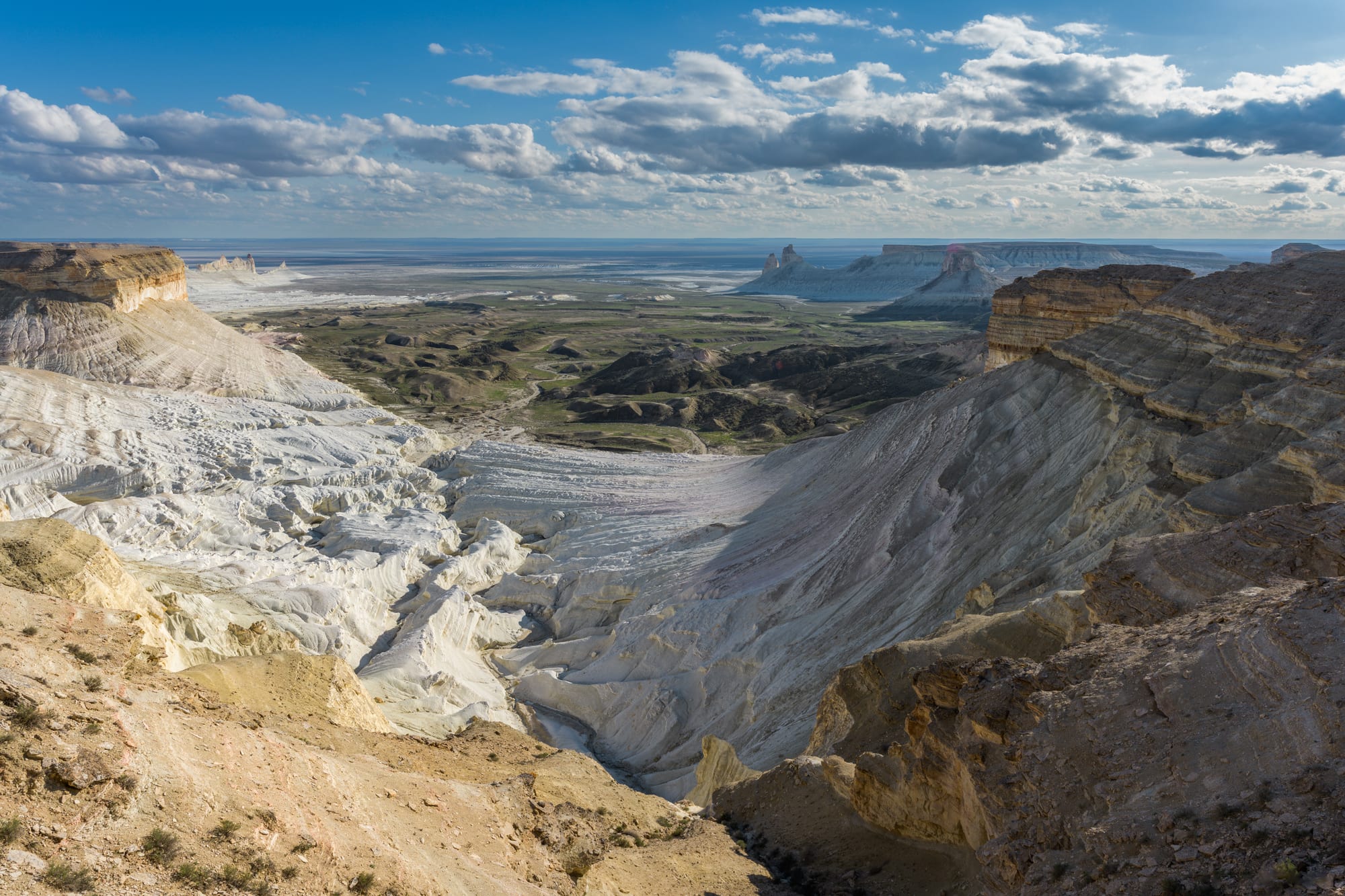
Chalk-white cliffs and free-standing rock pinnacles rising from a flat desert plain, stretching to the horizon under a pale sky

Kazakhstan

The Bozjyra tract in the Mangystau region, where the eroded edge of the Ustyurt Plateau breaks into white chalk pinnacles above the desert. (Максаг79 / Wikimedia Commons · CC BY-SA 4.0)

The world's largest landlocked country — a vast expanse of steppe, desert, and mountains in Central Asia, once nomadic, then a Soviet testing ground, and now an oil-and-minerals state with a purpose-built futuristic capital.

Explore Kazakhstan

History

The Kazakh steppe was the domain of nomadic horse peoples for thousands of years — Scythians, Turkic khanates, and, from the fifteenth century, the Kazakh Khanate, whose people were organised into three "hordes" (zhuz) grazing herds across enormous distances. The Silk Road passed through the southern oasis cities of Otrar, Taraz, and Turkestan.

The Russian Empire absorbed the khanates through the eighteenth and nineteenth centuries, building forts and settling Slavic farmers. Soviet rule brought catastrophe: Stalin's forced collectivisation and settlement of the nomads in the early 1930s caused a famine that killed somewhere between about 1.5 and 2 million Kazakhs — between 38 and 42 per cent of all Kazakhs, the highest proportion of any ethnic group in the Soviet famines of the early 1930s — and made Kazakhs a minority in their own republic for decades. The USSR also used Kazakhstan for the Karlag labour camps, the Semipalatinsk nuclear test site, and the Baikonur Cosmodrome.

Independence came in 1991. Nursultan Nazarbayev, the last Soviet-era leader, ruled for almost three decades, moving the capital in 1997 from Almaty to a new city on the northern steppe, named Astana in 1998, and building an oil-funded authoritarian state. The city was renamed Nur-Sultan in his honour in 2019 and changed back to Astana in 2022. He handed the presidency to Kassym-Jomart Tokayev in 2019 but kept influence until the "Bloody January" protests of 2022, sparked by fuel prices, turned into deadly unrest and led to his removal as head of the Security Council. A new constitution, approved by referendum in March 2026 and in force since 1 July 2026, replaced the two-chamber parliament with a single-chamber Kurultai and brought back the post of vice president.

  • Kazakhstan: The Great Steppe — Two thousand years of nomad horse cultures on the world's largest grassland — the Kazakh Khanate, Russian conquest, a Soviet famine that killed nearly 40 per cent of the Kazakh people, nuclear tests, and an oil-rich independence

Culture & Customs

Kazakh culture descends from the nomadic life of the steppe, still celebrated in the yurt, the horse, hunting with golden eagles, the two-stringed dombra lute, and kymyz, fermented mare's milk. Nauryz, the spring new-year festival, is the biggest holiday, with feasting, games, and the ritual dish nauryz köje.

Society is Muslim by heritage — Sunni, and generally moderate and secular after seventy Soviet years — with a large Russian Orthodox minority in the north and a patchwork of other groups (Ukrainians, Uzbeks, Uyghurs, Germans, Koreans) left by deportations and migrations. Respect for elders, generous hospitality, and the importance of knowing one's ancestry seven generations back are enduring values.

The country presents two faces: cosmopolitan, Russian-speaking Almaty and the show-piece architecture of Astana on one side, and a rural, Kazakh-speaking life of herding and small towns on the other. A national revival since independence has promoted the Kazakh language, history, and the reclaiming of figures like the poet Abai.

  • Kazakhstan: The Guest Sent by God — A Muslim and Orthodox country with nomadic roots, where the young greet the old first, an unexpected visitor is treated as a gift, and the great moments of life are still marked with songs, blessings and a shower of sweets

Daily Life

Almaty, in the far southeast beneath the snow-capped Tian Shan, is the largest city and the cultural and financial centre — tree-lined, café-filled, and framed by mountains. Astana, on the flat northern steppe, is the young capital, a planned city of glass towers, ministries, and monuments that fills with civil servants and empties on weekends. Shymkent in the south is the third city, more Central Asian in feel.

The economy runs on oil and gas from the Caspian region, on uranium (Kazakhstan is the world's largest producer), and on other metals and grain, which has made it the wealthiest of the Central Asian states but left it exposed to commodity prices and to corruption. Much of the population still lives modestly in the regions.

Daily life mixes Soviet-era apartment blocks and stolovaya canteens with new malls and coffee chains, the marshrutka minibus, and, in the countryside, the herding calendar and the move to summer pastures.

  • Kazakhstan: Tea, Family and the Weekend Dacha — A tea bowl refilled all day, three generations often living close at hand, and a country of Soviet-built apartment blocks whose residents still head out to a garden plot every weekend of the growing season

Food

Kazakh cooking is meat-heavy, a legacy of the herding life. The national dish is beshbarmak — "five fingers" — boiled horse or lamb served over wide flat noodles and eaten by hand, with the broth (sorpa) drunk afterwards. Kazy (horsemeat sausage), kuyrdak (fried offal), and baursak (fried dough) are staples of a feast.

Central Asian dishes are everywhere too: plov (rice pilaf), manty (steamed dumplings), lagman (hand-pulled noodles), and samsa baked in a tandoor, reflecting Uzbek, Uyghur, and Dungan influence in the south. Russian salads, soups, and pelmeni are equally normal in the cities.

Kymyz and shubat (fermented camel's milk) are the traditional drinks; tea, usually black with milk, is served constantly; and vodka and Kazakh beer and wine are widely available.

  • Kazakhstan: Food and the National Dish — Boiled meat and wide noodles shared from one large platter, built for a nomadic steppe culture that measured hospitality by how generously a guest was fed

Attractions & Natural Wonders

Almaty is the base for the mountains: the Medeu skating rink and Shymbulak ski resort in a gorge above the city, the alpine meadows of Big Almaty Lake, and, further out, the turquoise Kolsai Lakes and the sunken forest of Lake Kaindy in the Tian Shan foothills. East toward the Chinese border, Charyn Canyon's "Valley of Castles" and the "Singing Dunes" of the Altyn-Emel park are classic day trips.

Astana is a sightseeing curiosity in its own right — the Bayterek tower, the tent-shaped Khan Shatyr mall, the pyramid Palace of Peace, and the sweeping government axis, all built from nothing since the late 1990s. Turkestan, in the south, has the great Timurid mausoleum of Khoja Ahmed Yasawi, a UNESCO site and a major place of Muslim pilgrimage.

For something stranger, the Mangystau region on the Caspian is a desert of chalk-white cliffs, isolated rock formations, and underground mosques, and the dried bed of the Aral Sea around the former fishing port of Aralsk is a monument to Soviet environmental disaster. The Altai mountains in the northeast and the Borovoe lake district add forest and granite scenery to a country better known for its emptiness.

Planning basics

Budget

Kazakhstan is moderately priced. Almaty and Astana have Western-level hotel and restaurant costs at the top end but cheap markets, canteens (stolovaya), and public transport; the regions are inexpensive. Cards are widely accepted in cities; carry cash for rural areas and shared transport.

Daily Budget Midrange
USD 70–150 (mid-range hotel, restaurants, a hired car or tour for the mountains and deserts)
Daily Budget Shoestring
USD 30–55 (hostel or guesthouse, canteen food, buses and trains)

Reaching Charyn Canyon, the Kolsai lakes, or the Mangystau region usually means a hired 4x4 or an organised day trip.

Visa Requirements

Citizens of the EU, the UK, the US, Canada, Australia, and many other countries enter visa-free for up to 30 days at a time, with a cap on the total stay within any 180-day period. Longer stays or work require a visa arranged in advance, and an e-visa is available to some nationalities.

Typical Stay
30 days visa-free for most Western passports

Register with the migration police if staying beyond a set number of days; most hotels do this for you automatically.

Safety

Kazakhstan is generally safe for visitors, with petty theft, taxi overcharging, and occasional bribe-seeking traffic police the main issues. Large protests are rare but the "Bloody January" unrest of 2022 was a serious exception; demonstrations should be avoided.

Source
US Department of State and UK FCDO travel advisories — check for the latest wording.

Use ride-hailing apps rather than hailing cars on the street, keep valuables secure in markets and on trains, and check the situation before travelling near the Chinese border or to the far west.

Source: US Department of State and UK FCDO travel advisories — check for the latest wording.

Climate

Sharply continental, with huge seasonal extremes. Winters are long and bitterly cold, especially on the northern steppe and in Astana (one of the coldest capitals in the world); summers are hot and dry. Spring and autumn are short. The mountains around Almaty are milder and greener.

Steppe
winters to -30°C and below; hot summers around 30–35°C
Almaty And Mountains
milder; deep snow in winter, pleasant summers, alpine at altitude

Transportation

Almaty and Astana have the main airports, with domestic flights linking the regional cities across the great distances. A comfortable, cheap long-distance rail network connects the main cities (Almaty–Astana–Shymkent and beyond). Almaty has a metro, buses, and a bike-share; a hired car or tour is needed for the natural sites.

Trains are the classic way to cross the country; the Almaty–Astana route takes a night in a sleeper.

Best Time to Visit

May to September for the steppe, the canyons, and the deserts, and June to September for hiking and the high mountain lakes. Winter suits skiing at Shymbulak near Almaty and seeing Astana's monumental centre under snow, if you can bear the cold.

Currency

The currency is the Kazakhstani tenge (KZT). It floats and has been volatile at times. ATMs are widespread in cities and larger towns; carry cash in the regions.

Symbol
₸
Currency Code
KZT — Kazakhstani tenge

Language

Kazakh, a Turkic language, is the state language and is being switched from the Cyrillic to the Latin alphabet. Russian is recognised for official use under the 2026 constitution, and it remains dominant in the cities, the north, and business — the 2021 census found more people speak Russian than Kazakh. English is limited outside the tourism trade and younger city dwellers.

English
Limited; growing among the young in Almaty and Astana
Widely Used
Russian
State Language
Kazakh (Turkic)