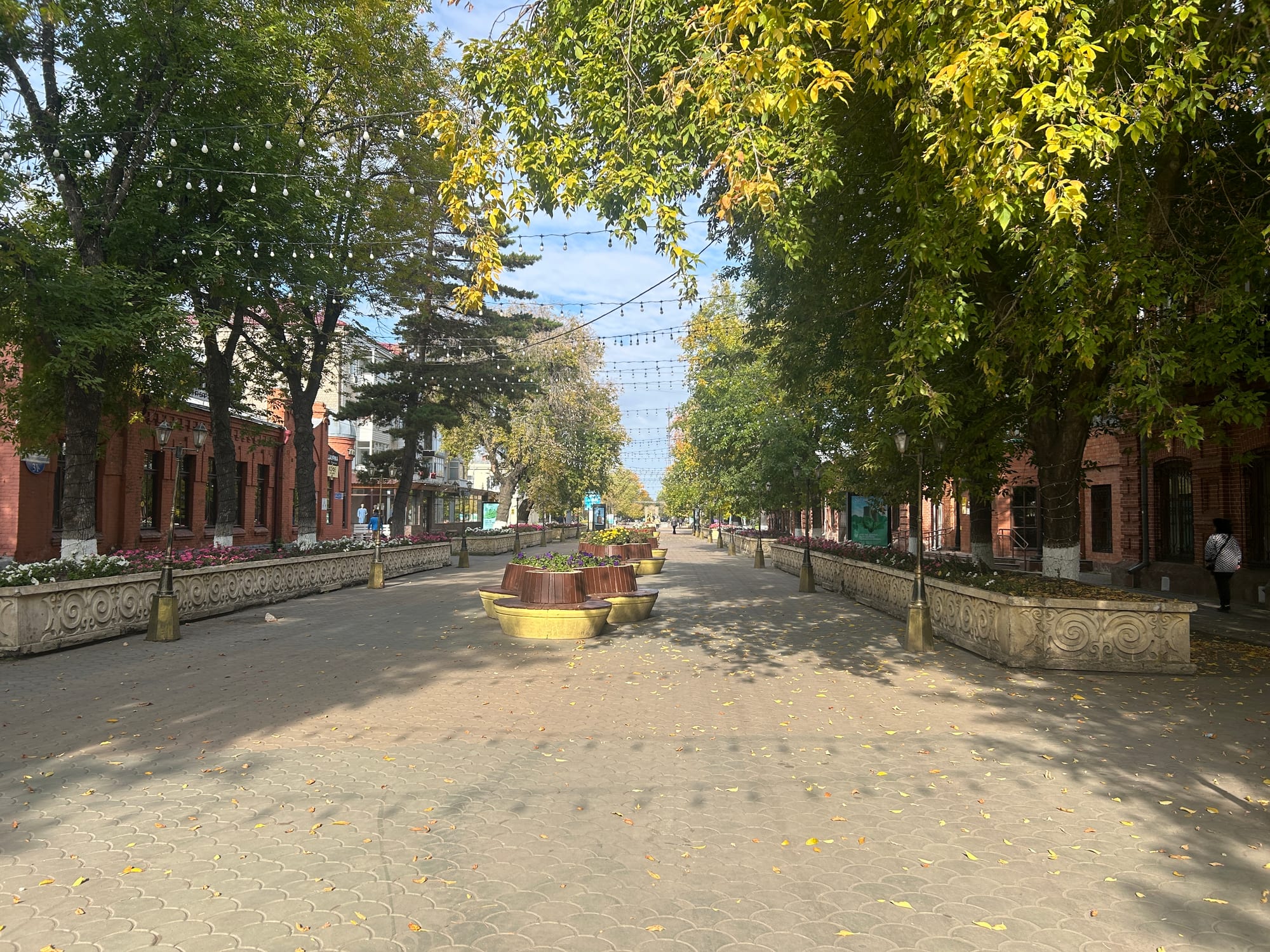
A tree-lined pedestrian street in Petropavl with paved walkway, flower planters, lamps and low brick buildings on both sides

Astana & the North, Kazakhstan

Petropavl

The pedestrian stretch of Constitution Street in central Petropavl in early autumn. (Sofiemama / Wikimedia Commons · CC0)

Kazakhstan's northernmost regional capital, on the Esil river close to the Russian border, founded in 1752 as the fortress of St Peter on the Russian defensive line. Merchant wealth from the Siberian trade left brick and wooden houses in the old centre, and the Trans-Siberian railway still runs through, making it a working northern town rather than a resort.

Neighbourhoods

  • The old merchant centre
    • First-time visitors
    • Historic district
    • Walking

    The blocks around Constitution Street, where the brick trading houses, shops and churches of the 19th-century town survive, partly restored and partly worn. A pedestrian stretch with planters and lamps runs through it, and most of the museums, cafés and hotels are within a few streets.

    Open in Maps
  • The podgora and the river quarters
    • Local life
    • Wooden houses

    Below the bluff towards the Esil lies the older, lower town of single-storey wooden houses with carved window frames, garden plots and unpaved lanes. It floods in some springs and is the part of the city that looks most like the Siberian settlements over the border.

    Open in Maps
  • The Soviet districts and the station
    • Close to public transport
    • Budget stays

    North and west of the centre, apartment estates, factories and the railway station built around the Trans-Siberian line. Trains to Russia, Astana and Almaty call here, and the area around the station has hotels, shops and bus links into the middle of town.

    Open in Maps

Things to do

The old town

  • Constitution Streetneighborhood

    The main street of the historic centre, part of it pedestrianised, lined with the brick premises of 19th-century merchants and now the city's principal place for a walk.

    Open in Maps
  • Merchant houses of the old centrelandmark

    Blocks of ornate brick and timber buildings raised on profits from the Siberian and Central Asian trade, several restored as shops, banks and museums.

    Open in Maps
  • Kyzylzhar fortress sitelandmark

    The high ground above the Esil where the fortress of St Peter was built in 1752, marked by monuments and interpretation rather than surviving walls.

    Open in Maps

Museums and places of worship

  • North Kazakhstan Regional Museum of Local Historymuseum

    The regional museum, covering the steppe's archaeology, including the Botai horse culture, the Cossack line, the merchant town and the Soviet century.

    Open in Maps
  • Magzhan Zhumabayev memorial museummuseum

    A museum devoted to the poet Magzhan Zhumabayev, who studied at a madrasah in the town as a boy, was arrested here and was shot in 1938.

    Open in Maps
  • Orthodox churches of the old centrelandmark

    The Orthodox churches of the merchant town, dedicated to the saints Peter and Paul who gave the fortress and the city their name.

    Open in Maps
  • The city's mosqueslandmark

    Petropavl had nine mosques by the early 20th century, six of them stone and most built by Tatar merchants in the quarter west of the centre; the Muslim population has grown again as Kazakh families have moved in from the district.

    Open in Maps

Parks and the river

  • The Esil embankmentattraction

    Paths and a beach along the river below the old town, used for walking, fishing and swimming in the short summer.

    Open in Maps
  • City parkpark

    The central park of shaded avenues, memorials and fairground rides, a standard evening destination for families.

    Open in Maps

Short trips from the city

  • Botaiattraction

    The archaeological culture of about 3700 to 3100 BC found in this region, whose settlements provide some of the earliest evidence anywhere for the keeping of horses.

    Open in Maps
  • Sergeyevka reservoirattraction

    A large reservoir on the Esil south of the city, used for fishing, boating and summer weekends.

    Open in Maps

Seasonal events

  • Nauryzlate March

    The spring new year is marked with yurts, concerts and nauryz kozhe in the central squares, welcomed in a city where winter has usually not finished.

  • Victory Day9 May

    Processions, wreath-laying and concerts at the war memorials, observed strongly in this Russian-speaking northern city.

  • City Daysummer

    Petropavl marks its founding with street concerts, sports and fireworks.

Eat and drink

Long-standing places and food districts in Petropavl. Hours, ratings and directions come from your maps app, always current.

Petropavl classics

  • Kazakh and Russian restaurants of the centreneighborhood

    Dining rooms around Constitution Street serve beshbarmak and cured horsemeat alongside pelmeni, borscht and cutlets, the standard combination of northern Kazakhstan.

    Open in Maps
  • River fish and northern smoked foodmarket

    Smoked and dried fish from the Esil and the region's lakes is sold at the markets, along with dairy, honey and forest berries from the surrounding district.

    Open in Maps

Markets and cafés

  • The central bazaarmarket

    The city market, with meat and dairy rows, kurt and irimshik, imported fruit, and counters cooking samsa, manty and lagman.

    Open in Maps
  • Cafés on Constitution Streetneighborhood

    Small coffee houses, bakeries and canteens along the pedestrian stretch, busy all year because there is nowhere else to sit in winter.

    Open in Maps

Experience Petropavl

History

The city began as a fortress. In 1752 Russian troops built the fort of St Peter on the high right bank of the Esil, part of the Novo-Ishim defensive line drawn across the northern steppe, and a settlement gathered beneath it. The Kazakh name for the place, Kyzylzhar, "red bank", describes the bluff above the river. Its position between Siberia and the Kazakh steppe made it a trading town: caravans came north with cotton, dried fruit, silk and livestock from Central Asia, and Russian merchants sent grain, metal and manufactured goods south.

The 19th century was the merchants' era. Petropavlovsk, as it was then, became one of the largest trading centres of the region, with a great annual fair, a customs house, mosques serving Tatar traders and brick trading houses along the main streets, many of which still stand. The Trans-Siberian railway reached the town in the mid-1890s and confirmed its importance, adding workshops, depots and a new quarter around the station.

The Soviet century industrialised it. Factories were evacuated here during the Second World War, defence and engineering plants followed, and the Virgin Lands campaign of the 1950s made the surrounding region a grain producer and brought settlers from across the Union. The region also received deportees, and the poet Magzhan Zhumabayev, who had studied in the town as a boy, was among the Kazakh writers who died in the purges. After independence the city lost much of its defence industry and a large share of its Russian and German population to emigration, and it was renamed Petropavl. It has continued to lose residents to Astana and to Russia while remaining the administrative centre of the North Kazakhstan Region.

Culture & Customs

Petropavl is one of the most Russian-speaking of Kazakhstan's regional capitals, where Russians are close to 60 per cent of the population, and the feel of the old centre — brick merchant fronts, carved wooden window frames, Orthodox domes — belongs to the Siberian towns over the border as much as to the steppe. Russians, Ukrainians, Tatars and Germans have lived here for generations alongside Kazakhs, and the mix shows in surnames, cooking and the calendar, where Nauryz, Easter, Victory Day and Kurban Ait are all marked.

Tatar merchants were an important community in the 19th-century town, and their mosques and trading houses are part of its architectural inheritance. The city's proudest literary name is Magzhan Zhumabayev, one of the leading Kazakh poets of the early 20th century, who studied at a madrasah here as a boy, was arrested in the city and was shot in 1938; a museum in the city keeps his memory. The town also remembers Abylai Khan, under whom the fortress became a major point of barter and transit trade between Siberia and the steppe.

Cultural life is small and institutional: a Russian drama theatre, a Kazakh music and drama theatre, the regional museum, a philharmonic and the usual round of school and city concerts. Sport, fishing, hunting and the dacha fill most free time. Manners are northern and direct, and hospitality is taken as an obligation rather than a courtesy: tea and food appear before a guest has sat down, and refusing outright is awkward.

Daily Life

About 220,000 people live in Petropavl, and the number has been falling for years as young residents leave for Astana, Almaty or Russia — the border is close enough that migration in both directions is an ordinary part of family life. The North Kazakhstan Region around it is one of the country's main grain area, and the agricultural cycle, from spring sowing to the late-summer harvest, sets the rhythm of the wider district.

In the city the employers are administration, the railway, food processing, engineering and defence-related plants, hospitals and the universities and colleges. Housing divides between Soviet apartment blocks, newer building near the centre and the wooden private houses of the lower quarters, where water, drainage and spring flooding remain live issues. Heating, road repair and the state of the hospitals are the standing complaints at city meetings.

Winter dominates. Snow lies for roughly five months, schools shut in the worst cold, and life moves between flats, offices, the market halls and a handful of shopping centres. The short summer is used intensively: the river beach, the dachas, fishing on the lakes, mushroom and berry picking, and preserving food for the winter. Cross-border trade with the Russian regions of Omsk and Kurgan shapes prices in the shops, and currency swings on one side of the line are felt immediately on the other.

Food

The northern table is the most Slavic in Kazakhstan. Pelmeni, borscht, shchi, salted cucumbers and tomatoes, sour cream, potatoes with dill and dark rye bread are everyday food, and the grain region means strong baking traditions: pirozhki, belyashi, honey cakes and jam from garden fruit. Fish from the Esil and the lakes of the district is smoked, salted or fried and sold from the markets.

The Kazakh table stands alongside it and appears at every celebration. Beshbarmak — boiled horsemeat or mutton with wide squares of pasta, onion sauce and a bowl of sorpa broth — is the dish that marks a wedding, a naming or the arrival of an important guest. Kazy and shuzhuk, cured horsemeat sausages, and kuyrdak, fried offal with potato, belong to the same repertoire, and autumn brings sogym, the slaughter for winter meat.

Central Asian street food has become ordinary here through internal migration: samsa baked in a tandoor, lagman noodles in spiced meat sauce, manty and plov, sold from small cafés and market counters. Korean salads, above all morkovcha, spiced grated carrot, come from the communities deported to Kazakhstan in the 1930s. Kurt, hard salted balls of dried sour milk, and irimshik, a sweet dried curd, are sold everywhere, including on the station platform, and tea with milk and baursak, fried dough puffs, finishes nearly every meal.

Planning tools

Budget

Petropavl is among the cheapest cities in Kazakhstan for visitors. Hotels are plain and inexpensive, canteens and markets cost very little, and city transport is minimal in price. The main expense for most travellers is getting here, since it is far from the rest of the country.

Daily Budget Midrange
USD 55–100 (mid-range hotel, restaurant meals, taxis, a car for trips into the district)
Daily Budget Shoestring
USD 25–40 (simple hotel or hostel, canteen and market meals, city buses)

Staying in the old centre puts the museums, the pedestrian street and the restaurants within a short walk, which matters a great deal in winter.

Best Time to Visit

June to early September, when the city is green, the river beaches and parks are in use and trips into the lake country are easy. May and September are cool and quiet. Winter is long, dark and severely cold, and the city offers little for a visitor outdoors, though the wooden streets under snow are striking.

Suggested Number of Days

A single day is enough for the old centre, the museums and the river. Two or three suit travellers who add the reservoir, the lake country to the south or a stop on a longer rail journey. Winter cold shortens most visits further.

First Visit
1 day
With Surroundings
2–3 days

Transportation

City buses and inexpensive ride-hailing cover Petropavl, and the historic centre is small enough to walk. The railway station is the practical hub, with taxis and buses running from it into the centre and out to the estates.

Use ride-hailing apps rather than unmarked cars, and allow extra time in snow and ice from November to March.

Airport & Station Connections

Petropavl lies on the Trans-Siberian main line, and trains from Russian cities pass through, alongside services to Astana, Kokshetau and Almaty; part of the route runs through Russian territory, which affects visa and transit requirements. Petropavl International Airport lies about 11 kilometres south of the city, with flights to Astana, Almaty and Shymkent, and the Russian border is only a short drive away, with road crossings towards Omsk and Kurgan. Astana is roughly 430 kilometres south-east.

Walkability

The old centre is compact, flat on top of the bluff and pleasant on foot, with a pedestrian street through the middle of it. The lower river quarters are walkable but have rough surfaces and unpaved lanes, and the Soviet districts are spread out along wide roads. Snow, ice and wind make walking hard for five months of the year.

Safety

A quiet provincial city with low levels of violent crime. Ordinary risks are petty theft in markets and at the station, taxi overcharging and traffic on the wide avenues. The climate is the real hazard: this is one of the coldest cities in Kazakhstan, with frostbite risk, ice underfoot and blizzards that close roads.

Carry serious winter clothing from November to March, be careful with documents and registration rules so close to the border, and do not photograph border posts or military installations. Check current official travel advice before travelling.

Climate

Sharply continental and the coldest of Kazakhstan's regional capitals, with a long snow season, short warm summers and brief, changeable transitions. Spring flooding on the Esil affects the low river quarters in some years.

Summer
warm — usually in the low to mid-20s°C by day in July, with thunderstorms, dust and mosquitoes near the water
Winter
long and very cold — frosts through more than five months, typically well below -10°C by day from December to February, with snow lying 40 to 50 centimetres deep on average and strong winds

Local Customs

Russian is the everyday language of most of the city, and Kazakh is used in official life and increasingly on the street as families move in from the district. Orthodox and Muslim holidays are both observed. Hospitality follows Kazakh form: tea served at once and poured a little at a time, shoes off indoors, elders served first, and guests pressed to eat more than they intend.

Tipping is optional, with about 10 per cent usual in restaurants; alcohol is sold only within set hours, and identity documents should be carried in a border region.

Common Payment Methods

The currency is the Kazakhstani tenge. Cards and phone transfers are accepted in shops, cafés and on buses, and ATMs are easy to find in the centre. Small cash sums remain useful at markets, for taxis and in the villages of the district.