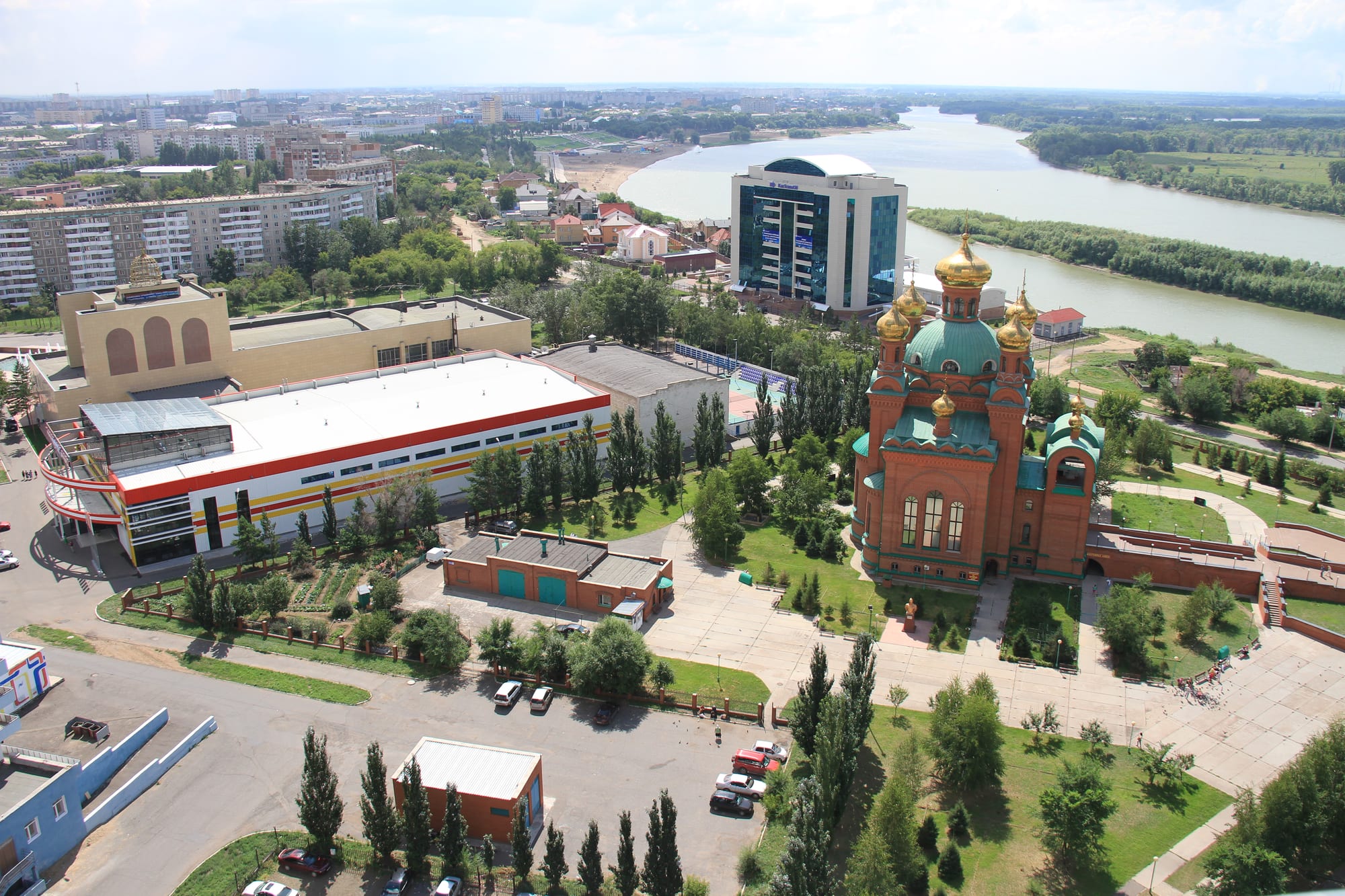
A red-brick cathedral with gold and green domes among trees, with apartment blocks behind and the wide Irtysh river curving past

Astana & the North, Kazakhstan

Pavlodar

The Annunciation Cathedral and the Irtysh river seen over central Pavlodar. (Djenalinov / Wikimedia Commons · CC BY-SA 4.0)

An industrial city of the northern steppe on the right bank of the Irtysh, founded as a Russian Cossack outpost and built up under Soviet rule around aluminium, oil refining and power. Its long riverside embankment, tree-lined Soviet avenues and the blue-domed Mashkhur Jusup mosque give a working city its public face.

Neighbourhoods

  • The central district and the embankment
    • First-time visitors
    • Walking
    • Cafés

    The older heart of the city between Lenin and Toraigyrov streets and the river, with the main square, theatres, museums, shops and the surfaced riverside walk. Most hotels and restaurants are here, and it is the only part of Pavlodar that is comfortably covered on foot.

    Open in Maps
  • Usolsky and the old river quarters
    • Local life
    • Historic streets

    North of the centre along the Irtysh, the low wooden and brick streets of the old settlement survive among newer building. The area keeps small shops, markets and the feel of the pre-Soviet river town.

    Open in Maps
  • The northern industrial districts
    • Industrial landscapes

    The aluminium, chemical and refining plants and their attached housing estates lie several kilometres north of the centre, connected by long straight roads and bus routes. Visitors rarely stay here, but the works define the city's economy and its skyline of chimneys.

    Open in Maps
  • The left bank and the road to Aksu
    • Quiet and residential
    • River beaches

    Across the bridge the country opens out into sandy shores, pine plantations, dachas and village settlements, used by residents for swimming, fishing and weekend houses rather than by visitors for accommodation.

    Open in Maps

Things to do

Landmarks and places of worship

  • Mashkhur Jusup Central Mosquelandmark

    The city's landmark mosque, opened in 2001, with a broad blue dome, four minarets and a plan that reads as a star from above; it is named after the Kazakh scholar and poet Mashhur Zhusup Kopeiuly.

    Open in Maps
  • Annunciation Cathedrallandmark

    The red-brick Orthodox cathedral near the river, with gold and green domes, the main church of a city with a large Slavic population.

    Open in Maps
  • The Irtysh embankmentattraction

    A long paved promenade above the river with steps down to the water, lawns, fountains and viewing points, the centre of outdoor life from May to September.

    Open in Maps

Museums and the arts

  • Pavlodar Regional Museum of Local Historymuseum

    The regional museum, covering steppe archaeology, nomadic life, the Russian settlement of the Irtysh and the Soviet industrial build-up.

    Open in Maps
  • Pavlodar Regional Art Museummuseum

    A collection of Kazakh and Russian painting, graphics and applied art, with changing exhibitions by artists from the region.

    Open in Maps
  • Estai Cultural and Leisure Centreattraction

    The central concert and cultural hall on the embankment, named after the Kazakh composer and singer Estai Berkimbayev, used for concerts and civic events.

    Open in Maps

Parks and the river

  • Irtysh Riverattraction

    One of the great rivers of Asia, flowing north from China through Kazakhstan into Siberia; at Pavlodar it is wide, sandy-shored and used for swimming, fishing and river cruises in summer.

    Open in Maps
  • City park and Victory Parkpark

    Shaded parks in the central district with war memorials, funfair rides and skating paths, a standard part of the evening routine for local families.

    Open in Maps

Short trips from the city

  • Aksuattraction

    A steel and power town on the Irtysh south of Pavlodar, built in the Soviet period around a ferroalloy plant and a large power station.

    Open in Maps
  • Ekibastuzattraction

    A coal town about 130 kilometres from Pavlodar, built around vast open-pit mines and the GRES-1 and GRES-2 power stations that supply electricity across Kazakhstan; the GRES-2 chimney, at 419.7 metres, is the tallest in the world.

    Open in Maps
  • Bayanaul National Parkpark

    Weathered granite hills, pine woods and lakes in the steppe south-west of the city, designated in 1985 as the country's first national park.

    Open in Maps

Seasonal events

  • Nauryzlate March

    The spring new year fills the central square with yurts, concerts and cauldrons of the grain soup nauryz kozhe, the biggest public celebration of the Pavlodar year.

  • Victory Day9 May

    Wreath-laying, veterans' processions and concerts at the war memorials, widely observed in a city with a strong Soviet-era memory.

  • City Daysummer

    Pavlodar marks its founding with concerts, sports events and fireworks along the embankment.

Eat and drink

Long-standing places and food districts in Pavlodar. Hours, ratings and directions come from your maps app, always current.

Pavlodar classics

  • Irtysh river fishmarket

    Smoked, salted and fried river fish is a regional speciality, sold in the markets and cooked in the city's Russian-style restaurants.

    Open in Maps
  • Kazakh national restaurantsneighborhood

    Restaurants in the centre serve beshbarmak, sorpa, kazy and other cured horsemeat, often in large rooms set up for family celebrations.

    Open in Maps

Food districts and markets

  • The central bazaarmarket

    The city market sells kurt, irimshik, honey, dried fruit, melons in season and rows of meat stalls, with cheap counters cooking samsa, lagman and manty.

    Open in Maps
  • Cafés on the embankmentneighborhood

    Summer terraces above the Irtysh serve shashlyk, pelmeni, pizza and beer to a city that spends every warm evening outdoors.

    Open in Maps

Experience Pavlodar

History

Pavlodar began as a Cossack post on the Irtysh. Koryakovsky fort was founded in 1720 as part of the Russian fortified line along the river, set up to control the salt lakes that gave it its early trade, and it grew into a river village handling salt, grain and livestock. In 1861 it was raised to the status of a town and renamed Pavlodar in honour of a newborn Russian grand duke. Steam boats on the Irtysh tied it to Omsk and Semipalatinsk, and merchants built brick houses and warehouses along the bank.

The Soviet period rebuilt the town completely. The Virgin Lands campaign from 1954 made the region a grain producer and brought thousands of settlers, and from the late 1950s Pavlodar was developed as an industrial centre: a tractor works, an aluminium smelter fed by bauxite from the region, an oil refinery supplied by pipeline from Siberia, chemical plants and the coal and power complex at nearby Ekibastuz. The population multiplied several times over as workers arrived from across the Union, and the city was laid out with wide avenues and standard apartment districts.

The region also carries a darker Soviet history: deportees and special settlers were sent to the area in the 1930s and 1940s, and the Semipalatinsk nuclear test site lay to the south-east, its fallout affecting parts of the Irtysh valley. After independence many Russian and German residents emigrated and the population fell, while the industrial base was privatised and partly revived. Pavlodar remains one of Kazakhstan's principal manufacturing cities, with the embankment rebuilt and the mosque and cathedral of the 1990s and 2000s giving the centre a different profile from the Soviet one.

Culture & Customs

Pavlodar is one of the most Russian-speaking cities in Kazakhstan. Russians and Ukrainians remain a large share of the population, and German families, many descended from deportees, were numerous before emigration in the 1990s. Russian is the language of the street and of most schools, though Kazakh is increasingly used in official life, and the city's calendar mixes Nauryz, Orthodox Easter, Victory Day and Kurban Ait without much friction.

The region takes particular pride in two figures from the Bayanaul district to the south-west: Mashkhur-Zhusup Kopeev (1858–1931), the Kazakh poet, historian and collector of oral folklore whose name the central mosque carries, and Kanysh Satbayev, the geologist who became the first president of the Kazakh Academy of Sciences. The poet Pavel Vasilyev, born at Zaysan in 1910, and the writer Sultanmakhmut Toraigyrov, who grew up in Bayanaul and whose name the state university in Pavlodar carries, are also local names, attached to streets, schools and museums.

Cultural life is provincial in scale but steady: a Russian drama theatre, a Kazakh music and drama theatre, the regional philharmonic, art and history museums, and the concert hall on the embankment. Sport matters — football, ice hockey, wrestling and boxing above all — and outside the institutions life revolves around the dacha, the river and the family table. Kazakh custom sets the pattern for hospitality across communities: guests fed at once, elders served first, and large gatherings for weddings, namings and funerals.

Daily Life

About 350,000 people live in Pavlodar, making it one of the larger cities of northern Kazakhstan. The economy remains industrial to a degree unusual even in this region: aluminium, alumina refining, petrochemicals, oil refining, electricity, machine building and food processing, with the plants concentrated in the northern zone and much of the workforce housed in the estates near them. Grain farming and livestock fill the surrounding district.

The centre is where public life happens. Families walk the embankment in the evening, markets open early, students fill the universities and institutes, and the cafés and shopping centres of the middle streets take the strain in the cold months. Housing is mostly Soviet-era blocks, with newer building in the central and southern areas and private houses in the older river quarters.

Two issues recur. One is air and water: emissions from the plants and from coal heating, and the state of the Irtysh, a river shared with China and Russia whose flow is a long-standing concern. The other is population: like the rest of the north, Pavlodar has lost residents to emigration and to internal migration towards Astana and Almaty, and holding on to graduates is a constant local argument. Winter shapes the daily routine for five months, with heating, transport reliability and icy pavements the shared preoccupations.

Food

Pavlodar eats across two traditions at once. From the Kazakh side come beshbarmak, boiled meat served over squares of pasta with onion sauce and a bowl of sorpa broth; kazy and shuzhuk, cured horsemeat sausages, sliced onto cold platters; and kuyrdak, fried offal and potato. Autumn brings sogym, the slaughter of a horse or cow for winter meat, and the cured products that follow it are a matter of family pride.

From the Slavic and German settlers come pelmeni, borscht, cabbage soup, salted and pickled vegetables, sour cream with everything, potatoes and dill, dark rye bread and yeast pastries — the grain belt means good local flour, and baking is taken seriously. The Irtysh supplies the city's own speciality: river fish, smoked, salted or fried, sold at the markets and served in beer halls and restaurants along the embankment.

Everyday eating is shaped by Central Asian street food and by migration from the south. Samsa baked on the walls of a tandoor, lagman noodles in a spiced meat sauce, manty and plov are sold in small cafés across the city, alongside Korean salads, above all morkovcha, spiced grated carrot, from the communities deported here in the 1930s. Kurt, hard salted balls of dried sour milk, and irimshik, a sweet dried curd, are sold at every market counter, and tea with milk, served with baursak, closes nearly every meal.

Planning tools

Budget

Pavlodar is one of the cheaper Kazakh cities. Hotels are modest and inexpensive, canteens and market food cost very little, and buses and ride-hailing are cheap. Costs rise only for visitors who hire a car and driver for the long trips out to Bayanaul or the coal country.

Daily Budget Midrange
USD 60–110 (mid-range hotel, restaurant meals, ride-hailing, an excursion out of the city)
Daily Budget Shoestring
USD 25–45 (simple hotel or hostel, canteen and bazaar meals, city buses)

Hotels in the centre keep a visitor within walking distance of the embankment, the museums and the main restaurants, which saves both time and taxi fares.

Best Time to Visit

June to early September, when the embankment, the river beaches and the parks are in use and trips to Bayanaul are straightforward. May and September are cooler and quieter. Winter is long and severe, and while the city functions normally, very little of it is enjoyable outdoors.

Suggested Number of Days

A day or two covers the centre, the embankment and the museums. Three or four make sense for travellers adding the national park or the industrial towns along the Irtysh. Winter weather and long road distances both stretch the time needed.

First Visit
1–2 days
With Surroundings
3–4 days

Transportation

City buses cover Pavlodar cheaply, and ride-hailing apps are the usual choice for anything awkward. The city is laid out on a wide grid, with the industrial districts several kilometres from the centre, so a journey across town takes a while even without traffic.

Use a ride-hailing app rather than flagging down private cars, and allow extra time in snow, when the long northern roads slow to a crawl.

Airport & Station Connections

Pavlodar International Airport lies about 8 kilometres south-east of the city and has domestic flights to Astana and Almaty and a small number of regional international services. Trains run to Astana, Semey, Ekibastuz and across the Russian border, and long-distance buses and shared taxis serve the northern cities. By road Astana is roughly 450 kilometres away.

Walkability

The central district is pleasant on foot: flat, shaded by trees, with the embankment as a long uninterrupted walk beside the water. Outside it the city becomes a scattering of Soviet estates and industrial zones on wide roads where walking makes little sense. Ice and wind make winter walking difficult from November to March.

Safety

Pavlodar is a generally safe provincial city with low violent crime. Everyday risks are petty theft in markets and on buses, taxi overcharging, heavy traffic on the wide avenues, and above all the climate, which brings frostbite risk and icy pavements in winter. Air quality is poor at times because of the plants and coal-fired heating.

Carry serious winter clothing from November to March, use ride-hailing apps, and do not photograph industrial plants, military sites or the border area. Check current official travel advice before travelling.

Climate

A sharply continental steppe climate with a wide annual range. Winters are long, dry and very cold with hard frosts and wind; summers are short, warm and dusty. Spring and autumn are brief transitions with sudden changes of weather.

Summer
warm to hot — a July average of about 21.5°C with much warmer afternoons, plus dust, thunderstorms and mosquitoes near the river
Winter
long and severe — a January average of about -16°C, with recorded lows near -45°C, strong winds and a frozen river

Local Customs

Russian is the everyday language of most of the city and Kazakh is used alongside it, with Orthodox churches and mosques both busy. Hospitality is taken seriously: tea appears immediately for guests, is poured only part way and refilled often, and shoes come off indoors. Modest dress and a headscarf for women are expected at the mosque, and photography inside churches and mosques should be asked about first.

Tipping is optional, with rounding up or about 10 per cent usual in restaurants; alcohol is sold only within set hours, and drinking in public places is prohibited.

Common Payment Methods

The currency is the Kazakhstani tenge. Card and phone payment is accepted in shops, cafés and on buses, and instant bank transfers by phone number are the local habit. ATMs are plentiful in the centre; small cash amounts remain useful for bazaars, taxis and village stops.