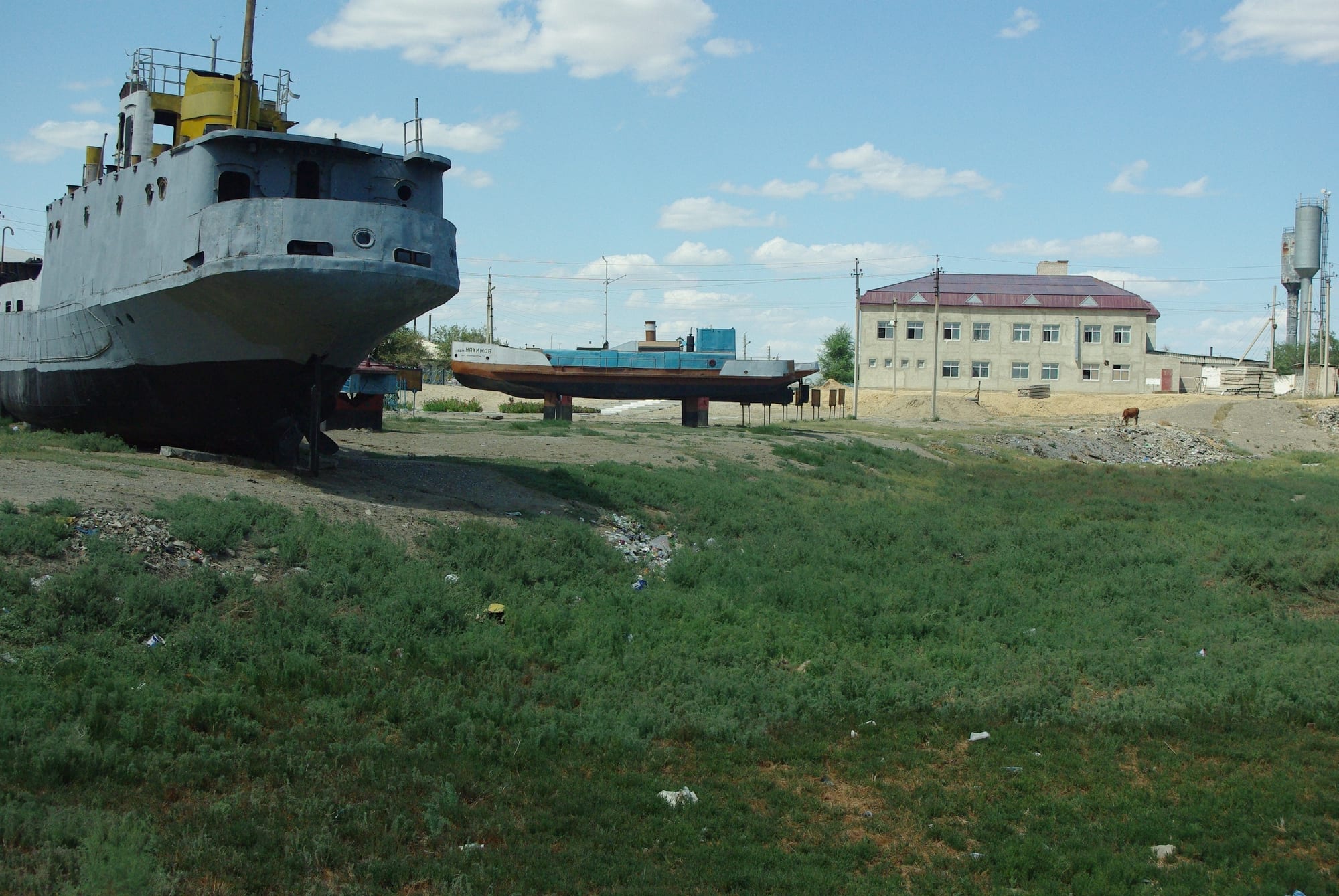
Two old ships propped up on dry grassy ground beside a low building, on what used to be the harbour of Aralsk

Turkistan, Shymkent & the South, Kazakhstan

Aralsk

Ships standing on the dry bed of the former harbour at Aralsk. (Yorian / Wikimedia Commons · CC BY-SA 3.0)

A small town in Kyzylorda Region that was once the chief fishing port of the Aral Sea. Irrigation of the Syr Darya and the Amu Darya emptied the water away from its quays from the 1960s, leaving ships on dry ground, and the Kokaral dam of 2005 has since raised the North Aral Sea and brought fishing back to the district.

Neighbourhoods

  • The station quarter
    • First-time visitors
    • Close to public transport

    The centre of town grew around the railway station on the Orenburg to Tashkent line, and the station building still sets the pace of the day as long-distance trains come and go. Shops, offices and the main hotels of the town are within a few streets of it.

    Open in Maps
  • The old harbour
    • Historic district
    • Photography

    North of the centre the quays, cranes and slipways of the fishing port stand on dry ground, with hulls propped up where the water used to be. The ground between the town and the former shore is now scrub and salt flat.

    Open in Maps
  • The outskirts and the steppe edge
    • Quiet and residential
    • Local life

    Single-storey houses with yards, animal pens and kitchen gardens spread towards the open steppe. Roads out of town lead to the fishing villages of the Aral district and to the new shoreline of the North Aral Sea.

    Open in Maps

Things to do

In the town

  • Aralskneighborhood

    The town itself, whose stranded port, station mosaic and wide empty streets record what the loss of the sea did to a working harbour.

    Open in Maps

Short trips from the town

  • North Aral Seaattraction

    The northern remnant of the Aral Sea, refilled and made less salty since the dam was built, and fished again from villages on its shore.

    Open in Maps
  • Kokarallandmark

    The former island, joined to the land as the sea shrank and now separating the northern and southern basins, carrying the earth dam completed in 2005 that keeps the river's water in the north.

    Open in Maps
  • Syr Daryaattraction

    The river that fed the Aral Sea, reaching its delta south-east of the town after crossing the whole of southern Kazakhstan.

    Open in Maps
  • Aral Seaattraction

    What remains of the lake that was once among the largest in the world, and the salt flats of its exposed bed.

    Open in Maps

Seasonal events

  • Nauryzlate March

    The spring new year, marked across Kazakhstan with nauryz köje, swings, wrestling and music in the town's main square.

  • Kurban Aitvaries with the Islamic calendar

    The feast of sacrifice, a public holiday spent visiting relatives and sharing meat, widely kept in this strongly Kazakh and Muslim district.

Eat and drink

Long-standing places and food districts in Aralsk. Hours, ratings and directions come from your maps app, always current.

Aralsk classics

  • The town bazaarmarket

    The covered and open stalls where fish from the North Aral Sea is sold smoked and dried beside flour, melons, rice from the Syr Darya and dried curd.

    Open in Maps
  • Canteens near the stationneighborhood

    Simple canteens and cafés serving soups, plov, lagman and tea to rail passengers and drivers; fried or baked fish appears when the catch is in.

    Open in Maps
  • Aral district fishneighborhood

    Flounder, pike-perch and carp from the northern sea and the river are the local speciality, usually fried, baked or smoked rather than dressed up.

    Open in Maps

Experience Aralsk

History

Aralsk owes its existence to the railway. The Orenburg to Tashkent line was built between 1899 and 1905, the station opened in 1905, and in the same year Russian merchants organised fishing companies in the settlement at the head of a sheltered bay. Shipbuilding yards followed, and the place grew into the chief port of the Aral Sea and a major supplier of fish to the surrounding region.

After the revolution the station settlement took the name Aralsk, and in 1938 it became a town and the centre of its district within the newly formed Kzyl-Orda oblast. Through the Soviet decades the fleet, the yards and the trade in fish supported the town, and the catch went out by rail to the cities.

From the 1960s the rivers that fed the sea, the Syr Darya and the Amu Darya, were diverted on a huge scale to irrigate cotton and rice. The sea fell, the water grew saltier, the commercial fish died out and by the 1980s the shoreline had retreated far beyond the quays. Vessels were abandoned where they sat, the port closed, and much of the population left. Relief came with the Kokaral dam, completed in 2005, which holds the Syr Darya's flow in the northern basin: the North Aral Sea has risen, its salinity has fallen, fish have returned and the water has moved back to within about 12 kilometres of the town, against roughly 100 kilometres before the dam was built.

Culture & Customs

Aralsk thinks of itself as a fishing town even in the years when there was almost nothing to catch, and the memory of the sea shapes local identity more than anything else. Older residents describe a childhood of boats, ice and gulls in a place that is now steppe, and the return of fish to the northern basin is discussed with a mixture of pride and caution. The town has appeared repeatedly in documentary films and photography about the Aral Sea, and visitors asking about the disaster are received matter-of-factly rather than as a novelty.

The district is strongly Kazakh-speaking, with Russian used less than in the north of the country. Customs of hospitality are kept firmly: a guest is fed before being questioned, tea is poured in small bowls and refilled constantly, and elders are deferred to in seating, speech and the sharing of meat. Islam is part of ordinary life, observed without display, and family events — weddings, the naming of children, memorial meals — are the main social occasions.

Music and oral tradition belong to the wider Syr Darya country, the land associated with Korkyt Ata, the legendary sage credited with the kobyz, whose memorial stands on the steppe further up the river. Nauryz in March is the year's great celebration, with swings, wrestling, horse games and cauldrons of nauryz köje in the square.

Daily Life

About 30,000 people live in Aralsk, which is the administrative centre of the Aral district of Kyzylorda Region. The population fell heavily in the late Soviet and early independence years as the fishery collapsed, and the town has not regained its former size. Work is found in local government, schools and the hospital, in the railway, in trade at the bazaar, and increasingly again in fishing and fish processing in the villages nearer the water.

Housing is mostly low: Soviet apartment blocks of a few storeys near the centre, and beyond them single-storey houses with yards where families keep a cow, sheep or chickens and grow vegetables through the short season. Water quality, dust and the health effects of the dry seabed have been long-standing grievances, and piped water and heating are recurring subjects of complaint.

The day starts early and pauses through the worst of the afternoon heat in summer. Trains arriving at the station are small events, drawing taxi drivers and traders. Many younger residents leave for Kyzylorda, Aktobe or the oil towns of the west and return for holidays, and money sent home matters to a good number of households. Talk in the town turns often to how far the water has come back and whether a second dam will be built to bring it further.

Food

Fish is the point of local pride. Flounder, introduced to survive the saltier water, along with pike-perch, carp, bream and catfish from the northern sea and the Syr Darya, is fried, baked, dried or smoked, and dried fish sold in strips at the bazaar is a standard gift to take away. Fish soup and fish baked whole with onions and tomato appear on tables and in the town's cafés when the catch is good.

The rest is steppe cooking. Beshbarmak — boiled mutton or horse meat with broad sheets of pasta and onion broth — is the dish for guests and celebrations. Plov, lagman noodles, manty dumplings and samsa baked in a tandoor fill the canteens, and kuyrdak, offal fried with onion, is everyday food. Rice grown along the lower Syr Darya around Kyzylorda is the local grain, and melons and watermelons arrive in late summer.

Dairy and bread accompany everything: baursak, small pieces of fried dough, kurt, hard balls of dried salted curd, and in the camel-herding country around the town shubat, fermented camel's milk, which is drunk both as refreshment and as a health remedy. Tea, black and with milk, is poured all day, and the bowl is filled only part way so that it can be refreshed often.

Planning tools

Budget

Aralsk is inexpensive. Accommodation is limited to small hotels and guesthouses, and food comes from canteens and the bazaar. The real cost is transport: reaching the ship graveyards, the new shoreline and the Kokaral dam means hiring a car and driver for the day, and prices rise when fuel is dear.

Daily Budget Midrange
USD 60–110 (small hotel, restaurant meals, a driver for the day to the sea and the dam)
Daily Budget Shoestring
USD 25–45 (guesthouse bed, canteen meals, shared taxis and trains)

Arrange a driver through the guesthouse a day ahead; there is no scheduled transport to the old seabed or the dam.

Best Time to Visit

April to early June and September to October. Spring greens the steppe briefly and the air is clear; autumn is mild and the fishing season is in full swing. Summer brings desert heat, dust and salt-laden wind off the old seabed, and winter on this open plain is cold and bleak, although the frozen sea has its own appeal.

Suggested Number of Days

A day covers the town on foot. Two or three allow a long drive out to the old seabed, the fishing villages and the dam, and an overnight stay by the water. Road conditions and the availability of a driver change the number more than anything else.

First Visit
1 day
With Surroundings
2–3 days

Transportation

There is no public transport worth the name inside the town, which is small enough to walk. Shared taxis leave from around the bazaar and the station for Kyzylorda and nearby villages, and everything beyond the tarmac is done by hired 4x4 with a local driver, often over sand and salt.

Agree the route and the price with a driver before setting off, and carry water and a spare fuel supply for trips onto the old seabed.

Airport & Station Connections

The town is on the main railway between Kyzylorda and Aktobe, part of the line from Tashkent towards Russia, and trains are the usual way in; the journey from Kyzylorda takes several hours. A road runs alongside the railway for drivers and shared taxis. The nearest airports are at Kyzylorda, a few hundred kilometres to the south-east, and Aktobe to the north-west.

Walkability

The centre is flat and easily walked end to end, from the station to the bazaar and out to the old harbour. Pavements are patchy and there is little shade, so summer walking is best early or late, and wind off the dry seabed can carry dust and salt at any season.

Safety

The town is quiet and hospitable, and crime against visitors is rare. The hazards are environmental and logistical: extreme summer heat, salt and dust in the air, long distances between settlements, and stretches of the old seabed with no water, fuel or reliable mobile signal.

Travel onto the seabed with a local driver rather than alone, carry more water than seems necessary, and dress modestly in this conservative district. Check current official travel advice before travelling.

Climate

A harsh desert and steppe climate with a very wide annual range, strong winds and little rain. The shrinking of the sea removed much of the moderating effect the water once had, so summers are hotter and winters colder than they were within living memory.

Summer
hot and dry, often 30–35°C and sometimes higher, with dust and salt carried on the wind
Winter
cold, with temperatures frequently below -10°C, little snow cover and a biting wind

Local Customs

This is a strongly Kazakh-speaking and Muslim district where custom is taken seriously. Elders are greeted first and served first, tea is poured for guests continuously and refusing food outright can offend. Shoes come off indoors. Modest clothing is expected, particularly at mosques and cemeteries, and photographing people or their houses calls for asking first.

Tipping is not usual; rounding up a taxi fare is enough. Alcohol is sold but drunk discreetly here, and men and women may be seated separately at a family meal.

Common Payment Methods

The currency is the Kazakhstani tenge. Cards and Kazakhstan's mobile payment apps work in larger shops and at the station, but the bazaar, village stalls and drivers deal in cash. Cash machines exist in the town centre but can be empty, so draw money in Kyzylorda or Aktobe before arriving.