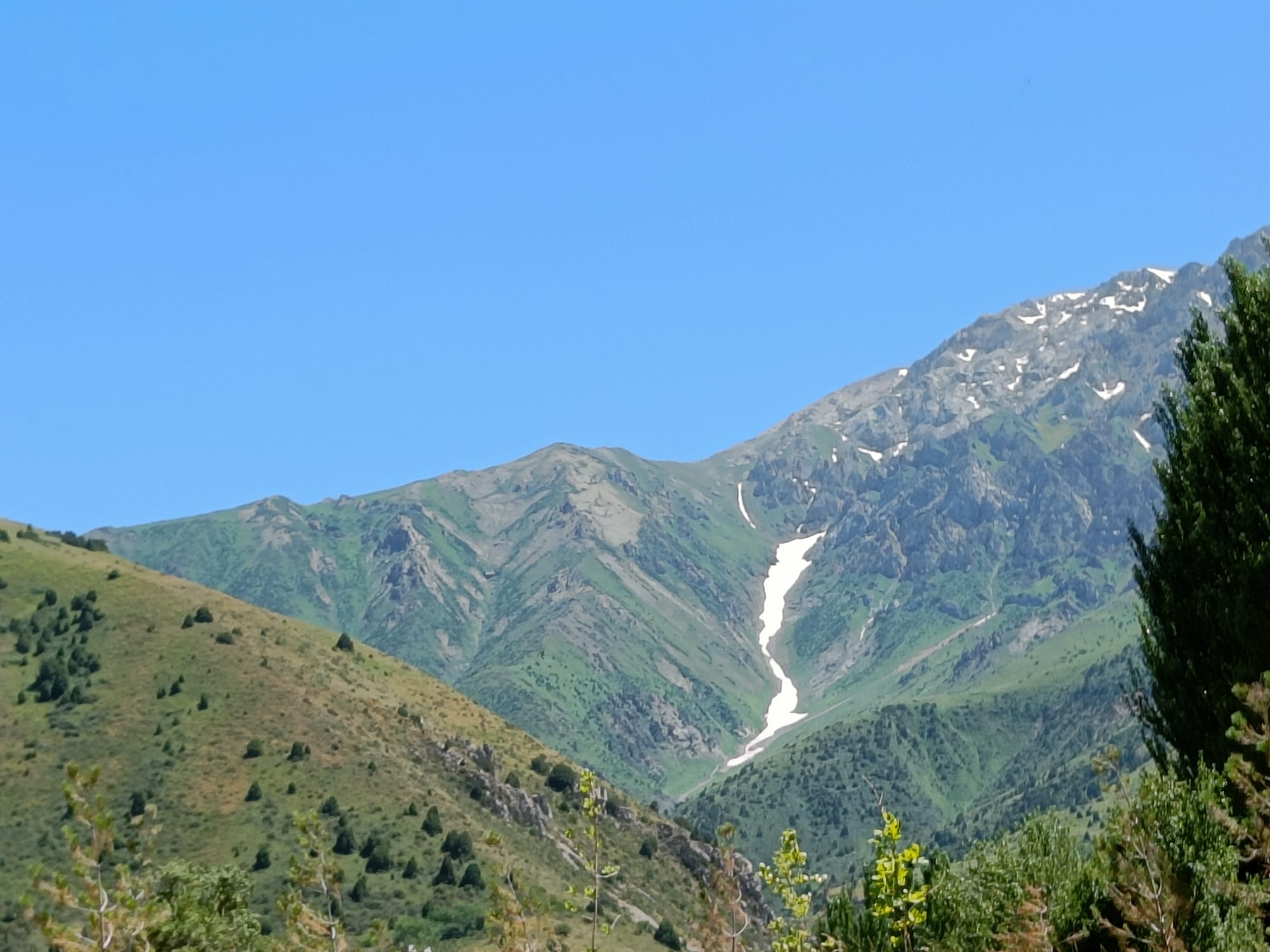
Green mountain slopes dotted with juniper rising to a rocky ridge with patches of snow under a clear blue sky

Kazakhstan

Turkistan, Shymkent & the South

Mountains of the Aksu-Zhabagly Nature Reserve in the Western Tien Shan, Turkistan Region. (Jack Bartovsky / Wikimedia Commons · CC BY-SA 4.0)

The hot, irrigated south of Kazakhstan along the Syr Darya, from the foothills of the Western Tian Shan around Shymkent through the pilgrimage city of Turkistan to Kyzylorda, the Baikonur Cosmodrome and the shrunken Aral Sea — the most Kazakh-speaking and devout part of the country, and its oldest urban land.

Explore Turkistan, Shymkent & the South

History

The Syr Darya valley has been farmed and fought over for more than two thousand years. Oasis towns grew along the river and the foothills, among them Otrar, Sauran, Sayram and Yasi, the future Turkistan, and they flourished as Silk Road stations between the settled world of Transoxiana and the nomads of the steppe. The philosopher al-Farabi is traditionally said to have been born near Otrar in the 9th century.

Otrar's governor made the region's most fateful decision in 1218, when he seized a Mongol-sponsored trade caravan and had its merchants killed. Genghis Khan's revenge began with the siege of Otrar in 1219 and swept across Central Asia. The towns recovered under the Timurids: in the 1380s and 1390s Timur ordered a grand mausoleum at Yasi over the grave of Khoja Ahmed Yasawi, the Sufi poet who had died there in the 12th century, and in 1405 Timur himself died at Otrar at the start of a campaign against China.

From the 16th century Turkistan served as the chief city of the Kazakh khans, and many were buried around Yasawi's shrine, Abylai Khan among them. The region passed to the Khanate of Kokand in the early 19th century and to Russia in the 1850s and 1860s; Kyzylorda, then called Perovsk, grew around a captured Kokand fort and was briefly the capital of Soviet Kazakhstan in the 1920s. In 1955 the Soviet Union began building the Baikonur Cosmodrome on the Kyzylorda steppe, from which Sputnik and Yuri Gagarin were launched, while Soviet irrigation of cotton and rice drained the rivers that fed the Aral Sea. In 2018 Shymkent became a city of national significance and Turkistan replaced it as the regional capital.

Culture & Customs

The south is the heartland of Kazakh language and tradition. Kazakh dominates in the streets as well as the villages, families are large, and customs of respect for elders, matchmaking and lavish weddings are kept more strictly than in the north. Islam is more visible too: mosques are well attended, and the Yasawi mausoleum is Kazakhstan's foremost pilgrimage site, visited by pilgrims from across the country and from Turkey and elsewhere in the Turkic world. Tradition holds that pilgrims should first visit the tomb of Arystan Bab, Yasawi's teacher, near Otrar.

The region also has a large Uzbek community, especially in Shymkent, Sayram and the districts along the Uzbek border, and the architecture, markets and cooking show strong Uzbek influence. Shymkent people have a reputation within Kazakhstan for directness, trading instinct and a love of celebrations.

Kyzylorda Region is proud of Korkyt Ata, the legendary sage and musician credited with inventing the kobyz, a two-stringed bowed instrument, and a monument to him stands on the steppe near the Syr Darya. Nauryz in March is celebrated here with swings, horse games, music and pots of nauryz köje.

Daily Life

Shymkent, with more than a million people, is the region's metropolis and Kazakhstan's third-largest city: a commercial town of wholesale bazaars, oil refining, food processing and construction, still growing fast from migration out of the villages. Kyzylorda has around 300,000 people, and Turkistan, much smaller, has been rebuilt since 2018 with new government buildings, hotels and a tourist quarter around the shrine.

Irrigation shapes the countryside. Cotton, melons and vegetables are grown in the Maktaaral district on the Uzbek border, and rice along the Syr Darya around Kyzylorda. Kyzylorda Region also has oilfields and uranium mines, and the town of Baikonur, leased to Russia, lives from the cosmodrome.

The pace of life is set by the heat: early starts, a long break in the middle of the day, and evenings outdoors in parks and teahouses. Around Aralsk, the drying of the Aral Sea left fishing villages kilometres from the water; the Kokaral dam, completed in 2005, has raised the level of the northern part of the sea and brought back some fishing.

Food

Southern cooking is closer to Uzbek food than anywhere else in Kazakhstan. Plov, rice fried and steamed with carrot, onion and mutton in a large kazan, is the dish of celebrations, and Shymkent is known for its samsa, meat pastries baked on the walls of a clay tandoor, and for shashlyk grilled on every corner. Lagman noodles, manty dumplings and flat round lepyoshka bread from the tandoor fill the bazaars, and beshbarmak remains the dish for honoured guests.

The irrigated farms supply the region's pride: sweet melons and watermelons in late summer, grapes, apricots and tomatoes, and rice from Kyzylorda. On the Kyzylorda steppe, camel herding gives shubat, fermented camel's milk, a regional staple, and fish from the northern Aral Sea is sold smoked and dried in Aralsk.

Green tea is more common here than elsewhere in the country, drunk plain from small bowls, though black tea with milk is also everywhere. Shymkent has its own large brewery, and kymyz and ayran are sold in summer.

Attractions & Natural Wonders

Turkistan is the centre of any visit. The mausoleum of Khoja Ahmed Yasawi, a UNESCO World Heritage Site, is a massive Timurid building with a turquoise ribbed dome, tiled walls and an unfinished main portal; inside are the tomb, a vast bronze cauldron and the graves of Kazakh khans. The small mausoleum of Rabiga Sultan Begim and a stretch of the old citadel walls stand nearby. North-west of the city the walls of Sauran, a medieval town, rise from the steppe.

South of Turkistan, the mound of Otrar, excavated in parts to show streets, baths and a mosque, sits in open farmland near the Arystan Bab mausoleum. Shymkent has its bazaars, the Independence Park and museums, and ancient Sayram, one of the oldest settlements in the region, lies just outside the city. In the mountains to the east, the Aksu-Zhabagly Nature Reserve, part of the UNESCO-listed Western Tien Shan, has the deep Aksu canyon, alpine meadows and spring tulips.

Kyzylorda Region fills the west. The Baikonur steppe around Kyzylorda holds the cosmodrome, where arranged tours visit the launch pads and museum, and the Korkyt Ata memorial. On the northern Aral shore, Aralsk was once a fishing port, and rusting ships lie stranded on the old seabed nearby.

Cities in Turkistan, Shymkent & the South

Planning basics

Budget

The south is one of the cheapest parts of Kazakhstan. Shymkent and Kyzylorda have inexpensive hotels, canteens and bazaars, and Turkistan's guesthouses are modest, though the new hotels built around the Yasawi complex charge more. The main extra costs are a driver for Otrar and Sauran and, above all, an organised tour with permits for Baikonur.

Daily Budget Midrange
USD 65–130 (mid-range hotel, restaurants, a driver for the Silk Road sites)
Daily Budget Shoestring
USD 25–45 (guesthouse or simple hotel, bazaar and canteen food, buses and trains)

Visits to Baikonur must be arranged well in advance through a specialist agency; turning up independently is not possible.

Safety

The south is generally safe and hospitable. The main risks are heat exhaustion at the exposed ruins in summer, road safety on busy highways, and petty theft in Shymkent's crowded bazaars. The Baikonur area is a restricted zone, and parts of the border with Uzbekistan are sensitive.

Carry water and sun protection at the ruins, dress modestly at shrines, and do not approach Baikonur without an arranged permit. Check current official travel advice before travelling.

Climate

The hottest and driest region of the country. Summers along the Syr Darya are long and fierce, with desert heat around Kyzylorda and the Aral Sea, while Shymkent and the mountain foothills are a little cooler and greener. Winters are short and mild in Shymkent but cold and windy on the open plains of Kyzylorda Region.

Summer
very hot and dry, often 35–40°C in Turkistan and Kyzylorda; cooler in the mountains of Aksu-Zhabagly
Winter
mild in Shymkent, around 0°C with little snow; colder in Kyzylorda, often -10°C or below

Transportation

Shymkent, Turkistan and Kyzylorda have airports with domestic flights, and the main railway from Almaty runs west through Shymkent and Turkistan to Kyzylorda and Aralsk on the way to Russia. Turkistan is about two to three hours from Shymkent by road or rail. Otrar and Sauran are reached by taxi or driver from Turkistan, and Aksu-Zhabagly by road from Shymkent.

Hire a driver for a day from Turkistan to combine Sauran, Otrar and the Arystan Bab mausoleum.

Best Time to Visit

April to early June and September to October. Spring brings tulips and green hills in Aksu-Zhabagly and bearable heat at the Silk Road ruins; Nauryz in late March is celebrated with particular energy in the south. Autumn is harvest season for melons and cotton. July and August are extremely hot at Turkistan, Otrar and Kyzylorda.