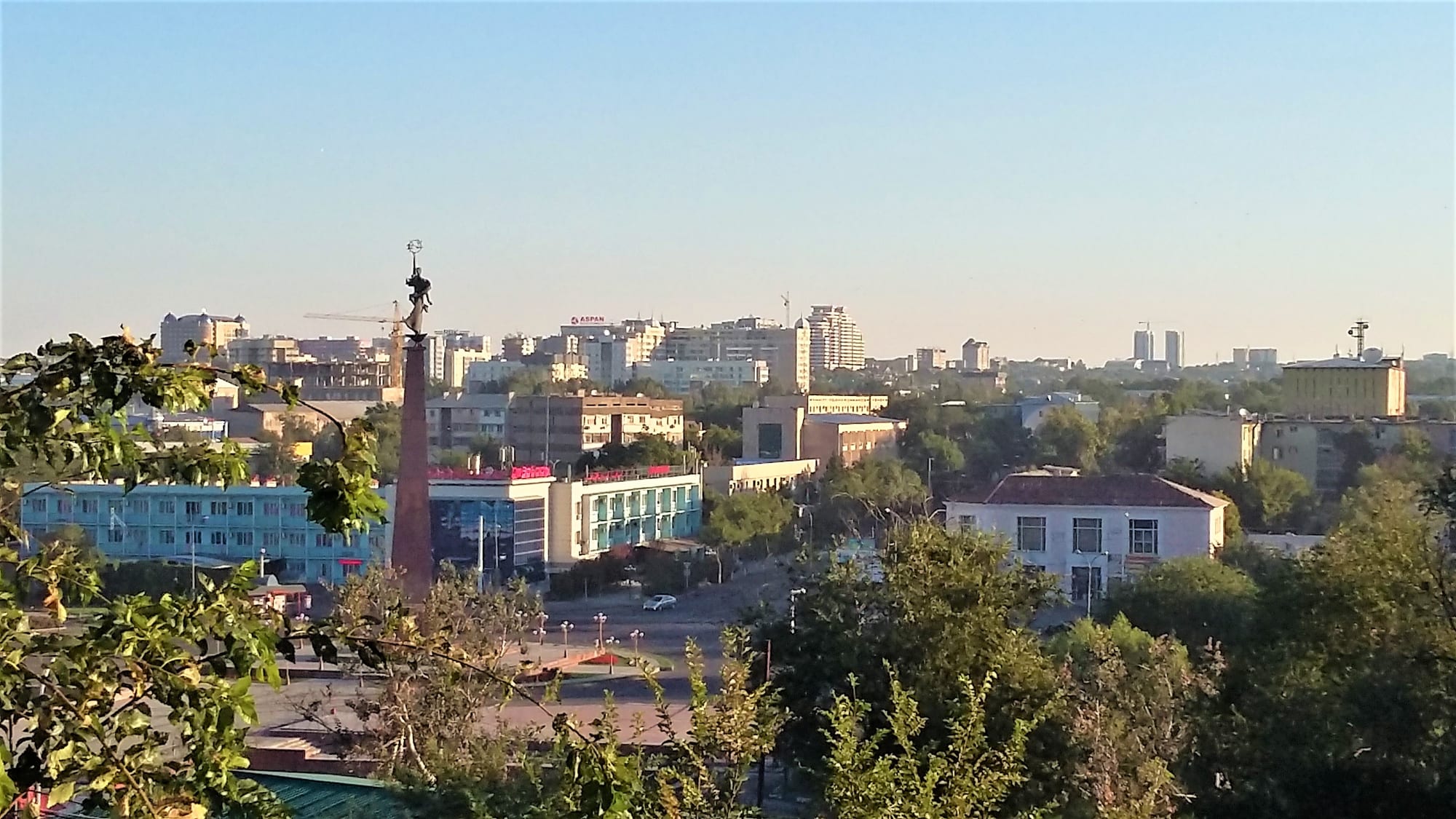
A view over the low green centre of a city, with a tall monument column, blocks of flats and towers rising among trees under a clear sky

Turkistan, Shymkent & the South, Kazakhstan

Shymkent

The centre of Shymkent seen over the trees, with a monument column rising above a square. (Rassim / Wikimedia Commons · CC BY-SA 3.0)

Kazakhstan's third-largest city, in the warm, irrigated south between the foothills of the Western Tian Shan and the Uzbek border. Grown from a caravan town on the road between the steppe and Transoxiana, it is now a sprawling commercial city of wholesale bazaars, refineries, parks and teahouses, with a reconstructed old citadel quarter and a reputation for trade and celebration.

Neighbourhoods

  • The centre
    • First-time visitors
    • Parks
    • Close to public transport

    The area around the main squares, the independence monument and the long avenues of shops, offices and restaurants. Most hotels, museums and theatres are here, and the big central parks give shade in summer.

    Open in Maps
  • The old citadel quarter
    • Historic district
    • Walks and viewpoints

    The hill above the Koshkar-Ata stream where the original fortified town stood, excavated and rebuilt with walls, gates and an open museum area, with parkland running down to the water below.

    Open in Maps
  • The bazaar district
    • Best for food
    • Shopping
    • Local life

    The dense trading quarter around the main markets, where wholesale halls, covered rows, food stalls and workshops run into one another. It is crowded, loud and the best place in the city to eat cheaply.

    Open in Maps
  • Nursat and the northern districts
    • Quiet and residential
    • Families

    Newer estates of flats and houses spreading north of the centre, with schools, malls and cafés and little for visitors. This is where much of the city's middle class lives.

    Open in Maps
  • The industrial south and the airport side
    • Close to transport

    The refinery, warehouses, wholesale depots and workers' districts out towards the main highway and the airport, functional and mainly of interest for arriving and leaving.

    Open in Maps
  • Sayram
    • Historic monuments
    • Local life

    An ancient settlement just east of the city, now effectively a suburb, with old mausoleums, a minaret and a more traditional, largely Uzbek way of life than central Shymkent.

    Open in Maps

Things to do

Parks and city sights

  • Independence Parkpark

    A large central park of avenues, fountains and monuments laid out for the anniversary of independence, and the usual place for an evening walk.

    Open in Maps
  • Shymkent Zooattraction

    One of the largest and oldest zoos in the country, covering more than fifty hectares of parkland outside the centre.

    Open in Maps

Historic places nearby

  • Sayramneighborhood

    One of the oldest settlements in the region, just east of the city, with medieval mausoleums, a minaret and a largely Uzbek population.

    Open in Maps
  • Otrarlandmark

    The excavated mound of the Silk Road city sacked by Genghis Khan's armies after its governor seized a Mongol caravan in 1218.

    Open in Maps

Mountains and reserves

  • Aksu-Zhabagly Nature Reservepark

    A reserve in the Talas Alatau known for its deep Aksu canyon, alpine meadows and wild tulips in spring, part of the UNESCO-listed Western Tien Shan.

    Open in Maps
  • Sayram-Ugam National Parkpark

    A national park in the western Tian Shan on the Uzbek border, taking in the Ugam Range, known for its juniper forest, gorges and high pasture.

    Open in Maps
  • Ugam Rangeviewpoint

    The mountain wall on the Uzbek border, snow-covered into early summer and visible from the city on clear days.

    Open in Maps

Seasonal events

  • Nauryzlate March

    The spring new year, celebrated in the south on a large scale, with yurts and stages in the parks, horse games, concerts and nauryz köje.

  • Kurban Aitvaries with the Islamic calendar

    The feast of sacrifice, marked with full mosques, family visiting and the sharing of meat with neighbours and relatives.

  • Ramadanvaries with the Islamic calendar

    The fasting month, widely kept in this traditionally observant city, with restaurants and families gathering for the evening meal after sunset.

Eat and drink

Long-standing places and food districts in Shymkent. Hours, ratings and directions come from your maps app, always current.

Bazaars and street food

  • The city bazaarsmarket

    Shymkent's markets are among the biggest in the country: melons, grapes and apricots in season, rice, spices, nuts and dried fruit, horsemeat and dairy, with cooks frying and baking along the aisles.

    Open in Maps
  • Tandoor bakeries and samsa stallsmarket

    Clay ovens across the city bake flat lepyoshka loaves and the meat-filled samsa for which Shymkent is known throughout Kazakhstan.

    Open in Maps

Shymkent classics

  • Plov and shashlyk housesrestaurant

    Southern plov cooked in a large kazan and mutton grilled over charcoal, served in plain canteens and in big family restaurants alike.

    Open in Maps
  • Teahouses and beer gardensrestaurant

    Shaded teahouses with raised platforms for eating and the open-air tables of the city's brewery culture, both busy through the long warm evenings.

    Open in Maps
  • Restaurants in Sayramneighborhood

    The suburb east of the city keeps a strongly Uzbek kitchen, with plov, samsa and bread baked in tandoors along its main streets.

    Open in Maps

Experience Shymkent

History

Shymkent grew where the caravan road between the steppe and the cities of Transoxiana crossed the well-watered foothills, and a fortified town existed on the hill above the Koshkar-Ata by the medieval period. Nearby Sayram, far older, was the larger place for centuries and the birthplace of Khoja Ahmed Yasawi, so early Shymkent lived partly in its shadow as a market and staging point for traders moving between Tashkent, Turkistan and the pastures to the north.

The town changed hands repeatedly. It was fought over by the Kazakh khans, the emirs of Bukhara and the Khanate of Kokand, which held it in the early 19th century, and Russian forces took it in 1864 during their advance into Central Asia. Under Russian rule it became Chimkent, a provincial town known for its gardens and its bazaar, renamed Chernyaev in 1914 and Chimkent again in 1924. The railway tied it into the wider Turkestan economy, and the city later became a junction on the Turkestan–Siberia line.

Soviet industrialisation transformed it: a lead smelter, chemical plants, a cement works, textile mills and, later, an oil refinery, with workers arriving from across the union and from the surrounding villages. The city's name was respelled Shymkent in 1993 and it grew very quickly as rural families moved in. In 2018 it was separated from the surrounding province and made a city of republican significance alongside Astana and Almaty, with Turkistan taking over as regional capital, and in the following years the old citadel hill was excavated and rebuilt as a historic quarter.

Culture & Customs

Shymkent has a strong and self-aware local character. People here are known across Kazakhstan for directness, a trading instinct, loyalty to family and neighbourhood, and a love of celebration: weddings and toi feasts run to hundreds of guests and are a serious social obligation. Jokes about the city's swagger are traded in both directions, and residents enjoy them.

It is the most Uzbek-influenced of Kazakhstan's big cities. Sayram and the districts towards the border have long-established Uzbek communities, and their architecture, courtyard houses, tandoor bread and cooking have shaped the city's everyday life. Kazakh is the main language of the streets, more so than in Almaty, and Islam is practised openly, with well-attended mosques and a high observance of Ramadan and the two Eids, alongside older steppe customs of hospitality and respect for elders.

Life is lived outdoors for much of the year. Teahouses with raised platforms, shaded courtyards, parks and roadside grills fill up through the long evenings, and the city's own brewery culture and its beer gardens are part of the summer routine. Football, wrestling and boxing draw local passion, and Shymkent has produced well-known fighters. The rebuilt citadel quarter, the markets and the parks are where the city shows itself to visitors.

Daily Life

More than a million people live in Shymkent, which has grown faster than almost any other city in the country as families have moved in from the villages of the south. Most live in flats in the Soviet-era and newer districts or in single-storey houses with courtyards and gardens on the edges, where the city runs out into farmland. Households are larger than the national average and several generations often share a plot.

The economy rests on trade above all — wholesale bazaars supplying much of southern Kazakhstan and goods moving to and from Uzbekistan — together with oil refining, chemicals, pharmaceuticals, cement, food processing and construction. Informal work in the markets and on building sites employs a great many people, wages are below those of Almaty and Astana, and labour migration to Russia and the northern cities is common.

The day is shaped by the heat: work begins early, the middle of the afternoon is slow, and the streets, parks and teahouses fill again after sunset, with children out late in summer. The city's difficulties are those of rapid expansion — traffic, water and power supply, air quality near the industrial zone, and districts built faster than schools and clinics could follow — while the separation from the province in 2018 brought new investment, public buildings and civic confidence.

Food

Shymkent is regarded within Kazakhstan as a city to eat in, and its cooking sits closer to Uzbek than to northern Kazakh food. Plov — rice with mutton, yellow carrot and onion cooked slowly in a wide kazan — is the dish of weddings and Sundays, and every district argues for its own version. Samsa, pastries of minced mutton, onion and fat baked against the wall of a clay tandoor, are the city's best-known street food, sold hot from bakery doorways all day.

Grilled meat is everywhere: shashlyk of mutton, beef and liver over charcoal, often with flatbread, raw onion and vinegar. Lagman, hand-pulled noodles served in broth or under a stir-fry, manty dumplings, shurpa soup and kuyrdak, a fry of offal and potato, fill the canteens, while beshbarmak — boiled meat and broth over wide sheets of pasta — remains the ceremonial Kazakh dish for guests.

The irrigated south supplies the markets: melons and watermelons in late summer, grapes, apricots, pomegranates and tomatoes, rice from the Syr Darya, and mountains of dried fruit and nuts. Dairy runs from ayran and kurt to shubat, fermented camel's milk, sold in the warm months. Green tea drunk plain from small bowls is the default in teahouses, black tea with milk at home, both served with bread, baursak and jam; the city also has a long-established brewery and a beer garden culture unusual in the south.

Planning tools

Budget

Shymkent is one of the cheaper large cities in Kazakhstan. Hotels are inexpensive compared with Almaty, bazaar and canteen food costs very little, and taxis around the city are cheap. Costs rise only for trips out to the mountains or the Silk Road sites, which usually mean a hired car or a driver for the day.

Daily Budget Midrange
USD 65–130 (mid-range hotel, restaurant meals, a driver for the Silk Road sites or the mountains)
Daily Budget Shoestring
USD 20–40 (hostel or simple hotel, bazaar and canteen food, buses and shared taxis)

Ride-hailing apps give fixed cheap fares within the city, and sharing a driver with other travellers makes the reserves and ruins much less expensive.

Best Time to Visit

April to early June and September to October. Spring is green, with blossom, wild tulips in the mountain reserves and comfortable walking weather; autumn brings the melon and grape harvest and clear warm days. July and August are fiercely hot, and winter is short, damp and grey with little snow.

Suggested Number of Days

The city itself is usually seen in a day or two. Most visitors use it as a base for the south and stay three to five days to reach the mountains and the Silk Road sites, which involve long drives; more time is needed if the mountains are the main aim.

First Visit
1–2 days
With Surroundings
3–5 days

Transportation

Buses and minibuses cover the city on the main avenues, and taxis ordered through ride-hailing apps are cheap and by far the easiest way to move around a place this spread out. The centre and the bazaar district can be walked. Intercity buses, shared taxis and trains run north to Turkistan and Kyzylorda, east to Taraz and Almaty, and south towards the Uzbek border.

Traffic is heavy on the ring roads and around the markets in the morning, so allow extra time when heading for the airport or the station.

Airport & Station Connections

Shymkent has an international airport a short drive from the centre, with domestic flights and regional connections, and sits on the main railway between Almaty, Turkistan and Kyzylorda. Buses and shared taxis run constantly along the highway to Taraz and Almaty, and the Uzbek border, with the road towards Tashkent, is about two hours south-west.

Walkability

The central avenues, the parks and the bazaar district are walkable and mostly flat, with trees along many streets. Beyond that the city is very spread out, built around wide roads with long blocks and uneven pavements, and the summer heat makes midday walking unpleasant, so taxis are the norm between districts.

Safety

Shymkent is generally safe, though as the country's busiest trading city it has more petty crime than smaller southern towns: pickpocketing and bag snatching in the crowded bazaars are the main risk. Traffic is fast and undisciplined, summer heat is severe, and unofficial taxis are best avoided in favour of ride-hailing apps.

Keep valuables out of sight in the markets, carry water and sun protection in summer, dress modestly at mosques and shrines, and agree fares in advance if not using an app. Check current official travel advice before travelling.

Climate

A hot, dry continental climate softened a little by the foothills, with long fierce summers, short mild winters and a brief green spring. Most rain falls between November and April, and the surrounding mountains are cooler and wetter than the city all year.

Summer
hot and dry, commonly 32–38°C in July, with warm nights and dust
Winter
mild for Kazakhstan, mostly around 0°C, with rain, damp spells and occasional light snow

Local Customs

The south is the most traditional part of the country, and Shymkent is both devout and famously sociable. Kazakh is dominant, with Uzbek widely spoken in Sayram and the border districts and Russian understood everywhere. Elders are greeted and served first, shoes are removed in homes, and hospitality is pressed on guests. Weddings and family celebrations are large and frequent, and modest dress is expected at mosques and mausoleums.

Tipping is not expected though bills are often rounded up, alcohol is sold openly but drunk discreetly, and people should be asked before being photographed in markets or at prayer.

Common Payment Methods

The currency is the Kazakhstani tenge. Cards and phone payments are accepted in hotels, supermarkets, malls and most restaurants, and Kazakh bank apps are used for almost everything locally, but cash remains necessary at the bazaars, for small canteens and in the villages. Cash machines are plentiful in the city.