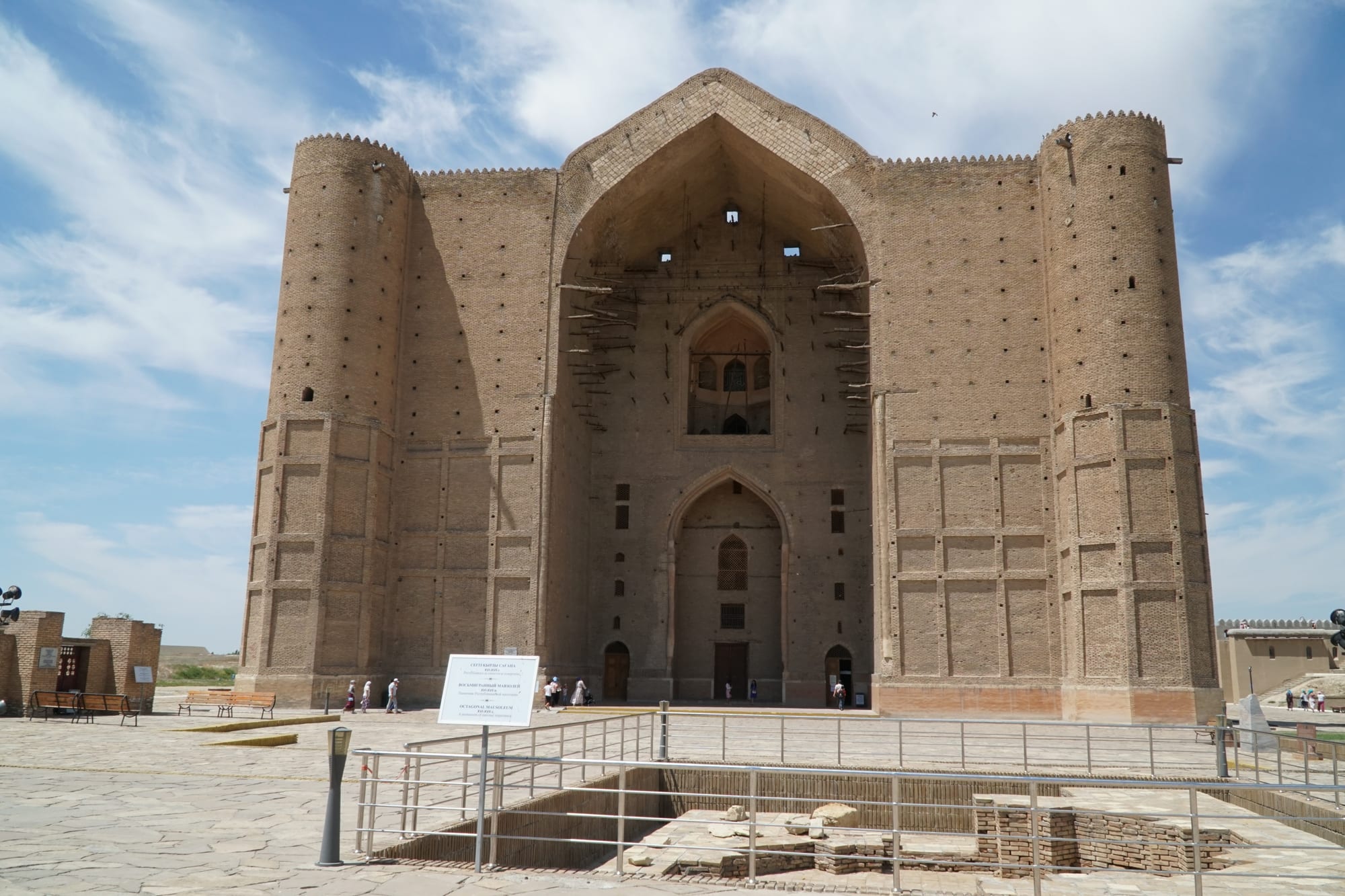
The tall unfinished brick front of a medieval mausoleum with a deep pointed arch and protruding scaffolding beams, above a paved plaza

Turkistan, Shymkent & the South, Kazakhstan

Turkistan

The unfinished main portal of the Mausoleum of Khoja Ahmed Yasawi in Turkistan. (Adam Harangozó / Wikimedia Commons · CC BY-SA 4.0)

A city on the dry plain north of the Syr Darya in southern Kazakhstan, built around the great Timurid mausoleum of the Sufi poet Khoja Ahmed Yasawi. Known as Yasi in the Middle Ages, it became the chief city of the Kazakh khans and their burial place, and since being made a regional capital in 2018 it has been rebuilt as the country's foremost pilgrimage and tourist destination.

Neighbourhoods

  • The shrine quarter
    • First-time visitors
    • Historic district
    • Pilgrimage

    The walled ground around the Yasawi mausoleum, with the excavated remains of the old citadel, smaller tombs, a medieval bath-house and museums, all laid out with lawns and paths. It is the reason almost everyone comes, and it is busiest at weekends and in the pilgrimage season.

    Open in Maps
  • The tourist quarter by the shrine
    • Hotels
    • Evening entertainment
    • Families

    The complex of new hotels, restaurants, shops and a canal built west of the mausoleum after 2018, in an ornamented style borrowed from Central Asian tradition. It is where most visitors sleep and eat, and it fills with families in the evening.

    Open in Maps
  • The Soviet centre
    • Local life
    • Markets
    • Everyday shopping

    Low streets of administrative buildings, shops, cafés and apartment blocks east of the shrine, with the bazaar and the bus and train connections. Ordinary, functional and useful for cheaper food and supplies.

    Open in Maps
  • The outer districts
    • Quiet and residential

    Single-storey houses behind fences, gardens, new estates and university buildings spreading out into the plain. Residential, with little for visitors, but growing quickly as the city expands.

    Open in Maps

Things to do

The shrine and its complex

  • Mausoleum of Khoja Ahmed Yasawilandmark

    Timur's unfinished mausoleum, begun in 1389, over the grave of the Sufi poet Khoja Ahmed Yasawi, a UNESCO World Heritage Site with a ribbed turquoise dome, tiled walls and a great bronze cauldron in its central hall.

    Open in Maps

The modern city

  • Ahmet Yesevi Universityattraction

    A joint Kazakh and Turkish university founded in 1991, whose campus and students give the pilgrim city a second, younger life.

    Open in Maps

Silk Road sites outside the city

  • Sauranlandmark

    The mud-brick walls and gates of a medieval town standing alone in the steppe, a walled town on the caravan routes.

    Open in Maps
  • Otrarlandmark

    The excavated mound of the Silk Road city whose governor's seizure of a Mongol caravan in 1218 brought Genghis Khan's armies into Central Asia.

    Open in Maps
  • Arystan Bab Mausoleumlandmark

    The tomb of Arystan Bab, traditionally held to be the teacher of Khoja Ahmed Yasawi, beside the Otrar ruins, which tradition says pilgrims should visit before going on to Turkistan.

    Open in Maps

Seasonal events

  • Nauryzlate March

    The spring new year, celebrated in the south with particular energy: yurts and stages in the squares, horse games, music and pots of nauryz köje.

  • Kurban Aitvaries with the Islamic calendar

    The feast of sacrifice, when the shrine and the city's mosques are at their busiest and families share meat with neighbours and the poor.

  • Ramadanvaries with the Islamic calendar

    The fasting month brings large numbers of pilgrims and evening meals after sunset in the restaurants around the shrine.

Eat and drink

Long-standing places and food districts in Turkistan. Hours, ratings and directions come from your maps app, always current.

Bazaars and street food

  • The central bazaarmarket

    Melons, dried apricots and raisins, nuts, rice from the Syr Darya, spices and meat, with bakers selling flat lepyoshka loaves and samsa straight from the tandoor.

    Open in Maps
  • Tandoor bakeries and samsa stallsmarket

    Clay ovens all over the city baking bread and meat pastries, the cheapest and most reliable food in town.

    Open in Maps

Around the shrine

  • Restaurants in the tourist quarterneighborhood

    The new complex west of the mausoleum concentrates the city's tourist restaurants and teahouses, serving plov, shashlyk, lagman and grilled meat.

    Open in Maps
  • Plov and shashlyk housesrestaurant

    Southern plov cooked in a large kazan and mutton grilled over charcoal, the standard celebratory and everyday meals of the region.

    Open in Maps

Experience Turkistan

History

The city was known as Yasi when Khoja Ahmed Yasawi, a Turkic Sufi poet whose verse spread Islam among the nomads in their own language, lived and died here in the 12th century. His grave became a place of pilgrimage almost at once, and the town grew around it as a religious centre on the edge of the steppe, at the point where the settled world of the Syr Darya met the pastures to the north.

Two centuries later Timur ordered a monumental mausoleum built over the grave. Work began in 1389 and stopped when he died in 1405, leaving the main portal unfinished, with its scaffolding beams still protruding from the brickwork — the building's most recognisable feature. From the 16th century the town, by then called Turkistan, served as the chief city of the Kazakh khans, and many of them were buried in and around the shrine, which made the place a political as well as a religious centre.

The Khanate of Kokand held the city in the early 19th century, and Russian forces took it in 1864. Under Soviet rule it became a provincial town with a cotton and food-processing economy, the shrine treated as a monument rather than a place of worship; it was inscribed as a UNESCO World Heritage Site in 2003. In 2018, when Shymkent was made a city of national significance, Turkistan replaced it as the regional capital, and since then a new administrative district, hotels, an airport, a university campus and a large visitor quarter beside the shrine have transformed a quiet town into one of the country's busiest destinations.

Culture & Customs

Turkistan is first of all a pilgrimage city. The tradition of visiting Yasawi's shrine is old and widely held, and pilgrims come from across Kazakhstan, from Turkey and from the wider Turkic world; many first visit the tomb of Arystan Bab, his teacher, near Otrar, in the order custom prescribes. The rhythms of the city follow the religious calendar, with crowds at the two Eids and in Ramadan.

Yasawi's teaching itself is part of the local identity. His Divan-i Hikmet, a collection of wisdom poems in Turkic, is treated as a foundation of Kazakh spiritual literature, and Sufi practice, blended with older steppe reverence for ancestors, still colours the way the shrine is visited. The Kazakh-Turkish university that carries his name has made the city a centre of Turkic cultural exchange, with Turkish staff and students a visible presence.

Southern customs are strong: seniority at the table, arranged and semi-arranged matchmaking, weddings of several hundred guests, and a religious observance more open than in northern Kazakhstan. Uzbek influence is present in the architecture, cooking and trade of the district. Visitors are welcomed easily, but the shrine is treated as a sacred place rather than a monument — voices are lowered, shoes removed where indicated, and photographs taken with care.

Daily Life

About 170,000 people live in Turkistan, and the city has grown quickly since it became a regional capital in 2018, adding government offices, housing estates, hotels and a university quarter. The population is overwhelmingly Kazakh and Kazakh-speaking, with an Uzbek minority, and families are larger than the national average.

Work is in administration, education, construction, trade and the visitor economy that has grown around the shrine: hotels, restaurants, guides, taxi drivers and craft and souvenir sellers. The countryside around the city grows cotton, melons, vegetables and grain on irrigated land and grazes sheep, and a good deal of produce reaches the city's bazaar directly from those farms. Wages are low and many households rely on several small incomes.

The day is organised around the heat: an early start, a long slow middle of the day, and evenings outdoors in the parks and along the canal by the shrine, where families walk and children play late. Weekly life peaks at Friday prayers and at weekends, when pilgrim buses arrive. The city's strains are those of very fast growth — water supply in a dry plain, new districts outstripping services, and the question of how a working provincial town and a national showpiece fit in the same place.

Food

Southern Kazakh cooking is close to Uzbek food, and plov is its centrepiece: rice cooked slowly with mutton, yellow carrot and onion in a heavy kazan, served for guests and celebrations and sold in plain shops by the portion. Beshbarmak, boiled meat over wide sheets of pasta in onion broth, remains the ceremonial Kazakh dish, brought out for family occasions and for honoured visitors.

The tandoor does much of the everyday work. Lepyoshka, flat round loaves stamped in the centre, and samsa, flaky pastries of minced mutton and onion, are baked against the oven wall and sold hot at the bazaar and on street corners. Lagman noodles, manty dumplings, shurpa broth and shashlyk grilled over charcoal fill the canteens, and kuyrdak, an offal and potato fry, is a traditional standby.

The irrigated farms of the Syr Darya give the region its fruit: melons and watermelons in late summer, apricots, grapes, tomatoes and rice grown downstream around Kyzylorda. Dried apricots, raisins and nuts are sold by weight in the market year round. Green tea, drunk plain from small bowls, is more common here than in the north, and black tea with milk is served with baursak, fried dough pieces, and with jam. Shubat, fermented camel's milk, and ayran are sold in the warm months, while alcohol is far less present in daily life than in the cities of the north.

Planning tools

Budget

Turkistan is inexpensive by Kazakh standards, though the hotels built for pilgrims and tourists near the shrine cost more than the plain hotels and guesthouses in the old centre. Food at the bazaar and in canteens is very cheap. The main additional expense is a driver for the ruins at Otrar and Sauran, which public transport does not serve usefully.

Daily Budget Midrange
USD 65–130 (mid-range hotel, restaurant meals, a driver for the Silk Road sites)
Daily Budget Shoestring
USD 25–45 (guesthouse or simple hotel, bazaar and canteen food, buses and shared taxis)

Rooms near the shrine fill and prices rise around Nauryz and the main Islamic holidays, so book ahead at those times.

Best Time to Visit

April to early June and September to October, when the plain is warm rather than fierce and the open ruins are bearable to walk. Nauryz in late March is the most animated time in the city. July and August bring desert heat well above the comfortable, and winters are short, grey and windy but never severe.

Suggested Number of Days

A day and a night is enough for the shrine complex and the modern quarter beside it. Adding the medieval sites in the surrounding steppe, each of which needs a car, brings a stay to two or three days.

First Visit
1–2 days
With Surroundings
2–3 days

Transportation

The city is small and flat, and taxis, usually arranged through ride-hailing apps, cost little. Buses and minibuses run along the main roads, and the shrine and the quarter beside it are walkable from most hotels. Trains on the Almaty–Shymkent–Kyzylorda line stop here, and buses and shared taxis run to Shymkent and Kyzylorda. The ruins outside the city need a hired car.

A driver hired for half a day can combine Otrar and Arystan Bab, and Sauran fits into a separate short trip north-west.

Airport & Station Connections

Turkistan lies on the main railway and highway between Shymkent and Kyzylorda, roughly two to three hours from Shymkent by road or rail. Trains arrive from Almaty and from Russia, buses and shared taxis run through the day, and the city has an international airport, opened in 2021, with domestic and regional flights. Many visitors come as a day trip from Shymkent.

Walkability

The shrine complex, the tourist quarter and the nearby hotels are easy and pleasant to walk between, and the ground inside the complex is paved and level. The rest of the city is spread out with long straight roads, little shade and hard summer heat, so most people take a taxi between the shrine and the bazaar or the station.

Safety

A calm and hospitable city with a heavy flow of pilgrims and visitors and little crime that affects them. The real hazards are the heat and sun at the shrine and at the exposed ruins in summer, traffic on the main roads, and the usual care needed with valuables in crowded markets and at busy religious festivals.

Carry water and sun protection, dress modestly at the shrine, remove shoes where asked and keep valuables close in crowds. Check current official travel advice before travelling.

Climate

A hot desert-edge climate with very hot dry summers, short mild winters and little rainfall, most of it in spring. Wind and dust are common on the open plain, and spring is brief and green before the heat sets in.

Summer
very hot and dry, often 35–40°C in July and August, with warm nights
Winter
short and moderate, generally between -5 and 5°C, with light snow and cold winds

Local Customs

This is one of the most traditional and religious parts of Kazakhstan. Kazakh is the everyday language, families are large, and elders are deferred to. At the shrine visitors should dress modestly with shoulders and knees covered, women usually cover their heads, shoes are removed where indicated, and prayer and quiet reflection take precedence over sightseeing. Photography of people at prayer requires permission.

Alcohol is less visible here than in northern cities and is best avoided near the shrine; hospitality is generous and refusing tea outright is impolite.

Common Payment Methods

The currency is the Kazakhstani tenge. Cards and phone payments are taken in hotels, the newer restaurants and supermarkets, while cash is needed at the bazaar, for taxis, for small canteens and at the sites outside the city. Cash machines are available in the centre and near the shrine.