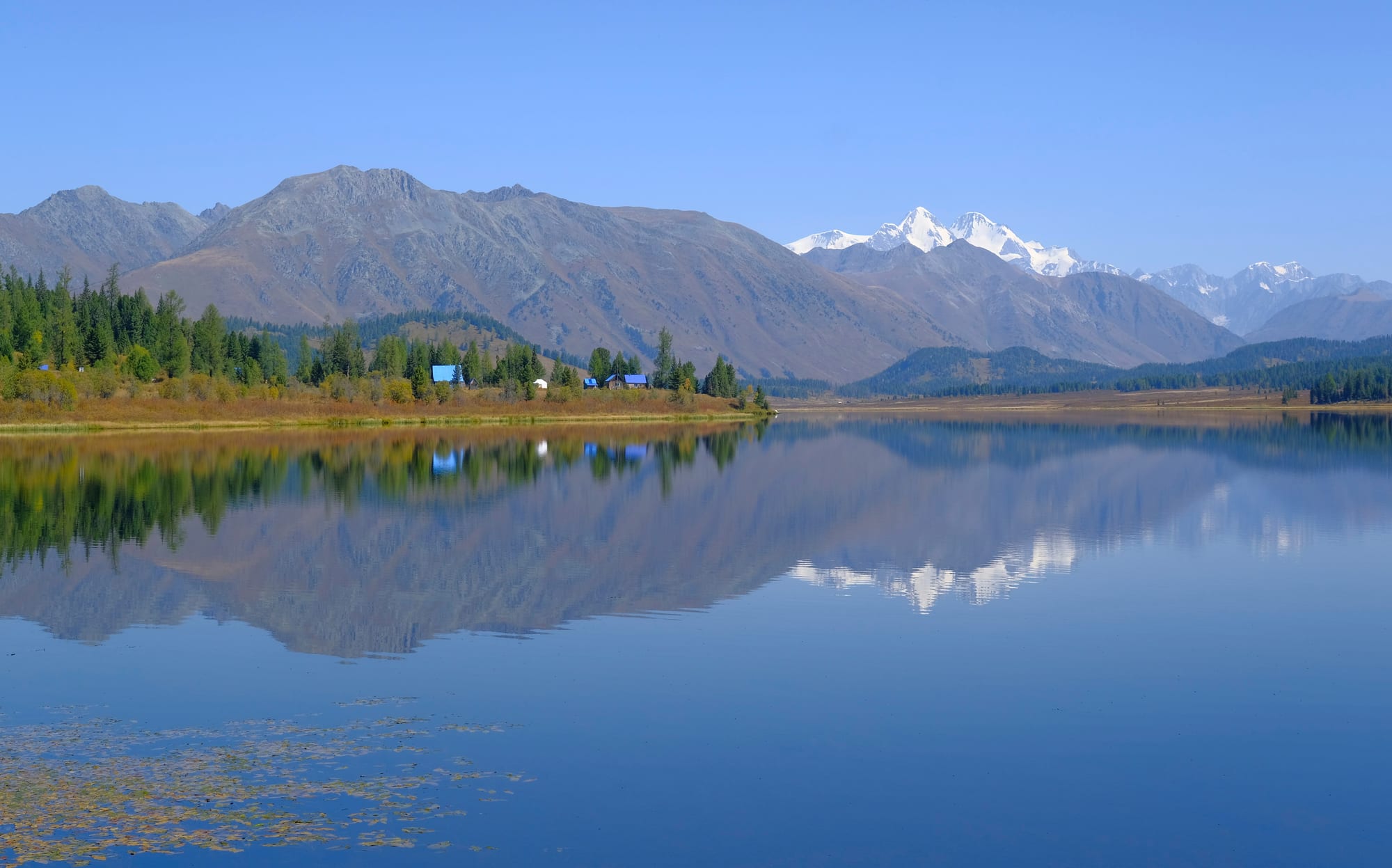
A still lake reflecting forested shores, grey mountain slopes and a snow-covered twin peak under a clear blue sky

Kazakhstan

East Kazakhstan & the Altai

Mount Belukha reflected in Yazevoye lake in Katon-Karagay National Park, East Kazakhstan Region. (Stanislav Sergeevich / Wikimedia Commons · CC BY-SA 4.0)

Kazakhstan's north-eastern corner, where the Irtysh flows out of China past Öskemen and Semey and the steppe rises into the forests and snow peaks of the Kazakh Altai — a region of mining towns, Russian exiles and Kazakh poets, marked by the legacy of the Semipalatinsk nuclear test site and holding the country's wildest mountain country.

Explore East Kazakhstan & the Altai

History

The Altai foothills and the Irtysh valley were home to the horse-riding peoples of the Scythian age, whose frozen burials have been found at Berel in the Bukhtarma valley, with horses buried in harness beside the dead. Later, Turkic khaganates, the Mongols and the Oirat Dzungars held the region, and the Dzungar wars of the early 18th century devastated the Kazakh clans that grazed these pastures.

Russia pushed up the Irtysh in the same years, founding Semipalatinsk in 1718 and Ust-Kamenogorsk, today's Öskemen, in 1720 as forts on the line against the Dzungars. The Altai's silver, lead and zinc drew miners, and Old Believers and peasant settlers colonised the valleys. Semipalatinsk became a trading city and a place of exile: Fyodor Dostoevsky served there as a soldier in the 1850s after his prison sentence. In the Shyngystau hills to the south, Abai Kunanbayev, the poet and thinker regarded as the founder of modern Kazakh literature, was born in 1845. In 1917 Semipalatinsk became a centre of the Alash movement, whose Kazakh autonomous government was suppressed by the Bolsheviks.

The Soviet era gave the region its darkest legacy. From 1949 to 1989 the Semipalatinsk Test Site, known locally as the Polygon, hosted hundreds of nuclear explosions, first in the atmosphere and later underground, exposing nearby villages to radiation. The anti-nuclear Nevada-Semipalatinsk movement, founded in 1989 by the poet Olzhas Suleimenov, helped force its closure in 1991. In 2022 the western districts around Semey became the new Abai Region.

Culture & Customs

The region looks two ways. Öskemen, Ridder and the mining towns grew as Russian industrial settlements, and Russian remains the dominant language there, with Orthodox churches and a strong Siberian flavour. Old Believer villages, founded by religious dissenters who fled persecution, survive in the Bukhtarma valley and the Altai foothills with their own customs and log-built houses.

Semey and Abai Region, by contrast, are a heartland of Kazakh literature. Abai's poems and "Words of Edification" are learnt by every Kazakh schoolchild, and the region also produced Shakarim Kudaiberdiev and Mukhtar Auezov, whose novel "The Path of Abai" is a national epic. Semey's museums, readings and poetry festivals keep that pride alive, and its older quarters show a mix of Kazakh, Tatar and Russian merchant culture.

In the Altai, Kazakh herders move their flocks to high summer pastures, and maral deer are farmed for their antlers, which are used in traditional remedies and in the antler baths offered at mountain sanatoriums. The memory of the nuclear tests shapes local identity strongly, and 29 August, the date of the test site's closure, is marked each year.

Daily Life

Öskemen is the capital of East Kazakhstan Region and one of the country's main metallurgical centres, with large zinc, lead, titanium and nuclear fuel plants. Semey, with over 300,000 people, is the capital of Abai Region and a centre of meat processing, trade and education. Ridder is a mining town in the mountains, and Kurchatov, the former research town of the test site, is small and shrinking.

The economy combines metals mining and processing with hydropower on the Irtysh, grain and livestock farming on the steppe, and beekeeping, maral farming and small-scale tourism in the Altai. Air pollution in Öskemen and the long-term health effects of nuclear testing around Semey are persistent public concerns.

Life follows long winters and short, busy summers, when families head to dachas, the Bukhtarma reservoir or the mountain lakes. Many young people leave for Almaty, Astana or Russia, and mountain villages are losing population.

Food

East Kazakhstan's kitchen blends Kazakh herders' food with Russian and Tatar cooking. Beshbarmak, kazy and kuyrdak are prepared with local mutton and horsemeat, while Russian pelmeni, pirozhki, soups and pickles are everyday fare. Semey's Tatar heritage gives the region belyashi, fried pastries filled with meat, and chak-chak, small pieces of fried dough bound with honey.

Honey is the region's signature product. Altai honey from the mountain meadows is sold at every market in Öskemen and Semey, alongside pine nuts, wild berries, dried herbs and teas. Fish from the Irtysh, Lake Zaysan and the mountain lakes is smoked, salted or fried, and Markakol is known for its lenok, a trout-like fish.

Kymyz is drunk fresh in the summer pastures, and tea with milk accompanies every meal, often with baursak and honey. Maral antler products and herbal tinctures are sold as health tonics.

Attractions & Natural Wonders

The Kazakh Altai around Katon-Karagay is the region's great natural attraction. Katon-Karagay National Park, the largest in the country, protects larch and cedar forest, alpine meadows, turquoise lakes and the glaciers of the Southern Altai, with Mount Belukha on the Russian border as its crown. Yazevoye lake gives the classic view of Belukha, the village of Rakhmanov Springs lies in the mountains of the same district, and the Berel burial mounds lie in the Bukhtarma valley.

Further south, Lake Markakol lies high in the mountains within a nature reserve, with forested shores and clear, cold water. Near Lake Zaysan the red clay cliffs of Kiin-Kerish are a striking desert landscape.

Öskemen has its open-air ethnographic museum and walks along the Irtysh and the Ulba, with the Sibinsk lakes within reach. Semey offers the Abai and Dostoevsky museums, the "Stronger than Death" monument to victims of the nuclear tests, and old Tatar mosques. The Irtysh valley links them, flowing through the Bukhtarma reservoir and past Öskemen towards Semey, and in the Shyngystau hills to the south the Abai and Shakarim mausoleum complex stands at Zhidebay.

Cities in East Kazakhstan & the Altai

Planning basics

Budget

East Kazakhstan is cheaper than Astana and Almaty. Öskemen and Semey have affordable hotels, canteens and markets, and village guesthouses in Katon-Karagay charge modest rates for bed and meals. The real costs are transport into the mountains, border-zone permits, and guides or 4x4 drivers for Belukha, Markakol and the remoter valleys.

Daily Budget Midrange
USD 65–130 (mid-range hotel or comfortable guesthouse, restaurants, a driver or guide in the Altai)
Daily Budget Shoestring
USD 25–45 (guesthouse or simple hotel, canteen food, intercity buses)

Arrange border-zone permits for the upper Katon-Karagay valleys and Markakol well in advance, usually through a local tour agency.

Safety

The cities are generally safe, though Öskemen suffers from industrial air pollution. The mountains carry real risks: sudden weather changes, river crossings, bears, ticks in spring and early summer, and the absence of mobile coverage. Border zones near China and Russia require permits, and parts of the former nuclear test site remain restricted.

Carry permits and passports in border areas, walk with a guide in the high Altai, check for ticks after walks, and do not enter the former test site except on authorised visits. Check current official travel advice before travelling.

Climate

Continental, but more varied than the rest of the country. Semey and the steppe of Abai Region have hot summers and very cold winters, and Öskemen lies in a valley prone to winter smog. The Altai is cooler and much wetter, with heavy snow, short green summers and permanent snow and glaciers on Belukha.

Summer
warm in Öskemen and Semey, 25–32°C; mild in the Altai valleys, 18–25°C, with frequent rain and cold nights
Winter
severe, often -15 to -25°C in the cities and colder in the mountains, with deep snow in the Altai

Transportation

Öskemen and Semey have airports with flights to Almaty and Astana, and railways link both cities to the national network. Roads into the Altai are long: Katon-Karagay is most of a day's drive from Öskemen, and Lake Markakol is reached by rough roads from the south. Public transport in the mountains is sparse, so most visitors travel with a driver or tour.

Plan the Altai as a multi-day trip from Öskemen and allow for slow mountain roads and weather delays.

Best Time to Visit

Late June to early September for the Altai, when the passes and mountain roads are open, the meadows are in flower and the lakes are ice-free; July and August are the main trekking season. May and September suit Öskemen and Semey. Autumn colours in the larch forests peak in September, and winter brings skiing near Öskemen.