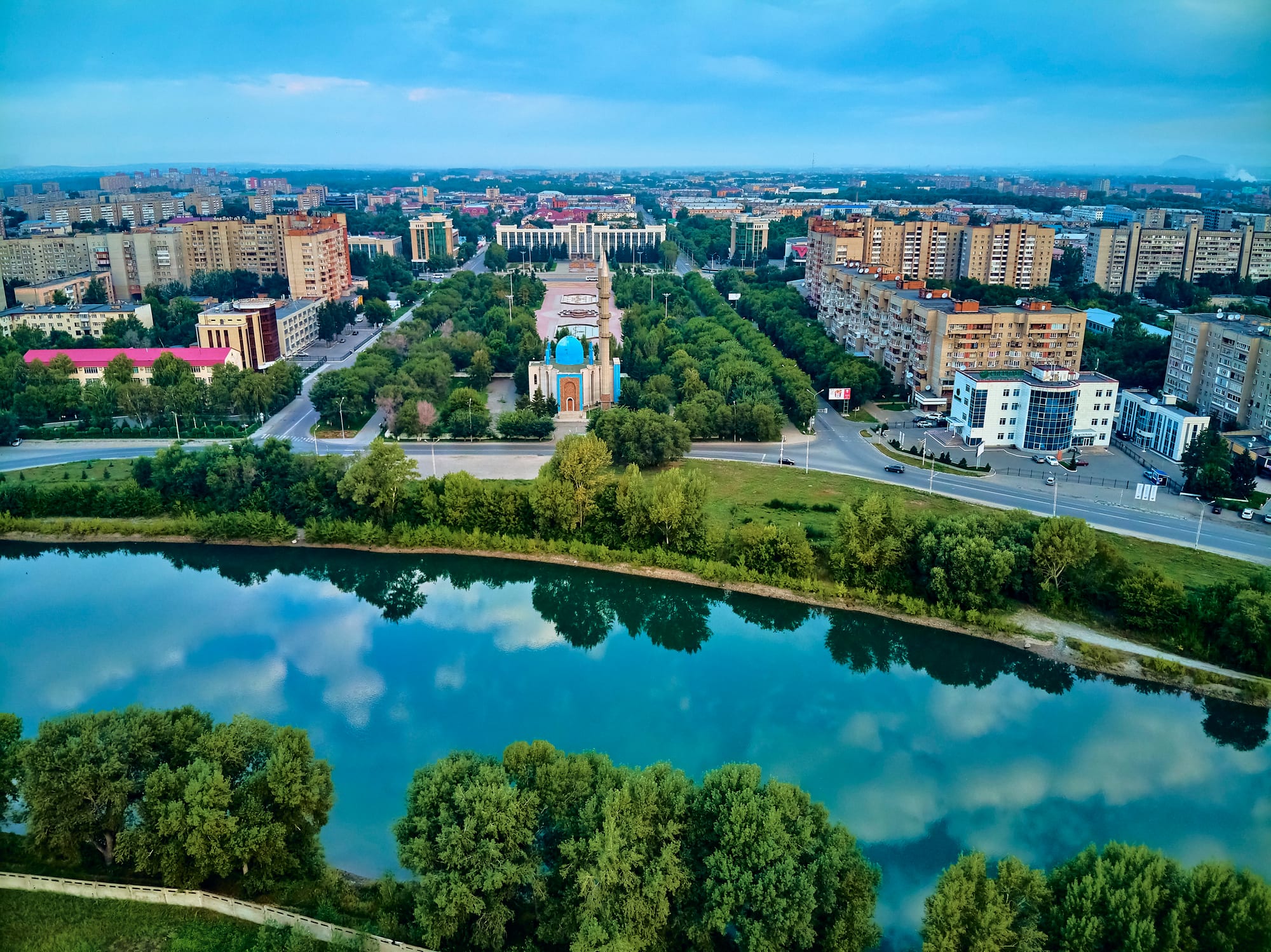
Aerial view of Oskemen in summer with a still river channel in the foreground, green trees, a blue-domed mosque and rows of flat blocks beyond

East Kazakhstan & the Altai, Kazakhstan

Oskemen

Oskemen in summer, looking across the water towards the mosque and the flat blocks of the centre. (Andriej Szypiłow / Wikimedia Commons · CC BY-SA 3.0)

The capital of East Kazakhstan Region, set where the Ulba flows into the Irtysh at the western edge of the Altai. Founded as a Russian fort in 1720 and known for most of its history as Ust-Kamenogorsk, it grew into a metals city of more than 300,000 people, with riverside parks, a strong ice hockey tradition and the road into the Kazakh Altai.

Neighbourhoods

  • The centre
    • First-time visitors
    • Close to public transport
    • Restaurants

    The grid of avenues and squares between the Ulba and the Irtysh, with the regional administration, theatres, museums, hotels and most of the city's restaurants. Wide pavements, fountains and long lines of poplars make it the part of the city built to be looked at.

    Open in Maps
  • The Strelka and the embankments
    • Parks
    • Walks
    • Quiet and residential

    The point where the Ulba meets the Irtysh, with riverside walks, beaches, war memorials and open ground used for city celebrations. Flat blocks and older houses back onto the parks, and the water is the focus of summer evenings.

    Open in Maps
  • KShT
    • Quiet and residential
    • Shopping

    A large residential district of microdistricts and shopping centres named after the construction-site settlement that preceded it, on the right bank away from the industrial plants. It is where much of the city actually lives, with markets, schools and bus routes to the centre.

    Open in Maps
  • Ablaketka
    • Local life
    • Industrial history

    An outlying district upstream near the hydroelectric dam and its lock, separated from the centre by the river and the works. Low houses, wooded slopes and the reservoir give it a semi-rural feel quite unlike the planned centre.

    Open in Maps

Things to do

Rivers, parks and viewpoints

  • The Ulbaattraction

    The Altai river that joins the Irtysh in the middle of the city, lined with embankments, bridges and parks and giving the city its shape.

    Open in Maps
  • The Irtyshattraction

    One of the great rivers of Asia, flowing out of China through Kazakhstan and on into Siberia, dammed above and below the city for hydroelectric power.

    Open in Maps
  • Ust-Kamenogorsk Damlandmark

    The hydroelectric dam on the Irtysh just upstream of the city at Ablaketka, beside it the highest lock in the world, which carries river traffic past the dam.

    Open in Maps

Sport and culture

  • Boris Alexandrov Sports Palaceattraction

    The city's ice arena, named after a local Olympic champion, home of a hockey club and of a school that has sent an unusual number of players to the top leagues.

    Open in Maps

Getting around

  • Oskemen Airporttransit hub

    The regional airport about 13 kilometres north-west of the centre, with flights to Astana and Almaty.

    Open in Maps

Short trips from the city

  • Bukhtarma Reservoirattraction

    A very large reservoir on the Irtysh upstream of the city, held back by the Bukhtarma dam, with beaches, holiday bases and the road towards the Altai along its shores.

    Open in Maps
  • Ridderattraction

    A mining town in the Altai north-east of the city on the Ulba, founded in 1786 after a rich deposit of gold, silver and other metals was found there, and ringed by forested hills.

    Open in Maps

Seasonal events

  • Nauryzlate March

    The spring new year, marked with yurts, wrestling, horse games and nauryz kozhe on the central squares while snow often still lies on the hills.

  • Victory Day9 May

    Wreath-laying at the war memorials by the rivers, followed by concerts and family picnics in the parks.

  • City Dayautumn

    The city's own holiday, marked with concerts and fairs on the squares and along the embankments at the end of the warm season.

  • The hockey seasonSeptember to April

    Ice hockey fills the arena through the long winter, and the city's club, Torpedo, has sent players to the national teams and to the NHL.

Eat and drink

Long-standing places and food districts in Oskemen. Hours, ratings and directions come from your maps app, always current.

Oskemen classics

  • Beshbarmak and steppe meatrestaurant

    Boiled mutton or horsemeat with wide sheets of pasta and onion broth, served with kazy sausage and sorpa, is the dish for guests in the city's Kazakh restaurants.

    Open in Maps
  • Russian and Siberian home cookingrestaurant

    Pelmeni, borscht, pirozhki, salted vegetables and river fish reflect the city's Russian and Old Believer surroundings, and appear on most menus alongside Kazakh dishes.

    Open in Maps

Markets

  • The city bazaarsmarket

    Altai honey, pine nuts, wild berries, dried herbs, smoked fish, kurt and horsemeat are the things to look for in the covered markets.

    Open in Maps

Experience Oskemen

History

The city began as a fort. In 1720 an expedition under Ivan Likharev, sent by Peter the Great to secure the upper Irtysh and look for gold, built a stockade where the Ulba joins the larger river, at the point where the Irtysh leaves its rocky gorge. The fort was first called Ust-Kamennaya; the later Russian name Ust-Kamenogorsk points to the mouth of the stone mountains. For decades it was a garrison on the line against the Dzungars, then a customs and trading post on a river route into the Altai.

Mining made the town. Silver, lead and zinc found in the Altai foothills in the eighteenth century drew imperial and later private mining ventures, and Ust-Kamenogorsk became the place where ore was gathered, smelted and shipped. Old Believers and peasant settlers filled the valleys around it, and by the nineteenth century the town had merchant houses, a river port and a growing Kazakh population trading with the steppe.

Soviet planning transformed it. The lead and zinc combine opened before the Second World War, evacuated industry arrived during the war, and afterwards came the Ulba Metallurgical Plant, the titanium and magnesium works and the hydroelectric dam on the Irtysh, making the city one of the Soviet Union's important centres for rare and strategic metals. The population passed 300,000, and blocks of flats spread along both rivers. Since independence it has kept the metals industry, taken the Kazakh name Oskemen, and become the administrative capital of East Kazakhstan Region, with the Altai increasingly promoted as a reason to come.

Culture & Customs

Oskemen feels more Siberian than most Kazakh cities. Russian is the ordinary language of the street, Orthodox churches stand near the new mosques, and the surrounding valleys hold Old Believer villages settled by religious dissenters who left Russia centuries ago and kept their own dress, songs and rules about food and drink. Kazakh language and culture have become steadily more prominent since independence, and the city now celebrates Nauryz on its main squares as fully as it does Victory Day.

Ice hockey is the local passion and the city's clearest claim to fame. The club founded in the Soviet years produced a stream of players for the Soviet, Russian and Kazakh national teams, and the arena carries the name of Boris Alexandrov, an Olympic gold medallist who began with the city's club; children learn to skate early and the sport dominates winter conversation.

The Altai is the other half of local identity. Families go to the mountains and the reservoir in summer, honey and antler products from the high pastures are sold in every market, and the region's Kazakh, Russian, Tatar and German communities all have their part in the city's music and food. Manners are straightforward and hospitable: guests are fed at once, tea is endless, elders are deferred to, and an invitation to a dacha or a mountain trip is a normal way of showing welcome.

Daily Life

More than 300,000 people live in Oskemen, making it one of the larger cities of Kazakhstan and the administrative centre of East Kazakhstan Region. The population is mixed, with Kazakhs and Russians in similar numbers and Tatar, Ukrainian, German and other communities alongside them, and it has been slowly changing as people move in from the surrounding districts.

Metals remain the backbone: zinc and lead processing, titanium and magnesium, and the Ulba plant with its beryllium, tantalum and nuclear fuel production, plus hydropower on the Irtysh, engineering and food processing. Universities, colleges and hospitals employ many others, and tourism into the Altai supports a growing number of guides, drivers and guesthouses.

The working day starts early and the city empties towards the rivers, the dachas and the mountains at weekends. Winter is lived indoors, with district heating, crowded buses and hockey; summer is lived outside, on the embankments, the beaches and the reservoir. Air quality is the most persistent public grievance, since the valley holds industrial emissions and coal smoke on still, cold days, and the drift of young people to Astana and Almaty is the other constant subject.

Food

Oskemen's food comes from two directions at once. From the steppe come beshbarmak, the boiled meat and pasta dish served to guests, kazy horsemeat sausage, kuyrdak of fried offal and potatoes, sorpa broth and baursak, the small pieces of fried dough eaten with tea. From Russia and Siberia come pelmeni, borscht, shchi, pirozhki, salted cucumbers and mushrooms, and the jams and compotes of a place with a short, intense berry season.

Altai honey is the regional product above all others, sold by the jar at every bazaar along with pine nuts, dried herbs, wild strawberries, sea buckthorn and the tinctures and antler preparations made in the mountains. Fish from the Irtysh, the reservoirs and the mountain lakes is fried, salted or smoked, and the Tatar community contributes belyashi, fried meat pastries, and chak-chak, fried dough bound with honey.

Tea is drunk all day, black and often with milk, and kymyz and shubat, fermented mare's and camel's milk, appear in summer as tonics rather than everyday drinks. The city's cafés also serve the common Central Asian repertoire of manty, samsa, plov, lagman and shashlik, which is what most people actually eat when they go out.

Planning tools

Budget

Oskemen is inexpensive compared with Astana and Almaty, with a good choice of hotels, guesthouses, canteens and markets. The city itself costs little; what raises a budget is transport into the Altai, where distances are long and most visitors hire a driver or join a tour, and where border-zone permits may be needed.

Daily Budget Midrange
USD 65–130 (mid-range hotel or comfortable guesthouse, restaurants, a driver or guide in the Altai)
Daily Budget Shoestring
USD 25–45 (guesthouse or simple hotel, canteen food, city and intercity buses)

Arrange Altai trips and any border-zone permits through a local agency well before arriving; permits take time and cannot be got on the day.

Best Time to Visit

May to September. Late spring is green and mild in the city, July and August are warm and the season for the reservoir, the lakes and the mountains, and September brings clear air and the turning of the larch forests. Winter is severe and the valley traps smog on still days, though it is the season for hockey and for skiing in the hills east of the city.

Suggested Number of Days

The city, its museums and its riverside are a day or two. Anyone using Oskemen as the base for the Altai should allow four to six days in all, because the mountain roads are long and weather can slow travel.

First Visit
1–2 days
With Surroundings
4–6 days

Transportation

The city is spread along the rivers, and buses and minibuses link the centre with KShT, Ablaketka and the industrial districts; taxis booked by app are cheap and widely used. Intercity buses and trains run to Semey, Astana and Almaty, and buses and shared cars serve the mountain towns. Getting into the Altai itself generally means a hired vehicle.

Roads into the mountains are slow and sometimes rough; allow far more time than the distance suggests, especially outside summer.

Airport & Station Connections

Oskemen Airport lies about 13 kilometres north-west of the centre, with flights to Astana and Almaty. Trains run to Semey, Astana and Almaty from the city's station, and the road to Semey takes about three hours. Many travellers arrive by air and continue into the Altai by hired car.

Walkability

The centre is flat, generously laid out and pleasant on foot, with long embankments, parks and wide pavements, and the museums and squares are within walking distance of each other. The city as a whole is spread out along the rivers, so crossing between districts means a bus or taxi. Ice and snow make winter walking slow from November to March.

Safety

Oskemen is a calm city with little crime affecting visitors; normal care with valuables in markets and on buses is enough. The greater concerns are environmental and seasonal: industrial air pollution that can settle over the valley in winter, severe cold, and the mountain risks beyond the city — sudden weather, river crossings and ticks in spring and early summer.

Check air quality on still winter days, carry warm layers on any trip into the mountains, use insect repellent and check for ticks after walks, and carry a passport and any permit in border districts. Check current official travel advice before travelling.

Climate

Continental, with hot summers and severe winters, and a valley setting that shelters the city from wind but also traps cold air and smoke. Rainfall is modest and spread through the year, and snow lies for months.

Summer
warm to hot — daytime temperatures are usually 25–32°C in July, with warm evenings by the rivers
Winter
severe — daytime temperatures stay well below freezing, often near -15°C in January, with deep snow and frequent haze in the valley

Local Customs

Russian is the everyday language, with Kazakh used in official life and increasingly in public; a greeting in either is welcome. Hospitality is pressed on guests, tea is poured a little at a time and refilled, and shoes come off inside homes. Elders are greeted first and served first. The region's Old Believer villages keep their own strict customs, and visitors there should ask before entering houses of prayer or taking photographs.

Accept tea and bread when offered, dress modestly in mosques, churches and villages, and do not photograph the metals plants or anything military.

Common Payment Methods

The currency is the Kazakhstani tenge. Cards and local mobile payment are accepted in hotels, shops, cafés and even many market stalls, and ATMs are easy to find in the centre. Cash matters as soon as the city is left behind, since mountain villages and guesthouses often cannot take cards.