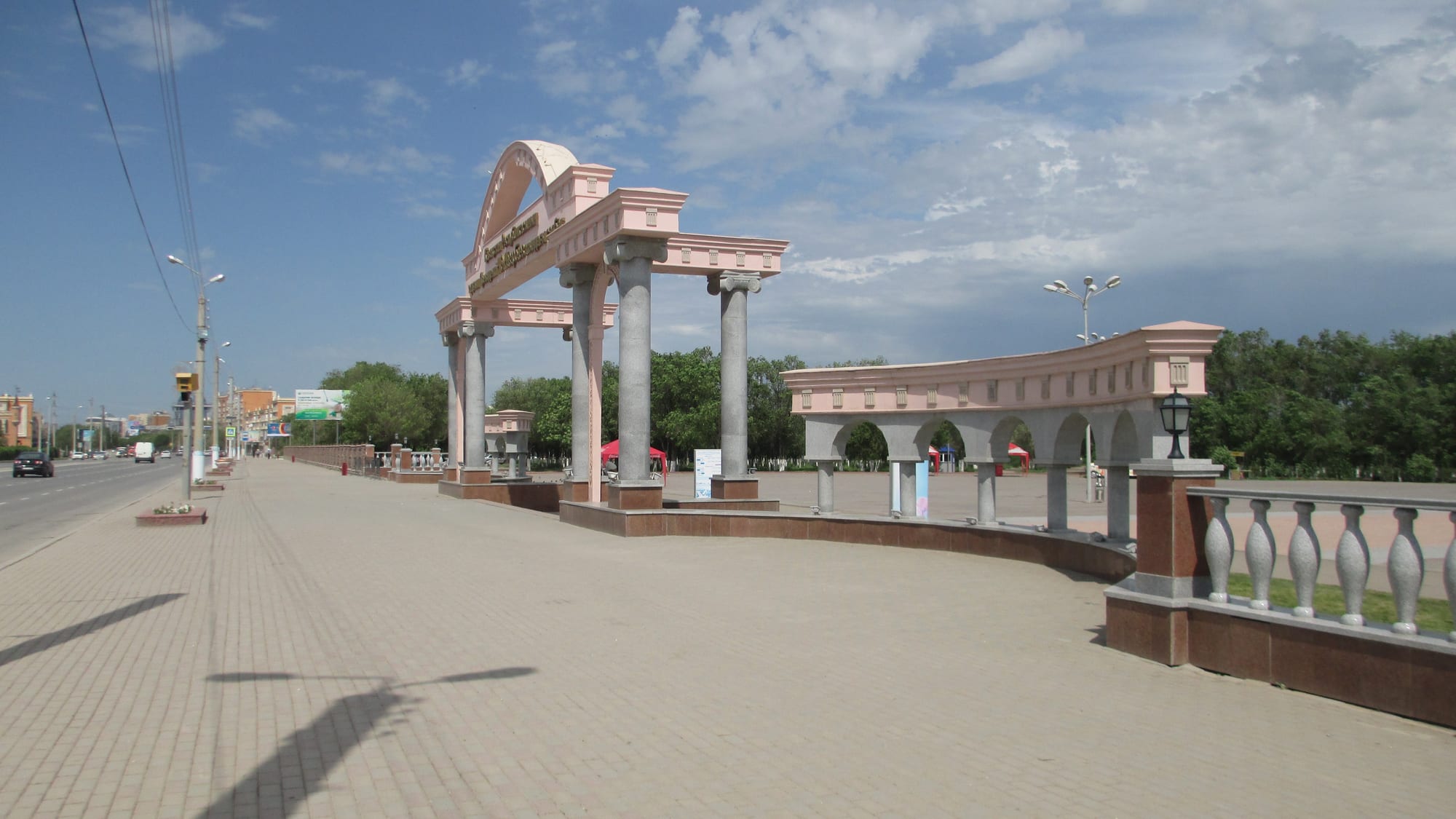
A pale stone colonnade and arched gateway beside a broad paved walk and a city avenue in Aktobe under a blue sky

The West & the Caspian, Kazakhstan

Aktobe

The entrance to the First President of Kazakhstan Park in Aktobe. (Esetok / Wikimedia Commons · CC BY-SA 4.0)

The largest city of western Kazakhstan, grown from a Russian fort of 1869 on the Ilek river into an industrial centre of chrome, oil and engineering. It stands on the road and railway from Russia towards Central Asia, and combines Soviet-planned avenues and riverside parks with a large modern mosque and new districts on the steppe.

Neighbourhoods

  • The old centre
    • First-time visitors
    • Close to public transport
    • Historic district

    The streets laid out around the original fort and the nineteenth-century town, with low brick buildings, the regional administration, museums and shops. Most hotels and the main avenues are here, and it is the easiest part of the city to walk.

    Open in Maps
  • The riverside and the parks
    • Walks and viewpoints
    • Families

    The Ilek river gives the city embankments, beaches and large parks, with the Aktobe reservoir a short way upstream. Families fill them in the evening in summer, and the ice draws skaters and anglers in winter.

    Open in Maps
  • The microdistricts
    • Local life
    • Quiet and residential

    Soviet-era apartment blocks in numbered districts spread west and south of the centre, each with its own shops, schools and courtyards. Shopping centres and markets serve them, and city buses run the length of the main avenues.

    Open in Maps
  • The new districts and the industrial edge
    • Newer building
    • Transport connections

    Newer apartment blocks, mosques and shopping centres have been built on the open steppe around the city, while the ferroalloy and chemical plants, rail yards and the airport lie on the outskirts.

    Open in Maps

Things to do

Landmarks in the city

  • Nur Gasyr Mosquelandmark

    The city's main mosque, faced in pale stone with golden domes and a tall minaret, with the Rukhaniyat museum on its ground floor.

    Open in Maps
  • Abulkhair Khan monumentlandmark

    A monument to the eighteenth-century khan of the Junior Horde, whose name is attached to the university and much else in the city.

    Open in Maps
  • Aktobe Regional Museum of History and Local Loremuseum

    Opened in 1929 and the oldest museum in the city, covering the archaeology of the western steppe, the Kazakh clans, the Russian fort and the Soviet industrial city.

    Open in Maps

Parks and the river

  • First President of Kazakhstan Parkpark

    A large landscaped park in the centre with colonnades, fountains, avenues and gardens, the city's main open space for evening walking.

    Open in Maps
  • Ilekattraction

    The river that gave the city its site, dammed just upstream to form the reservoir that supplies water and summer beaches.

    Open in Maps
  • Aktobe reservoirattraction

    The lake formed by damming the Ilek about 10 kilometres south-east of the city and known locally as the Aktobe Sea, used for swimming, boating and fishing in summer and for ice fishing in winter.

    Open in Maps

Sport and short trips

  • Central Stadiumattraction

    The city's football ground, home to FC Aktobe, one of the strongest sides in Kazakhstan in the 2000s and early 2010s.

    Open in Maps
  • Khromtauattraction

    A mining town on the steppe east of the city, built on one of the world's larger chromite deposits, which underpins the regional economy.

    Open in Maps
  • Mugodzhar Hillsattraction

    Low, eroded hills south of the city, regarded as the southern extension of the Ural mountains, with steppe, streams and grazing land.

    Open in Maps

Seasonal events

  • Nauryzlate March

    The spring new year, marked with yurts, swings, wrestling and nauryz köje in the city's parks and squares.

  • Kurban Aitvaries with the Islamic calendar

    The feast of sacrifice, a public holiday of family visits, shared meat and mosque attendance.

  • Football seasonMarch to November

    The months when the city's club plays its home league matches, long a focus of local pride in western Kazakhstan.

Eat and drink

Long-standing places and food districts in Aktobe. Hours, ratings and directions come from your maps app, always current.

Aktobe classics

  • Steppe kitchens and canteensneighborhood

    Canteens and restaurants in the centre serve beshbarmak, kuyrdak, plov, lagman and manty, the standard repertoire of the western steppe.

    Open in Maps
  • Shashlyk and tandoor bakeriesneighborhood

    Grills working over coals and clay ovens turning out samsa and flat lepyoshka bread are found along the main avenues and beside the markets.

    Open in Maps

Markets

  • Aktobe Central Marketmarket

    The city's main bazaar, selling horse meat and mutton, kazy sausage, dried curd, honey, and vegetables and melons brought up from the south.

    Open in Maps

Experience Aktobe

History

Aktobe began as a military post. In 1869 the Russian Empire built a fort at the confluence of the Ilek and the Kargaly to hold the steppe frontier and control the Kazakh clans of the Junior Horde, and named it Ak-Tyube, the white hill, for the rise it stood on. A trading settlement gathered around the garrison, granted town status as Aktyubinsk in 1891, and the arrival of the Orenburg to Tashkent railway at the beginning of the twentieth century turned it into a junction for grain, hides and livestock.

Industry arrived with the Soviet period and again during the Second World War, when factories were evacuated eastwards from Ukraine and Moscow and a chemical and ferroalloy industry was established: the Aktobe ferroalloy plant, commissioned in 1943, was the first ferrous metallurgy works in Kazakhstan. The discovery of enormous chromite deposits at Khromtau to the east tied the city's economy to metallurgy: chrome ore mined in the region has been smelted into ferroalloys in Aktobe ever since, and the plants remain among the largest employers.

Oilfields developed in the region from the late Soviet years and were expanded after independence with Chinese investment, adding a second industrial pillar. The city was renamed from Aktyubinsk to Aktobe in 1999, and it has grown quickly since, both from migration out of the villages and from families arriving from elsewhere in the country, spreading into new districts on the steppe. Its position on the road and rail corridor between Russia and Central Asia keeps it a place through which a great deal passes.

Culture & Customs

Aktobe is one of the more mixed cities of western Kazakhstan. Kazakh is the majority language and the fabric of family life, while Russian remains common in the street and at work, and the city has long-established Russian, Ukrainian and Tatar communities alongside its Kazakh majority. Mosques and Orthodox churches stand within the same districts, and both sets of holidays are publicly marked.

Traditional Kazakh custom is observed carefully, particularly in families with roots in the surrounding countryside. Elders are greeted and served first, a guest is fed before being questioned, and weddings, memorial feasts and the naming of children draw large gatherings. The region belongs to the Junior Horde, and the memory of Abulkhair Khan, who led it in the eighteenth century, is part of local identity, as is the dombra music and epic singing tradition of western Kazakhstan.

Football has an unusually strong hold here: the city's club has been among the country's leading sides, and match days are a focus of local pride in a region that often feels far from the capital. Everyday social life runs through the parks and the riverside in summer, through shopping centres and tea tables in winter, and through family visiting all year. People are direct, used to newcomers passing through, and quick to offer hospitality to anyone who stays.

Daily Life

About 560,000 people live in Aktobe, making it the fourth-largest city in the country and the largest in western Kazakhstan and the centre of a very large and thinly populated region. The city has grown steadily for three decades, spreading from the old centre and the Soviet microdistricts into new estates on the surrounding steppe, and housing construction is constant.

Heavy industry sets the tone of the economy: ferroalloy and chemical plants, engineering works, the chrome mines of the region and the oilfields developed with Chinese partners, alongside the railway, road haulage and the trade that comes with being a junction. Government offices, hospitals and several universities employ many others, and shift and rotation work is common. Wages are lower than in the oil cities to the south but living costs are lower too.

The rhythm of the year is severe. Winter lasts from November into March, with snow, ice and wind off the steppe, and life moves indoors; summer brings heat, long evenings, and crowds at the reservoir and in the parks. Traffic and parking in the centre, air quality near the industrial zones, and the cost and quality of new housing are the subjects most often raised by residents. Many young people study or work in Astana, Almaty or Russia and return for family occasions.

Food

Aktobe eats the food of the western steppe. Beshbarmak — boiled mutton or horse meat with broad sheets of pasta in onion broth — is the dish for guests and celebrations, served from a common platter and eaten with the hands by tradition. Horse meat is prized rather than exceptional here: kazy, the sausage made from rib meat, and zhaya and shuzhyk appear at feasts and on market stalls.

Everyday cooking mixes Kazakh, Russian and Central Asian dishes. Kuyrdak, offal fried with onion and potato, and sorpa, a clear meat broth, sit alongside plov, lagman noodles, manty dumplings and samsa baked on the walls of a tandoor. Russian influence shows in pelmeni, borscht and pickles, and Tatar and Ukrainian baking is part of the local repertoire. Shashlyk grilled over coals is the summer standby.

Dairy products from the steppe are everywhere: ayran, kurt, hard balls of dried salted curd, kymyz, fermented mare's milk, drunk in spring and summer, and shubat where camels are kept. Baursak, small squares of fried dough, accompanies tea at every meal, and tea itself — black, strong and poured with milk into bowls filled only part way — is constant. Melons, watermelons and grapes arrive from southern Kazakhstan in late summer.

Planning tools

Budget

Aktobe is cheaper than the oil cities of Atyrau and Aktau. Hotels are modest and aimed at business travellers and transit passengers, and canteens, markets and buses cost very little. Taxis are inexpensive, which matters in a city spread across a wide, flat site.

Daily Budget Midrange
USD 70–130 (mid-range hotel, restaurant meals, taxis and a car for a trip out of the city)
Daily Budget Shoestring
USD 30–50 (simple hotel or hostel, canteen and market food, city buses)

Rooms fill when conferences or football matches are on, so book ahead at those times; otherwise availability is good.

Best Time to Visit

May to September, when the steppe is green in early summer, the parks and the reservoir are in use and the days are long. Late spring and early autumn are the most comfortable. Winter is long, cold and windy, though the frozen river and snow-covered parks have their own appeal and the city carries on regardless.

Suggested Number of Days

One or two days are enough for the city, and two to three suit anyone including the surrounding steppe or breaking a longer journey across western Kazakhstan. Distances between towns, rather than the number of sights, decide the pace.

First Visit
1–2 days
With Surroundings
2–3 days

Transportation

City buses and minibuses run along the main avenues, and taxis, usually booked through a ride-hailing app, are cheap and the common way to get about. The city is spread out but flat, and the centre is walkable. Long-distance travel is by rail, by bus along the highways, or by air.

Use an app to book taxis where possible, and allow extra time in winter, when snow and ice slow traffic.

Airport & Station Connections

Aliya Moldagulova International Airport lies about 1.5 kilometres south-west of the city and has flights to Astana, Almaty and other regional cities. The city is a major junction on the railway between Russia and Central Asia, with trains north towards Orenburg and south towards Kyzylorda and Tashkent, and highways run in the same directions, carrying long-distance bus and lorry traffic.

Walkability

The old centre, the main avenues and the riverside parks are flat and pleasant to walk. The microdistricts and newer areas are widely spaced, built around vehicles, with long blocks and few shortcuts. Winter ice and the wind off the open steppe make walking hard work from November to March.

Safety

Aktobe is a fairly quiet regional city, and visitors are unlikely to meet more than ordinary risks: pickpocketing in the market crowds and caution with taxis taken off the street. Winter ice on pavements and roads, and heavy lorry traffic on the highways out of town, are the more practical hazards.

Use app-booked taxis at night, take care on icy pavements in winter, and do not photograph industrial plants or military sites. Check current official travel advice before travelling.

Climate

A sharply continental steppe climate with a very wide range between seasons, low rainfall and strong wind. Summers are hot and dry, winters long and cold, and spring and autumn short.

Summer
hot and dry, often 30–35°C in July, with warm evenings
Winter
long and cold, regularly -15°C or below, with snow, ice and steppe wind

Local Customs

The city is mixed, with Kazakh dominant and Russian widely spoken, and Orthodox churches standing alongside mosques. Kazakh customs are followed in family life: elders greeted and served first, shoes removed indoors, guests fed generously and tea poured again as soon as a bowl empties. Modest dress is expected at the mosque.

Accept food and tea when offered, take a small gift when visiting a home, and ask before photographing people.

Common Payment Methods

The currency is the Kazakhstani tenge. Cards and Kazakh mobile payment apps are accepted in shops, hotels and most cafés, while the bazaar and small canteens prefer cash. Cash machines are widespread, and banks in the centre will exchange dollars, euros and Russian roubles.