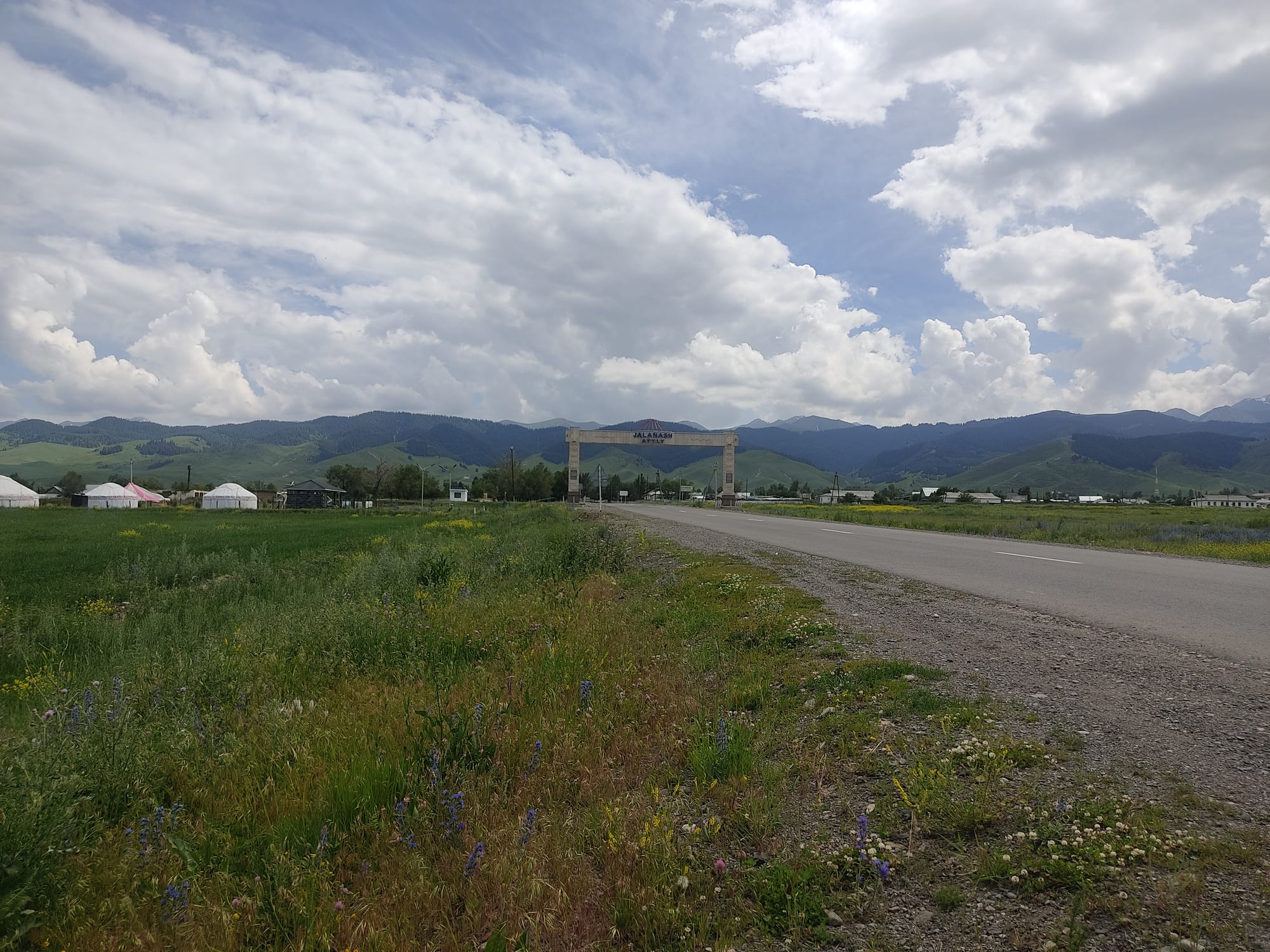
A tarmac road crossing green flowering meadows towards a village gateway arch, with low houses, white yurts and rounded green mountains behind

Almaty & the Southeast, Kazakhstan

Kegen

The entrance to Zhalanash, a village in Kegen District west of Kegen itself. (TakingOver / Wikimedia Commons · CC BY-SA 4.0)

A village in the uplands of southeastern Kazakhstan, about 2,000 metres above sea level in a broad valley between the ranges of the Tian Shan and the road to the Kyrgyz border. Long a stock-raising and trading settlement, it is now the administrative centre of Kegen District and the place most travellers pass through on the way to Charyn Canyon, the Kolsai lakes and Lake Kaindy.

Neighbourhoods

  • The village centre
    • First-time visitors
    • Guesthouses
    • Close to public transport

    A grid of low houses behind painted fences around the district administration, the bazaar, a few shops and the bus stand. Almost everything a visitor needs is within a few minutes' walk, and guesthouses and drivers are arranged here.

    Open in Maps
  • The Karkara valley
    • Mountain scenery
    • Horses and summer pastures

    The wide grassland southeast of the village along the road towards the Kyrgyz frontier, grazed by horses and sheep and ringed by high ridges. Herding camps appear here in summer, and the valley is empty and windswept for most of the year.

    Open in Maps
  • Zhalanash and the road west
    • Quiet and residential
    • Access to the lakes

    The string of farming villages along the road that runs west from Kegen towards Saty and the Kolsai lakes, with yurts pitched beside the tarmac in summer. Many visitors sleep out here rather than in Kegen itself.

    Open in Maps

Things to do

The Charyn canyons

  • Charyn Canyonlandmark

    A gorge of red sandstone cut into the steppe north-west of the village, whose Valley of Castles is a walkable corridor of eroded towers above the river.

    Open in Maps
  • Charyn National Parkpark

    The protected area along the Charyn river that takes in the canyon system and a relict grove of ash trees on the valley floor.

    Open in Maps
  • Charyn Riverattraction

    The fast river that carved the canyons, running north from the mountains above Kegen towards the Ili.

    Open in Maps

Short trips from the village

  • Lake Kaindyattraction

    A small lake formed when a landslide triggered by the 1911 Kebin earthquake dammed the valley, where the bare trunks of drowned spruce trees still stand upright in cold green water.

    Open in Maps
  • Kungey Alatauviewpoint

    The range separating the valley from Lake Issyk-Kul, with spruce forest on its northern slopes and pastures below the snowline.

    Open in Maps

Seasonal events

  • Nauryzlate March

    The spring new year, marked in the village with music, games, hospitality and pots of the grain-and-meat soup nauryz köje.

  • Summer horse gamessummer

    Kokpar and other mounted contests are held in the district's villages at weddings and holidays during the warm months.

Eat and drink

Long-standing places and food districts in Kegen. Hours, ratings and directions come from your maps app, always current.

Village kitchens and the bazaar

  • Kegen bazaarmarket

    Bread, dairy, horsemeat, dried fruit and vegetables from the valley farms, with stalls selling samsa and tea beside the trading rows.

    Open in Maps
  • Canteens on the through roadrestaurant

    Simple roadside canteens and cafés serving lagman, manty, shashlyk and soups to drivers and passengers heading east towards the border.

    Open in Maps
  • Roadside dairy stallsmarket

    In summer, families sell kymyz, fermented mare's milk, and shubat, fermented camel's milk, from stands along the valley roads.

    Open in Maps

Experience Kegen

History

Kegen grew where the mountain valleys meet: a natural crossing point between the pastures of the Kazakh Great Horde, the Kyrgyz country beyond the Karkara valley, and the caravan roads towards the Ili and the Chinese frontier. Nomadic families moved their herds through this ground for centuries, wintering low and taking the animals up to the summer pastures on the slopes above.

Russian expansion into Zhetysu in the second half of the 19th century brought administration, Cossack settlers and peasant farmers into the valleys, and permanent villages of low brick and timber houses replaced seasonal camps. The Karkara valley a few kilometres to the south-east, on the route into the Kyrgyz country, was a meeting ground for herders and traders from both sides of the mountains. In 1916 the uprising against wartime conscription swept these districts; in its suppression many Kazakh and Kyrgyz families fled east over the mountain passes into China, a flight remembered across the region.

Soviet rule turned the herds and fields into collective and state farms and made Kegen an administrative centre, with a school, a hospital, a house of culture and the low official buildings that still line its main street. Collectivisation settled most of the remaining nomadic households. After independence in 1991 the farms were broken up and many younger residents left for Almaty, while the roads east of the village, built for the frontier and for the farms, began to carry travellers heading for the canyon and the lakes instead.

Culture & Customs

This is a Kazakh-speaking countryside, more traditional in habit than Almaty four or five hours away, and the customs of the pastoral world remain part of ordinary life. Horses are worked as well as kept, families move animals to higher ground in summer, and the skills of riding, slaughtering and preserving meat and milk are everyday knowledge rather than heritage display. Weddings are large, prepared over weeks and attended by extended families from across the district.

Hospitality is close to obligatory. A visitor who reaches a house is given tea, bread, butter, cream and whatever else is available, and refusing everything is awkward; the place of honour at the table belongs to the eldest guest. Nauryz, the spring new year in late March, is the main festival of the year, with visiting between houses, music and communal cooking, and mounted games such as kokpar are held at holidays and celebrations in the district's villages.

Islam here is practised in a form long blended with older steppe custom: respect for ancestors and for the spirits of place, visits to family graves, and modest village mosques. The district has also long been mixed, with Kyrgyz families on the border side, Uyghur and Dungan households in the wider region, and Russian surnames left from the farming settlements. Dombra music, sung poetry and the reputation of a good horseman still carry weight.

Daily Life

About eight and a half thousand people live in Kegen, making it a large village rather than a town, and its role is to serve the farms and hamlets around it: the district offices, the school, the clinic, the bazaar and the fuel station are here. The economy is livestock above all — sheep, horses and cattle grazed on pasture that is green only for part of the year — with hay, potatoes and vegetables grown on irrigated plots, and wages from public sector jobs, transport and a growing trade in guesthouses and drivers.

Houses are single storey with courtyards, sheds and stacked fuel for the winter, and most families keep animals even if someone in the household also has a salary. The rhythm follows the light and the season: early work with the herds, a long afternoon, and a return to the house before the cold comes down. Summer empties part of the village upwards as families go to the pastures; winter turns it inward, with snow on the valley and long evenings indoors.

The pressures are those of rural Kazakhstan generally — young people leaving for Almaty and Astana, reliance on a single road for supplies, and patchy services and mobile coverage in the side valleys. Against that, the flow of visitors heading to Charyn and the Kolsai lakes has given some households an income that did not exist a generation ago.

Food

The cooking is meat, milk and bread, the food of a herding valley. Mutton, beef and horsemeat are the staples; kazy, the horsemeat sausage made from rib meat, is brought out for guests and holidays, and beshbarmak — boiled meat served over broad sheets of pasta with onion broth, eaten with the hands as its name suggests — is the dish of a celebration or an honoured visitor. Sorpa, the broth that goes with it, is drunk from bowls.

Dairy is everywhere and much of it is fermented or dried: ayran, the thick sour milk; kurt, hard salted balls of dried curd carried as a snack; irimshik, a dry crumbly curd; and in the warm months kymyz from mares and shubat from camels, sold from roadside stands and considered restorative. Butter and thick cream are set out with bread at any table.

Bread comes as flat rounds baked in a clay oven and as baursak, small squares of fried dough that accompany tea. Tea itself, black and taken with milk, is served constantly and in quantity. The everyday restaurant dishes are those of the wider southeast: lagman noodles under stir-fried meat and vegetables, steamed manty dumplings, samsa pastries and shashlyk grilled over charcoal at the roadside, with potatoes, carrots and onions doing most of the work of the vegetable side.

Planning tools

Budget

Kegen is far cheaper than Almaty. Beds are in guesthouses and family homes rather than hotels, food is canteen and bazaar food, and there is little to spend money on in the village itself. The real cost of a stay here is transport: the canyons, lakes and mountain roads are spread across a wide area and most visitors share the price of a car and driver for the day.

Daily Budget Midrange
USD 60–120 (a comfortable guesthouse room, meals in cafés, a car and driver for the lakes and canyon)
Daily Budget Shoestring
USD 20–40 (guesthouse bed or homestay, bazaar and canteen food, shared minibuses)

Sharing a driver with other travellers is far cheaper than hiring one alone, and carrying cash from Almaty avoids relying on the village's few machines.

Best Time to Visit

June to September, when the mountain roads to the lakes are reliably open, the pastures are green and the days are warm. Late spring brings wildflowers and high water in the rivers, and September has clear air and autumn colour in the spruce forests. From November to April the valley is cold and snowy and many of the side roads are hard or impossible to drive.

Suggested Number of Days

Most people sleep here once, as a stop between Almaty and the mountains. Two or three nights suit anyone wanting to reach several of the surrounding valleys without long daily drives, and walkers who want time in the high forest stay longer.

First Visit
1 night
With Surroundings
2–3 days

Transportation

The village is a road junction rather than a transport hub. Shared taxis and minibuses connect it with Almaty and with neighbouring villages, and beyond that almost all movement is by hired car, driver or guesthouse transfer. Distances are long and the surfaces vary from good tarmac to rough gravel, so a high-clearance vehicle is usual for the tracks to Lake Kaindy and the upper pastures. Walking and hitching are common between nearby villages.

Agree the route and price with a driver before setting off, and allow for slow going and no fuel stops on the mountain tracks.

Airport & Station Connections

Kegen lies east of Almaty on the road that runs on to Narynkol, usually four to five hours by car through the Kokpek pass and the Charyn valley. Shared taxis and minibuses run from Almaty, and drivers on multi-day trips to the canyon and the lakes pass through. There is no railway and no airport; the nearest airport is Almaty's. The road continues south-east towards the Kyrgyz frontier at Karkara and east towards the villages under the high Tian Shan.

Walkability

The village is small enough to cross on foot in a quarter of an hour, and most of its streets are quiet, unpaved at the edges and shared with cattle and horses. Nothing inside Kegen is far from anything else, but every sight worth the journey is tens of kilometres away, so walking is for the village and the meadows around it rather than for sightseeing.

Safety

The village and its valley are calm, and hospitality towards strangers is the norm. The genuine risks are environmental and practical: altitude and sudden weather changes in the mountains, cold nights even in summer, rough roads, thin mobile coverage in the side valleys, ticks in spring and early summer, and dogs guarding herds. Some areas near the Chinese border are restricted zones that require permits.

Carry warm layers, water and cash, leaving word of the intended route before heading into the mountains, ask locally about permit rules near the border, and check for ticks after spring walks. Check current official travel advice before travelling.

Climate

A dry upland continental climate, cooler than Almaty because of the altitude. Days are warm and bright in summer with cold nights and afternoon thunderstorms in the mountains; winter is long, snowy and windy, and spring and autumn are short.

Summer
warm days of roughly 22–28°C, with nights that can fall close to 5°C and colder still at the lakes
Winter
cold, usually well below 0°C by day with hard frosts, snow cover and wind across the open valley

Local Customs

Village life is Kazakh-speaking and traditional, though Russian is widely understood. Guests are treated generously and tea, bread and dairy are offered as a matter of course; taking a small gift when invited into a home is appreciated, and shoes come off at the door. Elders are greeted first. Dress is modest away from the towns, and people should be asked before being photographed, particularly at herding camps and family gatherings.

Tipping is not expected, accepting at least a little of what is offered is polite, and permission should be sought before entering pastures or approaching working horses and guard dogs.

Common Payment Methods

The currency is the Kazakhstani tenge. Cards are accepted in some shops in the village, but cash is essential for homestays, drivers, market stalls and anything in the surrounding villages. Cash machines are few and can be out of service, so money is best drawn in Almaty before setting out.